
The archetypal disciple Myth Meaning & Symbolism
A timeless story of the one who seeks a master, endures trials of faith and doubt, and ultimately discovers the teacher within.
The Tale of The Archetypal Disciple
Listen. There is a story that breathes in the space between every master and every student, a story older than temples, older than written word. It begins not with a king or a warrior, but with a Seeker.
In the grey hour before dawn, when the world holds its breath, a figure walks. Their feet are bare and dusted with the soil of a hundred roads. Their eyes are not weary, but hungry—a hollowed-out hunger that bread cannot fill. They have left the village, the family hearth, the known maps of the world. They seek the One Who Knows. Some call this figure the shishya, others the talmid, or simply the pilgrim. Their name is forgotten, for in this moment, they are only Longing made flesh.
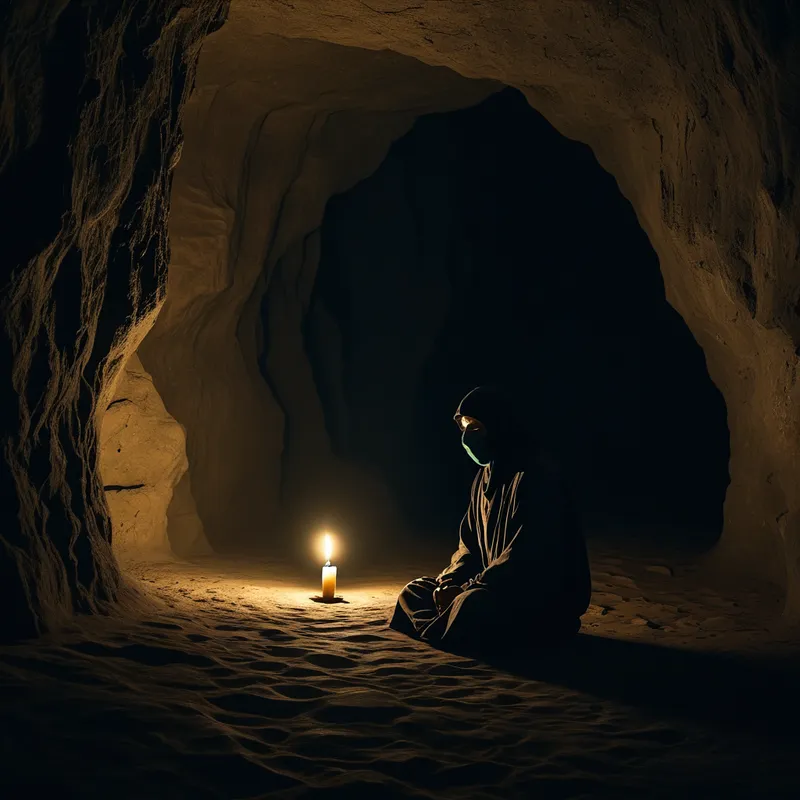
Their journey ends at a place outside of places: a cave high on a wind-scoured mountain, a hut deep in a murmuring forest, a simple room above a bustling market. Here sits the Master. Not adorned in gold, but in a profound stillness that seems to bend the light. The Seeker approaches, their offering not gold or spice, but their own trembling emptiness. They kneel. They say the only words left to them: "Teach me."
And so begins the great undoing. The Master gives tasks that defy sense: to count the grains of sand on a vast beach, to fill a cracked jug from a distant well, to sit for years in silent vigil. The disciple obeys, their mind a storm of frustration, their body a testament to ache. They scrub floors that are already clean, tend gardens in the dead of winter, copy texts whose words are blurred. This is the first gate: the annihilation of the clever self, the breaking of the intellect upon the rock of simple, repetitive being.
Then comes the night of the soul. The disciple sits in their cell, the candle guttering. The Master's words seem like riddles, their presence like a closed door. A cold doubt, more terrifying than any beast, uncoils in the belly. "Have I been fooled? Is this all a waste? Is the Master even real, or a phantom of my own desperate need?" This is the second, deeper gate: the confrontation with the Abyss of Meaninglessness. The disciple must face the terrifying possibility that they are utterly, completely alone.
In this darkest hour, a shift occurs. Not a voice from the heavens, but a quiet turning within. The disciple, exhausted of seeking outside, finally listens. And in that listening, they hear not the Master's teaching, but the echo of their own deepest nature. They see that the cracked jug they were told to fill is their own heart. The sand they were told to count is the infinite moment of Now. The text they copied is the scripture of their own breath.
They rise. They walk to the Master's door, not with a question, but with a silence that is itself the answer. The Master meets their gaze, and for the first time, the disciple does not see a separate being, but a mirror. The Master smiles, a smile that holds the warmth of a setting sun and the coolness of a rising moon. "The teaching is complete," the Master says. "Go. The road awaits its master." And the disciple, who is a disciple no longer, bows—not to the figure before them, but to the recognition that has dawned within. They turn and walk back down the mountain, into the world, carrying nothing and everything.
Cultural Origins & Context
This is not a myth bound to a single scroll or epic. It is the ur-narrative of the human spirit's educational impulse, echoing in every tradition that posits a path from ignorance to wisdom. We find its structure in the guru-shishya parampara of India, where knowledge is transmitted not merely as information but as a living current. It breathes in the stories of Zen monks facing impossible koans from their roshi. It is the backbone of the Greek philosophical schools, where disciples like Plato followed Socrates, not just to learn doctrines, but to learn a way of being.
The story was never confined to temples or monasteries. It was told by firesides, by wandering storytellers, and encoded in folk tales about the fool who seeks a magician. Its societal function was multifaceted: it modeled the proper attitude of humility necessary for learning, it validated the often arduous and non-linear path of mastery, and it ultimately served as a map for the transformation of a raw individual into a conscious contributor to the cultural and spiritual whole. It taught that true authority is earned through surrender, and true freedom is found through discipline.
Symbolic Architecture
The myth is a perfect symbolic blueprint for the psyche's journey from a state of unconscious longing to conscious integration.
The disciple represents the ego, the conscious "I," which correctly intuits its own incompleteness and seeks wholeness in what it perceives as an external source of power and knowledge—the Master, or the Self.
The Master is the archetypal symbol of the Self, the central organizing principle of the psyche that embodies our latent wholeness and wisdom. The Master's seemingly irrational tasks symbolize the ways the Self dismantles the ego's rigid structures. Counting sand is a command to attend to the infinite particulars of reality, breaking the habit of abstraction. Filling a cracked jug is the painful, repeated process of confronting one's own inherent insufficiency—the crack that allows the light in.
The long journey to find the Master is the initial stage of psychological awareness, where one realizes something is missing. The trials of obedience represent the necessary humiliation of the ego, its pride and self-sufficiency. The crisis of doubt in the cell is the critical encounter with the shadow and the terrifying freedom of nihilism. It is the dark night where all projected meaning dissolves.
The final recognition is the moment of coniunctio, where the ego realizes its fundamental identity with the Self. The disciple understands that the Master was never an external other, but the projected image of their own highest potential. The command to "go" signifies that this integrated consciousness must now be embodied in the world of action and relationship.

The Dreamer's Resonance
When this myth stirs in the modern dreamscape, it signals a profound initiation underway in the dreamer's psyche. To dream of searching frantically for a guide or teacher reflects a waking-life sense of being lost at a crossroads, seeking direction in career, relationships, or identity. The somatic feeling is often one of anxious searching, a tightness in the chest.
Dreams of being given impossible, tedious, or meaningless tasks by an authority figure point directly to the ego's resistance to the psyche's own curriculum for growth. The waking-life situation may feel frustratingly stagnant or absurd. The body may feel heavy, burdened.
The most potent dream is the crisis in the cell: dreaming of being alone in a small, confined space (elevator, room, cave) flooded with despair, doubt, or the terrifying thought that everything you've built your life upon is an illusion. This is the somatic signature of the old self dissolving. It can feel like freefall, a visceral panic. Yet, this is the precise dream-moment where the possibility of true autonomy is born. If the dream shifts, and the dreamer finds a light source within the cell, or their own reflection becomes the face of the wise one, it marks the critical inner turning point.

Alchemical Translation
The myth of the disciple is the alchemical Magnum Opus in narrative form. Its stages correspond precisely to the process of psychic transmutation known as individuation.
The initial state of the seeker is the prima materia, the unrefined lead of the personality, aware of its base nature and longing for gold. The submission to the Master is the stage of nigredo. This is the necessary blackening, the dissolution of the ego's pretensions in the fires of obedience and menial labor. The ego's sense of specialness is burned away.
The crisis of doubt in the cell is the depth of the nigredo, where all light seems extinguished. But from this blackness emerges the albedo. This is the first glimmer of inner light, the "star in the darkness" that the alchemists sought. It is the moment the disciple listens and hears their own truth. The recognition scene with the Master is the citrinitas, where the purified white substance begins to take on the hue of solar consciousness—the dawning of Self-knowledge.
The final command and the disciple's return to the world is the rubedo. The gold is not kept in a vault; it must circulate. The integrated consciousness, having realized its source within, must now engage with life not as a needy seeker, but as a grounded, compassionate, and authoritative presence.
For the modern individual, this myth instructs us that every true learning journey—in therapy, in art, in mastering a craft, in deep relationship—follows this arc. We must first project our wisdom onto an other (therapist, mentor, ideal). We must then endure the frustrating, humbling work of practice and confrontation with our own resistance (the shadow). We must pass through the crisis of faith where we question the entire endeavor. And if we persist, we will eventually internalize the function of the guide. We become our own wise master, capable of both deep discernment and compassionate action in the world. The myth ends not with the disciple becoming a recluse on the mountain, but with them descending, transformed, to walk the human road. The ultimate teaching is that enlightenment, or wholeness, is for the sake of the world.
Associated Symbols
Explore related symbols from the CaleaDream lexicon: