The Aquila Myth Meaning & Symbolism
The story of the legion's lost eagle, a symbol of divine favor and legionary soul, and the perilous quest to reclaim it from dishonor.
The Tale of The Aquila
Listen. Hear the wind howl across the Germania forests, a cold breath that carries the scent of pine, damp earth, and iron. It is the breath of the land itself, and it does not welcome the tread of the legion. Here, beneath a bruised and heavy sky, the Legio marches, a serpent of disciplined muscle and polished steel. At its heart, borne aloft by the Aquilifer, is the soul of the legion. It is not the general, nor the centurion’s vine-staff. It is the Aquila.
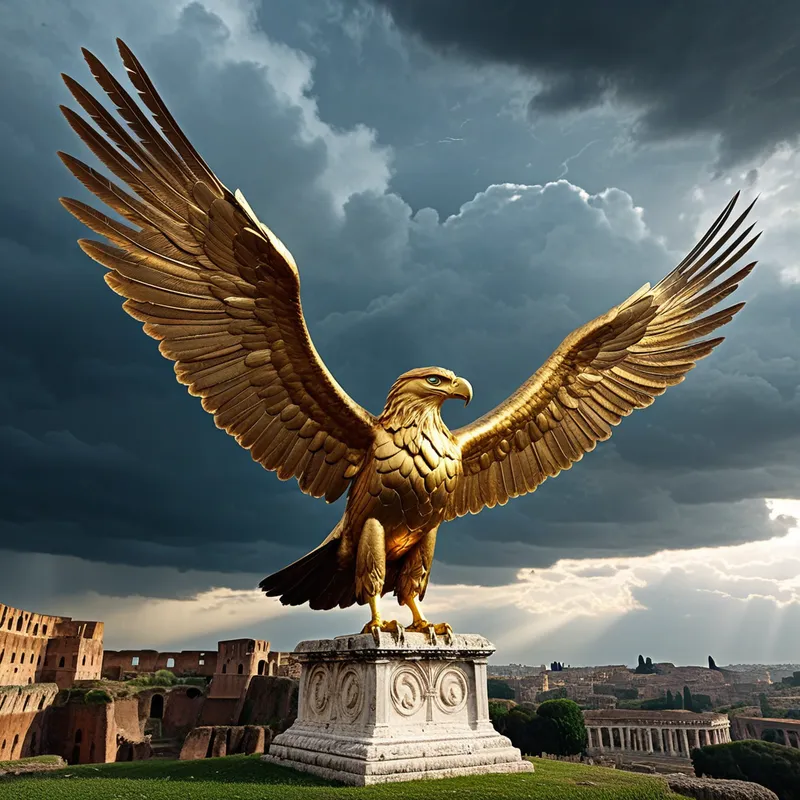
Crafted of gold, its wings are spread as if to embrace the very favor of Jupiter himself. To look upon it is to see the promise of Rome—order, victory, divine right. The Aquilifer, his face a mask of solemn pride, feels its weight as a sacred trust. The eagle’s shadow falls upon the ranks, a blessing and a burden.
Then, the forest erupts. A cacophony of war-horns, the guttural cries of the Germani, a storm of painted flesh and fury. The battle turns to chaos, a bloody press of men in the mud. The serpent is broken. In the melee, a spear finds the Aquilifer. He falls, and as he falls, his grip fails. The golden eagle, this piece of the legion’s spirit, is wrenched from its pole. For a heartbeat, it glints in the gloom—a fallen sun—before being swallowed by the press of enemy warriors and the churning mire.
Silence follows, but it is a deeper, more terrible sound than any battle cry. It is the silence of a soul severed. The legion, what remains of it, retreats. They do not speak of the battle. They speak only of the Loss. The Aquila is gone. Without it, the legion is a body without a genius, a name without honor. It is a walking shame. News flies to Rome on wings of disgrace. The Senate hears it in hushed, horrified tones. The people feel a cold dread. An eagle has been taken. A piece of Rome’s covenant with the gods lies in barbarian mud.
Years may pass. The legion is rebuilt, but it is a hollow thing. Then, a rumor, carried by a trader or a captured scout. The eagle is not destroyed. It is kept in a chieftain’s hall, a trophy in a dank longhouse deep in the trackless woods, guarded by superstition and pride. This rumor becomes a single, burning ember in the ash of their honor. A centurion, his hair now grey at the temples but his eyes burning with a young man’s fire, steps forward. He volunteers not for a campaign, but for a quest. He will take a handful of the most desperate, the most shamed men—those who were there that day—and they will go into the belly of the wild.
Their journey is not of miles, but of descent. They move by night, through rivers that steal breath and forests that whisper of ancient watchers. They are ghosts seeking a ghost. They find the village, the longhouse. Inside, by the firelight, it hangs: tarnished, smeared with soot, but unmistakable. Their Aquila. The centurion’s hand does not tremble as he takes it. The return is a flight, a desperate race against the dawn and the rising alarm. They are hunted, harried, pushed to the very edge of life. Some fall, their blood a final offering to the reclaimed spirit.
But when they burst from the treeline, staggering, bleeding, holding the eagle aloft before the stunned outposts of the Limes, a sound rises. It begins as a gasp, then a cry, then a roar that shakes the very watchtowers. The eagle has returned. The legion, and all of Rome with it, can breathe again. The soul has been dragged back from the underworld.

Cultural Origins & Context
The myth of the lost and recovered Aquila is not a single, codified story from Romulus and Remus, but a powerful narrative pattern born from the brutal reality of Roman military life. It is a historical phantasm that haunted the Roman psyche. The Aquila was no mere flag; it was a cult object, a literal embodiment of the legion’s numen—its divine spirit and protective force. To lose it was the ultimate military and spiritual catastrophe, signaling the withdrawal of Jupiter’s favor.
This narrative was passed down not by poets in villas, but by soldiers around campfires and by statesmen in the Forum using it as a parable of national resilience. Historical events, like the disastrous defeat of Publius Quinctilius Varus in the Teutoburg Forest, where three eagles were lost, and the subsequent campaigns of Germanicus to recover them, provided the fertile soil from which this mythic pattern grew. Its societal function was profound: it transformed a potentially paralyzing trauma (loss, dishonor) into a template for heroic redemption. It taught that honor was not a static possession, but something that could be lost in the mud and must be won back through near-impossible courage.
Symbolic Architecture
At its core, the Aquila represents the Self in its collective and individual form. It is the central, organizing principle of identity and value. The legion without its eagle is the psyche without a center—fragmented, purposeless, and ashamed.
The fall of the eagle is not an accident of war; it is the inevitable descent of the conscious spirit into the clutches of the shadow when it becomes over-extended, arrogant, or blind.
The dark Germanic forest is the shadow realm, the unconscious, where all that is wild, untamed, and “barbaric” to the ordered Roman (ego) consciousness resides. The loss signifies a catastrophic inflation—the belief in the invincibility of the conscious order—followed by a crushing enmeshment with the neglected aspects of the self. The Aquilifer’s death is the death of the old carrier of identity; the old way of bearing the self can no longer hold.
The quest for recovery is the heroic journey into the underworld of the psyche. The centurion and his band are not fresh recruits; they are the scarred, shamed parts of the self that carry the memory of the trauma. Only they have the motivation to delve into the darkness. Reclaiming the tarnished eagle from the chieftain’s hall (the shadow’s stronghold) is the act of reclaiming one’s core value and integrity from the grip of complex, shame, and trauma.
The Dreamer’s Resonance
When this myth stirs in the modern dreamer, it often manifests as dreams of profound loss of something sacred or central: a stolen heirloom, a desecrated home, a forgotten vital password, or a beloved figure who has become distant and cold. The somatic experience is one of hollow dread, a sinking in the solar plexus—the very feeling of “having lost one’s spirit.”
The dreamer may find themselves in a labyrinthine, decaying building (the hollow legion fort) or a threatening, overgrown wilderness (the Germanic forest), searching fruitlessly. The psychological process at work is one of dissociation—a severance from the animating core of one’s being, often following a period of burnout, a moral failure, a betrayal, or any experience that shatters one’s self-concept. The dream is not merely replaying the wound; it is, in its painful way, mapping the territory of the loss. It is asking the dreamer: Where did you leave your gold? What part of your soul did you sacrifice, and to what dark bargain?
Alchemical Translation
The alchemical process mirrored here is the Nigredo leading to the Albedo—the blackening putrefaction followed by the whitening purification. The loss of the Aquila is the Nigredo: the descent into the massa confusa, the utter black despair of meaninglessness and shame. The legion’s hollow existence is the long, painful fermentation in this state.
The quest to recover the eagle is the conscious, willful application of the opus contra naturam—the work against nature. It is the ego, humbled and wounded, deciding to turn and face the source of its disintegration.
The centurion’s small band represents the nascent, focused consciousness required for this work. They do not raise an army (a grand, ego-driven solution); they move with stealth, embracing the qualities of the shadow (the night, the forest) to navigate it. This is the beginning of the Albedo. Recovering the tarnished eagle is the recovery of the prima materia—the original, but now corrupted, soul-substance.
The final, often overlooked stage is the return and reintegration. The eagle is tarnished, not new. It bears the scars of its captivity. The psychic transmutation is complete not when the perfect, idealized self is restored (an impossibility), but when the scarred, redeemed self is welcomed back into the center of one’s life. The roar of the legion that greets its return is the joyous, tearful reconciliation of the whole psyche with its once-lost, now-reclaimed core. The individuated self is not a pristine gold statue on a pole; it is a golden eagle, once lost to the mud, now shining all the more brightly for having been recovered. Its flight is earned, not given.
Associated Symbols
Explore related symbols from the CaleaDream lexicon: