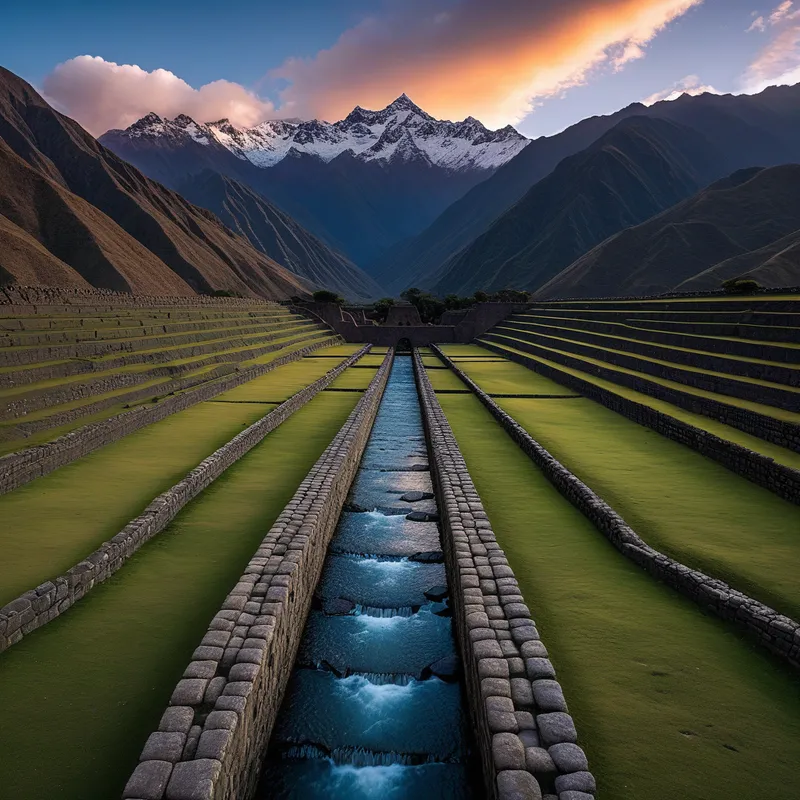
The Aqueducts of Tipón Myth Meaning & Symbolism
A myth of the Viracocha's challenge to channel divine water, teaching humanity the sacred art of balance and flow.
The Tale of The Aqueducts of Tipón
Listen. [The world](/myths/the-world “Myth from Tarot culture.”/) was young, and the mountains, the Apus, held their breath. In the high cradle of the Andes, where the condor’s shadow is a blessing, there lay a valley of profound silence. It was a place of potential, a bowl of earth beneath the stern gaze of [Pachamama](/myths/pachamama “Myth from Incan culture.”/), but it was a thirsty potential. The rains came and went, capricious as a hummingbird. The springs wept from the rock, but their tears were lost, swallowed by the greedy soil or evaporated by the relentless sun. The people there lived in a rhythm of scarcity, their hearts as parched as their fields.
Then, from the realm where thought becomes form, the Viracocha spoke. Not in thunder, but in a whisper that entered the dreams of the wisest Amauta. The whisper was a question, a challenge etched in starlight: “Can you hear the song of the [water](/myths/water “Myth from Chinese culture.”/)? Can you build a throat for the mountain to sing?”
The chosen one, a master of stone and star named Qhapaq, awoke with the geometry of flow burning behind his eyes. He climbed to the highest spring, the Pacarina. There, he did not simply see water. He saw the liquid soul of the Apu, a silver thread of life trembling to descend but fearing the chaos of [the fall](/myths/the-fall “Myth from Biblical culture.”/). Qhapaq placed his hands on the wet rock and made a vow not to take, but to guide.
The conflict was not with a monster, but with the nature of things—with gravity’s brutal pull and the land’s stubborn form. The first channels he built were too steep; the water, a frantic, erosive rage that shattered stone. Then they were too shallow; the water grew lazy, stagnant, a breeding ground for despair. The people murmured. [The earth](/myths/the-earth “Myth from Hindu culture.”/) resisted.
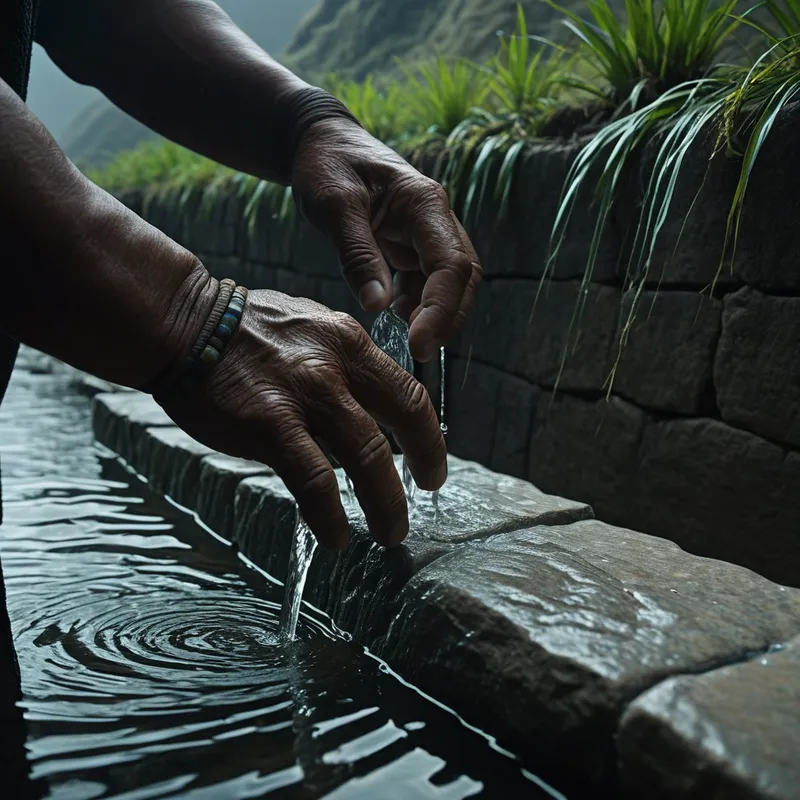
In his darkest moment, Qhapaq fasted under the cold eye of [the moon](/myths/the-moon “Myth from Tarot culture.”/), Mama Killa. He dreamed not of answers, but of a single drop of dew tracing a perfect, slow path down a [spider](/myths/spider “Myth from Native American culture.”/)’s web. He awoke not with a shout, but with a hum. The sacred water did not wish to be commanded, but conversed with. It desired not a prison, but a partnership.
The rising action was a symphony of applied reverence. Qhapaq and his apprentices learned to listen to the slope, to feel the perfect gradient where water would neither rage nor sleep, but dance. They carved stone not as masters, but as petitioners, asking each rock to become a part of the song. They built gentle curves where the water could rest and reflect [the sky](/myths/the-sky “Myth from Persian culture.”/), and precise drops where it could laugh in a sparkling cascade. They engineered steps and pools, a rhythmic breath for the flowing spirit.
Finally, the day of the first flow arrived. The ceremonial plug was removed from the Pacarina. A hush fell. Then, a silken whisper grew into a clear, musical murmur. The divine water, the Sami of the mountain, descended. It did not flood or trickle. It processed. It flowed with a serene, purposeful grace through the stone arteries, filling each terrace, blessing each turn. It reached the valley floor not as a conqueror, but as a benediction. The land drank deeply, and the first green shoots pierced the soil in hours. The Aqueducts of Tipón did not conquer nature. They had revealed the sacred conversation hidden within it, and in doing so, made [the desert](/myths/the-desert “Myth from Biblical culture.”/) bloom.
Cultural Origins & Context
The story of Tipón’s aqueducts is not a single, codified myth from a sacred text, but a living narrative woven into the technological and spiritual fabric of the Tawantinsuyu. It emerges from the profound Incan worldview where there is no division between the practical and the sacred. Engineering was a form of prayer; hydrology, a branch of theology.
This tale was likely transmitted orally by the Amautas and the master architects, the Qhapaq Nan builders, to apprentices. Its societal function was multifaceted. On one level, it was a pedagogical tool, encoding the principles of sacred geometry, gravity-fed water management, and sustainable agriculture in a memorable narrative. On a deeper level, it served as a cosmological map. The aqueducts physically manifested the Incan principle of Ayni—reciprocity. The people did not extract water; they entered into a relationship with it, building a dignified path for its journey in exchange for its life-giving force. The myth justified and sanctified the immense labor required, framing [the architect](/myths/the-architect “Myth from Various culture.”/) not as a laborer, but as a priest mediating between the divine will of Viracocha (the source) and the needs of Pachamama (the receiver).
Symbolic Architecture
At its core, the myth is a profound [allegory](/symbols/allegory “Symbol: A narrative device where characters, events, or settings represent abstract ideas or moral qualities, conveying deeper meanings through symbolic storytelling.”/) for the conscious channeling of [life](/symbols/life “Symbol: The symbol of ‘Life’ represents a journey of growth, interconnectedness, and existential meaning, encompassing both the joys and challenges that define human experience.”/) force, or psychic [energy](/symbols/energy “Symbol: Energy symbolizes vitality, motivation, and the drive that fuels actions and ambitions.”/). The untamed spring represents the raw, potent, and often chaotic power of the unconscious—our instincts, emotions, and creative potential. The parched [valley](/symbols/valley “Symbol: A valley often symbolizes a period of transition or a place of respite between two extremes.”/) symbolizes a conscious [life](/symbols/life “Symbol: The symbol of ‘Life’ represents a journey of growth, interconnectedness, and existential meaning, encompassing both the joys and challenges that define human experience.”/) that is arid, structured, but unfulfilled, cut off from its deep [source](/symbols/source “Symbol: The origin point of something, often representing beginnings, nourishment, or the fundamental cause behind phenomena.”/).
The aqueduct is the individuated psyche itself—the constructed, conscious channel that allows the boundless waters of the unconscious to flow into the world without destroying it or being lost.
Qhapaq represents the emerging ego-[consciousness](/symbols/consciousness “Symbol: Consciousness represents the state of awareness and perception, encompassing thoughts, feelings, and experiences.”/) tasked with this sacred work. His initial failures—the [water](/symbols/water “Symbol: Water symbolizes the subconscious mind, emotions, and the flow of life, representing both cleansing and creation.”/)’s rage or stagnation—mirror the psychological perils of mismanagement: the explosive, unmediated [eruption](/symbols/eruption “Symbol: A sudden, violent release of pent-up energy or emotion from beneath the surface, often representing transformation or crisis.”/) of complex (possession by the unconscious) or the blocked, depressive stagnation of energy (complexes acting as dams). The [revelation](/symbols/revelation “Symbol: A sudden, profound disclosure of truth or insight, often through artistic or musical means, that transforms understanding.”/) from the [spider](/symbols/spider “Symbol: Represents creativity, feminine energy, and the weaving of destiny, as well as potential feelings of entrapment or anxiety.”/)’s web is the [insight](/symbols/insight “Symbol: A sudden, deep understanding of a complex situation or truth, often arriving unexpectedly and illuminating hidden connections.”/) of the transcendent function, the [discovery](/symbols/discovery “Symbol: The act of finding something previously unknown, hidden, or lost, often representing personal growth, new opportunities, or hidden aspects of the self.”/) of the natural, inherent [pattern](/symbols/pattern “Symbol: A ‘Pattern’ in dreams often signifies the underlying structure of experiences and thoughts, representing both order and the repetitiveness of life’s situations.”/)—[the Self](/myths/the-self “Myth from Jungian culture.”/)’s own [blueprint](/symbols/blueprint “Symbol: A blueprint represents the foundational plan or design for something, often symbolizing potential, structure, and the mapping of one’s inner self or future.”/)—that allows for [integration](/symbols/integration “Symbol: The process of unifying disparate parts of the self or experience into a cohesive whole, often representing psychological wholeness or resolution of internal conflict.”/). The final, perfectly graded channel symbolizes the achieved state where consciousness and the unconscious are in a dynamic, flowing [relationship](/symbols/relationship “Symbol: A representation of connections we have with others in our lives, often reflecting our emotional state.”/). The [water](/symbols/water “Symbol: Water symbolizes the subconscious mind, emotions, and the flow of life, representing both cleansing and creation.”/)’s purposeful dance is the [symbol](/symbols/symbol “Symbol: A symbol can represent an idea, concept, or belief, serving as a powerful tool for communication and understanding.”/) of libido (life energy) now harnessed for creation, nourishment, and sustainable growth.
The Dreamer’s Resonance
When this myth pattern activates in the modern dreamer, it often surfaces during periods of profound inner re-organization. To dream of chaotic, flooding water or of searching desperately for a spring indicates a powerful upwelling from the unconscious that the conscious mind feels ill-equipped to handle—a creative, emotional, or instinctual force threatening to overwhelm.
Conversely, dreaming of intricate, beautiful but dry or broken channels speaks to a life that is over-structured, intellectually rigid, or spiritually arid. The dream ego may be a technician futilely repairing cracks, sensing that the system of one’s life is beautifully designed but devoid of the vital, animating flow.
The somatic experience is key. One might awaken with a sense of pressure in the chest (the dammed spring) or a profound thirst (the arid valley). The healing dream in this cycle is the dream of witnessing or participating in the activation of a perfect, flowing system. One might place a final stone, or simply watch with awe as clear water begins its journey. This signals the somatic release and psychological moment where a new, more resilient channel of being has been formed within the [psyche](/myths/psyche “Myth from Greek culture.”/), allowing blocked energy to move and life to regenerate.

Alchemical Translation
The alchemical process mirrored here is that of [Solutio](/myths/solutio “Myth from Alchemical culture.”/) (dissolution) followed by Coagulatio (coagulation), not once, but in a refined, iterative cycle. The initial, failed channels represent crude, unconscious attempts at coagulation—trying to solidify a personality structure or a life path that cannot hold the fluid truth of the Self. These structures must be dissolved by the very waters they seek to contain.
The triumph at Tipón is the creation of a Corpus Subtile—a subtle body or vessel. This is the aqueduct: a psychic structure strong enough to give form, yet flexible enough to honor flow.
For the modern individual, the myth models the individuation journey as one of becoming a sacred engineer of one’s own soul. The first task is to locate one’s Pacarina—the authentic source of one’s passion, creativity, or soul’s calling, often found in the “high places” of memory, dream, or abandoned joy. The long labor is the careful, patient work of introspection and conscious living—carving and placing the stones of discipline, insight, and right action. Each stone is a choice aligned with the natural gradient of one’s deepest nature, not the steep cliff of societal expectation or the flat plain of complacency.
The final, flowing water is the realized life, where one’s innate potential (the water) and one’s lived expression (the channel) are in perfect Ayni. One does not possess creativity or spirit; one provides a course for it. The individual becomes a conduit, and in that sacred service, the barren places within and around them inevitably, gracefully, begin to bloom.
Associated Symbols
Explore related symbols from the CaleaDream lexicon: