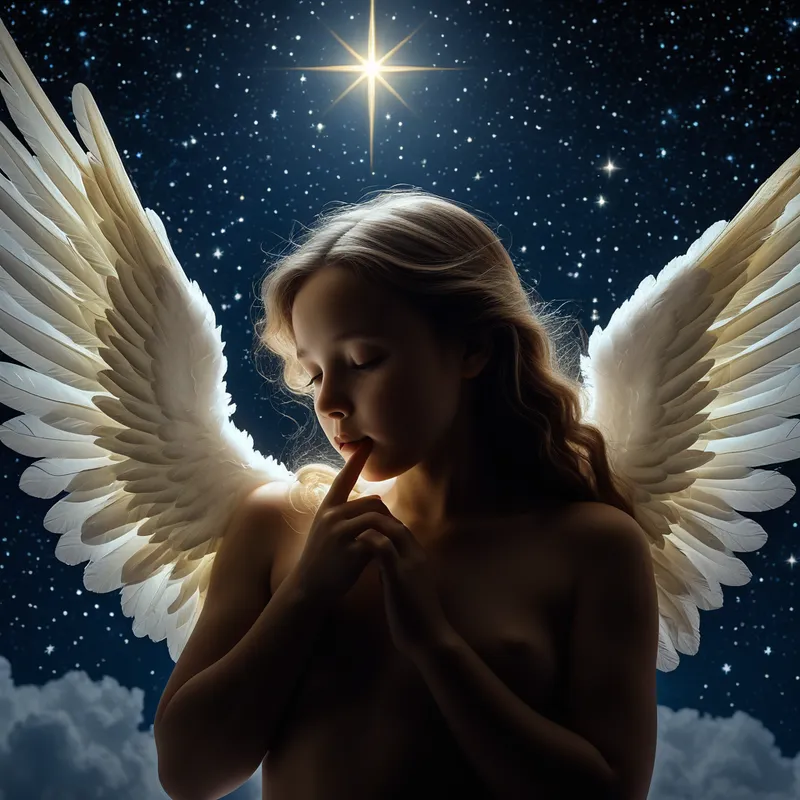
The Angel of Forgetfulness Myth Meaning & Symbolism
A myth of the soul's pre-birth journey, where an angel's touch ensures we forget the divine to fully embrace the human experience.
The Tale of The Angel of Forgetfulness
Before the first cry, before the first breath of earthly air, there is a place of pure knowing. It is a womb of light, not of flesh, where the soul abides in its primordial state. Here, the soul knows all. It has traversed the Atzilut, glimpsed the architecture of creation, and learned the Torah from end to end. It understands the secret names of things, the music of the spheres, and the intricate map of its own destiny—every choice, every sorrow, every moment of joy that awaits in the world below.
But to enter that world, to be born, a price must be paid. A divine decree echoes through the chambers of pre-existence: no soul may carry this unmediated knowledge into the realm of action, of struggle, of becoming. To know the end from the beginning is to render the journey meaningless. The test of life requires forgetting.
And so, in the final moments before the soul is sent spinning into the cascade of birth, a messenger arrives. This is not an angel of wrath or of song, but of a necessary, tender mercy. He is Lailah, or in other tellings, a nameless emissary of the Holy One, blessed be He. His wings are the color of the deep twilight, neither day nor night. His presence is calm, immense, and suffused with a heartbreaking compassion.
He approaches the radiant soul. There is no struggle, for the soul understands the necessity. The angel gazes upon it with eyes that hold the memory of every soul that has ever been and ever will be. Then, with infinite gentleness, he extends his finger. He touches the soul just above its upper lip, creating the philtrum. In that touch, a river of light—the river of oblivion—flows. Not a violent erasure, but a gentle veiling. The direct knowledge of the divine, the blueprint of the self, the clear memory of the covenant made before the Merkabah… all of it recedes into the deepest vault of the spirit, becoming the subconscious, the yechidah, the indelible point of divine connection that can never be extinguished but can no longer be consciously recalled.
The soul, now shrouded in the mystery of forgetfulness, is ushered toward the light of the world. It descends, and with its first gasp, the last conscious echo of that celestial knowledge fades into a whisper, a haunting intuition, a lifelong yearning for a home it cannot quite name.

Cultural Origins & Context
This poignant narrative is not found in the canonical texts of the Torah but flourishes in the rich soil of Aggadah. It appears in the Talmud (Niddah 30b) and is elaborated upon in later Kabbalistic and Hasidic teachings. It was a story told by rabbis and mystics to answer profound existential questions: Why do we not remember our pre-existence? Why does life feel like a search for something lost? What is the source of our innate moral compass?
Its societal function was multifaceted. For the community, it offered a powerful theodicy, explaining the innocence of newborns and the universal human condition of seeking wisdom. For the individual, it provided a map of the soul’s journey, framing earthly life not as a fall from grace, but as a necessary descent into amnesia for the purpose of authentic spiritual achievement. The learning we do in this life, therefore, is not acquiring something new, but remembering what our soul once knew. This transformed study and ethical action into acts of anamnesis—sacred recollection.
Symbolic Architecture
The myth is a masterful symbolic depiction of the [human](/symbols/human “Symbol: The symbol of a human represents individuality, complexity of emotions, and social relationships.”/) psyche’s [structure](/symbols/structure “Symbol: Structure in dreams often symbolizes stability, organization, and the framework of one’s life, reflecting how one perceives their environment and personal life.”/). The [soul](/symbols/soul “Symbol: The soul represents the essence of a person, encompassing their spirit, identity, and connection to the universe.”/)‘s pre-[birth](/symbols/birth “Symbol: Birth symbolizes new beginnings, transformation, and the potential for growth and development.”/) [knowledge](/symbols/knowledge “Symbol: Knowledge symbolizes learning, understanding, and wisdom, embodying the acquisition of information and enlightenment.”/) represents the totality of the Self, the unconscious wholeness we are born with. The [angel](/symbols/angel “Symbol: Angels often symbolize guidance, protection, and divine intervention, embodying a connection to higher realms.”/) represents the necessary principle of limitation, the [veil](/symbols/veil “Symbol: A veil typically symbolizes concealment, protection, and transformation, representing both mystery and femininity across cultures.”/) that creates the conditions for [consciousness](/symbols/consciousness “Symbol: Consciousness represents the state of awareness and perception, encompassing thoughts, feelings, and experiences.”/) to emerge. Without this [veil](/symbols/veil “Symbol: A veil typically symbolizes concealment, protection, and transformation, representing both mystery and femininity across cultures.”/), there is no ego, no separate “I” to have an experience.
The birth of consciousness is predicated on a sacred amnesia. We must forget we are the ocean to fully experience being a wave.
The philtrum is the physical seal of this psychic treaty. It is the [monument](/symbols/monument “Symbol: A structure built to commemorate a person, event, or idea, often representing legacy, memory, and cultural identity.”/) to the forgotten [covenant](/symbols/covenant “Symbol: A binding agreement or sacred promise between parties, often carrying deep moral, spiritual, or social obligations and consequences.”/), a permanent, bodily reminder that a pact was made. It symbolizes the interface between the known and the unknown, the conscious mind and the vast unconscious. Every human face carries this [mark](/symbols/mark “Symbol: A ‘mark’ often symbolizes identity, achievement, or a defining characteristic in dreams.”/) of the angel, making forgetfulness not a flaw, but the universal human signature.
The Dreamer’s Resonance
When this mythic pattern stirs in the modern dreamer, it often manifests as dreams of profound, bittersweet loss coupled with a search. You may dream of a vast, beautiful library where you can intuitively find any book, but upon waking, the knowledge evaporates. You may encounter a serene, shadowy figure who gifts you an object of great power—a Key, a Cup—only to have it dissolve in your hands. Or you may experience the somatic sensation of a gentle touch on your face upon waking.
Psychologically, these dreams signal a process of reconnecting with innate, soul-level knowledge. The “forgotten” material is seeking integration. The dream is the Angel in reverse; instead of veiling knowledge, it is allowing glimpses of it to seep through the barrier. This process can feel like grief—mourning a wisdom you feel you should possess. It is the psyche’s way of initiating a deeper phase of individuation, where you are called to reclaim your intrinsic blueprint not through external learning, but through internal remembrance.

Alchemical Translation
The alchemical journey modeled here is the opus contra naturam—the work against nature. The “natural” state, in this myth, is the soul’s omniscience. The angel’s touch is the prima materia, the first separation that creates the leaden state of human ignorance. The entire earthly life becomes the alchemical vessel.
Our struggles, our studies, our loves and losses are the heat and agitation that slowly distill this leaden forgetfulness. The goal is not to recover the pre-birth state—that is impossible for a conscious being—but to transmute the raw experience of not-knowing into a higher, earned wisdom. The unconscious knowledge (gold) must be dissolved (forgotten) so it can be precipitated out anew through lived experience (re-membered).
The ultimate alchemy is to transform the pain of forgetting into the grace of seeking, thereby making the journey itself the revelation.
The triumph is not in arriving at a destination of full recall, but in the quality of the quest. Each moment of genuine insight, ethical courage, or creative inspiration is a fleck of gold recovered from the river of oblivion. By the end of a life consciously lived, the soul has not simply returned to its origin; it has created a new, more complex wholeness—the philosopher’s gold of a personality that has chosen its divine nature through the fog of freedom.
Associated Symbols
Explore related symbols from the CaleaDream lexicon:
- Angel — The divine agent of necessary limitation, whose touch creates the condition for individual consciousness and the human journey of seeking.
- Destiny — The soul’s pre-known path, which becomes a hidden compass guiding the individual from the depths of the unconscious after the angel’s touch.
- Forgetfulness — The sacred veil that enables authentic experience, representing the necessary separation from primal unity required for growth.
- Key — The symbol of latent knowledge and the tools (study, insight, intuition) we use to unlock the wisdom veiled within our own souls.
- Light — The primordial knowledge and divine radiance of the soul’s pre-existent state, which becomes the inner spark we spend a lifetime trying to rekindle.
- Moon — The reflective, subconscious mind that holds the memory of the soul’s divine light, now seen indirectly, in phases and glimpses.
- River — The flowing, transformative process of oblivion itself, carrying the soul from pure knowledge into the sea of human experience.
- Shadow — The personal unconscious that holds all the forgotten knowledge and potential of the Self, which we must integrate to become whole.
- Soul — The eternal essence that undergoes the initiatory ordeal of forgetting in order to achieve a realized, individual existence.
- Tree — The organic structure of life and growth, symbolizing how wisdom must now be grown from the seed of forgotten knowledge rather than received whole.
- Wound — The philtrum, a mark of a sacred, necessary wounding that is the source of all human longing and the potential for profound healing through remembrance.
- Journey — The core narrative of human life, framed not as exile but as a purposeful quest to recover what was lovingly taken in order to give it meaning.