The Amphictyonic League Myth Meaning & Symbolism
A sacred pact forged not by kings, but by shared reverence for the Earth, binding disparate tribes into a league of mutual oath and collective guardianship.
The Tale of The Amphictyonic League
Hear now, not of a single hero, but of a covenant. In the age when the gods walked closer to the green earth, when every spring had its nymph and every mountain its echo of Pan, the lands of Hellas were a tapestry of separate threads. Tribe knew not tribe, save for the clash of spear on shield. The soil was rich, but trust was barren.
Then came the whisper on [the wind](/myths/the-wind “Myth from Various culture.”/), a murmur not from Olympus, but from the deep, dark breast of [the Earth](/myths/the-earth “Myth from Hindu culture.”/) herself, Demeter. It stirred in [the sacred grove](/myths/the-sacred-grove “Myth from Celtic culture.”/) of Delphi, where the stone of the [Omphalos](/myths/omphalos “Myth from Greek culture.”/) hummed with a low, persistent frequency. It traveled down the slopes of Parnassus to the hot springs and narrow pass of Thermopylae, a place already steeped in the metallic scent of old battles and the sulfurous breath of [the earth](/myths/the-earth “Myth from Hindu culture.”/).
The call was not a command, but a yearning. It was felt first by the priests who tended the altars, a tightening in the chest, a vision of blight spreading from field to field, not from drought, but from spite. It was heard by the shepherds on the slopes, a dissonance in the pipes, where melodies that should have harmonized instead clashed and broke. The very land, the shared mother, grew weary of nourishing children who sought only to spill each other’s blood upon her.
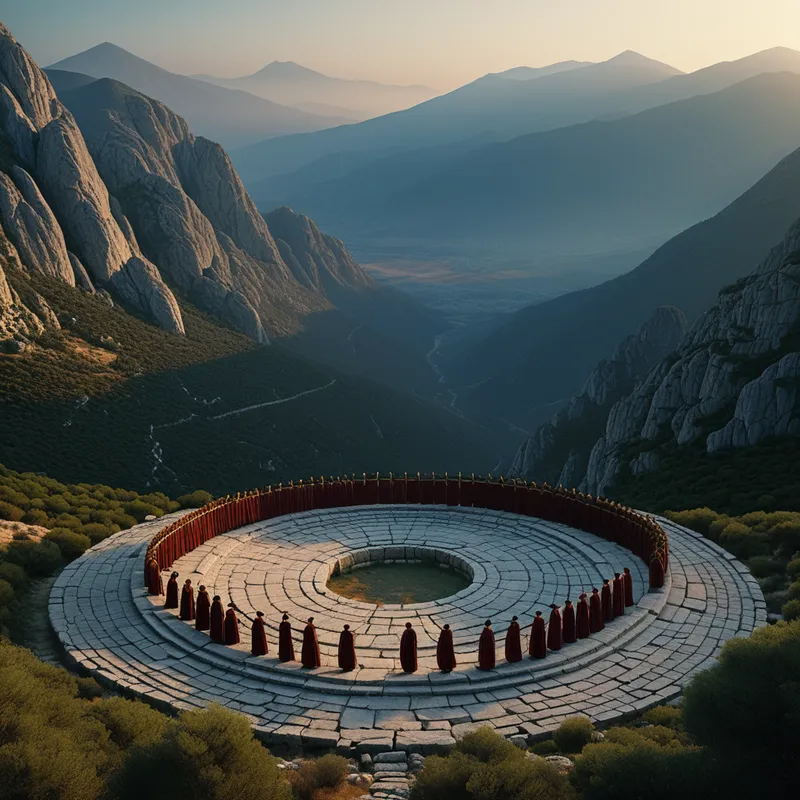
And so, they came. Not as an army, but as a gathering. Twelve envoys, from the Ionians by the coast to the Dorians of the rugged interior, from the farmers of Boeotia to the sailors of Attica. They left their polished armor at home, bringing instead a clod of earth from their ancestral field and a flask of [water](/myths/water “Myth from Chinese culture.”/) from their local spring. The air at Thermopylae was thick with mist and tension, the ground underfoot both spongy and firm.
There was no single founder to raise a banner. The pact was woven in the space between them. They stood in a circle around the ancient altar of Demeter, each placing their offering of earth and water into a common krater. A Mycenaean cup of such antiquity that its heroes were forgotten was brought forth. Into it, they mixed the blended earth and water with wine, and one by one, they drank. The oath was not sworn on a god of war, but on the deities of growth and shared sustenance: Demeter of the Grain and Dionysus of the Vine. Their voices, once a cacophony of dialects, rose as one chant: to never raze each other’s cities to the ground; to never cut off the life-giving flow of water, even in siege; to defend the sanctity of the shared sanctuaries, especially Delphi, the navel of [the world](/myths/the-world “Myth from Tarot culture.”/).
The resolution was not a victory cry, but a deep, collective exhalation. [The mist](/myths/the-mist “Myth from Celtic culture.”/) did not part with dramatic sunlight, but it seemed to thin, allowing each delegate to see the face of the other clearly—not as an enemy, but as a fellow oath-sworn, a synedros (councilor). They returned to their lands not with plunder, but with a sacred, invisible thread now stitched into the fabric of their being, a thread that connected them to eleven others. The League was born not from conquest, but from a shared vow to care for what was common, to become, in essence, guardians of [the hearth](/myths/the-hearth “Myth from Norse culture.”/)-fire of Hellas itself.
Cultural Origins & Context
The Amphictyonic League is a rare mytho-historical entity, its roots tangled deeply in the pre-classical soil of tribal Greece. Unlike the epic tales of [Homer](/myths/homer “Myth from Greek culture.”/), this was not a story for the banquet hall, but for the council fire and the sacred precinct. It was a foundational narrative of diplomacy, passed down by priests, heralds, and elders who governed the practical, sacred, and political symbiosis between communities.
Historically, several such leagues existed, but the most famous was the Delphic Amphictyony, which administered and protected [the oracle of Delphi](/myths/the-oracle-of-delphi “Myth from Global/Universal culture.”/). Its societal function was profoundly pragmatic yet sacred: to manage shared resources (like the sacred land, the Crisaean plain), to organize panhellenic festivals like the Pythian Games, and to arbitrate disputes under the auspices of Apollo. It was a proto-constitutional myth, a story the Greeks told themselves about how to be a civilization beyond [the polis](/myths/the-polis “Myth from Greek culture.”/). It modeled a unity that was not homogenizing—each tribe kept its unique customs and gods—but was based on mutual respect for sacred boundaries and a higher, collective law. In a world perpetually on the brink of fratricidal war, the myth of the League offered a template for peace through sacred obligation.
Symbolic Architecture
Psychologically, the Amphictyonic League represents the archetypal move from [fragmentation](/symbols/fragmentation “Symbol: The experience of breaking apart, losing cohesion, or being separated into pieces. Often represents disintegration of self, relationships, or reality.”/) to a conscious confederation of the [psyche](/myths/psyche “Myth from Greek culture.”/). The twelve tribes symbolize the disparate, often conflicting, sub-personalities, complexes, and inherited “tribal” instincts within an individual—the inner [warrior](/symbols/warrior “Symbol: A spiritual archetype representing inner strength, discipline, and the struggle for higher purpose or self-mastery.”/), the nurturer, the skeptic, the visionary, all speaking different internal dialects.
The sacred oath is not a demand for uniformity, but a covenant for conscious co-existence. It is the ego’s agreement to let the Self govern the shared, inner sanctuary.
The central deities are telling: Demeter and Dionysus. They are gods of cycles, of the [buried seed](/symbols/buried-seed “Symbol: The buried seed represents the potential for growth, creativity, and new beginnings lying dormant beneath the surface.”/) and the liberating vintage, representing the nourishing and the ecstatic-unifying principles of [life](/symbols/life “Symbol: The symbol of ‘Life’ represents a journey of growth, interconnectedness, and existential meaning, encompassing both the joys and challenges that define human experience.”/). The pact is sworn not to a god of order (Zeus) or [strategy](/symbols/strategy “Symbol: A plan of action designed to achieve a long-term or overall aim, often involving competition, resource management, and foresight.”/) (Athena), but to the powers that ensure shared [life](/symbols/life “Symbol: The symbol of ‘Life’ represents a journey of growth, interconnectedness, and existential meaning, encompassing both the joys and challenges that define human experience.”/) continues. The core symbols are the mixed [earth](/symbols/earth “Symbol: The symbol of Earth often represents grounding, stability, and the physical realm, embodying a connection to nature and the innate support it provides.”/) and [water](/symbols/water “Symbol: Water symbolizes the subconscious mind, emotions, and the flow of life, representing both cleansing and creation.”/) (the foundational, somatic blend of different essences), the common cup (the [vessel](/symbols/vessel “Symbol: A container or structure that holds, transports, or protects something essential, representing the self, emotions, or life journey.”/) of a shared [fate](/symbols/fate “Symbol: Fate represents the belief in predetermined outcomes, suggesting that some aspects of life are beyond human control.”/)), and the sacred precinct (the inviolable inner sanctum of [the Self](/myths/the-self “Myth from Jungian culture.”/), which must be protected from the psyche’s own ravaging tendencies). The primary conflict is between autarkic isolationism and the terrifying, fertile [vulnerability](/symbols/vulnerability “Symbol: A state of emotional or physical exposure, often involving risk of harm, that reveals authentic self beneath protective layers.”/) of interdependence.
The Dreamer’s Resonance
When this myth stirs in the modern unconscious, it rarely appears as a historical tableau. Instead, one might dream of being in a council of arguing versions of oneself, all needing to sign a single, crucial document. Or of discovering a beautiful, overgrown garden that belongs to no one house but sits at the center of a neighborhood, and feeling a fierce urge to tend to it. There may be dreams of repairing a vital, communal aqueduct that has been sabotaged, or of trying to translate between several estranged family members at a reunion to forge a new family rule.
Somatically, this process can feel like a pressure in the chest—the heart-center being asked to become a meeting ground. There is often anxiety, the fear that in acknowledging these inner “others,” one’s own identity will be diluted. The psychological process is one of moving from identification with a single inner tribe (e.g., “I am only my ambitious self”) to a relationship with the full inner assembly. It is the work of inner diplomacy, where the goal is not to conquer the inner Dorian or Ionian, but to hear their concerns and swear a mutual oath to the health of the whole psychic ecosystem.

Alchemical Translation
The alchemical journey mirrored here is the coniunctio oppositorum—[the conjunction](/myths/the-conjunction “Myth from Alchemical culture.”/) of opposites—on a collective, intra-psychic scale. [The prima materia](/myths/the-prima-materia “Myth from Alchemical culture.”/) is the raw, fragmented state of the psyche, where complexes war like city-states. The first operation is the Calling of the Council: [the ego](/myths/the-ego “Myth from Jungian culture.”/), hearing the distress of the land (the somatic, embodied Self), must convene the inner factions. This requires a descent from the throne of singular control.
The League teaches that sovereignty is not about absolute rule, but about facilitating a sacred covenant between all that dwells within one’s borders.
The Swearing of the Oath is the crucial [nigredo](/myths/nigredo “Myth from Alchemical culture.”/)-to-albedo transition. It is the humbling, dark moment of mixing one’s unique “earth” with that of the other. The fermentation occurs in the common krater, symbolizing [the vessel](/myths/the-vessel “Myth from Alchemical culture.”/) of the therapeutic or reflective process. The oath itself—to not destroy, to not cut off sustenance—is the establishment of a new, inner ethical law based on preservation rather than domination.
The resulting League is the alchemical lapis, not a stone of perfection, but a functioning, living system. It is the individuated Self not as a monolithic king, but as a wise, caretaker president of a council. The league meets twice a year—symbolizing the need for continual re-convening, re-negotiation, and re-dedication to the oath. For the modern individual, the [triumph](/myths/triumph “Myth from Roman culture.”/) is not a final, integrated state, but the ongoing, vigilant practice of being Amphictyonic—of tending the shared sanctuaries within, ensuring no inner voice is utterly silenced, and protecting the sacred, central oracle (the connection to the Self) from the pollution of unchecked, partisan inner conflict. One becomes, in essence, the guardian of one’s own Delphi.
Associated Symbols
Explore related symbols from the CaleaDream lexicon: