The Amazon River Creation
An ancient Amazonian myth explaining the river's origin through celestial conflict and earth-bound transformation, revealing deep connections to nature.
The Tale of The Amazon River Creation
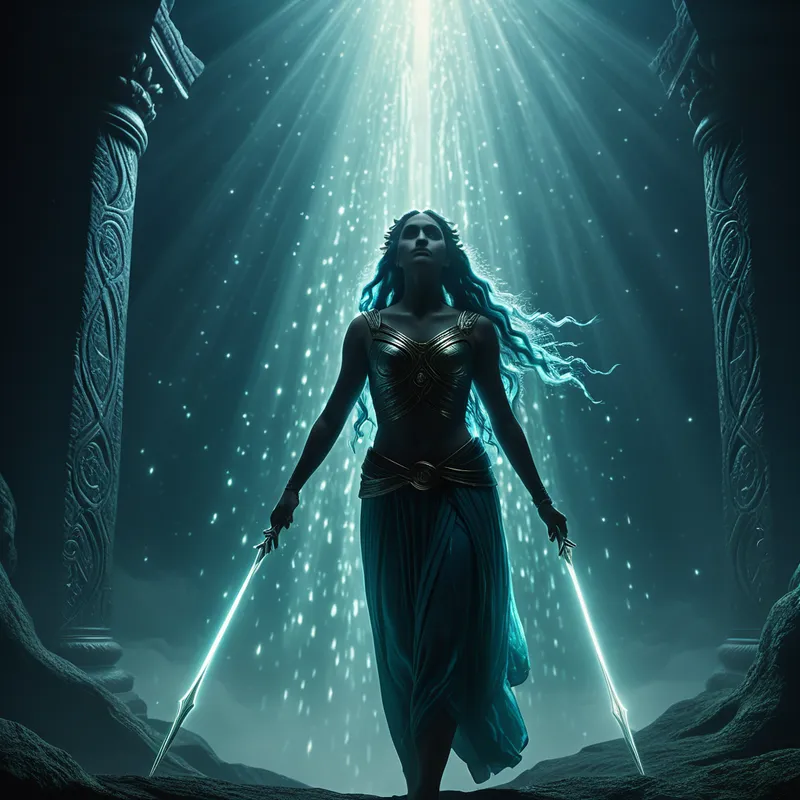
In the time before time, when [the world](/myths/the-world “Myth from Tarot culture.”/) was a vast, unbroken tapestry of green, [the sky](/myths/the-sky “Myth from Persian culture.”/) and [the earth](/myths/the-earth “Myth from Hindu culture.”/) were not separate realms but lovers in a tight embrace. The celestial vault, personified as the great God Guaraci, shone his light upon the verdant body of [the Earth](/myths/the-earth “Myth from Hindu culture.”/) Mother, Gaia-pora. Their union was fertile and complete, a closed circle of life where every root, every leaf, every creature was known and held. But within this perfection, a tension simmered. The spirits of the earth, the Curupira and the Caipora, guardians of the forest’s deepest secrets, grew restless under the constant, watchful gaze of [the sky](/myths/the-sky “Myth from Persian culture.”/). They longed for shadows, for mysteries the sun could not penetrate, for a realm of their own.
This longing took form in Iururá, a beautiful and powerful earth spirit, daughter of the forest’s deepest shadows. She was of the earth, but her spirit held a celestial fire, a spark of rebellious light that drew the eye of Jaci, [the Moon](/myths/the-moon “Myth from Tarot culture.”/). Jaci, in his silvery solitude, fell into a profound longing for Iururá. He descended from the sky, his cool light weaving through the canopy, seeking her in the heart of the world. Their meeting was a collision of realms. Where Jaci’s light touched the dark soil, it did not warm but wept, creating the first dew. Their secret love was a transgression against the established Order of Guaraci and Gaia-pora.
Guaraci, the Sun, discovered this union. His rage was not hot, but cold and terrible—a rage of betrayal that fractured the unity of his world. In a voice that shook the foundations of the forest, he condemned Jaci to eternal exile, casting him back into the lonely sky. But his judgment for Iururá was more profound. He would not destroy her; he would transform her. Her earthly form, born of shadow and secret love, was to be unmade and remade as a perpetual testament to her nature and her crime.
He struck the ground where she stood with a single, searing beam of concentrated light. But the Earth Mother, Gaia-pora, felt the pain of her daughter and intervened. She softened the blow, turning the punitive fire into a catalyst of agonized change. Iururá did not burn; she unraveled. Her flesh became the rich, dark soil of the banks. Her bones became the stones and submerged logs. Her long, flowing hair became the vines and hanging lianas. And her tears—the tears of loss, of celestial love forbidden—began to flow. They flowed from the very wound in the earth where Guaraci’s light had struck, fed by the secret weeping of Jaci’s moonlight from above and the compassionate groundwater of Gaia-pora from below.
These were not gentle tears. They were a torrent of grief and transformation, carving through the unbroken green, parting the eternal embrace of the forest floor. This was the birth-wail of [the river](/myths/the-river “Myth from Buddhist culture.”/). It snaked and thrashed, a Serpent of [Water](/myths/water “Myth from Chinese culture.”/) cutting through the flesh of the world. It was not a clean creation, but a violent, messy genesis born from conflict, love, and judgment. [The river](/myths/the-river “Myth from Buddhist culture.”/), now named after warrior women of later tales, carried within its currents the memory of Iururá: its dark, reflective depths held the secrets of the earth (her origin), its surface glittered with the stolen kisses of the moon (her love), and its relentless flow was the eternal sentence passed by the sun (her transformation). Thus, the Amazon was born—not as a gift, but as a flowing, living scar, a boundary and a bridge between the warring realms of sky and earth.
Cultural Origins & Context
This narrative is woven from the threads of various Indigenous Amazonian cosmologies, particularly drawing from Tupi-Guarani foundational myths. In these worldviews, the environment is not a passive setting but an active, sentient participant in a dynamic cosmic drama. The river is never just a geographical feature; it is a character with a biography, a will, and a role in maintaining cosmic balance.
The central tension between celestial beings (Guaraci/Sun, Jaci/Moon) and earth spirits (Curupira, Iururá) reflects a fundamental Amazonian understanding of reality. The forest, with its immense, often impenetrable density, is a realm of powerful, autonomous spirits who resist domination. The open sky, by contrast, represents order, law, and distant power. The myth explains the river as the necessary consequence of the interaction—and collision—between these two sovereign principles. It serves as a mediator, however tumultuous.
Furthermore, the myth functions as an etiological narrative that encodes ecological wisdom. The river’s origin in conflict explains its dual nature: life-giving and destructive, a source of food and a cause of floods. Its birth from tears and transformation speaks to the deep emotional and spiritual resonance the river holds for the peoples who live along it. The river is understood as a being with emotional depth, capable of sorrow and memory, which demands respect and specific ritual conduct from humans who navigate its waters and consume its bounty.
Symbolic Architecture
The myth constructs a profound symbolic [landscape](/symbols/landscape “Symbol: Landscapes in dreams are powerful symbols representing the dreamer’s emotional state, personal journey, and the broader context of life situations.”/) where geography is [psychology](/symbols/psychology “Symbol: Psychology in dreams often represents the exploration of the self, the subconscious mind, and emotional conflicts.”/). The unbroken [forest](/symbols/forest “Symbol: The forest symbolizes a complex domain of the unconscious mind, representing both mystery and potential for personal growth.”/) represents the primordial, unconscious unity—a state of being where all opposites are merged. The [river](/symbols/river “Symbol: A river often symbolizes the flow of emotions, the passage of time, and life’s journey, reflecting transitions and movement in one’s life.”/)’s creation is the [moment](/symbols/moment “Symbol: The symbol of a ‘moment’ embodies the significance of transient experiences that encapsulate emotional depth or pivotal transformations in life.”/) of [differentiation](/symbols/differentiation “Symbol: The process of distinguishing or separating parts of the self, emotions, or identity from a whole, often marking a developmental or psychological milestone.”/), the painful but necessary [emergence](/symbols/emergence “Symbol: A process of coming into being, rising from obscurity, or breaking through a barrier, often representing birth, transformation, or revelation.”/) of [consciousness](/symbols/consciousness “Symbol: Consciousness represents the state of awareness and perception, encompassing thoughts, feelings, and experiences.”/) that creates distinction (sky/[earth](/symbols/earth “Symbol: The symbol of Earth often represents grounding, stability, and the physical realm, embodying a connection to nature and the innate support it provides.”/), light/dark, male/female) and thus the possibility for [relationship](/symbols/relationship “Symbol: A representation of connections we have with others in our lives, often reflecting our emotional state.”/), even conflicted relationship.
The river is the embodied tension between the paternal, ordering principle of the Sky Father and the maternal, generative, and secret-holding principle of the Earth Mother. It is the child of their discord, a permanent wound that is also the source of all sustenance.
Iururá’s transformation is not a [death](/symbols/death “Symbol: Symbolizes transformation, endings, and new beginnings; often associated with fear of the unknown.”/) but a [metamorphosis](/symbols/metamorphosis “Symbol: A profound, often irreversible transformation of form, identity, or state, representing a complete journey from one condition to another.”/) into a more essential state. She becomes the artery of the continent, moving from individual [spirit](/symbols/spirit “Symbol: Spirit symbolizes the essence of life, vitality, and the spiritual journey of the individual.”/) to systemic function. This reflects an archetypal understanding of Transformation where the personal must be sacrificed to become part of the greater ecological and cosmic [body](/symbols/body “Symbol: The body in dreams often symbolizes the dreamer’s self-identity, personal health, and the relationship they have with their physical existence.”/). The river, therefore, symbolizes the process of psychic [life](/symbols/life “Symbol: The symbol of ‘Life’ represents a journey of growth, interconnectedness, and existential meaning, encompassing both the joys and challenges that define human experience.”/) itself: a constant flow shaped by past traumas (the wound), driven by deep desires (the forbidden love), and subject to overarching laws (the solar decree).
The Dreamer’s Resonance
For the individual [psyche](/myths/psyche “Myth from Greek culture.”/), the Amazon River’s creation myth mirrors the birth of one’s own emotional and instinctual life. The “unbroken forest” can represent the undifferentiated self of early childhood or a state of psychological stagnation. The “forbidden love” between moon and earth spirit symbolizes the emergence of a deep, perhaps taboo, complex—a feeling or desire that challenges the internalized “solar” laws of [the ego](/myths/the-ego “Myth from Jungian culture.”/), our personal Guaraci who demands order and control.
The cataclysmic judgment and the resulting river represent the often-painful integration of this complex. We do not simply erase forbidden feelings; we are transformed by them. Our grief, our longing, our rebellion carve channels through our psyche, creating depth, contour, and a capacity for flow. The resulting inner “river” is our emotional body: sometimes calm, sometimes raging, always carrying the silt of our past and reflecting the light of our changing consciousness. To dream of such a river is to encounter the raw, untamed flow of the unconscious itself, which can be both nourishing and terrifying.
Alchemical Translation
In the alchemical opus, the goal is the [coniunctio oppositorum](/myths/coniunctio-oppositorum “Myth from Alchemical culture.”/)—[the sacred marriage](/myths/the-sacred-marriage “Myth from Various culture.”/) of opposites. This myth presents a brutal, yet quintessential, version of that process. The fixed, solar consciousness (Guaraci) and the fluid, lunar-earthly unconscious (Iururá/Jaci) do not unite in harmony. They collide in a mortificatio, a symbolic [death](/myths/death “Myth from Tarot culture.”/) and dissolution.
The river is the aqua permanens, the permanent water, born not from gentle mixing but from violent confrontation. It is the solvent that results from the clash of fire (sun’s judgment) and terra (earth’s body), capable of dissolving the old, rigid unity to allow for a new, dynamic order to emerge.
The flowing water is the key agent of transformation. It does the work that fixed fire cannot: it wears down resistance, carries away debris, and creates new pathways. The myth tells us that true creation—especially the creation of something as vast and life-sustaining as a river or a mature psyche—requires a rupture. The pristine “forest” of the old self must be carved open by the waters of profound experience, often experienced as grief, conflict, or love that breaks the rules. The river is the evidence that the alchemical process is ongoing, that the marriage of opposites is less a static achievement and more a perpetual, flowing tension.
Associated Symbols
Explore related symbols from the CaleaDream lexicon:
- River — The central symbol of life’s relentless flow, carving its path through the landscape of existence, shaped by past forces and forever moving toward an unknown sea.
- Serpent — A primal emblem of transformation, cyclical time, and the mysterious, winding currents of instinct and unconscious knowledge that underpin the visible world.
- Water — The element of the emotions, the unconscious mind, purification, and the fluid medium through which all life and change must pass.
- Wound — The necessary rupture or opening that precedes healing and creation, the source from which profound new realities can emerge.
- Transformation Cocoon — The state of dissolution and latent potential where old forms break down so that new, more essential forms can be assembled.
- Moon — The celestial body governing reflection, the unconscious, cycles, fertility, and the hidden, receptive aspects of nature that defy solar order.
- Sun — The archetypal symbol of consciousness, order, law, discernment, and the penetrating light of the ego and paternal principle.
- Forest — The dense, mysterious, and fecund realm of the untamed unconscious, teeming with autonomous life and spirits, representing wholeness in its unbroken state.
- Earth — The foundational, maternal principle of nourishment, stability, embodiment, and the deep, dark ground from which all life springs and to which it returns.
- Grief — The profound emotional current that, like the river’s source, can carve canyons of depth in the soul and give rise to compassionate, life-sustaining flow.
- Raging River Flood — The overwhelming, destructive, yet cleansing power of unleashed emotional or instinctual forces that reshape the landscape of [the self](/myths/the-self “Myth from Jungian culture.”/).
- Bridge — The structure or understanding that allows passage between separated realms, such as sky and earth, consciousness and unconsciousness, born from the very divide it seeks to span.