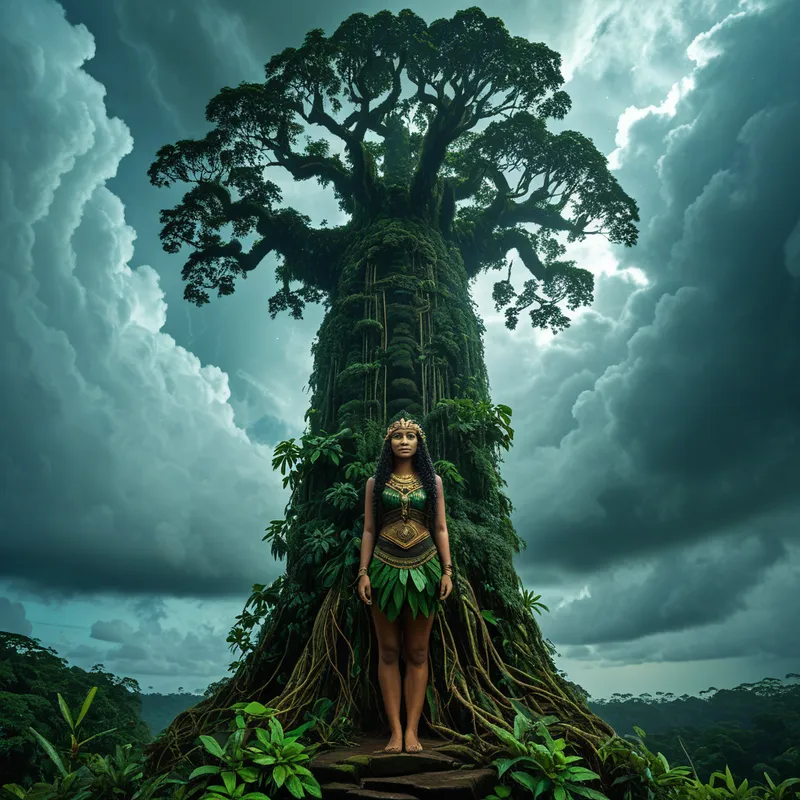
The Amazon rainforest in Greek Myth Meaning & Symbolism
The myth of Gaia's final, untamed daughter, a primordial forest born from divine grief, holding the world's forgotten breath and the promise of renewal.
The Tale of The Amazon rainforest in Greek
Listen, and hear the whisper that comes not from the wind, but from the deep, green silence before time. In the age when the Titans still walked the skin of the world, and the Ouranides cast long shadows, the Earth Mother Gaia wept. Her tears were not of salt, but of sap and soil. She had borne the starry heavens and the restless sea, had given form to mountains and valleys, but one child remained unborn within her—a dream of pure, untamed life, a memory of the world’s first, unfettered breath.
This dream grew heavy in her womb of clay and stone. It was a longing so vast it threatened to split the continents. And so, in a grove where no god dared tread, where the light fell in shattered emeralds through a canopy that touched the belly of the sky, Gaia brought forth her final daughter. She was not born with a cry, but with a sigh—a great exhalation that became the humid air. She did not open her eyes, for her eyes were the dark, reflective pools where jaguars came to drink. Her hair was the endless cascade of lianas and vines; her skin, the mosaic of a million types of bark and fern. They named her Amazones, which means “without a breast,” for she was whole unto herself, needing no nurture from gods or men, giving sustenance from every leaf and fruit.
Amazones slept, and in her dreaming, she grew. Her breath became the weather systems, her slow, tectonic heartbeat the rhythm of the seasons. She was a world within the world. For eons, she lay in her green cathedral, known only to the creatures that wore feathers and fur, and to the river that coiled through her like a great, liquid serpent. The Olympian gods, in their gleaming arrogance on Mount Olympus, dismissed her as mere wilderness, a backdrop to their dramas.
But then came the Heroic Age. Men, armed with fire and iron, began to hear rumors of a land of impossible abundance and terror. They spoke of a place where trees bled when cut, where the very air could drive a man mad with its fecund perfume. They called it the “Lungs of the World,” for it seemed to breathe for all creation. A great hero, seeking a final labor to cement his name, was tasked not with slaying a beast, but with finding the heart of this living entity. He hacked his way through the green wall, a mere insect in the immensity. He did not find a monster to conquer, but a presence. It asked him no questions, offered no battle. It simply was. And in that overwhelming, silent is-ness, the hero’s quest dissolved. He dropped his sword, which was swallowed by soft moss in a single afternoon. He sat by a blackwater tributary, and for the first time, heard not the stories of gods and glory in his head, but the endless, intricate story of a single leaf decaying into earth. He did not return a conqueror. He returned, if he returned at all, as a man who had forgotten how to be a hero, and had instead remembered how to be a part of something alive.
Cultural Origins & Context
This is a myth without a single, ancient text. It is a story written in the collective longing of a globalized world. The “Greek” framing is a vessel, a familiar mythological language we use to articulate a profoundly modern, universal anxiety and reverence. It arises from the intersection of late 20th and 21st-century ecological consciousness with the deep human need for sacred geography. We are the culture that created it. Anthropologists, climate scientists, indigenous rights activists, and poets have become its bards, passing down the “myth” through documentaries, scientific reports, protest slogans, and viral imagery.
Its societal function is dual. First, it serves as a narrative containment field for our overwhelming grief and awe regarding planetary-scale ecological change. By envisioning the rainforest as a single, vast, sentient entity—a Titaness—we can relate to it emotionally, as one would to a character in an epic, rather than as a complex, impersonal biophysical system. Second, it acts as a corrective mirror to the dominant Western mythos of conquest and extraction. It re-frames the forest not as a resource to be dominated (a classic heroic narrative), but as a primordial, sovereign being whose wholeness is essential to our own survival. The myth is told wherever people speak of “the lungs of the Earth” or defend “the standing people” (trees). It is a global folklore born of crisis and connection.
Symbolic Architecture
At its core, the myth of Amazones symbolizes the Psyche as Ecosystem. She is the ultimate representation of the Self in its unassimilated, primordial state—teeming with infinite, interconnected life, both luminous and shadowed.
The forest does not know the concept of waste; decay is but a slower form of breath. In the psyche, so too must every repressed memory, every shame, every forgotten dream be allowed its process of decomposition, to become the fertile humus from which new consciousness grows.
The hero’s failed quest is the critical symbol. His sword, the tool of egoic differentiation and will, is rendered meaningless. His dissolution in the face of her sheer being represents the ego’s necessary surrender when confronted with the magnitude of the unconscious Self. Amazones is not the Shadow to be battled, but the greater Ground of Being that contains both shadow and light. The rivers flowing through her are the libidinal currents of the soul, and the incredible biodiversity symbolizes the multiplicity of sub-personalities, complexes, and archetypal potentials within a single, coherent system.

The Dreamer’s Resonance
When this myth pattern erupts in the modern dreamscape, it often manifests as dreams of overwhelming, beautiful, and sometimes terrifying natural abundance within civilized spaces. To dream of a forest growing through one’s living room, or of a familiar city street transforming into a root-tangled path, is to experience the psyche’s insistence on reintegration.
The somatic experience is one of ecological claustrophobia or expansion. The dreamer may feel the humid, thick air of the dream-forest as a physical pressure on the chest—a somatic signal of the unconscious becoming too present, too dense to ignore. Conversely, they may feel a profound, vegetative calm, a slowing of the heart to match a dream of deep, green stillness. This is the process of the psyche attempting to metabolize complexity and interconnection. It is the Self asserting its primary, wild nature over the artificially ordered “city” of the conscious personality. The dream is an invitation to stop “hacking through” one’s own interiority with the sword of analysis, and to instead sit by the internal blackwater river and listen.

Alchemical Translation
The alchemical journey modeled here is the Nigredo giving way not to a purified gold, but to the Viriditas, the greening. The initial state is one of fragmentation: the hero-ego, separate from the world, on a linear quest. The confrontation with Amazones is the dissolution in the prima materia—the chaotic, fecund, all-containing substance of the soul.
Individuation is not the construction of a shining, isolated citadel of consciousness. It is the conscious participation in the already-existing, ancient, and breathing ecosystem of the Self. One does not build the forest; one discovers they have always been a tree within it.
The triumph is the abandonment of the conquest paradigm. The alchemical “gold” is the realization of interdependent wholeness. For the modern individual, this translates to the work of moving from an ego-centric psychology (“I think, therefore I am”) to an eco-centric psychology (“I am because I am related”). It is the transmutation of loneliness into solitude, of anxiety about one’s place into a recognition of one’s inherent belonging to a vast, living network. The labor is not to slay one’s inner monsters, but to grant them habitat, to understand their role in the nutrient cycle of the soul. To know oneself, in the spirit of this myth, is to become a humble, attentive steward of the immense, breathing rainforest within.
Associated Symbols
Explore related symbols from the CaleaDream lexicon: