The Alban Hefin Myth Meaning & Symbolism
The myth of the Sun King's triumphant peak and his sacred, self-aware sacrifice into the waiting arms of the Goddess of the Land.
The Tale of The Alban Hefin
Listen. The wheel of the year turns, and we come to the still point, the breath held at the peak of the world. This is the day of Alban Hefin. The air is thick with the scent of honeysuckle and sun-warmed earth. In the east, the sky pales not with the tentative blush of spring, but with the fierce, gold promise of dominion.
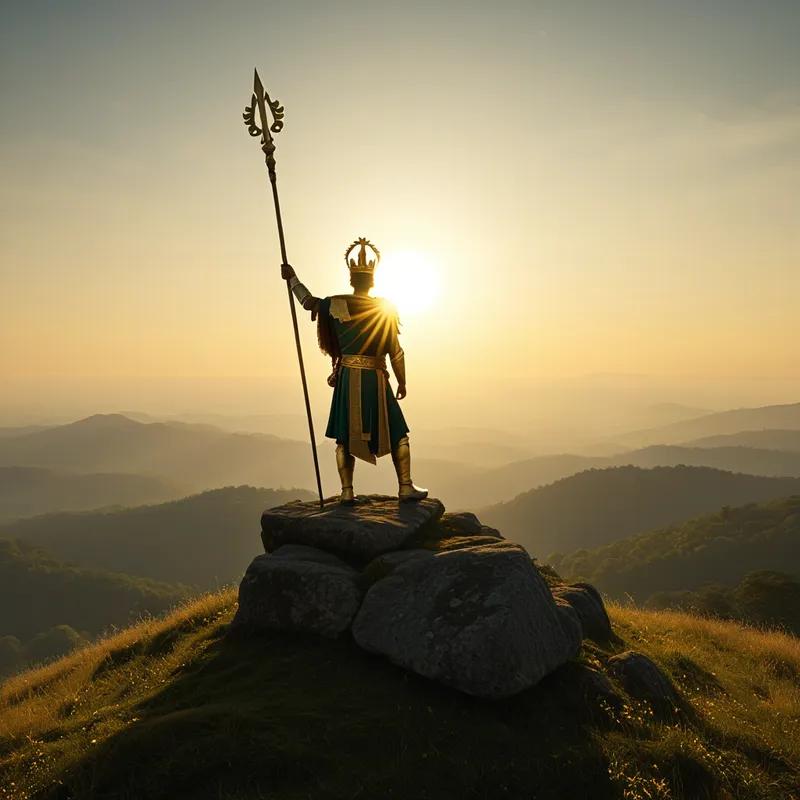
He rises, the Sun King. He is not the young, green god of the spring equinox, but the sovereign in his full majesty. His hair is the color of ripe wheat, his eyes the blue of the high, endless sky. His crown is of oak leaves, sturdy and enduring, and in his hand he carries a spear of pure, distilled sunlight. With each step he takes from the horizon to the zenith, the world sings. Flowers turn their faces to him, bees hum his praises, and the stones of the ancient hills hum with stored warmth.
He climbs the sacred hill, the place where the land reaches up to meet the sky. At its summit stands the Hirlas, the Sentinel Stone, grey and immutable. As the Sun King reaches the peak of his climb, he plunges his solar spear into the top of the stone. A sound rings out—not a clash, but a deep, resonant chord that vibrates through bone and soil alike. The light is absolute, triumphant. This is his moment of perfect power, the longest day, the shortest night. He stands, a pillar of brilliance, and for a heartbeat, time itself stops.
But in that very moment of supreme victory, he feels it. A whisper in the heat haze. A cool breath at the nape of his neck. He looks not to the bright sky, but down, into the shadows stretching long from the base of the stone. There, in the deep green of the forest edge, She waits. The Cailleach of Summer, the Goddess of the Land, is no crone now. She is the embodiment of the lush, fecund earth, cloaked in flowers, her eyes deep pools of forest shade. She does not challenge him. She simply holds his gaze, and in her look, he sees the truth.
His brilliance cannot last. The spear of light, though potent, is already casting the longest shadow it ever will. His triumph contains its own end. The wheel must turn. The understanding dawns in him not as a defeat, but as a deeper, more sacred duty. The conflict is not against her, but within himself: the choice between clinging to unsustainable peak or accepting the graceful, necessary descent.
As the sun begins its infinitesimal slide from the zenith, the Sun King does not rage. He kneels. He places his hand upon the warm grass, feeling the heartbeat of the land thrumming beneath. He offers his light, not as a conqueror, but as a consort. The Goddess steps forward, and the fierce, direct light of the spear softens, becoming the dappled, golden light of a summer afternoon, filtered through a canopy of green. He joins her in the glen, and his light is absorbed into the life of the soil, into the ripening berry and the deepening root. The longest day surrenders, willingly, to the coming night, knowing this sacrifice is the promise of future harvest. The hero’s journey is not to eternal noon, but to conscious participation in the cycle.
Cultural Origins & Context
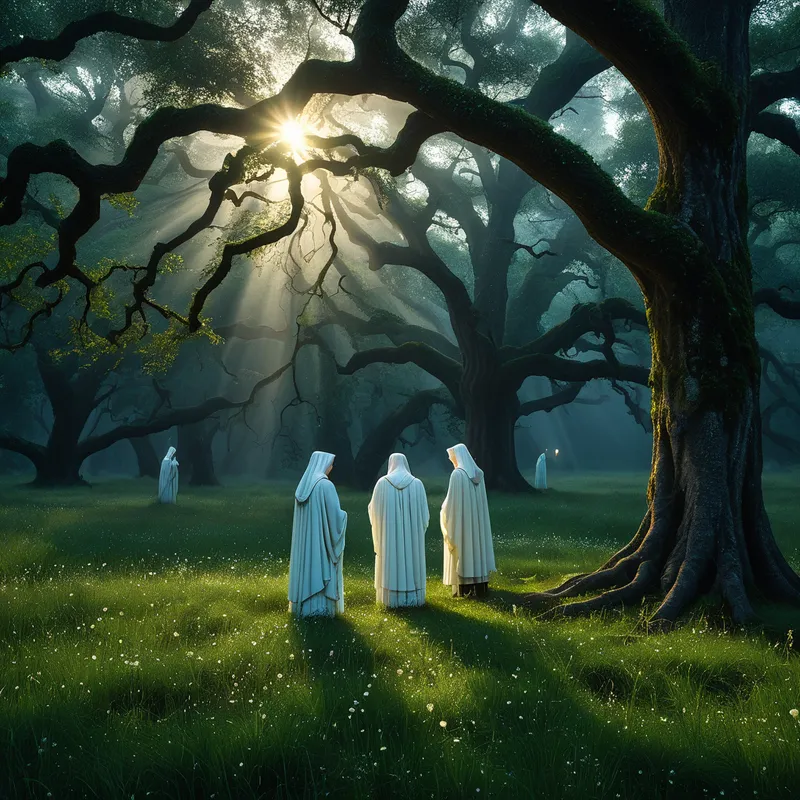
The tale of Alban Hefin is not a singular narrative from a dusty tome, but a seasonal liturgy woven into the very landscape of the Celtic world. Its “text” was the alignment of stone circles like Stonehenge, where the dawn of the solstice sun would pierce the heart of the monument. Its “bards” were the Druids, the philosopher-priests who served as intermediaries between the tribe, the land, and the cosmos. They did not merely tell this story; they orchestrated its enactment through ritual observation, sacred fire, and communal gathering.
The societal function was profound. It was a cosmological anchor, aligning human time with celestial time. The myth explained the inevitable turn of the seasons, framing the waning of light not as a loss to be feared, but as a necessary phase in a sacred contract. It reinforced the core Druidic principle of Fír—the right order of things. The King’s sacrifice ensured the fertility of the land, which in turn ensured the survival of the people. The myth was a collective reassurance of cyclic renewal, teaching that from the peak of power must come the generosity of sacrifice for the greater web of life.
Symbolic Architecture
At its heart, Alban Hefin is the archetypal drama of the conscious ego at its zenith facing the call of the deeper Self. The Sun King represents the principle of conscious awareness, clarity, differentiation, and outward-focused energy—the “I” that shines brightly and claims its territory.
The peak of the mountain is not a place to build a house, but a vantage point from which to see the whole of the kingdom one must descend to rule.
The Cailleach in her summer aspect symbolizes the unconscious, the fertile dark, the realm of instinct, growth, and ultimately, dissolution and transformation. She is not a villain, but the complementary opposite. The Hirlas stone is the axis mundi, the world pillar where these two realms meet and communicate. The plunging of the solar spear is the moment of maximum inflation of the conscious mind, which simultaneously creates the conditions for its own integration. The true “victory” is the King’s realization that his light is meant to serve life, not merely to dominate the sky.
The Dreamer’s Resonance
When this myth stirs in the modern psyche, it often surfaces in dreams of brilliant, yet fleeting, success. You may dream of standing on a breathtaking summit, only to notice the path leading down into a beautiful, but darkening, forest. You might dream of a radiant light source that begins to dim, not from failure, but from a gentle, internal decision. There is a somatic quality of warmth, fullness, even slight over-extension—the feeling after a great achievement that leaves you curiously empty.
These dreams signal a psychological process of integration after culmination. The psyche is processing a peak experience—a career triumph, the completion of a major project, a moment of perfect recognition—and is now navigating the essential, often uncomfortable, “what next?” This is the descent from the zenith, where the conscious mind, having proven its strength, is now being invited to offer its gains to the broader, more mysterious processes of the soul. The dream may evoke a melancholic beauty, the poignant sweetness of a perfect moment that cannot, and should not, be held static.
Alchemical Translation
The alchemical journey mirrored in Alban Hefin is the solve et coagula—dissolve and coagulate—applied to the psyche itself. The Sun King’s brilliant, solar consciousness (the coagula, the solidified achievement) must willingly solve or dissolve into the lunar, receptive waters of the unconscious.
Individuation is not the endless ascent of the hero, but his sacred marriage at the peak, where he learns that his strength is a gift to be surrendered, not a possession to be hoarded.
For the modern individual, this translates to the critical work following any major life achievement. The triumph of landing the dream job must be sacrificed to the daily, often shadowy, work of mastery and service. The high of creative inspiration must be surrendered to the disciplined, earthy labor of editing and shaping. The myth models a conscious, willing descent from inflation. It is the CEO who steps down to mentor, the artist who destroys their favorite piece to learn from it, the thinker who allows their brilliant theory to be complicated by messy, real-world data. This is the alchemical gold: not the peak of power itself, but the wisdom and generative potency that flows from its sacred sacrifice. The light does not die; it is translated. It becomes the nourishing warmth in the soil from which the next cycle of growth—deeper, richer, and more connected—will inevitably spring.
Associated Symbols
Explore related symbols from the CaleaDream lexicon: