
The Acuara Healing Spirits Myth Meaning & Symbolism
A myth of a people forgetting their bond with the river, falling into spiritual sickness, and being healed by the return of the water's ancient spirits.
The Tale of The Acuara Healing Spirits
Listen. The story begins not with a shout, but with a silence. A forgetting.
In the time when the river was a god and the forest a cathedral, the people of the green heart knew a secret. They knew the water was not just for drinking, not just for bathing. It was a living memory. Every ripple on the Amazon carried the whispers of the Acuara, spirits woven from the first rains and the deepest springs. They were the pulse within the current, the coolness in the shade, the clarity in the pool. To honor them was simple: a song at dawn, a story told by the bank, a careful offering of gratitude before taking a drink. In return, the Acuara wove health into the people’s bones, clarity into their minds, and peace into their dreams. Illness was a rare visitor, quickly shown the door by the spirits’ song.
But human memory is a leaf on the current. Seasons turned. The people grew numerous and proud. They built their homes further from the river’s main embrace, tapping smaller streams. They began to speak of conquering the forest, of bending it to their will. The morning songs to the water were replaced by the sounds of axes. The stories of the Acuara became tales for children, then not even that. The sacred bond frayed, then snapped.
And the silence that followed was not peaceful. It was a thick, green sickness. A languor settled in the village. Fevers burned without fire. Wounds that should have closed wept and festered. Dreams became tangled with fear. The healers’ herbs lost their potency; their chants echoed hollowly in the heavy air. It was as if the soul of the people themselves was putrefying, and their bodies were merely following. Despair, a vine as choking as any in the jungle, began to climb.
It was the oldest shaman, a man whose skin was like river-smoothed bark, who finally remembered. In a fever-dream of his own, he saw the river—not as water, but as a vast, sleeping entity, its spirit withdrawn, its surface dull and silent. He heard a word, carried from a time before his grandfather’s grandfather: Acuara.
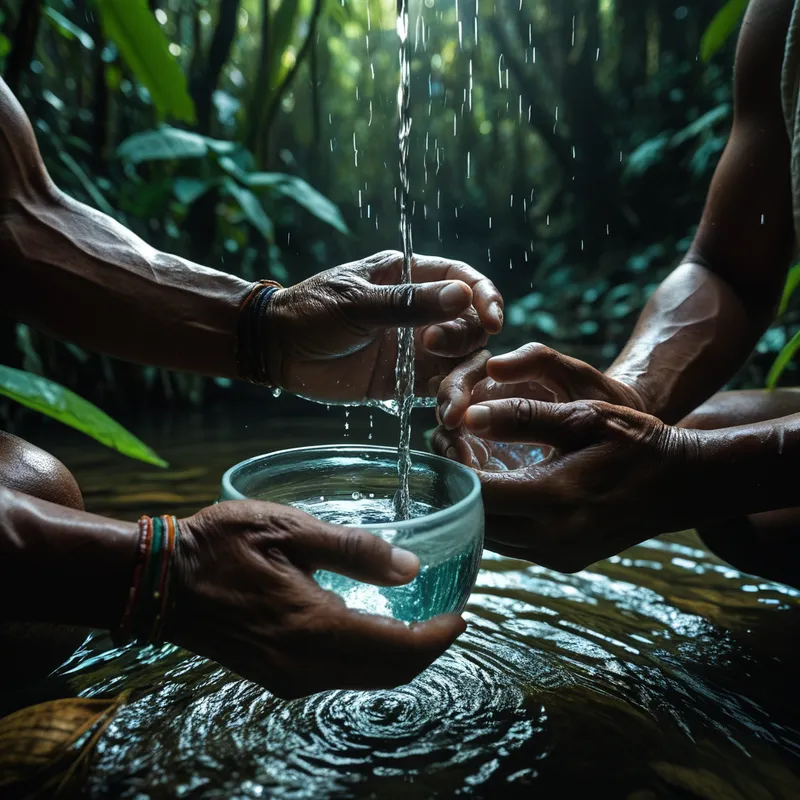
With the last of his strength, he crawled to the bank of the great river. He did not bring powerful herbs or loud invocations. He brought only his failing body and a whispered apology. He lowered his face to the water, not to drink, but to weep. His tears, hot with human regret, fell into the cool, indifferent flow.
And the river remembered.
Where his tears met the water, a light began, soft as a firefly. Then another, and another. The lights were not on the water, but within it. They coalesced, swirled, and rose. Forms emerged—shimmering, translucent figures of impossible beauty, shaped from liquid light and trailing vines of luminous algae. The Acuara had returned.
They did not speak in words, but in sensations. A wave of coolness washed over the shaman, and his fever broke. The spirits flowed past him, a gentle procession, into the village. They moved through the huts like a blessed mist. Where they passed, the heat of fever was quenched. Festering wounds were cleansed as if by a thousand gentle rains. The oppressive air itself was scoured clean, filled with the scent of ozone after a storm and wet earth.
The people awoke, not with a start, but with a deep, collective sigh, as if remembering how to breathe. The physical healing was instant, but the deeper cure was slower. It was the re-awakening of memory, the humbling realization of their place within, not above, the living web. The Acuara did not stay. As the village healed, their luminous forms faded back into the river’s flow. But their lesson remained, written not on stone, but on the heart: the healing spirit is always present, but it must be seen, remembered, and honored.
Cultural Origins & Context
This myth, in its essence, belongs to the vast tapestry of Indigenous Amazonian worldviews, where the environment is not a resource but a community of sentient beings. While “Acuara” is a term shaped for this narrative, it embodies a pervasive truth across many Amazonian cultures: the personhood of water. Rivers, lakes, and rains are often seen as ancestors, deities, or spirit nations with their own agency and consciousness.
Such stories were the province of shamans (pajés) and elders, told during rites of passage, healing ceremonies, or times of communal crisis. The myth functioned as a vital ecological and ethical charter. It encoded critical survival knowledge—the sacredness of water sources—within a compelling spiritual narrative. Its societal function was prophylactic; it served to maintain the psycho-spiritual hygiene of the community by reinforcing the behaviors (respect, reciprocity, gratitude) that ensured physical health and environmental balance. To forget the story was to risk the literal and metaphorical sickness that follows disconnection.
Symbolic Architecture
At its core, the myth is a profound map of a specific psychic catastrophe and its [resolution](/symbols/resolution “Symbol: In arts and music, resolution refers to the movement from dissonance to consonance, creating a sense of completion, release, or finality in a composition.”/). The Acuara represent the [anima](/symbols/anima “Symbol: The feminine archetype within the male unconscious, representing soul, creativity, and connection to the inner world.”/) mundi—the world [soul](/symbols/soul “Symbol: The soul represents the essence of a person, encompassing their spirit, identity, and connection to the universe.”/)—as it manifests in the local, [life](/symbols/life “Symbol: The symbol of ‘Life’ represents a journey of growth, interconnectedness, and existential meaning, encompassing both the joys and challenges that define human experience.”/)-giving element: [water](/symbols/water “Symbol: Water symbolizes the subconscious mind, emotions, and the flow of life, representing both cleansing and creation.”/). They are the objective psyche of [nature](/symbols/nature “Symbol: Nature symbolizes growth, connectivity, and the primal forces of existence.”/) itself, the healing intelligence inherent in the [cosmos](/symbols/cosmos “Symbol: The entire universe as an ordered, harmonious system, often representing the totality of existence, spiritual connection, and the unknown.”/).
The spirit does not abandon us; we become blind to its presence. Healing is not an acquisition, but a restoration of vision.
The [village](/symbols/village “Symbol: Symbolizes community, connection, and a reflection of one’s roots or origins.”/)’s “forgetting” symbolizes the ego’s [inflation](/symbols/inflation “Symbol: A dream symbol representing feelings of diminishing value, loss of control, or expansion beyond sustainable limits in one’s life or psyche.”/), where [consciousness](/symbols/consciousness “Symbol: Consciousness represents the state of awareness and perception, encompassing thoughts, feelings, and experiences.”/) cuts itself off from its instinctual and spiritual roots. The resulting sickness is not merely physical; it is the sickness of the soul in [isolation](/symbols/isolation “Symbol: A state of physical or emotional separation from others, often representing a need for introspection or signaling distress.”/), a state of nigredo. The festering wounds are symbolic of psychic contents—traumas, complexes, neglected duties—that cannot be integrated without the cleansing, reconciling power of the unconscious (the [river](/symbols/river “Symbol: A river often symbolizes the flow of emotions, the passage of time, and life’s journey, reflecting transitions and movement in one’s life.”/)).
The [shaman](/symbols/shaman “Symbol: A spiritual mediator who bridges the human and spirit worlds, often through altered states, healing, and guidance.”/)’s [journey](/symbols/journey “Symbol: A journey in dreams typically signifies adventure, growth, or a significant life transition.”/) is the archetypal “[night](/symbols/night “Symbol: Night often symbolizes the unconscious, mystery, and the unknown, representing the realm of dreams and intuition.”/) sea journey.” His crawl to the riverbank is an act of ego-surrender. His offering is not pride or [strength](/symbols/strength “Symbol: ‘Strength’ symbolizes resilience, courage, and the ability to overcome challenges.”/), but his own brokenness and authentic [remorse](/symbols/remorse “Symbol: A deep emotional regret for past actions, often tied to moral or ethical failure, signaling a desire for atonement or reconciliation.”/)—the “hot tears” of genuine affect. This is the key that re-opens the [dialogue](/symbols/dialogue “Symbol: Conversation or exchange between characters, representing communication, relationships, and narrative flow in games and leisure activities.”/) between consciousness and the deep psyche.

The Dreamer’s Resonance
When this myth stirs in the modern dreamer, it often signals a profound crisis of disconnection. You may dream of polluted or stagnant water, of dying plants in your home, of a profound thirst that cannot be quenched. The body in the dream may be covered in rashes, unhealing cuts, or feel heavy with a debilitating fever. This is the somatic echo of a soul-state.
The psyche is announcing that a vital lifeline to your own inner Acuara—your instinctual wisdom, your emotional truth, your spiritual source—has been severed. You have “forgotten the song.” This often coincides with periods of burnout, chronic stress, or a life lived solely on the surface of things, dictated by external demands (building the village further from the river). The dream is the beginning of the fever, the psyche’s attempt to force a crisis that will ultimately lead you back to your own bank, to make your own offering of tears.

Alchemical Translation
The myth models the complete arc of psychic transmutation, or individuation. The initial state is one of unconscious participation with the spirit (the early village). This is lost, leading to the mortificatio—the dying, festering state of nigredo.
The cure for the wound is found at the site of the original rupture. One must return to the very place where the connection was lost.
The shaman’s act is the solutio—the dissolving of the hardened ego in the waters of the unconscious. His tears are the first, precious drop of the aqua permanens, the divine water that dissolves and reunites. The return of the Acuara is the albedo, the washing whiteness, the cleansing and illumination that follows the surrender. The physical healing represents the integration of previously split-off psychic energy.
For the modern individual, the “river” is the flow of the unconscious. The “forgetting” is our neglect of dream life, intuition, creative play, and deep feeling. The “sickness” is anxiety, depression, meaninglessness. The “shaman’s crawl” is the difficult, humble act of turning inward—through therapy, meditation, art, or simply honest self-reflection—and offering our authentic pain, our “tears,” to something greater than the ego. The healing that follows is not the elimination of all challenge, but the restoration of flow, the re-establishment of a living dialogue between the personal self and the transpersonal, healing spirit within the depths of one’s own being.
Associated Symbols
Explore related symbols from the CaleaDream lexicon:
- Water — The primordial substance of life and the unconscious mind; in this myth, it is the literal and spiritual medium of the Acuara, representing the source of all healing and cleansing.
- Healing — The core action of the myth, representing not just a cure for symptoms, but the restoration of a broken sacred relationship between humanity and the animating spirit of the world.
- Spirit — The essential nature of the Acuara, representing the invisible, intelligent life-force within nature that responds to reverence and authentic human feeling.
- River — The flowing, dynamic pathway of life and consciousness; the specific home of the Acuara and the artery through which healing returns to the forgotten village.
- Forest — The symbolic and literal womb of the myth, representing the complex, interconnected web of life from which the people foolishly attempt to separate themselves.
- Wound — The physical manifestation of spiritual forgetting, symbolizing the festering, unintegrated aspects of the psyche that can only be cleansed by a return to the source.
- Dream — The realm where the shaman receives the crucial memory of the Acuara, representing the bridge between the forgotten conscious world and the remembering unconscious.
- Ritual — The forgotten songs and offerings, whose abandonment causes the sickness, and whose spirit (authentic remorse) must be rediscovered to invite healing back.
- Ancestral Spirits — The Acuara can be seen as a specific manifestation of these, representing the accumulated wisdom and life-force of the land itself, passed down through the element of water.
- Forgotten — The central human failure in the myth, representing the ego’s capacity to sever itself from nourishing depths, a prerequisite for the ensuing crisis and potential renewal.