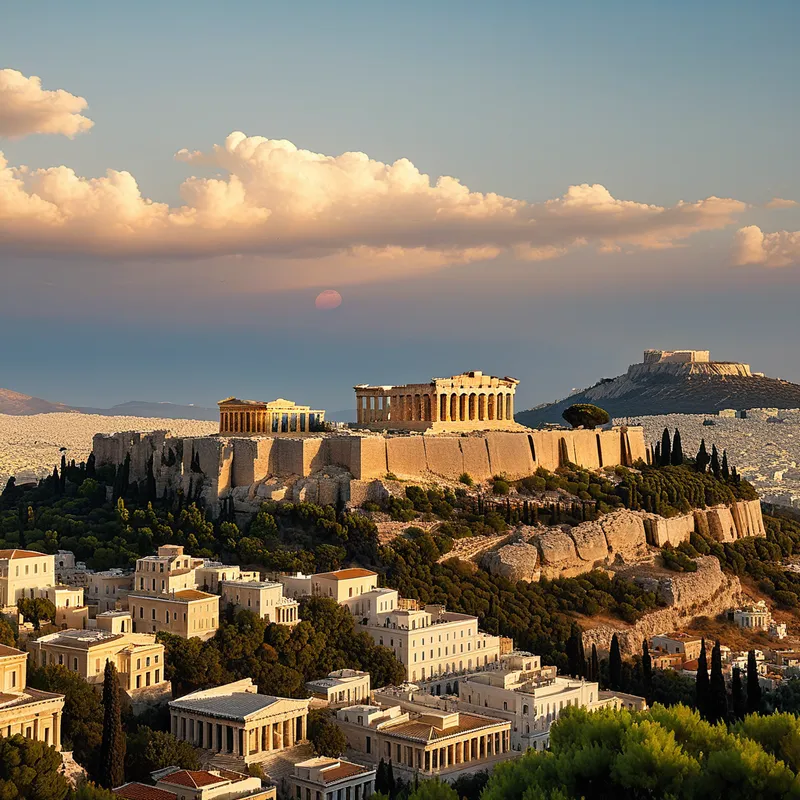
The Acropolis Myth Meaning & Symbolism
A sacred contest between Athena and Poseidon for the soul of a city, establishing divine order, wisdom, and the foundation of civilization.
The Tale of The Acropolis
Hear now the tale of the rock, the sacred high place. It was a time when the world was still being dreamed by the gods, when the air over Attica was clear and new. Upon a great, flat-topped rock that watched over the plains and the sea, the first people gathered. They were strong, but they were nameless. Their city had no soul, no patron, no name to echo in the halls of Olympus.
The rock itself was a promise, a bare stage awaiting its drama. It called out, not with a voice, but with a potent silence—a vacancy that demanded to be filled by a story worthy of eternity. The news of this primeval vacancy reached the ears of the great gods. Two mighty powers heard the call most clearly: Poseidon</ab title>, the Earth-Shaker, Lord of the Deep, and Athena, the grey-eyed daughter sprung from the mind of Zeus.
A contest was declared. The people, the first king Cecrops, and the watching gods would bear witness. The victor would give the city its name, its essence, its divine breath.
Poseidon moved first. With a roar that shook the very foundations of the world, he raised his three-pronged spear, the trident, high. The air crackled with the scent of ozone and salt. He brought it down upon the bare stone of the Acropolis with a sound like thunder breaking rock. The earth split. But from the fissure, there did not spring a life-giving river. Instead, a saltwater spring, or in some tellings, a magnificent, snorting war-horse, surged forth. The horse was power incarnate—speed, conquest, the untamed force of nature. The spring was the sea itself, claiming the land, a symbol of naval dominion and terrifying might. The people gasped, some in awe, some in a creeping fear at this raw, untamed power offered to them.
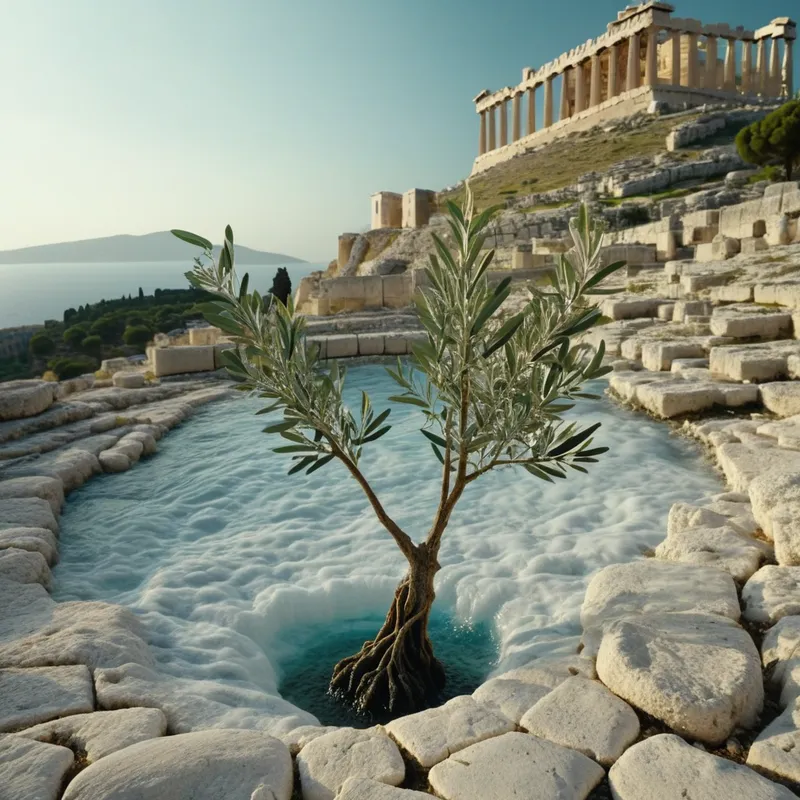
Then came Athena. Her approach was silent, a presence more felt than heard. She knelt on the sun-warmed stone, her touch not violent, but deliberate. Where her fingers met the earth, she planted a seed. All watched, the silence profound. From that small, buried promise, a shoot emerged, then a sapling, then a full-grown olive tree—its leaves a shimmering silver-green, its gnarled trunk speaking of ancient resilience. It offered food, oil for light and anointing, wood for warmth, and the promise of peaceable, sustained life. It was not the gift of a moment’s conquest, but of a civilization’s enduring foundation.
The vote was cast. King Cecrops and his people saw in the olive tree the greater boon. It was the gift of the mind, of strategy over brute force, of cultivation over domination. The city was named Athens. Athena’s owl would henceforth watch from the high rock. And though Poseidon’s fury was great—some say he sent a flood in his wrath—a pact was made. The Athenians would forever honor him too, for no city of wisdom can ignore the depths of the unconscious or the tempests of the soul. The Acropolis was no longer just a rock. It was a testament, a sacred contract between the human, the divine, and the very nature of order itself.
Cultural Origins & Context
The myth of the contest is not a single, codified text but a foundational narrative woven into the fabric of Athenian identity. It was a cult myth, performed and recounted in the very space it described. The tale was central to the Panathenaia, the great festival for Athena, where a sacred robe (peplos) was carried up to her temple on the Acropolis. This ritual re-enactment of the myth served a critical societal function: it justified Athenian supremacy, explained the presence of both Athena’s olive and Poseidon’s salt spring on the rock (features pointed out to visitors), and articulated a core civic ideology. It proclaimed that Athens was founded not on mere force, but on the principles of wisdom (metis), justice (dike), and the arts of peace—even as it acknowledged the ever-present threat of chaotic, elemental power that must be respected and integrated.
Symbolic Architecture
The Acropolis myth is a profound blueprint for the psyche’s foundational act: the establishment of a ruling consciousness.
The sacred high place is not where we escape the world, but where we choose which principles will order it.
The Rock itself is the bedrock of the Self, the immutable, elevated center of identity and awareness upon which the personality is built. The Contest represents the critical, psychic conflict between two fundamental archetypal energies vying to govern this nascent self. Poseidon embodies the chthonic, emotional, and instinctual forces—the deep, salty waters of the unconscious, raw ambition, and untamed passion. His gift is potent but ambiguous: the war-horse (impulsive action) or the salt spring (sterile emotion).
Athena represents the logos principle: structured thought, strategic wisdom, and conscious cultivation. Her olive tree is a symbol of immense depth. It is rooted in the earth (connected to the unconscious) but produces for the world of light (consciousness). It requires patience, care, and craft to yield its benefits—oil for light (illumination), healing (wholeness), and sustenance (endurance).
The people’s Choice is the ego’s fateful decision in aligning the Self’s center with a governing principle. Choosing Athena does not destroy Poseidon; his spring remains. This signifies that a wise consciousness does not repress the deep, instinctual forces but acknowledges their permanent presence and power, finding a way to honor them within a larger, ordered structure.
The Dreamer’s Resonance
To dream of an Acropolis is to dream of the Self’s citadel. One may dream of climbing a steep, rocky path toward a luminous structure above, speaking to a conscious striving for integration and perspective. Conversely, dreaming of a ruined or besieged Acropolis often mirrors a psyche under threat—where foundational beliefs, values, or one’s sense of order are crumbling or under attack from unconscious contents (represented perhaps by rising floodwaters or seismic tremors).
A dream featuring a direct contest between a figure of stormy, emotional power and one of calm, strategic intelligence reflects an active, internal conflict of values. Which principle will you build upon? The somatic experience can be one of tension in the chest (the conflict) followed by either grounding (the olive tree’s roots) or destabilization (the earth shaking). Such dreams ask the dreamer: What is the contest for the center of your being right now? Is it between rage and reason, passion and prudence, chaos and order?
Alchemical Translation
The myth models the alchemical process of coagulatio—the making solid, the formation of the sacred stone, or the Philosopher’s Stone of the integrated Self. The prima materia is the undifferentiated rock, the chaotic potential of the psyche.
Individuation begins with a contest at the center, where the unconscious demands recognition and consciousness must choose its sovereign.
The first stage is the nigredo, the confrontation with the dark, salty waters of Poseidon—the flooding of the conscious mind by unruly emotions, complexes, and primal instincts. This is necessary; the foundation must be tested. The strike of the trident is this brutal confrontation.
Athena’s intervention is the albedo, the whitening, the emergence of illuminating consciousness. Planting the seed is an act of intentionality, of applying mindful awareness (metis) to the fertile but chaotic ground of the psyche. The growing olive tree represents the citrinitas, the yellowing or solar phase, where this conscious principle takes root, grows, and begins to bear fruit—the development of enduring values, wise judgment, and a sustainable way of being.
The final, enduring state of the Acropolis—temple upon firm rock, with both symbols present—is the rubedo, the reddening, the achievement of a lasting, sacred order. The Self (the rock) is now governed by a conscious, wise principle (Athena), but it has fully integrated and made sacred pact with the powerful, unconscious forces (Poseidon). The individual no longer fears the depths but has built a resilient, illuminated citadel from which to engage both the inner and outer worlds. The city has its name. The Self is founded.
Associated Symbols
Explore related symbols from the CaleaDream lexicon: