The 47 Ronin Myth Meaning & Symbolism
A lord is wronged, his loyal samurai become masterless ronin, and they enact a legendary, sacrificial act of vengeance to restore cosmic order.
The Tale of The 47 Ronin
Listen, and hear a tale written not on paper, but in snow and blood, in the long silence between a breath and a blade’s fall.
In the Genroku era, when the Shogun held the land in an iron grasp, there lived a lord, Asano Naganori. A man of principle, he was tasked with hosting envoys of the Emperor. To guide him in the intricate, [spider](/myths/spider “Myth from Native American culture.”/)-silk web of court ritual, the Shogun appointed a master of ceremonies, Kira Yoshinaka. But Kira was a man whose soul had been hollowed out and filled with avarice. He expected lavish gifts for his guidance; Asano, believing in the purity of duty, offered only respect. This insult, a crack in the veneer of courtly decorum, festered into a venomous grudge.
Day after day, Kira tormented Asano. He withheld crucial instructions, mocked him publicly, and twisted the sacred protocols into snares. The poison dripped, until one fateful day within the Pine Corridor of Edo Castle, the cup of Asano’s endurance overflowed. Honor, that invisible armor, could bear no more. In a flash of righteous fury, Asano drew his short sword and struck at Kira. The blade only grazed the master of ceremonies’ forehead—a wound more symbolic than mortal. But to draw a blade within the Shogun’s castle was to tear the very fabric of order itself.
The judgment was swift and severe. Asano was ordered to commit seppuku. His lands were confiscated, his family line severed, and his [samurai](/myths/samurai “Myth from Japanese culture.”/) were cast adrift, transformed instantly into ronin—men without a master, without purpose, their souls as barren as a winter field.
Among them was Oishi Kuranosuke. As the castle gates sealed and [the world](/myths/the-world “Myth from Tarot culture.”/) saw only broken men, a fire was kindled in the deep silence of their hearts. A vow, unspoken yet absolute, passed between them: katakiuchi. Kira must die. But the Shogun’s watchful eyes were everywhere. To act immediately was to fail. So began the great performance of dissolution.
Oishi, the steadfast leader, became a public spectacle of disgrace. He abandoned his wife, plunged into drunken debauchery in Kyoto’s pleasure quarters, a laughingstock. His men scattered, becoming merchants, monks, beggars—ghosts in the mundane world. For nearly two years, they endured the agony of dishonor, all while secretly gathering intelligence, smuggling arms, and waiting. They waited for the moment when Kira’s guard, lulled by their apparent ruin, would drop.
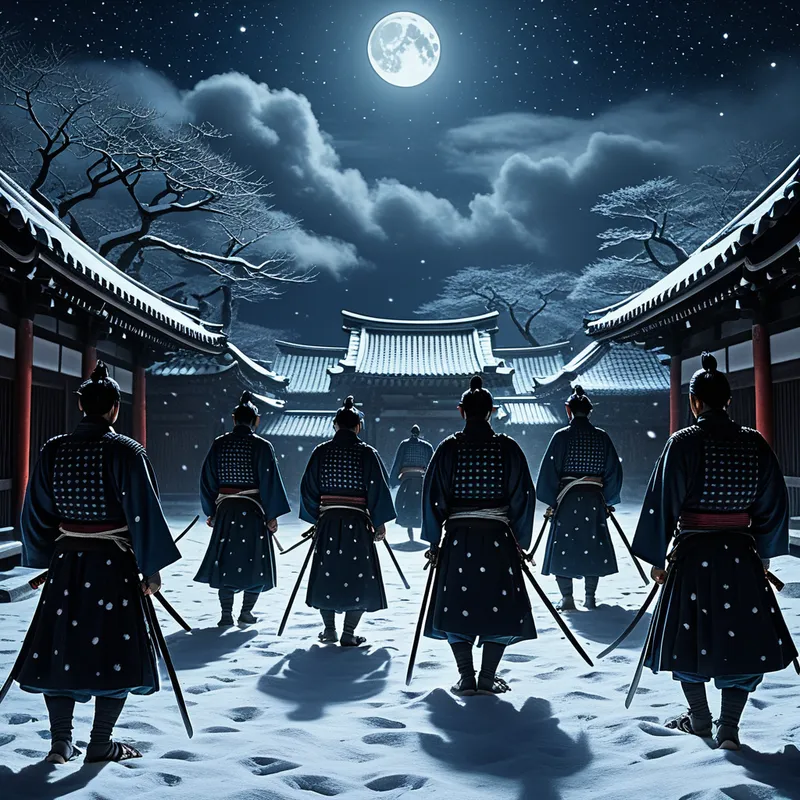
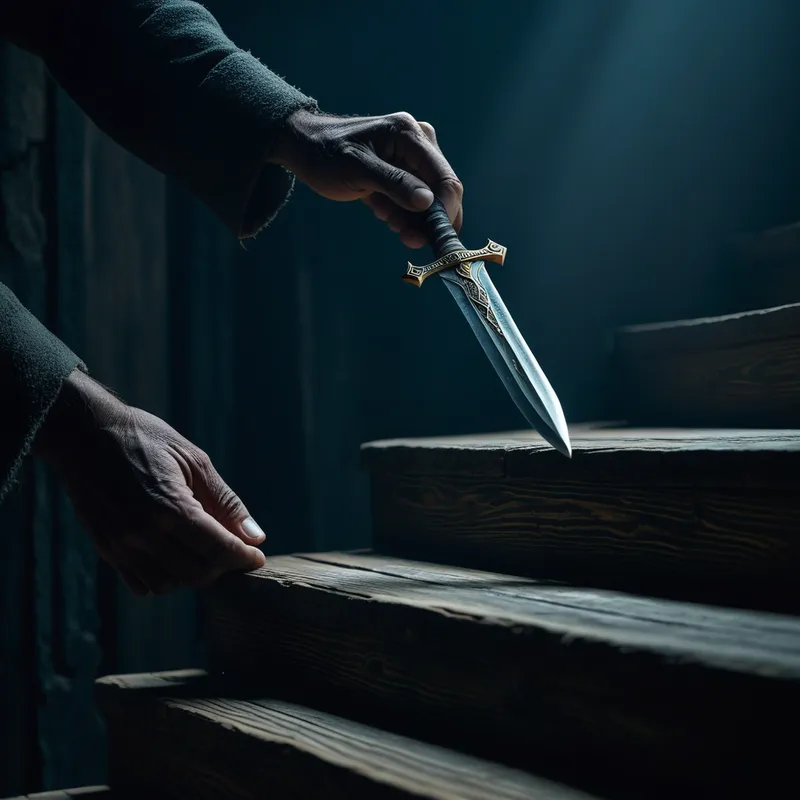
That moment came on a bitter winter’s night, the fourteenth day of the twelfth month. As a soft snow began to blanket Edo, muffling all sound, forty-seven shadows converged. They divided into two bands and stormed Kira’s heavily fortified mansion. It was not a battle, but a surgical strike of vengeance. They fought with the silent fury of men reclaiming their souls. They found Kira cowering in an outhouse store-room. With the same dagger Asano used to end his own life, they offered Kira the honor of seppuku. He could only tremble in cowardice. And so, with a single, clean stroke, Oishi severed his head.
Their mission complete, the forty-seven ronin, bearing Kira’s head, processed in solemn silence through the sleeping city to [the temple](/myths/the-temple “Myth from Jewish culture.”/) of Sengakuji. There, they washed the head in a well and laid it before their lord’s grave. The offering was complete. The order, shattered by Asano’s strike, had been restored by their unwavering will.
Then, they waited. They had obeyed the higher law of bushido, but had broken the Shogun’s law of peace. After weeks of deliberation that gripped the nation, the judgment came. For their loyalty, they were granted the honor of dying not as criminals, but as samurai. One by one, by their own hand, they performed seppuku. Their graves lie at Sengakuji still, and the well where they washed the head is called the Chushingura—the Treasury of Loyal Retainers.
Cultural Origins & Context
The story of the Forty-Seven Ronin is not merely a legend but a historical incident that occurred between 1701 and 1703. Its transition from history to national myth was immediate and powerful, fueled by the contemporary kabuki and bunraku plays that dramatized the events, often with altered names to bypass censorship, under titles like Chushingura.
The tale served a critical societal function in the Edo period. During this time of enforced peace under the Tokugawa Shogunate, the warrior class, the samurai, found their martial purpose constrained. The myth of the 47 Ronin provided a potent narrative container for the core tensions of the era: the conflict between absolute feudal loyalty (giri) and human feeling (ninjo), and between the uncompromising demands of the warrior code and the rigid laws of the state. It asked the question: What is true honor when the systems of power are corrupt or unjust? It became a moral compass, a story told to reinforce the values of duty, perseverance, and ultimate sacrifice for a transcendent principle.
Symbolic Architecture
At its [heart](/symbols/heart “Symbol: The heart symbolizes love, emotion, and the core of one’s existence, representing deep connections with others and self.”/), this is a myth of the Restoration of the Moral [Cosmos](/symbols/cosmos “Symbol: The entire universe as an ordered, harmonious system, often representing the totality of existence, spiritual connection, and the unknown.”/). The [lord](/symbols/lord “Symbol: The symbol of ‘Lord’ represents authority, mastery, and control, along with associated power dynamics in relationships.”/), Asano, represents a principled but naive [consciousness](/symbols/consciousness “Symbol: Consciousness represents the state of awareness and perception, encompassing thoughts, feelings, and experiences.”/), shattered by its encounter with a shadowy, corrupt [authority](/symbols/authority “Symbol: A symbol representing power structures, rules, and control, often reflecting one’s relationship with societal or personal governance.”/) (Kira). His [death](/symbols/death “Symbol: Symbolizes transformation, endings, and new beginnings; often associated with fear of the unknown.”/) is the catastrophic [fragmentation](/symbols/fragmentation “Symbol: The experience of breaking apart, losing cohesion, or being separated into pieces. Often represents disintegration of self, relationships, or reality.”/) of a world order.
The true ordeal is not the lord’s death, but the long, conscious descent into the appearance of worthlessness that must precede the restoration of meaning.
The forty-seven ronin symbolize the fragmented [psyche](/myths/psyche “Myth from Greek culture.”/) after a traumatic [betrayal](/symbols/betrayal “Symbol: A profound violation of trust in artistic or musical contexts, often representing broken creative partnerships or artistic integrity compromised.”/) of its core values. Their masterless state is the psychological [condition](/symbols/condition “Symbol: Condition reflects the state of being, often focusing on physical, emotional, or situational aspects of life.”/) of anomie—a [loss](/symbols/loss “Symbol: Loss often symbolizes change, grief, and transformation in dreams, representing the emotional or psychological detachment from something or someone significant.”/) of [purpose](/symbols/purpose “Symbol: Purpose signifies direction, meaning, and intention in life, often reflecting personal ambitions and core values.”/) and [connection](/symbols/connection “Symbol: Connection symbolizes relationships, communication, and bonds among individuals.”/). Oishi’s deliberate embrace of disgrace is the ultimate symbolic act: the conscious wearing of the [shadow](/symbols/shadow “Symbol: The ‘shadow’ embodies the unconscious, repressed aspects of the self and often represents fears or hidden emotions.”/) as a disguise. To achieve their goal, they had to become the very [thing](/myths/thing “Myth from Norse culture.”/) they despised (drunken, dishonorable fools) in the eyes of the world. This represents the painful but necessary [integration](/symbols/integration “Symbol: The process of unifying disparate parts of the self or experience into a cohesive whole, often representing psychological wholeness or resolution of internal conflict.”/) of contraries—[strength](/symbols/strength “Symbol: ‘Strength’ symbolizes resilience, courage, and the ability to overcome challenges.”/) through apparent weakness, [clarity](/symbols/clarity “Symbol: A state of mental transparency and sharp focus, often representing resolution of confusion or attainment of insight.”/) through strategic [obscurity](/symbols/obscurity “Symbol: A state of being unclear, hidden, or difficult to perceive, often representing the unknown, unconscious, or unresolved aspects of life.”/).
Their vengeance is not mere violence, but a meticulous, ritualized act. It is [psychology](/symbols/psychology “Symbol: Psychology in dreams often represents the exploration of the self, the subconscious mind, and emotional conflicts.”/) as sacred geometry. Every step—the waiting, the planning, the final offering of the head at the grave—transforms a raw, personal vendetta into a collective [ceremony](/symbols/ceremony “Symbol: Ceremonies in dreams often symbolize transitions, rituals of passage, or significant life events.”/) that mends a tear in the symbolic order. Their subsequent seppuku is the final, logical seal on this act. Having restored the [cosmic balance](/symbols/cosmic-balance “Symbol: The ‘Cosmic Balance’ signifies the equilibrium of forces in the universe, highlighting the interplay of opposites such as light and dark, creation and destruction.”/), they voluntarily sacrifice their individual lives, transmuting their [story](/symbols/story “Symbol: The symbol of ‘Story’ represents the narrative woven through our lives, embodying experiences, lessons, and emotions that shape our identities.”/) from one of revenge into one of eternal loyalty.
The Dreamer’s Resonance
When this myth stirs in the modern dreamer, it often manifests not as samurai, but as a profound somatic and psychological process. You may dream of being part of a silent, determined group working toward a goal that others misunderstand. You may dream of waiting interminably, of holding a secret truth while the world believes you have given up. You may dream of a sacred object—a family heirloom, a piece of art, a personal principle—that has been desecrated, and a deep, non-negotiable knowing that it must be restored, regardless of the cost.
The somatic feeling is one of coiled tension held over a long duration—a tightness in the jaw, a readiness in the shoulders, a cold clarity in the gut. Psychologically, this dream pattern signals a confrontation with a deep injustice, either external (a betrayal, an unethical work situation) or internal (the betrayal of one’s own values through compromise or inaction). The dream is the psyche’s council of retainers, gathering its resources for a necessary, integrity-restoring action. The long “waiting period” in the dream reflects the incubation time the psyche needs to plan, to gather strength, and to ensure that the restorative action, when it comes, is precise and complete, not a mere outburst of anger.
Alchemical Translation
For the modern individual navigating the path of individuation, the 47 Ronin model a supreme alchemical operation: the transmutation of humiliation into honor, fragmentation into purposeful unity, and personal loss into a legacy of meaning.
The process begins with the Mortificatio—the humiliating death of the old identity (Asano’s death, the ronin’s disgrace). This is the necessary dissolution, the feeling that one’s world has ended. [The ego](/myths/the-ego “Myth from Jungian culture.”/)‘s naive certainties are shattered.
The alchemical vessel is not the flask, but the sustained tension of holding a sacred vow in a profane world.
Then comes the [Nigredo](/myths/nigredo “Myth from Alchemical culture.”/), the long, dark work. This is Oishi’s drunken performance and the men’s scattered hiding. Psychologically, it is the conscious endurance of depression, confusion, and shadow-work. It is allowing oneself to be seen as a failure while secretly tending the inner flame of purpose. This stage requires the brutal discipline of subordinating immediate emotional reactions (the desire for quick revenge) to a higher, long-term goal (meaningful restoration).
The raid is the Albedo—the purifying, lunar operation. It is the moment of clear, cold, moonlit action, where all planning culminates in a decisive, focused strike that cuts away the corrupting influence (Kira). In the soul, this is the act of setting a powerful, non-negotiable boundary, of finally speaking the truth after long silence, of cutting off a toxic pattern.
The offering at the grave and the final seppuku represent the [Rubedo](/myths/rubedo “Myth from Alchemical culture.”/), the reddening, the achievement of the goal. Here, the act is completed and consecrated. The psychological parallel is the full integration of the experience. The modern individual must “lay the head at the grave”—to consciously acknowledge and honor what was lost. The final “seppuku” is the voluntary death of the self that was defined solely by the grievance. One achieves the goal—restored integrity—and then must let go of the identity of “the wounded one” or “the avenger” to be reborn into a new wholeness. The legacy is not the revenge, but the legendary loyalty to one’s own deepest truth.
Associated Symbols
Explore related symbols from the CaleaDream lexicon: