Tetsubin Myth Meaning & Symbolism
A myth of elemental spirits and a master smith forging an iron kettle, a vessel that holds not just water, but the soul of the world.
The Tale of Tetsubin
Listen, and hear the song of the mountain, the whisper of the ore, and the breath of the fire. This is not a story of gods on high, but of spirits in the stone and the hands that dare to listen.
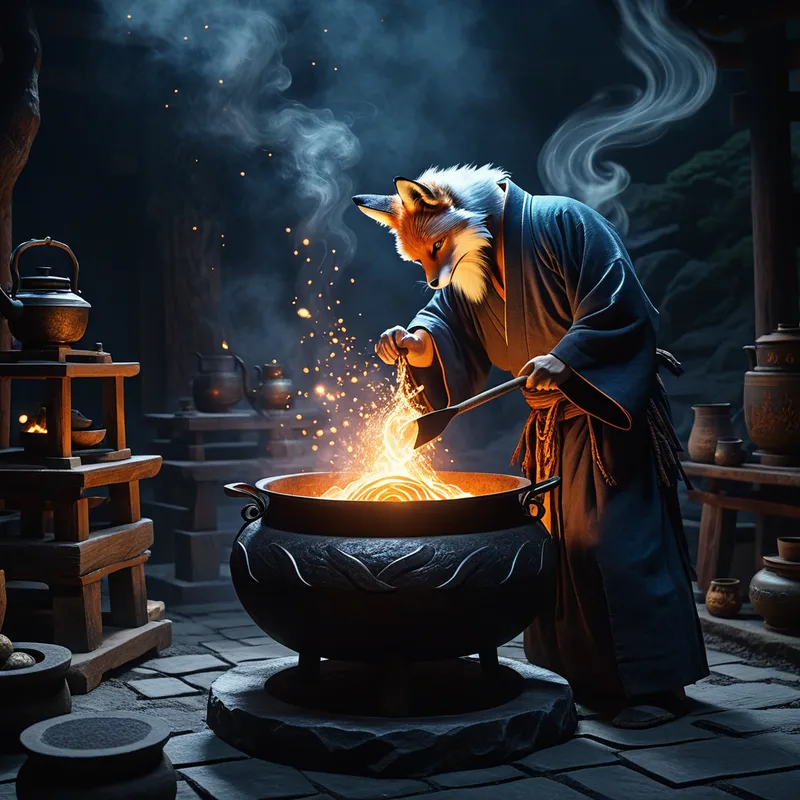
In a time when [the world](/myths/the-world “Myth from Tarot culture.”/) was closer to its own dreaming, there lived a smith named Masataka. His forge was not in a village, but high in [the mist](/myths/the-mist “Myth from Celtic culture.”/)-wrapped mountains, where the veins of iron sang to him in his sleep. He was a quiet man, for he spent his days in conversation with the elements. The mountain spirit, Yama-no-Kami, was his silent partner, offering its iron bones only to those who asked with respect and promised worthy form.
One autumn, as the leaves bled crimson, a profound stillness fell upon the forge. The fire in his hearth guttered low, not from lack of wood, but from a lack of purpose. Masataka felt a deep yearning, not for a sword or a ploughshare, but for a vessel. A vessel to hold not just [water](/myths/water “Myth from Chinese culture.”/), but warmth. Not just tea, but communion.
He climbed to the sacred peak, to the raw seam of ore where the mountain’s heart was exposed. He placed his hands upon the cold, dark stone and made his plea not with words, but with the image in his soul: a rounded belly to cradle heat, a strong arch to bear weight, a spout to sing as it pours. The mountain was silent. Then, a single piece of ore, darker than the rest, loosened and fell into his palm. It was warm.
The forging was a ritual of immense tension. The fire spirit, Ho-musubi, had to be coaxed to a heat that could melt stone yet not devour the iron’s soul. Masataka worked for three days and three nights. As he hammered, he wasn’t shaping metal; he was mediating a argument between elements. The iron wished to remain a wild, hard [thing](/myths/thing “Myth from Norse culture.”/) of [the earth](/myths/the-earth “Myth from Hindu culture.”/). The fire wished to consume it utterly. The water, waiting in a nearby bucket, whispered of a future of soft steam and gentle erosion.
In [the crucible](/myths/the-crucible “Myth from Alchemical culture.”/) of this conflict, the form of the Tetsubin emerged. But it was lifeless. A hollow shell. In despair, Masataka knew the final spirit had not been invited: the air. He took the finished kettle to the cliff’s edge at dawn. As the first wind of day, the Kaze-no-Kami, swept up the valley, he lifted the kettle high. [The wind](/myths/the-wind “Myth from Various culture.”/) rushed into the spout, through the empty belly, and out the lid’s vent, creating a low, haunting hum—the kettle’s first breath.
He filled it with water from a sacred spring and placed it on the fire. The water did not merely boil. It transformed. The steam that rose was not formless; it carried the faint scent of pine from the mountain, the memory of the forge’s fire, and the cool clarity of the spring. When he poured the first cup, the sound from the spout was a clear, resonant note, the sound of the mountain itself giving drink. The Tetsubin was no longer a made thing. It was a pact, given form.
Cultural Origins & Context
The myth of the Tetsubin is a folk narrative, born from the intersection of Shinto animism and the profound material culture of Japanese craftsmanship. It is not a myth recorded in the Kojiki, but one that lived in the smoke of village forges and was told by masters to their apprentices. Its origin is the takumi—the artisan possessed of spiritual skill.
This story functioned as a foundational ethic for all monozukuri (the art of making things). It taught that true creation is not an act of domination over material, but a sacred dialogue with it. The smith is a priest, the forge a temporary shrine, and the object a vessel for the kami that inhabit all matter. The Tetsubin, as a central object in the chanoyu, became the perfect symbol for this philosophy. It was the humble, essential heart of the ceremony, transforming plain water into the medium of hospitality, mindfulness, and connection. The myth ensured that every time water was boiled, it was not merely a physical process, but a recitation of this ancient pact between human, mineral, fire, water, and air.
Symbolic Architecture
At its core, the myth is a [blueprint](/symbols/blueprint “Symbol: A blueprint represents the foundational plan or design for something, often symbolizing potential, structure, and the mapping of one’s inner self or future.”/) for conscious creation and the [integration](/symbols/integration “Symbol: The process of unifying disparate parts of the self or experience into a cohesive whole, often representing psychological wholeness or resolution of internal conflict.”/) of opposites. The Tetsubin itself is the [mandala](/symbols/mandala “Symbol: A sacred geometric circle representing wholeness, the cosmos, and the journey toward spiritual integration.”/), [the sacred circle](/myths/the-sacred-circle “Myth from Various culture.”/) that contains and harmonizes warring forces.
The vessel is not what holds the contents; it is the shape of the relationship between them.
The Iron represents the raw, unconscious Self—dense, stubborn, and of the [earth](/symbols/earth “Symbol: The symbol of Earth often represents grounding, stability, and the physical realm, embodying a connection to nature and the innate support it provides.”/). It is our unrefined potential, our instincts, and our [shadow](/symbols/shadow “Symbol: The ‘shadow’ embodies the unconscious, repressed aspects of the self and often represents fears or hidden emotions.”/). The Fire is the transformative force of [consciousness](/symbols/consciousness “Symbol: Consciousness represents the state of awareness and perception, encompassing thoughts, feelings, and experiences.”/), will, and often, suffering. It is the painful but necessary heat of introspection that forces change. The [Water](/symbols/water “Symbol: Water symbolizes the subconscious mind, emotions, and the flow of life, representing both cleansing and creation.”/) is the fluid [realm](/symbols/realm “Symbol: The symbol of ‘Realm’ often signifies the boundaries of one’s consciousness, experiences, or emotional states, suggesting aspects of reality that are either explored or ignored.”/) of [emotion](/symbols/emotion “Symbol: Emotion symbolizes our inner feelings and responses to experiences, often guiding our actions and choices.”/), [intuition](/symbols/intuition “Symbol: The immediate, non-rational understanding of truth or insight, often described as a ‘gut feeling’ or inner knowing that bypasses conscious reasoning.”/), and the [collective unconscious](/symbols/collective-unconscious “Symbol: The Collective Unconscious refers to the part of the unconscious mind shared among beings of the same species, embodying universal experiences and archetypes.”/). It is what we seek to warm and bring to [expression](/symbols/expression “Symbol: Expression represents the act of conveying thoughts, emotions, and individuality, emphasizing personal communication and creativity.”/). The Air is the [spirit](/symbols/spirit “Symbol: Spirit symbolizes the essence of life, vitality, and the spiritual journey of the individual.”/), the intellect, and the [breath](/symbols/breath “Symbol: Breath symbolizes life, vitality, and the connection between the physical and spiritual realms.”/) of [life](/symbols/life “Symbol: The symbol of ‘Life’ represents a journey of growth, interconnectedness, and existential meaning, encompassing both the joys and challenges that define human experience.”/) that must animate the final form.
Masataka, the [Creator](/symbols/creator “Symbol: A figure representing ultimate origin, divine power, or profound authorship. Often embodies the source of existence, innovation, or personal destiny.”/) [archetype](/symbols/archetype “Symbol: A universal, primordial pattern or prototype in the collective unconscious that shapes human experience, behavior, and creative expression.”/), does not impose a form. He becomes the [vessel](/symbols/vessel “Symbol: A container or structure that holds, transports, or protects something essential, representing the self, emotions, or life journey.”/) for the process itself. His “sacrifice” is his ego; he subordinates his will to the needs of the materials and the spirits. The conflict in the forge is the internal conflict of individuation—the painful but necessary process of the conscious mind (fire) engaging the stubborn patterns of the [psyche](/myths/psyche “Myth from Greek culture.”/) (iron) to give safe form to the [depths](/symbols/depths “Symbol: Represents the subconscious, hidden emotions, or foundational aspects of the self, often linked to primal fears or profound truths.”/) of feeling (water).
The Dreamer’s Resonance
To dream of a Tetsubin is to dream of one’s own capacity for containment and transformation. A dream of forging a Tetsubin suggests the dreamer is in a potent, often stressful, phase of self-creation. They are in the “fire,” hammering their raw experiences (iron) into a new identity. Somatic sensations might include heat, pressure, or the ache of sustained effort.
A dream of a boiling Tetsubin, especially if it is rattling or screaming, points to repressed emotions (water) coming to a head, heated by a current situation (fire). The psyche is signaling that a release—a “pouring out”—is necessary to avoid a rupture.
Dreaming of a cracked or empty Tetsubin speaks to a felt sense of spiritual or emotional depletion. [The vessel](/myths/the-vessel “Myth from Alchemical culture.”/) of [the Self](/myths/the-self “Myth from Jungian culture.”/) feels unable to hold or transform life’s experiences. Conversely, finding a perfect, warm Tetsubin in a dream and drinking from it indicates a moment of profound self-nourishment and integration, where one is able to receive the wisdom of their own processed experiences.
Alchemical Translation
The myth of the Tetsubin is a manual for psychic alchemy. The modern individual is both Masataka and the forge. Our life experiences are the raw ore. Our conscious attention and will are the fire. Our emotions and relationships are the water. Our search for meaning is the wind seeking a vessel to animate.
The first step is the descent to the mountain heart—withdrawing from the noise of the world to connect with one’s own raw, foundational nature. What is the unshaped “ore” of your being? The next is the kindling of [the sacred fire](/myths/the-sacred-fire “Myth from Native American culture.”/), which requires fuel (honest self-reflection) and a container (a practice like journaling or therapy) to prevent it from becoming a destructive blaze.
The goal of alchemy was not to destroy the base metal, but to discover the gold already hidden within it. The Tetsubin does not hide its iron; it celebrates its transformation.
The hammering is the daily work of integrating insights, breaking old patterns, and practicing new behaviors. It is repetitive, arduous, and essential. The final, crucial step is often forgotten: inviting the air. This is the act of giving one’s newly forged “vessel”—a new perspective, a creative work, a healed relationship—a place in the world. Letting the wind of spirit and connection flow through it, giving it its voice and purpose.
In the end, we are not meant to become untouchable, perfect gods. We are meant to become like the Tetsubin: strong, resilient, marked by the fire of our experiences, holding a warm, life-giving essence within, and capable of pouring it out for ourselves and others in a clear, resonant stream. We become the pact, given form.
Associated Symbols
Explore related symbols from the CaleaDream lexicon: