
Terma Hidden Treasure Texts
Sacred Tibetan Buddhist texts hidden for centuries, revealed by enlightened masters to guide spiritual seekers through esoteric teachings and transformative practices.
The Tale of Terma Hidden Treasure Texts
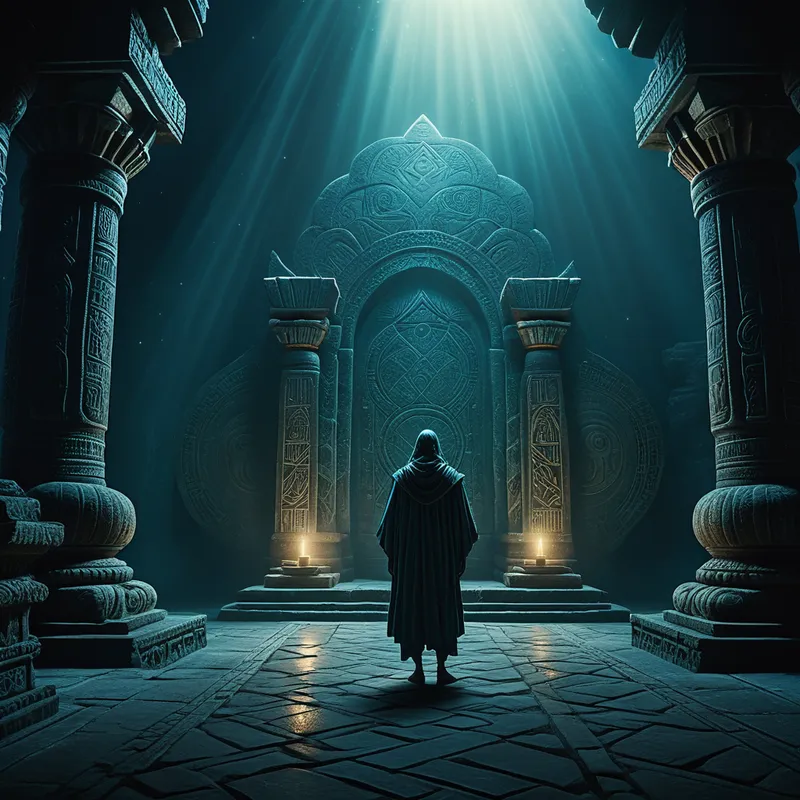
The story of Terma begins not with writing, but with concealment. In the twilight of the 8th [century](/myths/century “Myth from Biblical culture.”/), as the [Dharma](/myths/dharma “Myth from Hindu culture.”/) took root in the snow-laden valleys of Tibet, the great master [Padmasambhava](/myths/padmasambhava “Myth from Buddhist culture.”/)—[the Lotus](/myths/the-lotus “Myth from Hindu culture.”/)-Born Guru—foresaw a future age of spiritual decay, conflict, and obscured wisdom. He perceived that the most potent and essential teachings, those too profound for his immediate disciples, would be lost or misunderstood in the coming darkness. But a master does not abandon his children to the night. With his consort, the dakini [Yeshe Tsogyal](/myths/yeshe-tsogyal “Myth from Tibetan Buddhist culture.”/), and his closest realized disciples, he performed a sacred act of temporal alchemy. They did not hide gold or jewels. They hid light itself.
These teachings, these upadeshas, were crystallized into forms of consciousness—encoded into scrolls of yellow parchment written in dakini script, into symbolic diagrams (yantras), into sacred substances, and even into the very fabric of the elements: within lakes, inside pillars of temples, sealed within the heart of mountains, and, most subtly, within the pure nature of mind itself. Padmasambhava then entrusted these treasures to a retinue of enlightened protectors, the dharmapalas and [dakinis](/myths/dakinis “Myth from Tibetan culture.”/), charging them to guard the treasures until the destined moment.
Centuries passed. The prophecies of darkness unfolded. Then, in a time of need, a child would be born under specific signs. This child, a tertön or treasure-revealer, would carry the karmic imprint of a former disciple of Padmasambhava. Their life would be marked by visionary dreams, spontaneous recollections, and profound encounters with the protectors of the Terma. The landscape itself would call to them. A cliff face would shimmer with unseen script; a lake would whisper from its depths; a dream would unfold with cryptic clarity.
The revelation, or terma, is never a simple discovery. It is a fierce and sacred ordeal. The tertön, often guided by a dakini in human form, must journey to the precise physical or psychic location. They must overcome both outer obstacles—treacherous terrain, skeptical onlookers—and inner obscurations of doubt and pride. At the moment of extraction, the boundary between worlds dissolves. The tertön might reach into solid rock and withdraw a casket that melts into light in their hands, its contents now imprinted directly upon their awareness. The physical object, if there is one, often serves merely as a support, a key to unlock the treasure already latent within their mindstream. The revealed teaching—a cycle of meditation, a wrathful practice for turbulent times, a guide to the nature of reality—then flows forth, perfectly tailored for the era of its unveiling, a fresh spring from an ancient, eternal source.
Cultural Origins & Context
The Terma tradition emerged within the Nyingma school of Tibetan Buddhism, the “Ancient Ones,” who trace their lineage directly to Padmasambhava. It represents a brilliant theological and psychological response to historical crisis. Following the persecution of Buddhism under King Langdarma in the 9th century, the continuity of oral and textual lineages was severely fractured. The Terma system provided a mechanism for spiritual renewal that bypassed corrupted or broken human lineages, sourcing authority directly from the primordial enlightened intent of Padmasambhava.
This is not a tradition of antiquarianism, but of urgent relevance. Each major tertön—figures like Nyangral Nyima Özer, Guru Chowang, Jigme Lingpa, and in the 19th century, the monumental Jamgön Kongtrül Lodrö Thaye—arose during periods of social fragmentation or spiritual stagnation. Their revealed treasures provided not only new ritual texts but also fresh symbolic frameworks to re-contextualize the Dharma for their contemporaries. The tradition acknowledges that wisdom must be continually rediscovered and re-embodied; it cannot survive as a static relic. The Terma is thus a living dialogue between the timeless (the concealed teaching) and the timely (the moment of its revelation).
Symbolic Architecture
At its core, the Terma tradition deconstructs the naive [dichotomy](/symbols/dichotomy “Symbol: A division into two contrasting parts, often representing opposing forces, choices, or perspectives within artistic or musical expression.”/) between the “outer” and the “inner,” the historical and the eternal. It presents a [universe](/symbols/universe “Symbol: The universe symbolizes vastness, interconnectedness, and the mysteries of existence beyond the individual self.”/) that is psychically permeable, where mind and matter are in constant, meaningful interplay.
The mountain is not just a hiding place for a scroll; it is the scroll. The tertön’s mind is not just a reader of the text; it is the parchment upon which the dakini script is written. The revelation occurs in the sacred space where these two truths converge.
The process mirrors the fundamental Buddhist view of the ālaya-vijñāna, the storehouse [consciousness](/symbols/consciousness “Symbol: Consciousness represents the state of awareness and perception, encompassing thoughts, feelings, and experiences.”/), where all karmic seeds are deposited. The Terma is a seed of awakening planted in the collective storehouse—both of the land and the [lineage](/symbols/lineage “Symbol: Represents ancestral heritage, family connections, and the transmission of traits, values, and responsibilities across generations.”/)—by a [Buddha](/symbols/buddha “Symbol: The image of Buddha embodies spiritual enlightenment, peace, and a quest for inner truth.”/), to ripen under specific conditions. The tertön is the one in whom the conditions of [soil](/symbols/soil “Symbol: Soil symbolizes fertility, nourishment, and the foundation of life, serving as a metaphor for growth and stability.”/), moisture, and warmth align to allow that seed to [sprout](/symbols/sprout “Symbol: A new beginning emerging from potential, representing growth, vulnerability, and the earliest stage of development.”/) into full [bloom](/symbols/bloom “Symbol: Represents growth, vitality, and the flourishing of potential, often tied to emotional awakening or physical health.”/) for the benefit of all.
Furthermore, the dakini, as the [guardian](/symbols/guardian “Symbol: A protector figure representing safety, authority, and guidance, often embodying parental, societal, or spiritual oversight.”/) and muse of the Terma, symbolizes the dynamic, intuitive, and fiercely compassionate [aspect](/symbols/aspect “Symbol: A distinct feature, quality, or perspective of something, often representing a partial view of a larger whole.”/) of wisdom. She is the active principle that dissolves rigid conceptual mind, allowing the hidden [treasure](/symbols/treasure “Symbol: A hidden or valuable object representing spiritual wealth, inner potential, or divine reward.”/) of innate [awareness](/symbols/awareness “Symbol: Conscious perception of self, surroundings, or internal states. Often signifies awakening, insight, or heightened sensitivity.”/) (rigpa) to shine forth. Without her blessing, the [treasure](/symbols/treasure “Symbol: A hidden or valuable object representing spiritual wealth, inner potential, or divine reward.”/) remains inert, a locked [chest](/symbols/chest “Symbol: The chest symbolizes the core of one’s being, encompassing emotions, identity, and the protective barriers we create around ourselves.”/) without a key.
The Dreamer’s Resonance
For the depth psychologist, the Terma is a powerful archetypal drama of the individuation process. It speaks directly to the modern seeker who feels that the deepest truths are not found in external dogma, but must be unearthed from within one’s own psychic substance.
The tertön’s journey is the journey of every individual confronting their own “hidden treasure”—the latent wholeness, or Self, concealed by the rubble of personal history, trauma, and societal conditioning. The initial dreams and visions are the stirrings of the unconscious, [the Self](/myths/the-self “Myth from Jungian culture.”/) signaling its readiness to be known. The arduous pilgrimage represents the necessary ordeal of confronting shadow elements and dismantling [the ego](/myths/the-ego “Myth from Jungian culture.”/)’s defenses. The moment of revelation is the transformative experience of psychic integration, where a fragment of one’s deeper nature becomes conscious, bringing with it a sense of profound meaning and renewed vitality.
The myth assures us that our most essential wisdom is not manufactured, but recovered. It is already present, placed there by our own deeper nature (the “inner Padmasambhava”), waiting for the right moment in our personal lifecycle to be revealed. We are all, in a sense, potential tertöns of our own buried wholeness.

Alchemical Translation
The alchemy of Terma is the transmutation of the latent into the manifest, of potential into kinetic wisdom. It is a process of [solve et coagula](/myths/solve-et-coagula “Myth from Alchemical culture.”/): first, the dissolution of ordinary perception (the solid rock, the conventional timeline), followed by the coagulation of a new, revelatory understanding.
The treasure is not found in the past; it is activated in the present. The tertön does not retrieve an antique; they midwife a birth. The text, once revealed, is not a dead letter from a golden age, but a living current that rewires the consciousness of the present age.
This alchemy operates on the collective level as well. A Terma cycle often reintroduces suppressed or marginalized aspects of the spiritual spectrum—fierce compassion, ecstatic devotion, or direct experiential paradigms—that the orthodox tradition has perhaps overly intellectualized or sanitized. It is a corrective, a rebalancing force from the depths of the [psyche](/myths/psyche “Myth from Greek culture.”/) of the lineage itself. The treasure thus heals not only the individual discoverer but the cultural body from which they emerge, reintegrating lost soul-parts back into the communal whole.
Associated Symbols
Explore related symbols from the CaleaDream lexicon:
- Treasure Chest — The sacred receptacle of concealed wisdom, representing the unconscious mind or the spiritual heart where ultimate truth lies hidden, awaiting the correct karmic key.
- Key of Knowledge — The specific circumstance, spiritual maturity, or visionary insight that unlocks the sealed treasure, dissolving the boundary between the seeker and the sought.
- Buddhist [Stupa](/myths/stupa “Myth from Buddhist culture.”/) — A architectural reliquary and world-axis, mirroring the function of a Terma as a condensed, enshrined point of enlightenment embedded within the landscape of [samsara](/myths/samsara “Myth from Buddhist culture.”/).
- Veiled Knowledge — Wisdom that is intentionally obscured, not to deprive, but to preserve its potency for a recipient capable of bearing its transformative light.
- Reveal of Hidden Chambers — The moment of apocalypse (un-veiling) in the psyche or in ritual space, where a previously sealed dimension of reality or self-understanding is suddenly made accessible.
- Mirror — The pristine, non-dual awareness (rigpa) that is both the medium upon which the Terma is encoded and the faculty that recognizes and reflects it upon revelation.
- Cave — [The womb](/myths/the-womb “Myth from Various culture.”/) of [the earth](/myths/the-earth “Myth from Hindu culture.”/) and the recesses of the mind, a place of retreat, gestation, and the secret safeguarding of luminous potential until its time of emergence.
- Dream — The primary medium of communication from the guardians of the treasure, a liminal state where temporal logic is suspended and symbolic directives from the deep psyche are transmitted.
- Dakini (as Symbolic Archetype) — The dynamic, feminine embodiment of wisdom that acts as guardian, muse, and catalyst, fiercely cutting through illusion to facilitate the revelation.
- Seed — The Terma teaching itself in its potential state, planted by an enlightened intent to ripen under the perfect conditions of a future discoverer’s mind and era.
- Mountain — The enduring, majestic container of hidden truth, representing both the formidable challenge of the spiritual path and the immutable ground of being from which treasures arise.
- Text — Not merely written words, but any form—sound, substance, or pure meaning—into which liberating insight can be encoded and transmitted across time.