Teraphim Myth Meaning & Symbolism
A myth of stolen household gods, a journey of deception, and the profound struggle to integrate the fragmented pieces of ancestral and personal power.
The Tale of Teraphim
Listen, and hear the whisper of clay and blood. In the land between the rivers, where the sun bakes the earth and the stars are nails hammered into the dome of night, there lived a man marked by the gods. His name was Jacob, a sojourner in the house of his uncle, Laban.
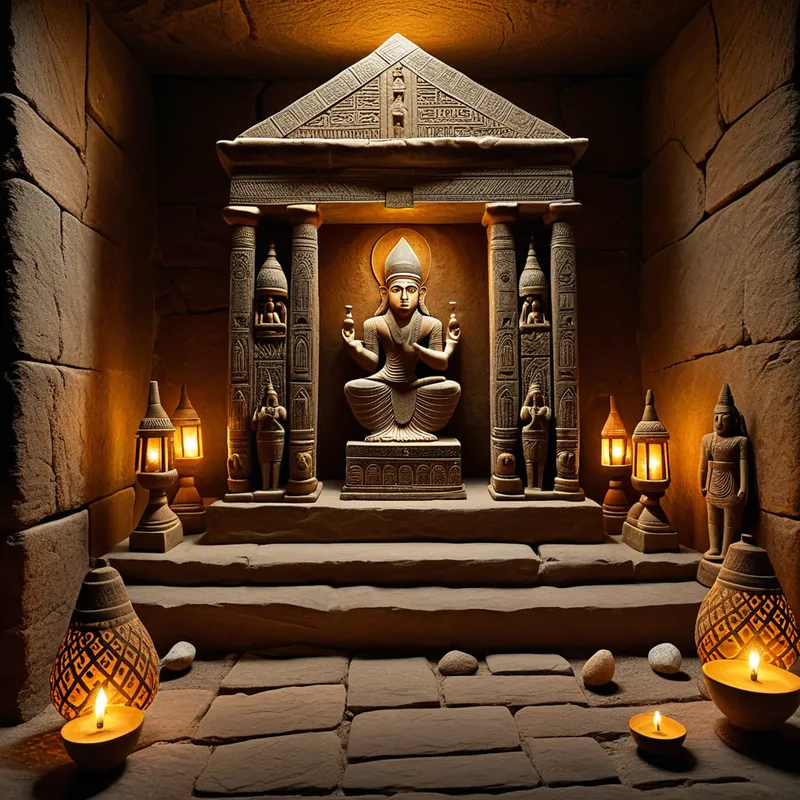
Laban’s house was rich with flocks, but richer still were the silent watchers in the corner of the tent: the Teraphim. They were not grand like the idols of the city temples. They were small, of carved wood and polished stone, worn smooth by generations of hands. They were the soul of the household, the vessels of its luck, the ears of its ancestors. To possess them was to hold the lineage’s promise and its power.
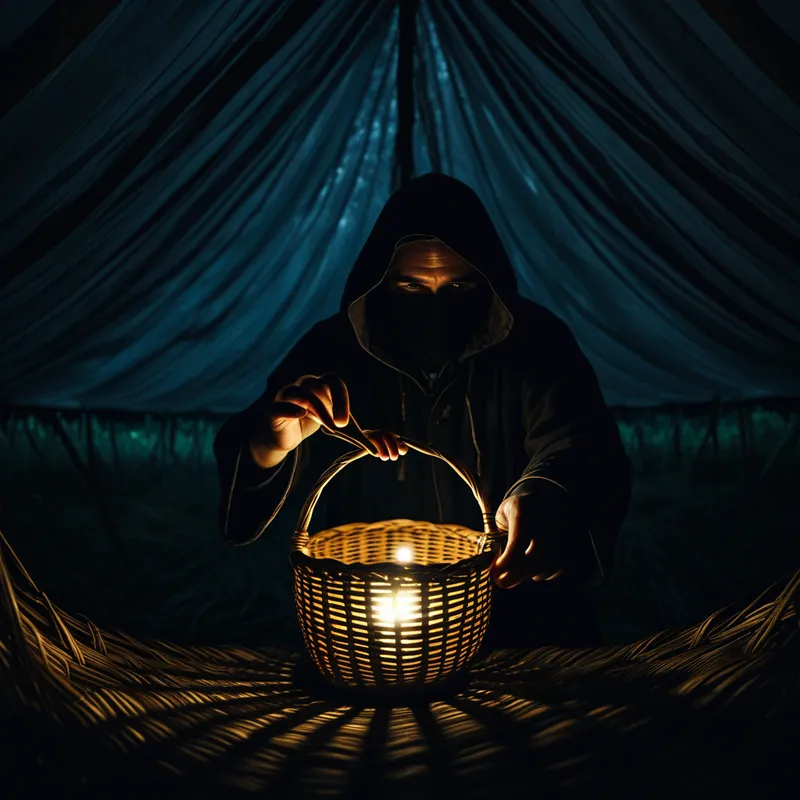
Jacob served for years, his wages shifting like desert sands. When the time came to flee with his wives, his children, and the flocks earned by cunning, his heart was a drum of fear and resolve. But Rachel, beloved and fierce, carried a deeper secret. On the eve of their flight, she entered her father’s inner tent. The air was thick with the smell of old wool and incense. There, by the faint light of a dying lamp, she saw them—the Teraphim. They seemed to watch her, not with eyes, but with a presence like cool water in a clay jar.
She did not pray to them. She took them. She hid them in the camel’s saddlebag upon which she would sit, placing the weight of stolen divinity beneath her. The journey began under a nervous sky.
Days later, the fury arrived. Laban, breathing the hot wind of betrayal, pursued them across the stony ground. He overtook them, his face a storm. “Why have you stolen my gods?” he roared, his accusation cutting deeper than any claim over sheep or goats.
Jacob, ignorant of Rachel’s theft, swore a terrible oath: “With whomever you find your gods, he shall not live.” He did not know he had just condemned his own heart.
Laban searched. Tent by tent, sack by sack, he sifted through the belongings of his daughters and grandchildren. The air grew tight as a drawn bowstring. Finally, he came to Rachel’s tent. She sat upon the saddlebag, the Teraphim a secret weight beneath her. “Forgive me, my father,” she said, her voice a fragile thread, “that I cannot rise before you, for the way of women is upon me.” It was the unchallengeable taboo.
Laban halted. He searched the rest of the tent but dared not approach his daughter or the seat she guarded. The gods remained hidden, inches from his grasp, silent within their stolen sanctuary. The confrontation ended not with a clash of swords, but with a mound of stones—a covenant of separation, a boundary drawn. Laban returned to his land, his household gods lost. Jacob traveled on toward his destiny, bearing a blessing he did not fully understand, and a sacred theft that would whisper in the blood of his children for generations.
Cultural Origins & Context
The story of the Teraphim is woven into the fabric of Mesopotamian domestic and tribal life. Unlike the official state cults centered on deities like Anu or Inanna, the Teraphim belonged to the intimate, shadowed space of the family. They were ancestral figurines, perhaps representing deified forebears or localized protective spirits. Their power was not in monumental temples but in the everyday—ensuring fertility, protecting the hearth, and legitimizing inheritance. To possess the household gods was to hold the title to the family’s spiritual and material legacy.
This narrative, preserved within the Book of Genesis, is a rare literary window into this deeply personal stratum of ancient belief. It functions as an etiological tale, explaining a rift and a transfer of power. It was a story told not by royal scribes to glorify kings, but within family and tribal gatherings to explore themes of cunning, destiny, and the ambiguous nature of blessing—often born not from purity, but from a fraught entanglement with the shadows of the past.
Symbolic Architecture
The Teraphim are not merely stolen property; they are the symbolic carriers of the fragmented soul. They represent the manā—the impersonal, transferable power or luck of a lineage—made concrete. Rachel’s theft is an act of profound, if unconscious, psychological rebellion. She does not just take an object; she severs a psychic cord and transfers the ancestral potency to a new vessel—her own future and the lineage of her children.
The stolen god is the unintegrated aspect of the Self, the piece of heritage we must claim for ourselves, often through an act that feels like betrayal.
Jacob’s ignorant oath highlights the peril of this integration. The conscious ego (Jacob) swears to destroy the very thing the anima (Rachel) is trying to secure for the future. The entire drama unfolds in a liminal space—the desert between homes—which is the perfect psychological landscape for such a risky operation of the soul. Rachel’s ruse, using the “way of women,” is deeply symbolic. It employs the creative, life-giving, and mysterious power of the feminine as both a shield and a sacred container, protecting the nascent, fragile new identity from the reactive, possessive authority of the old (Laban).
The Dreamer's Resonance
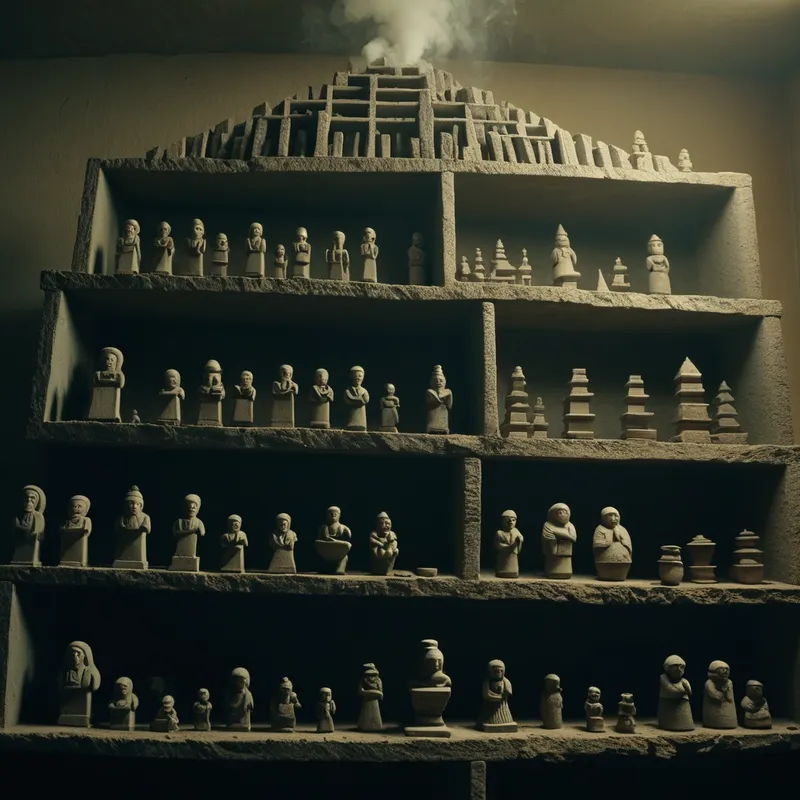
When this myth stirs in the modern unconscious, it often manifests in dreams of hidden, potent objects in the family home. One might dream of discovering small, ancient statues in a grandparent’s attic, of secretly pocketing a family heirloom during a fraught gathering, or of a familiar room in one’s childhood house containing a forgotten shrine. The somatic feeling is one of tense secrecy, a racing heart coupled with a sense of fated necessity.
Psychologically, this signals a process of reclaiming personal authority from the ancestral field. The dreamer is navigating the “Laban” within—the internalized voice of familial expectation, tradition, or legacy that claims ownership over one’s destiny. The “Rachel” act is the psyche’s move to clandestinely identify and take back the vital energy, the talent, or the unique spark that feels rightfully theirs but has been held captive within the family system. It is the soul’s rebellion against a fate assigned by others.
Alchemical Translation
The alchemy modeled here is the transmutation of inherited fate into personal destiny. The process is not clean, noble, or heroic in the classic sense. It is messy, fraught with deception, and carries the weight of guilt (the theft) and potential self-condemnation (Jacob’s oath).
The first stage is separation (fleeing Laban’s house)—the conscious decision to differentiate from the dominant family or cultural complex. The second, critical stage is the nigredo—the blackening. This is the theft itself, the shadow act. It feels like a sin because it breaks a deep, often unspoken, loyalty. Yet, it is necessary. One must “steal” the fire of one’s own spirit back from the collective hearth.
Individuation requires a sacred theft from the treasury of the ancestors. We must take what is ours, even if it is guarded by the gods of our fathers.
Rachel’s containment of the gods symbolizes the albedo—the whitening. The stolen elements are hidden in the vessel of the body (the saddle she sits on) and protected by the truth of one’s own nature (her feminine condition). They are incubated. Finally, the covenant of stones with Laban represents the rubedo—the reddening or integration. A new boundary is established. The old authority is acknowledged but left behind. The stolen gods are not worshipped openly; they travel with the individual, becoming an internalized source of guidance and power, no longer external idols but integrated parts of a new, more complete Self. The blessing moves forward, forever marked by the cunning of its acquisition.
Associated Symbols
Explore related symbols from the CaleaDream lexicon: