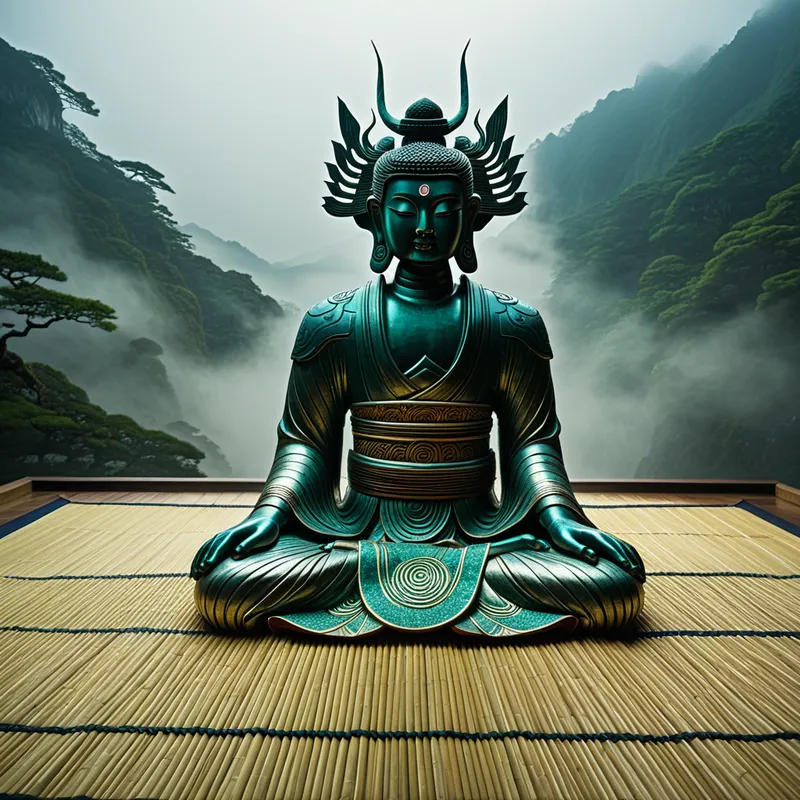
Tatami Myth Meaning & Symbolism
The myth of Tatami tells of the first woven floor, born from the union of earth and sky, creating a sacred boundary for human life and spirit.
The Tale of Tatami
Listen, and feel the earth beneath you. In the time before time, when the world was raw mud and restless spirit, the people walked upon the bare ground. Their feet knew the chill of damp soil, the sharpness of stone, the treachery of uneven land. Their homes were spaces of wind and exposure, where the sacred and the mundane bled into one another, and sleep was a fragile thing, haunted by the breath of the wild earth.
The Kami looked upon this and saw a discord. Humanity was adrift, unmoored between the great Takamagahara and the shadowy Yomi. They had no firm place to stand, to gather, to become. So spoke Amaterasu-Ōmikami, her voice the light that defines shape: "They must have a boundary. A skin between their world and the raw world. A floor for their becoming."
The task fell not to a warrior, but to a weaver. Takumi-no-Kami, the spirit of skilled hands and patient growth, descended to the marshy fields where the igusa grew tall and green, drinking deep from the earth and reaching for the sky. He gathered the strongest, straightest rushes, each one a bridge between below and above. From the mountains, he called for the strength of wild hemp to become the warp and weft. His fingers, moving with the rhythm of the seasons, began to plait.
But a floor is not just a thing; it is a pact. Kunitsukami rumbled, reluctant to be covered, to be separated from the feet of its children. The weaver knelt, pressing his palms to the soil. "Great One," he whispered, "I do not seal you away. I invite you up. Through this weave, your strength will rise, firm and level. Your children will not forget you; they will meet you on this gentle plane." The earth’s grumbling softened to a low, warm hum.
The first mat was born. It was not laid, but offered. Takumi-no-Kami placed it at the threshold of a simple dwelling. As the first person stepped upon it, a silence fell—a profound, new silence. The constant murmur of the soil was now a steady, supportive hum. The chill was gone, replaced by a resilient warmth. The space it defined was no longer just a shelter; it was a room. A place for sitting, for sleeping, for speaking, for being. It was a rectangle of captured peace, a woven island of human order in the vast sea of nature. The myth says that on that first tatami, the first true dream was dreamed, not of fleeing the wild, but of dwelling in harmony with it.
Cultural Origins & Context
The story of Tatami is not found in a single, canonical text like the Kojiki, but is woven into the very fabric of Japanese material and spiritual life. It is a mukashibanashi of the most fundamental kind, passed down not by bards but by craftsmen—the tatami-shi (tatami masters). Their workshops were the repositories of this lore, where the act of measuring, cutting, and sewing was a ritual retelling.
Historically, tatami evolved from thin, portable mats used by nobility in the Heian period to the wall-to-wall flooring defining the washitsu in the Muromachi era. Its societal function was deeply hierarchical; the number and arrangement of mats measured a room's size and, by extension, the status of its occupant. But beneath this social code lay the older, mythic function: to create sacred, defined space. The tokonoma, the room's spiritual focal point, always sits upon tatami. The tea ceremony, a choreography of mindfulness, is performed upon it. The myth served to sanctify this everyday object, teaching that civilization begins not with a wall, but with a floor—a conscious, crafted foundation for life.
Symbolic Architecture
The tatami mat is a profound symbol of the liminal—the threshold itself made manifest. It is neither the earth nor the furniture upon it; it is the mediating plane.
The true foundation is not what we build upon, but the conscious boundary we create between chaos and order.
Its construction is a map of the cosmos: the earthy, vertical rush cores represent the world axis, the individual strands of existence. They are bound by the horizontal hemp twine, the connective principle of relationship and community. The tight, borderless weave of the core (doko) holds the space, while the cloth border (heri) defines its limits, marking the sacred from the mundane. Psychologically, it represents the ego in the Jungian sense—not the personality, but the necessary, firm, and flexible structure of consciousness that allows the Self to manifest in a stable form. It is the "skin" of the psyche, the container that makes experience possible.
The standardized size, traditionally based on the proportions of a reclining human, further embeds the myth into the body. The tatami is a field of being, scaled to human measure. It symbolizes groundedness, stability, and the human capacity to create islands of meaning and order within the unconscious, fertile, and often chaotic ground of nature (the instinctual world).
The Dreamer's Resonance
When the image of a tatami mat surfaces in a modern dream, it rarely arrives as mere decor. It appears as an actor in the psyche's drama. To dream of a new, pristine, sun-warmed tatami mat often signals a somatic need for grounding, for establishing a new, stable foundation in one's life—perhaps after a period of emotional or spiritual "drifting." The body-mind seeks that firm, supportive plane.
Conversely, to dream of a worn, frayed, or uneven tatami mat points to a foundation in crisis. The dreamer's sense of stability, their ego-structure, may be compromised. A tatami mat that is buckling, sprouting moss, or dissolving back into earth suggests a confrontation with what has been repressed—the raw, instinctual "ground" breaking through the civilized surface. This can be a frightening but ultimately healing process, a call to repair one's foundational boundaries.
Dreams of measuring, cutting, or weaving tatami speak to an active psychological process of individuation—the conscious crafting of one's own unique space for being. The dreamer is at work, assembling the rushes of their experiences into a coherent, personal floor upon which they can stand.
Alchemical Translation
The myth of Tatami models the alchemical process of coagulatio—the making solid, the embodiment of spirit. The initial state is the massa confusa: the muddy, undifferentiated ground of unconscious potential and primal fear. The human spirit, like the pre-tatami people, is exposed and vulnerable.
Individuation is not about rising above our nature, but about weaving a conscious foundation within it.
The alchemical agent is Takumi-no-Kami—the archetype of the skilled, patient Craftsman within us. This is the function of consciousness that selects, arranges, and binds. The igusa rushes are the raw materials of our life—our instincts, experiences, memories, and traits. The act of weaving is the slow, diligent work of self-reflection and integration, creating a stable platform (the ego) from these disparate strands.
The negotiation with Kunitsukami is critical. It represents the necessary dialogue with the unconscious, the body, and the shadow. We cannot simply repress our earthy, instinctual nature to build a spiritual life. We must invite it up, transmute its raw power into supportive strength. The final product—the tatami-floored room—is the temenos, the sacred precinct of the Self. It is a space where one can sit in meditation, engage in relationship, rest, and dream, all upon a foundation that is both human-made and deeply connected to the natural order. The ultimate transmutation is this: from walking fearfully upon the unknown earth to dwelling consciously upon a woven earth, a foundation you have participated in creating.
Associated Symbols
Explore related symbols from the CaleaDream lexicon: