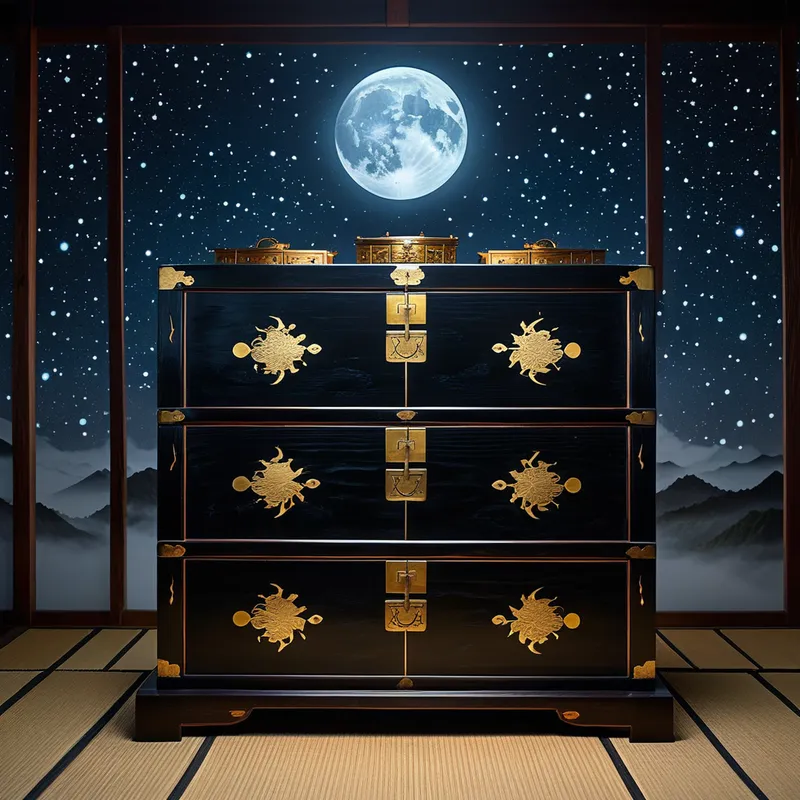
Tansu Myth Meaning & Symbolism
The myth of Tansu tells of a divine chest that holds the essence of all things, a vessel of containment, memory, and the soul's hidden architecture.
The Tale of Tansu
In the age when [the world](/myths/the-world “Myth from Tarot culture.”/) was still soft, when the kami walked as mist through the cedar forests, there was a silence that was not empty, but full. It was the silence of things unformed, of essences waiting for a home. The great craftsman deity, Hayanui, looked upon this swirling potential and felt a profound ache—not of creation, but of containment. To make was one [thing](/myths/thing “Myth from Norse culture.”/); to hold was another.
From the heartwood of the first sacred sugi, he began to fashion a vessel. His tools were [the wind](/myths/the-wind “Myth from Various culture.”/)’s whisper and the patience of stone. He did not carve a statue or a palace, but a chest. A Tansu. Its sides were joined not with iron, but with the breath of foxes; its lacquer was the deep, resonant black of a moonless night over still [water](/myths/water “Myth from Chinese culture.”/). He fitted it with drawers—some wide and shallow, others deep and narrow, and secret compartments known only to the grain of the wood.
Into the first drawer, he placed the sigh of dawn breaking over [Mount Fuji](/myths/mount-fuji “Myth from Japanese culture.”/). Into the second, the precise click of a cicada’s wing. He gathered the laughter of children from riverbanks, the solemn weight of a [samurai](/myths/samurai “Myth from Japanese culture.”/)’s resolve, the fleeting warmth of sun on [tatami](/myths/tatami “Myth from Japanese culture.”/), and the cool loneliness of a single shizuku falling from a leaf. Every memory, every potential experience, every fragment of a soul’s journey yet to be walked, he folded carefully and stored. The Tansu did not judge. The joyous and the sorrowful lay side by side, separated only by thin panels of fragrant wood.
The other kami came to see. They peered into the slightly open drawers and saw flashes of lives unlived, loves unfulfilled, victories unwon. “You have made a prison for ghosts,” one said. “You have made a treasure box for starlight,” said another. Hayanui simply closed the last drawer with a soft, final kata. The sound was not a lock, but a completion. The great chest sat in the clearing, neither radiating power nor demanding worship. It simply was. It held the blueprint of existence, the quiet catalog of all that could be. It waited, not for an owner, but for the understanding that to be alive is to be both the craftsman and the chest, endlessly storing and retrieving the precious, burdensome, and beautiful contents of a self.
Cultural Origins & Context
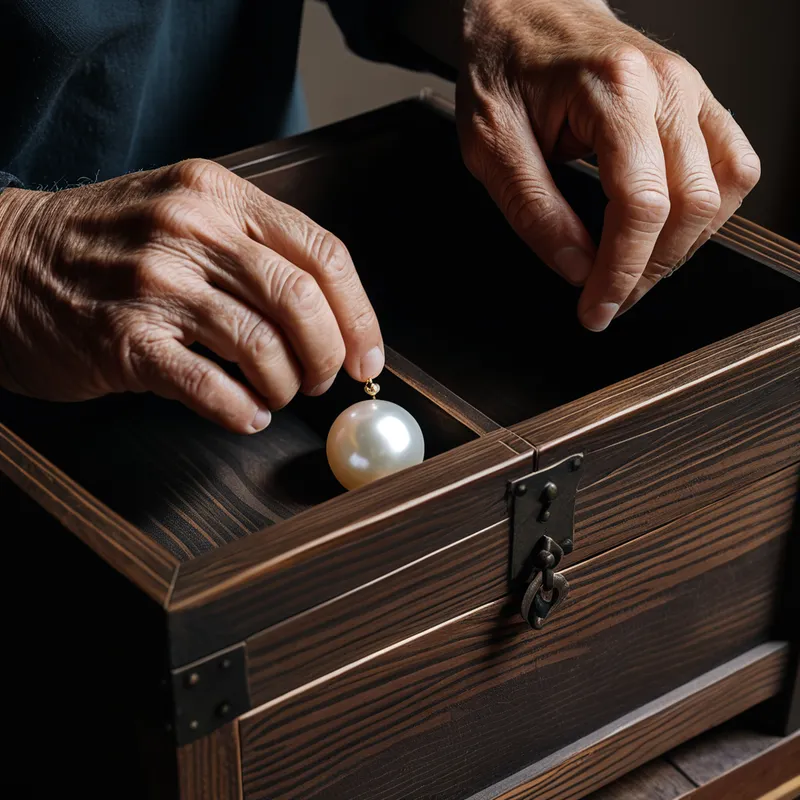
The myth of Tansu does not belong to a single, canonical text like the Kojiki or Nihon Shoki. It is a folkloric stratum, a story whispered by master carpenters (tōryō) to their apprentices in the dusty, resin-scented air of workshops. It is a myth born from the object itself—the iconic Japanese chest, ubiquitous in homes for centuries, used to store kimono, tools, accounts, and heirlooms.
Its transmission was somatic, passed down through the hands and the eye. A carpenter teaching how to fit a kigumi joint so perfectly it becomes invisible might say, “This is how Hayanui joined the sides, so the soul would not leak out.” The myth served a profound societal function: it sacralized the mundane. In a culture with deep animistic roots (Shinto), where spirits reside in all things, the Tansu myth elevated a piece of furniture into a vessel for tamashii. It taught that containment is not oppression, but a form of reverence. To store something properly is to honor its spirit, to keep it safe for its season of use. The myth wove practical life—storage, order, preservation—into the cosmic order.
Symbolic Architecture
The Tansu is the ultimate [symbol](/symbols/symbol “Symbol: A symbol can represent an idea, concept, or belief, serving as a powerful tool for communication and understanding.”/) of the vas, the sacred [vessel](/symbols/vessel “Symbol: A container or structure that holds, transports, or protects something essential, representing the self, emotions, or life journey.”/) of [alchemy](/symbols/alchemy “Symbol: A transformative process of purification and creation, often symbolizing personal or spiritual evolution through difficult stages.”/) and [psychology](/symbols/psychology “Symbol: Psychology in dreams often represents the exploration of the self, the subconscious mind, and emotional conflicts.”/). It represents the very [structure](/symbols/structure “Symbol: Structure in dreams often symbolizes stability, organization, and the framework of one’s life, reflecting how one perceives their environment and personal life.”/) of the [psyche](/myths/psyche “Myth from Greek culture.”/) and the physical [body](/symbols/body “Symbol: The body in dreams often symbolizes the dreamer’s self-identity, personal health, and the relationship they have with their physical existence.”/) as a container for experience.
The self is not a monolithic statue, but a complex cabinet of countless drawers. Some are for daily use, others are locked and forgotten, and a few are secret even to the one who owns the chest.
The drawers and compartments symbolize the compartments of the mind and the layers of [the self](/myths/the-self “Myth from Jungian culture.”/)—the [persona](/symbols/persona “Symbol: The social mask or outward identity one presents to the world, often concealing the true self.”/), [the ego](/myths/the-ego “Myth from Jungian culture.”/), [the personal unconscious](/myths/the-personal-unconscious “Myth from Jungian Psychology culture.”/), and the [collective unconscious](/symbols/collective-unconscious “Symbol: The Collective Unconscious refers to the part of the unconscious mind shared among beings of the same species, embodying universal experiences and archetypes.”/). The hidden compartments are the repressed memories, the latent talents, the [shadow](/symbols/shadow “Symbol: The ‘shadow’ embodies the unconscious, repressed aspects of the self and often represents fears or hidden emotions.”/) aspects we have consciously or unconsciously concealed. The joinery, flawless and without nails, represents the integrity of [the self](/myths/the-self “Myth from Jungian culture.”/)—how our experiences and traits are interlocked to form a cohesive whole. The contents—the sighs, laughter, and memories—are the raw data of a [life](/symbols/life “Symbol: The symbol of ‘Life’ represents a journey of growth, interconnectedness, and existential meaning, encompassing both the joys and challenges that define human experience.”/), the psychic [material](/symbols/material “Symbol: Material signifies the tangible aspects of life, often representing physical resources, desires, and the physical world’s influence on our existence.”/). The Tansu itself does not create this material; it receives, holds, and organizes it. It is the [archetype](/symbols/archetype “Symbol: A universal, primordial pattern or prototype in the collective unconscious that shapes human experience, behavior, and creative expression.”/) of the [Caregiver](/symbols/caregiver “Symbol: A spiritual or mythical figure representing nurturing, protection, and unconditional support, often embodying divine or archetypal parental energy.”/), not in an external sense, but internally. It is the part of the psyche that seeks to hold, protect, and order the contents of our existence, preventing a chaotic flood of undifferentiated feeling and [memory](/symbols/memory “Symbol: Memory symbolizes the past, lessons learned, and the narratives we construct about our identities.”/).
The Dreamer’s Resonance
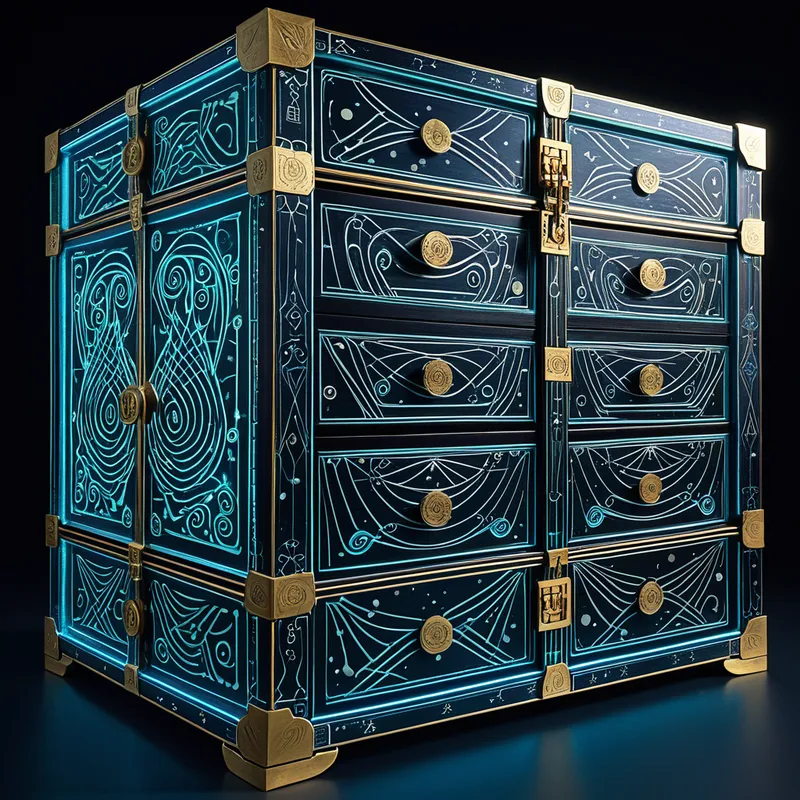
When the image of a Tansu, particularly an intricate, ancient, or mysterious one, appears in modern dreams, it signals a process of psychic inventory and integration. The dreamer is not merely “searching their memory”; they are encountering the very architecture of their inner world.
A dream of struggling to open a stuck drawer points to resistance in accessing a certain memory, emotion, or aspect of the self. There is a known compartment, but the mechanism is jammed by fear or shame. A dream of discovering a hidden drawer full of light or treasure signifies the sudden, grace-filled emergence of a latent gift, a recovered memory, or a profound insight from the unconscious. Conversely, a drawer overflowing with dark, formless substance may represent a compartment of [the shadow](/myths/the-shadow “Myth from Jungian culture.”/) that can no longer be contained and demands attention. The somatic feeling in these dreams is key: the weight of the wood, the smooth slide of a drawer, the frustration of a locked latch. These are bodily metaphors for psychological processes—the heaviness of repression, the ease of access when we are self-accepting, the barrier of our own defenses.

Alchemical Translation
The myth of Tansu models the individuation process not as a heroic quest outward, but as a meticulous, reverent curation inward. The alchemical opus is one of sorting, ordering, and ultimately, understanding the contents of our own vessel.
[The first stage](/myths/the-first-stage “Myth from Alchemical culture.”/) is Inventory (Visita). This is the conscious, often difficult work of opening every drawer—the bright and the dark. It requires the courage of the craftsman to look at all the raw material of one’s life without flinching. The second is Ordering (Ordinatio). This is not about throwing things away, but about understanding the relationship between compartments. Why is joy stored next to grief? What does this secret compartment protect? This stage involves recognizing patterns and connections, seeing the self as an interconnected system. The final stage is Integration (Complecti).
The goal is not to empty the chest, but to become on speaking terms with all its contents. The integrated self is the master carpenter who knows every joint, every hidden catch, and who can retrieve any memory or quality without the chest breaking apart.
This is the alchemical translation: the leaden confusion of an unexamined life is transmuted into the golden awareness of a contained, ordered, and wholly inhabited self. The Tansu, once a mythic object out there, becomes the lived reality in here—the sacred, intricate, and utterly unique container of a soul. We achieve not by adding more, but by understanding the profound art of holding what we already are.
Associated Symbols
Explore related symbols from the CaleaDream lexicon: