Tangaroa God of the Sea
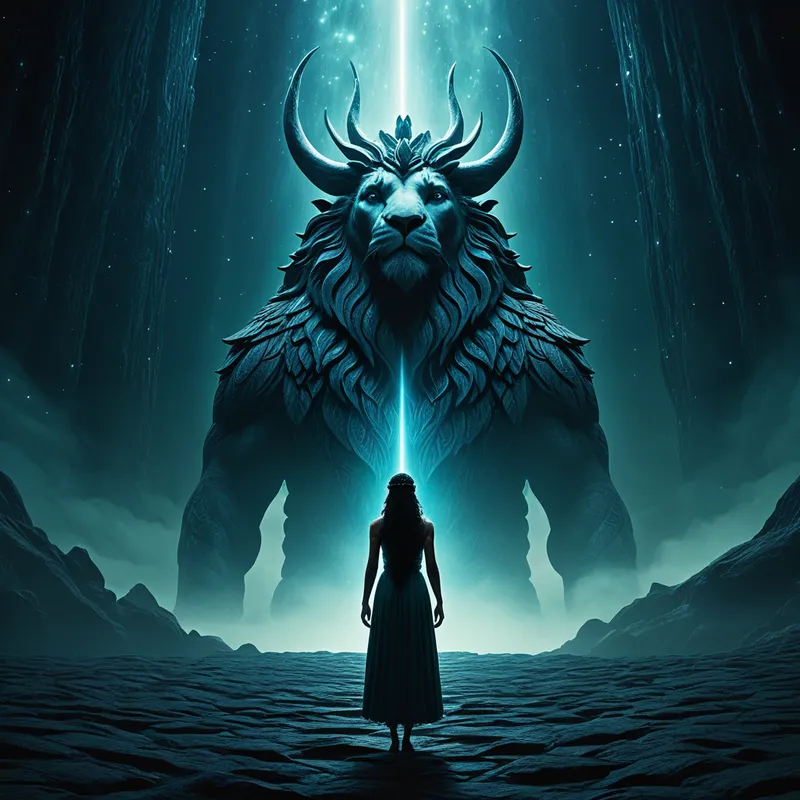
Tangaroa is the Maori god of the sea, a primordial creator who commands ocean life and embodies both nurturing and destructive forces.
The Tale of Tangaroa God of the Sea
In the beginning, there was Te Kore, the Nothingness, a vast and potent void. From this primal potential, the thought and the longing for being emerged, stirring the parents of all: Ranginui, the Sky Father, and Papatūānuku, the Earth Mother. They lay in a tight, loving embrace, and within the darkness of their union, their children were conceived. Among these first divine beings was Tangaroa, whose spirit was formed from the yearning for space, for fluidity, for the ceaseless motion that the tight clutch of his parents could not permit.
Tangaroa, with his brothers Tāne (of forests and birds), Tāwhirimātea (of winds and storms), Rongo (of cultivated foods), and Haumia (of uncultivated foods), grew restless in the cramped darkness. They conspired, debating how to separate their parents to allow light and life into the world. It was Tāne who succeeded, planting his feet upon his mother and thrusting his father upwards with immense, slow strength, creating the vault of the sky and the plane of the earth. But this act of creation was also an act of profound rupture. As the primal parents were wrenched apart, their tears fell—the first rains, the first mists. And from the anguish of this separation, Tangaroa’s own domain was born: the great, salt expanse of the sea, the waters that filled the hollows of his mother’s body and reflected his father’s face.
Yet, the story of creation is also a story of conflict. Tāwhirimātea, the god of winds, was furious at his brothers for violently separating their parents. He waged terrible war upon them. He attacked Tāne’s forests, uprooting trees. He pursued Rongo and Haumia. And he turned his fury upon Tangaroa. The winds howled and whipped the sea into monstrous waves, seeking to crush the sea god back into the land. In defense, Tangaroa fled, retreating to the depths. But his retreat was strategic. He called upon his own progeny—the fish and reptiles of the sea—and commanded them to remain steadfast in his realm. To Tāne, who offered refuge to the fleeing children of Tangaroa in his forests, the sea god declared an eternal feud. The creatures that sought the land, like lizards, became taboo to Tangaroa’s people, forever marking the schism between the realms of sea and forest.
Thus, Tangaroa rules not a placid kingdom, but a dynamic, living cosmos. He is the source of all fish and marine life, the generous provider who fills the nets of fishers. His breath is the tide, his moods the calm and the storm. He is the guardian of the ocean’s deepest mysteries and the terrifying force that can swallow canoes whole. In his realm, the islands themselves are born—not from rock alone, but from the union of his creative force with the fishing exploits of the great hero Māui, who, with his magical fishhook, pulled the North Island of Aotearoa from the depths of Tangaroa’s domain.
Cultural Origins & Context
Tangaroa (also known as Takaroa in some Eastern Polynesian traditions) is a foundational deity in the Māori worldview, a direct descendant of the primordial parents. His narrative is embedded within the Whakapapa, the sacred genealogy that maps the descent of all things from Te Kore through to the tangible world, Te Ao Mārama. This places him not as a distant, Olympian figure, but as an ancestor, intimately connected to the people and the land itself.
As a primary god of the sea, his influence was immediate and vital for coastal and riverine Māori communities. He was the ultimate source of kaimoana (seafood), a critical food resource. Rituals and karakia (incantations) were directed to him before fishing expeditions, asking for abundance and safe passage. Violations of tapu (sacred restrictions) related to the sea, such as improper disposal of waste or disrespectful fishing practices, were believed to incur his wrath, resulting in poor catches or disastrous storms.
His identity is complex, embodying a fundamental duality. He is both Tangaroa-whakamau-tai, Tangaroa who secures the tide (the orderly, life-giving aspect), and Tangaroa-whāriki-ki-te-moana, Tangaroa who spreads the mat upon the ocean (a metaphor for calming the waves, but also suggestive of his encompassing, sometimes smothering power). This duality reflects the Māori understanding of the natural world as a realm of interconnected forces that are both nurturing and formidable, requiring respect and careful engagement rather than domination.
Symbolic Architecture
Tangaroa’s myth constructs a profound symbolic architecture for understanding existence. The sea is not merely a geographical feature; it is the amniotic fluid of Papatūānuku, the tears of the separated parents, and the realm of the unconscious from which tangible forms are drawn. Tangaroa’s flight to the depths during the war with Tāwhirimātea is not a defeat, but a descent into potential, a consolidation of his own creative authority.
His feud with Tāne establishes a critical cosmological polarity: the fluid, hidden, salt realm of the sea (Tangaroa) versus the solid, visible, fresh realm of the land and forests (Tāne). This is not simple opposition, but a necessary tension that defines ecological and spiritual boundaries.
The act of fishing thus becomes a sacred dialogue with this deity. The fisherman, through skill and ritual, enters into a temporary, respectful relationship with Tangaroa’s bounty, acknowledging that what is taken is a gift from a powerful and temperamental ancestor. The ocean is his body, its creatures his children, and to navigate it is to move across the skin of a living god.
The Dreamer's Resonance
To encounter Tangaroa in the imaginal realm is to confront the depths of the unconscious psyche. He is the personification of the emotional and instinctual substrate of being—vast, ancient, and teeming with life-forms of thought, memory, and feeling that are not yet fully conscious. His nurturing aspect represents the psyche’s capacity to provide sustenance, insight, and the fluid medium for psychic growth. His storms are the upwellings of raw affect, the tempests of rage, grief, or passion that can overwhelm the conscious mind.
The dreamer adrift on his sea is the ego navigating the unconscious. The calm voyage speaks to a period of integration and easy access to deep resources. The storm signifies inner turmoil, a clash of psychic forces (like the war of the gods), where old structures are threatened by powerful emotional winds. Tangaroa’s duality calls the dreamer to respect these depths, to learn their rhythms and laws, and to understand that creativity and chaos emanate from the same source. To be in right relationship with this inner Tangaroa is to practice a kind of psychic fishing—casting one’s attention into the depths with respect and skill, hoping to draw up nourishing insights without provoking a devastating backlash from neglected or dishonored parts of the self.
Alchemical Translation
In the alchemical vessel of the soul, Tangaroa represents the principle of Solutio—dissolution in the primal waters. This is not destruction, but the necessary return to a fluid state where rigid forms are broken down, allowing for recombination and rebirth. His salt sea is the aqua permanens, the permanent water that contains the seed of all transformation.
The separation of Rangi and Papa, which births his domain, is the archetypal separation that must precede any conscious development. The ego (light, Te Ao Mārama) is born from the undifferentiated unconscious (the dark embrace), but at the cost of a fundamental wound—the grief of the parents, which becomes the saline medium of all subsequent emotional life.
Tangaroa’s enduring conflict with Tāne mirrors the internal tension between the fluid intelligence of the heart and instincts (water) and the structured, ascending intelligence of the mind and spirit (forest, air). Psychological wholeness does not mean resolving this conflict, but holding the tension, acknowledging that wisdom arises from both the deep, swirling currents of feeling and the rooted, branching structures of thought. The Māori practice of maintaining the tapu between sea and forest creatures is a cultural analogue to this alchemical separatio—keeping certain energies distinct to allow each its full potency, even as they exist within a unified whole.
Associated Symbols
Explore related symbols from the CaleaDream lexicon:
- Ocean — The vast, unconscious realm of potential, emotion, and ancestral memory, embodying both nurturing abundance and terrifying, formless power.
- Chaos — The primal, unordered state from which all forms emerge, represented by the tumultuous, creative, and destructive forces of the sea.
- Creation — The act of bringing forth tangible reality from the void, exemplified by Tangaroa’s emergence from the primal parents and his role in populating the sea.
- Separation — The necessary, painful act that creates distinction and space for life, as seen in the parting of Sky and Earth which gave birth to Tangaroa’s domain.
- Fish — The manifest children and treasures of the deep, symbols of the tangible insights, nourishment, and resources drawn from the unconscious.
- Storm — The violent, disruptive aspect of nature and psyche, representing emotional upheaval, divine wrath, and the clash of powerful inner forces.
- Depth — The hidden, profound layers of being, the realm of secrets, origins, and potentials that lie beneath the surface of conscious awareness.
- Salt — The essence of the sea, representing preservation, wisdom, tears, and the enduring, sometimes bitter, quality of experience and memory.
- Ancestor — A foundational being from whom life and tradition descend, positioning the natural world not as separate but as kin, demanding relational respect.
- Grief — The seminal emotional waters born from primal loss or separation, which become the medium for all subsequent feeling and connection.
- Power — The inherent, ambivalent force of nature that commands respect, providing sustenance or enacting destruction based on the relationship with it.
- Dream — The medium through which the depths communicate, a nightly voyage upon the inner sea where the shapes of Tangaroa’s realm may be encountered.