Symposium of Plato Myth Meaning & Symbolism
A philosophical dialogue where guests at a banquet offer competing speeches on the nature and origin of Love, culminating in Socrates' revelation of a transcendent ladder of desire.
The Tale of Symposium of Plato
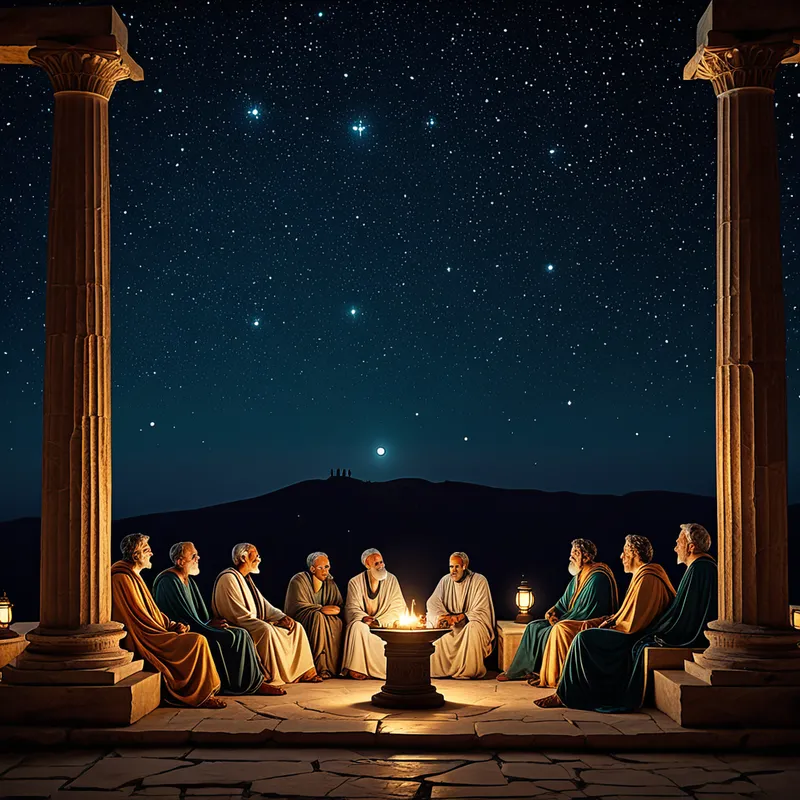
The night air in Athens was thick with the scent of wine and victory. Agathon, the young and beautiful tragedian, had won the prize. His house, a sanctuary of marble and murmured intellect, was now a vessel for celebration. The couches were arranged in a sacred circle, cushions of deep purple and crimson cradling the most brilliant minds the city had to offer. The lamps flickered, casting dancing shadows that seemed to listen.
First came Phaedrus, his voice earnest. He sang of Eros as the oldest of gods, the great daimon who inspires men to noble deeds and shame from cowardice. Then Pausanias, clever and dividing, spoke of two Loves: a common, earthly one and a heavenly one that loves the soul and seeks wisdom. The physician Eryximachus, ever the scientist, expanded Love into a cosmic principle, the harmony that moves the stars and heals the body.
Then Aristophanes, the comic poet, though gripped by hiccups, told a tale that hushed the room. He spoke of a time when humans were spherical beings, with four arms, four legs, and two faces. They were powerful, audacious, and threatened the gods. Zeus, in his wrath, split them all in two, like eggs sliced with a hair. And since that day, each half-yearns, searches, and clings to its other—our love is the desperate, healing attempt to become whole again. A profound melancholy settled over the symposiasts, a recognition of an ancient wound.
Agathon himself then rose, pouring forth a torrent of poetic praise, painting Eros as the youngest, most beautiful, and tender of gods, the source of all virtue and gentleness. The room applauded the elegance. All eyes then turned to [Socrates](/myths/socrates “Myth from Greek culture.”/), the old stone-cutter, whose silence had been a presence of its own.
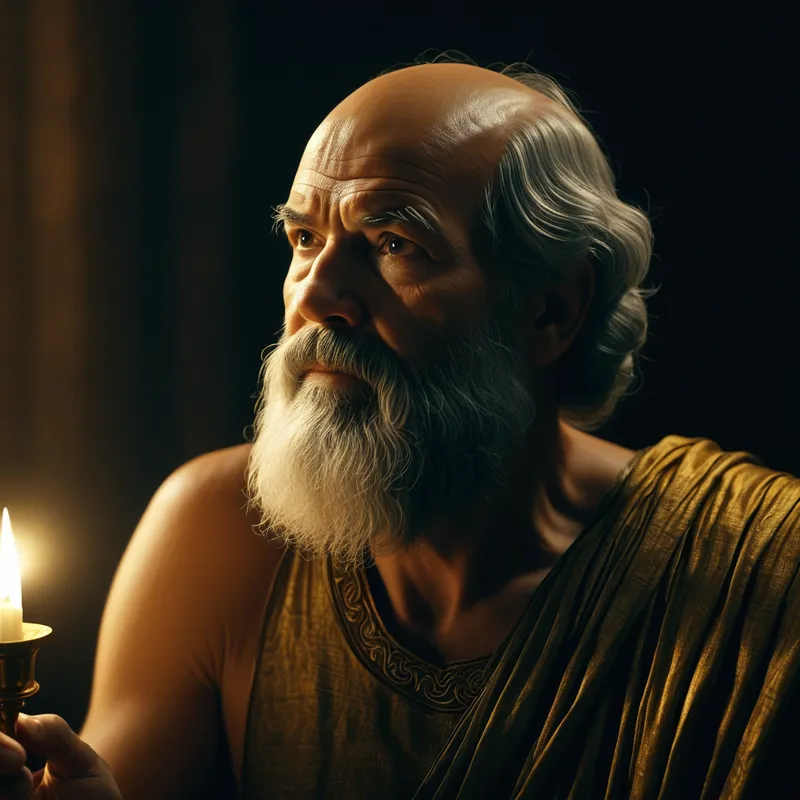
With a gentle, probing manner, he began not with a speech, but with questions, unraveling Agathon’s beautiful assumptions. Love, Socrates revealed, is not itself beautiful and good, but desires beauty and goodness. It is a great daimon, a spirit between mortal and immortal, need and fulfillment, ignorance and wisdom. And then, he summoned a ghost to the feast—the voice of Diotima, a priestess of Mantinea, who had taught him these mysteries.
Through Socrates, Diotima’s voice filled the chamber. She spoke of Love as [the child](/myths/the-child “Myth from Alchemy culture.”/) of Poros (Resource) and [Penia](/myths/penia “Myth from Greek culture.”/) (Poverty), conceived on the day of Aphrodite’s birth. Ever needy, ever resourceful, a seeker, not a possessor. And then, she unveiled the Ladder. The soul, struck by the beauty of a single body, must learn to see the beauty in all beautiful bodies. Then to see the higher beauty in souls, in laws and institutions, in the vast meadows of knowledge. Until, in a sudden flash, it beholds Beauty itself—absolute, pure, unchanging, the source of all beautiful things. This was the final revelation, the true goal of Eros. A stunned silence followed, more profound than any applause. The philosophical ecstasy was broken by the drunken, crowing entrance of Alcibiades, who in his wild, loving praise of Socrates, became a living, tragic embodiment of the very desires just described.
Cultural Origins & Context
The [Symposium](/myths/symposium “Myth from Greek culture.”/) is not a myth from the oral, archaic tradition of [Homer](/myths/homer “Myth from Greek culture.”/), but a meticulously crafted philosophical dialogue written by Plato in the early 4th century BCE. Its setting, however, is authentically Athenian: the symposion, a private drinking party following a dinner, reserved for citizen men. This was a key social and intellectual institution where poetry, politics, and philosophy were debated amidst wine, music, and the complex social dance of philia (friendship) and eros (desire).
Plato uses this familiar, culturally resonant setting as a narrative vessel for revolutionary ideas. By placing the teachings in the mouths of historical figures—his teacher Socrates, the famous playwrights, the notorious general Alcibiades—he grounds transcendent philosophy in the messy, human reality of Athens. The work was part of a literary and pedagogical project, designed to be read and discussed within Plato’s Academy and by the educated elite. Its function was societal in the deepest sense: to reorient the Athenian soul away from the pursuit of political power and physical pleasure, and toward the cultivation of wisdom and the vision of eternal truth.
Symbolic Architecture
At its core, the myth of the Symposium is a symbolic map of the [soul](/symbols/soul “Symbol: The soul represents the essence of a person, encompassing their spirit, identity, and connection to the universe.”/)’s [journey](/symbols/journey “Symbol: A journey in dreams typically signifies adventure, growth, or a significant life transition.”/) from [fragmentation](/symbols/fragmentation “Symbol: The experience of breaking apart, losing cohesion, or being separated into pieces. Often represents disintegration of self, relationships, or reality.”/) to unity, from [appetite](/symbols/appetite “Symbol: Represents desire, need, and consumption in physical, emotional, or spiritual realms. Often signals unmet needs or excessive cravings.”/) to essence. Each speech is not merely an [opinion](/symbols/opinion “Symbol: An opinion in a dream symbolizes personal beliefs and thoughts about oneself and the world, often reflecting inner conflicts or uncertainties.”/), but a stage of [consciousness](/symbols/consciousness “Symbol: Consciousness represents the state of awareness and perception, encompassing thoughts, feelings, and experiences.”/), a partial [truth](/symbols/truth “Symbol: Truth represents authenticity, honesty, and the quest for knowledge beyond mere appearances.”/) that must be integrated and transcended.
Love is the child of Resource and Poverty, forever seeking what it lacks, forever ingenious in its pursuit.
The central [symbol](/symbols/symbol “Symbol: A symbol can represent an idea, concept, or belief, serving as a powerful tool for communication and understanding.”/) is the Ladder of [Ascent](/symbols/ascent “Symbol: Symbolizes upward movement, progress, spiritual elevation, or striving toward higher goals, often representing personal growth or transcendence.”/), or the Scala Amoris. Each rung represents an alchemical [expansion](/symbols/expansion “Symbol: A symbol of growth, increase, or extension beyond current boundaries, often representing personal development, opportunity, or overwhelming change.”/) of [perception](/symbols/perception “Symbol: The process of becoming aware of something through the senses. In dreams, it often represents how one interprets reality or internal states.”/): from the particular (one beautiful [body](/symbols/body “Symbol: The body in dreams often symbolizes the dreamer’s self-identity, personal health, and the relationship they have with their physical existence.”/)) to the universal ([Beauty](/symbols/beauty “Symbol: This symbol embodies aesthetics, harmony, and the appreciation of life’s finer qualities.”/) itself). This is the [psychology](/symbols/psychology “Symbol: Psychology in dreams often represents the exploration of the self, the subconscious mind, and emotional conflicts.”/) of [sublimation](/symbols/sublimation “Symbol: Transforming base impulses into creative or socially acceptable outlets, often seen in artistic expression.”/)—not the denial of desire, but its guided redirection toward its highest possible object. The spherical beings of Aristophanes’ speech symbolize our felt experience of lack and longing, our psychological fragmentation. Diotima’s ladder provides the cure: not merely finding our “other half” in another person (which keeps us looking [outward](/symbols/outward “Symbol: Movement or orientation away from the self or center; expansion, expression, or externalization of inner states into the world.”/)), but through an [inward](/symbols/inward “Symbol: A journey toward self-awareness, introspection, and the exploration of one’s inner world, thoughts, and unconscious mind.”/) turn that recognizes the partial [beauty](/symbols/beauty “Symbol: This symbol embodies aesthetics, harmony, and the appreciation of life’s finer qualities.”/) in the other as a [reflection](/symbols/reflection “Symbol: Reflection signifies self-examination, awareness, and the search for truth within oneself.”/) of, and [pointer](/symbols/pointer “Symbol: A symbol of direction, guidance, or authority, often representing external influence, instruction, or the act of singling something out.”/) to, the absolute.
Socrates himself becomes the living symbol of the daimonic Eros—physically ugly yet magnetically attractive, professing ignorance yet full of divine wisdom, a man who embodies the paradoxical state of being in love with the [idea](/symbols/idea “Symbol: An ‘Idea’ represents a spark of creativity, innovation, or realization, often emerging as a solution to a problem or a new outlook on life.”/) of Love itself.

The Dreamer’s Resonance
When this myth stirs in the modern unconscious, it rarely appears as a philosophical debate. Instead, one might dream of a staircase that appears in a familiar house, leading to an unknown, radiant floor. There is a compelling urge to ascend. Or perhaps the dream features a series of lovers or beloved objects, each morphing into the next, revealing a common, shining quality behind their faces. There is a sense of progression, of outgrowing.
These dreams signal a somatic and psychological process of integration. The dreamer is likely grappling with a powerful desire—for a person, a status, a creative project—that feels all-consuming. The myth-dream presents the possibility that this specific desire is not the end, but the beginning of a path. The anxiety or euphoria attached to the beloved object is the engine, but the [psyche](/myths/psyche “Myth from Greek culture.”/) is hinting at a deeper destination. It is the soul’s intelligence working to transmute a personal eros into a transpersonal drive, moving from being possessed by a desire to following it as a guide toward greater wholeness.

Alchemical Translation
The alchemical work modeled by the Symposium is the opus contra naturam—the work against our lower, fragmented nature. It is the individuation process where the lead of our instinctual, possessive longing is turned into the gold of conscious, creative love.
[The first stage](/myths/the-first-stage “Myth from Alchemical culture.”/), calcinatio, is the burning heat of initial desire (Phaedrus, Aristophanes). The [solutio](/myths/solutio “Myth from Alchemical culture.”/) is the dissolution of [the ego](/myths/the-ego “Myth from Jungian culture.”/)’s claim that this one object is the sole source of fulfillment (Socrates questioning Agathon). The coagulatio is the re-forming of desire into a structured path, the ladder (Diotima’s revelation). The sublimatio is the ascension itself, the spiritualization of the drive.
The ultimate goal is not to abandon the world of beautiful things, but to see through them, to perceive the eternal Form that casts them as fleeting shadows.
For the modern individual, this means engaging in a profound inner dialogue. When captivated by a person, a career, or an ideal, one must ask the Socratic questions: What is it, truly, that I love in this? What quality does it possess that stirs me? This practice begins to separate the Absolute (Beauty, Goodness, Truth) from the relative container it currently inhabits. The “[triumph](/myths/triumph “Myth from Roman culture.”/)” is not a conquest, but a revelation—a shift in perception where one’s fundamental relationship to desire changes. One no longer loves in order to possess, but loves because one has glimpsed, through the beloved, [the immortal](/myths/the-immortal “Myth from Taoist culture.”/) source of all that is worthy of love. The psyche becomes a symposium, hosting its own internal voices of partial truth, guided by the daimonic spirit of inquiry, forever ascending.
Associated Symbols
Explore related symbols from the CaleaDream lexicon: