Symposium Myth Meaning & Symbolism
A philosophical feast where seven Athenians deliver competing speeches on the nature and origin of Eros, culminating in Socrates' revelation of divine ascent.
The Tale of Symposium
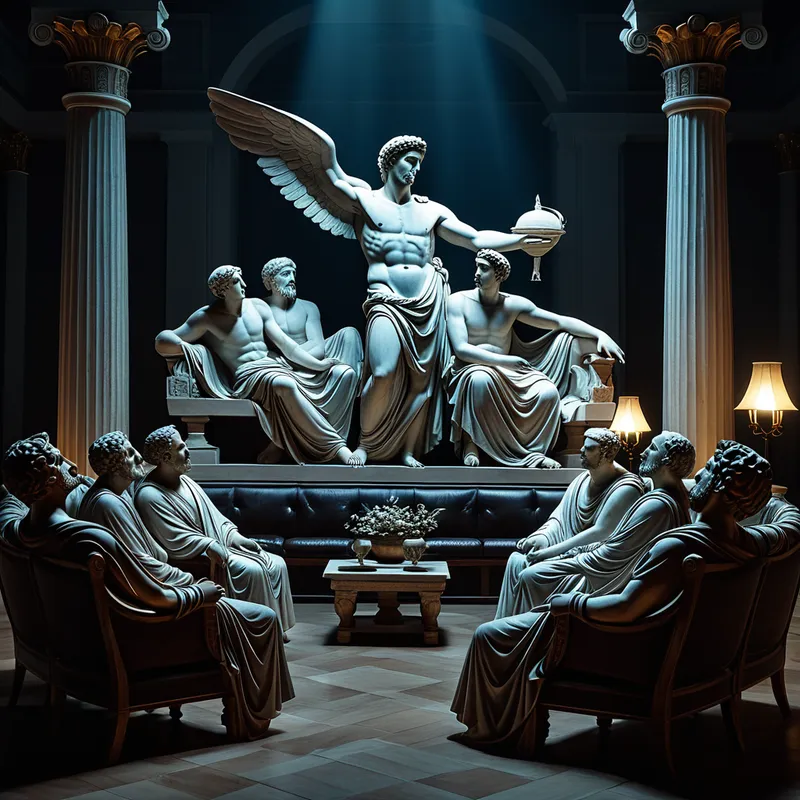
Let the wine be poured, the couches arranged, and the lamps lit. The night is not for drunkenness, but for a deeper intoxication. In the house of the poet Agathon, a gathering is called. The air is thick with the scent of olive oil, myrrh, and the promise of words that will outlast the wine.
The men recline—Eryximachus the healer, Aristophanes the laughter-maker, Pausanias the lover, and others. At the edge of the circle, a presence: Socrates, who arrived late, lost in thought on a neighbor’s porch. He is the still point, the question in the heart of their certainty.
They decide to speak, not of trivial things, but of Eros himself. Let each man offer a hymn to the god of longing.
Pausanias begins, splitting love in two: a common, earthly desire and a heavenly, soul-directed passion. Eryximachus expands this, seeing Eros as the harmonizing principle in all nature, in medicine, in music, in the very seasons. Then, the room shifts. Aristophanes, his hiccups finally stilled, tells a tale that makes the heart ache.
Once, he says, we were not as we are now. Humans were spherical beings, with four arms, four legs, and two faces. They were powerful, arrogant, and threatened the gods. As punishment, Zeus split them in two, like an egg sliced by a hair. Since that day, each half wanders the earth, desperate, incomplete, searching for its other. Our longing for union, our embrace—this is the memory of our original wholeness, the desperate attempt to heal the wound of our divine separation. The room falls silent, heavy with the truth of this primal homesickness.
The host, Agathon, then sings. He paints Eros as the youngest, most beautiful, and tender of gods, the source of all virtue and poetic grace. His words are sweet, a beautiful veil.
All eyes turn to Socrates. He does not sing. He questions. He dismantles the beautiful speech, not with malice, but with a surgeon’s precision. “Is love love of something?” he asks. It must be. And if it loves beauty, it must lack it. Eros, then, is not a beautiful god, but a daimon—a spirit, the child of Penia (Poverty) and Poros (Resource). He is ever-needy, ever-seeking, the intermediary between mortal and divine, ignorance and wisdom.
And then, he tells not his own story, but that of a Diotima, a wise woman who taught him the mysteries. She speaks of the Ladder of Love. One begins by loving a single beautiful body. Then, one learns to see the beauty in all bodies. Then, the greater beauty in souls, in laws, in knowledge. Step by step, the lover ascends, until finally, in a sudden revelation, one beholds Beauty itself—absolute, eternal, unchanging. This is the true goal of Eros: not the possession of a person, but the soul’s ascent to the divine.
As the speech ends, a clamor at the door. Alcibiades, crown of ivy and violets askew, stumbles in, drunk and brilliant. He offers not a speech on love, but a portrait of the lover: Socrates himself. He speaks of the philosopher’s irresistible, ugly beauty, his endurance, his confounding wisdom. He compares him to a silenos statue, grotesque on the outside, but containing golden images of the gods within. The night dissolves into more drinking, as the men, one by one, fall asleep. At dawn, only Socrates remains awake, having drunk them all under the table, before rising to begin another day in pursuit of truth.

Cultural Origins & Context
The Symposium is not a myth from the oral, Homeric tradition, but a philosophical and literary creation of the 4th century BCE, immortalized by Plato. It is set against the backdrop of classical Athenian symposia—exclusive drinking parties for elite citizen men that were central to social, political, and intellectual life. These gatherings were ritualized spaces for bonding, debate, and performance, governed by rules of consumption and conversation.
Plato’s genius was to transform this social institution into a dramatic vessel for his deepest ideas. By using the dialogue form and placing the teachings in the mouth of Socrates (and through him, Diotima), he rooted transcendent philosophy in a recognizable, human scene. The myth of the spherical beings and the allegory of the Ladder are presented not as dogmatic truths, but as compelling “likely stories” (eikôs mythos) offered within a specific, competitive context. The work functioned as advanced pedagogy for Plato’s Academy, a model of dialectical inquiry, and a profound piece of cultural criticism, contrasting the superficial, self-congratulatory rhetoric of the sophists and poets with the demanding, transformative path of Socratic philosophy.
Symbolic Architecture
At its core, the Symposium is a profound map of desire. It deconstructs the god Eros from a personified deity into a fundamental, driving principle of lack and aspiration.
Eros is the child of Poverty and Resource, forever in between, forever seeking. It is the psychic energy of the incomplete reaching for completion.
Aristophanes’ myth of the split spheres is the archetypal symbol of human fragmentation. It names our existential condition: we are born severed, carrying a phantom memory of wholeness. Our relationships, our passions, our creativity—all are attempts to mend this primordial wound. This is not merely romantic love, but the soul’s longing for its missing counterpart, which could be a calling, a purpose, or a connection to the transcendent.
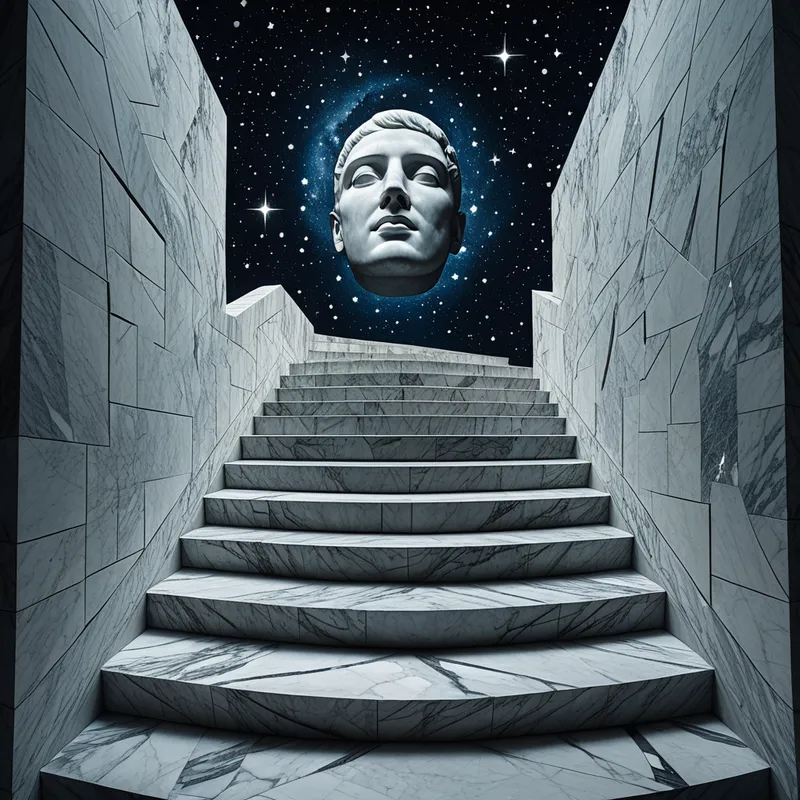
The Ladder of Love, revealed by Diotima, is the symbolic architecture for the soul’s evolution. It represents a psychic alchemy where base, particular desire is progressively refined and sublimated. Each rung is a stage of consciousness:
- Love of a particular body: Instinctual, possessive attraction.
- Love of beauty in all bodies: Recognition of the universal in the particular.
- Love of beautiful souls: The shift from physical to moral and psychological beauty.
- Love of beautiful practices and laws: Beauty embodied in culture and community.
- Love of knowledge: Beauty found in ideas and sciences.
- Beholding Beauty Itself: The ultimate, unmediated encounter with the Form of the Beautiful, the source of all lesser beauties.
This is not an abandonment of the world, but a deepening of vision that sees the world as a reflection of the divine.

The Dreamer’s Resonance
When this myth stirs in the modern unconscious, it often manifests as dreams of profound searching or fragmented connection. You may dream of a lost twin, a mirror image you cannot reach, or a puzzle with a missing piece—direct echoes of Aristophanes’ severed beings. This signals a somatic feeling of incompleteness, a core loneliness that exists even within relationships.
Dreams of staircases, ladders, or elevators that ascend through strange, layered landscapes mirror the Ladder of Love. The dreamer may feel compelled to climb but be unsure of the destination, or they may find themselves stuck on a particular floor—perhaps a level representing a fixation on physical appearance, a draining relationship, or an all-consuming intellectual pursuit. The dream is asking: Where is your desire currently stationed? What is the next level of integration?
The arrival of a silenos-figure like Socrates—an outwardly unattractive or unsettling presence who nonetheless exudes compelling wisdom—can indicate the psyche’s call to look beyond superficial appearances for guidance. This figure often disrupts the dream’s complacency, introducing challenging questions that destabilize the dreamer’s current “speech” about their life.
Alchemical Translation
The Symposium provides a master blueprint for the alchemical process of individuation—the journey toward psychological wholeness. It begins with the nigredo, the recognition of our blackened, fragmented state as described by Aristophanes. We must consciously feel the wound of separation, our “poverty,” to ignite the seeking fire of Eros.
The work of the soul is to transmute the lead of possessive longing into the gold of creative aspiration. Love is the solvent and the fire.
The Ladder is the stages of albedo and citrinitas—the whitening and yellowing—where we purify and differentiate our desires. Each step requires a death: the death of believing one beautiful person is the ultimate answer, the death of valuing only physical form, the death of narrow intellectualism. We learn to love the category, the pattern, the principle, and finally, the source.
Socrates, as the embodiment of the daimonic principle, represents the inner guide or transcendent function that mediates between our mortal limitations and our divine potential. He is the inner voice that questions our comfortable Agathon-like speeches to ourselves. The ultimate rubedo, the reddening or culmination, is not an escape from the world, but the attainment of a perspective from which the world is seen sub specie aeternitatis—under the aspect of eternity. The individual who has glimpsed Beauty Itself does not abandon human love or civic duty; they engage with it more fully, now seeing it infused with a sacred radiance. The feast ends, the guests sleep, but the philosopher remains awake, carrying the transformed consciousness into the dawning day.
Associated Symbols
Explore related symbols from the CaleaDream lexicon: