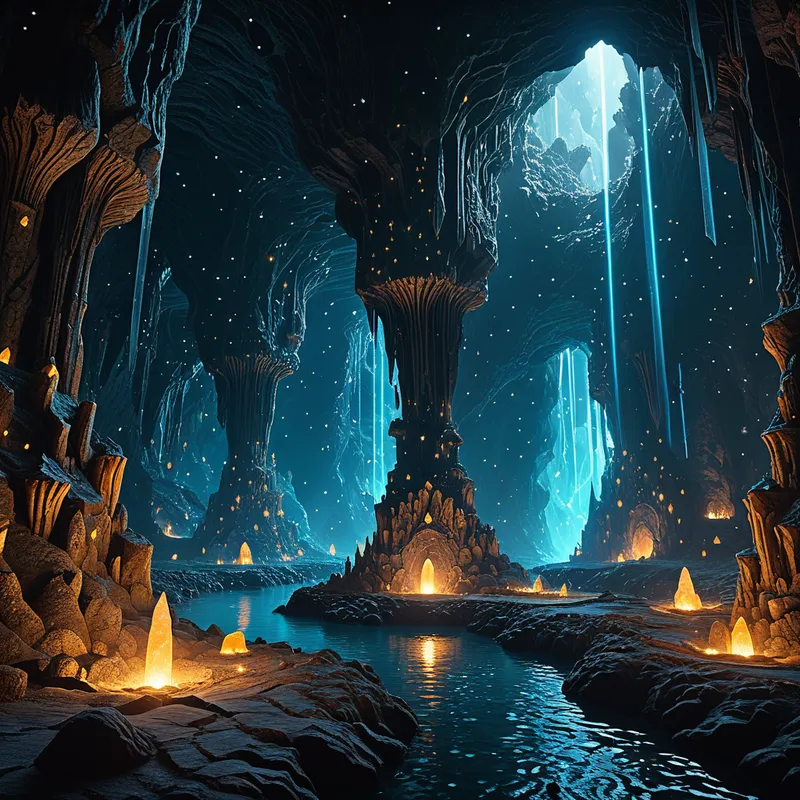
Svartalfheim Myth Meaning & Symbolism
The myth of the dark realm where raw, chaotic potential is forged into objects of fate and power, demanding a descent into the underworld of the self.
The Tale of Svartalfheim
Hear now a tale not of sun-drenched fields, but of the deep places. Beneath the gnarled roots of the Yggdrasil, where the soil is black and the stone remembers the first cold, lies a realm. This is Svartalfheim, the home of the Svartálfar. Here, light does not fall from the sky but rises from the earth itself—a sullen glow from molten rivers, a cool shimmer from luminous fungi on cavern walls vast as the night.
Into this realm of eternal craft came the gods, not as conquerors, but as supplicants. For in the heavens of Asgard, beauty was, but power was wanting. Odin, the All-Father, whose single eye saw all fates, needed a spear that would never miss, a binding of his own will to the weave of destiny. His brother Thor, whose laughter shook the clouds, required a hammer to defend the realms, a weapon of unparalleled might. And the golden god Freyr sought a ship that could fold itself into a pocket, yet carry all the gods, a vessel of pure magic.
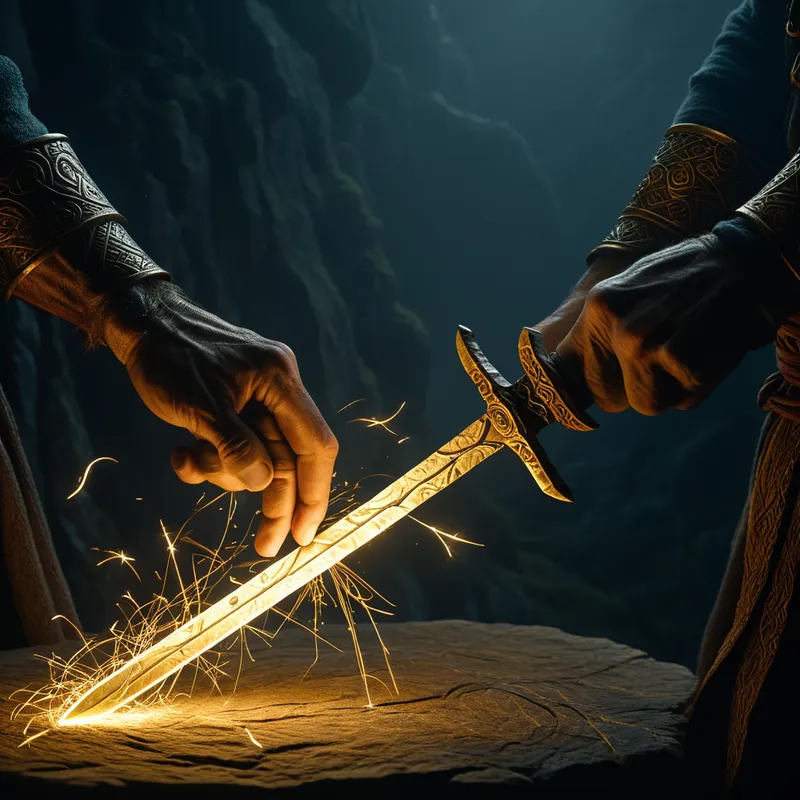
They did not command. They journeyed. Down, down, past the well of Urd, where the roots drank deep of memory and time. The air grew thick, smelling of metal, damp stone, and the ozone of deep-earth energy. Before them, in halls hewn from living rock, the Svartálfar worked. They were not tall, but their stature was in their craft. Their hands, clever and strong, danced with hammer and tongs. Their forges were not mere fire, but the captured heart of the world’s making.
The gods laid their desires before the masters of the deep: the brothers Brokkr and Sindri (or Eitri). A wager was struck, sealed not with gold, but with pride. The brothers would create three wonders. As they worked, the god Loki, in the form of a fly, stung and harassed them, testing their focus to the limit. Yet through the pain, the brothers toiled. From the roaring bellows and the screaming anvil, wonders were born: Gungnir, the spear that carved fate; Skidbladnir, the ship that sailed on any breath; and finally, Mjölnir, the hammer whose strike was thunder, whose return was sure.
The realm held its breath. In the deep dark, the raw stuff of chaos—the ores of ambition, the metals of conflict, the gems of hidden knowledge—had been subjected to will, to skill, to relentless, focused heat. From the formless dark of Svartalfheim came the shaped instruments that would define the age of gods. The descent was complete. The treasures ascended.
Cultural Origins & Context
The myths of Svartalfheim reach us through the fragmented, Christianized texts of 13th-century Iceland, primarily the Prose Edda of Snorri Sturluson and the older, poetic verses of the Poetic Edda. These were not holy scriptures, but the living lore of a culture deeply connected to material craft, seasonal struggle, and a worldview that saw agency and consciousness in all things—from a towering tree to a smith’s anvil.
The tales of the Svartálfar were likely told in longhouses by firelight, serving multiple functions. They explained the origin of extraordinary objects and natural phenomena (thunder was Thor’s hammer). They reinforced a societal value: that profound skill (idróttir) was a form of magic, worthy of respect even from the gods. Most importantly, they mapped the cosmos. Svartalfheim was not a “hell” of punishment, but a necessary, integral layer of reality. It was the below, the counterpart to Asgard’s above, a realm where potential took form. The myths taught that creation is not a purely luminous act; it requires a descent into the dark, raw, and chaotic foundations of existence.
Symbolic Architecture
Svartalfheim is the psychological and cosmological domain of the shadow, not as a repository of evil, but as the seat of unformed potential, instinct, and profound creative force. It is the unconscious workshop of the psyche.
The artifact is not found in the light; it is forged in the dark. The treasure you seek is waiting in the part of yourself you have yet to meet.
The Svartálfar themselves symbolize the autonomous, complex, and often “other” creative forces within the unconscious. They are not under the ego’s direct control (the gods cannot command them, only bargain). They work with the raw materials of the psyche—primal emotions, forgotten memories, innate talents, and repressed desires (the ores and metals). The forges and anvils represent the transformative pressure of conscious attention and life’s trials—the heat and hammer blows necessary to shape raw potential into a functional, conscious “artifact” (a skill, a work of art, a new attitude).
The gods’ descent signifies the ego’s necessary journey into its own depths to acquire what it lacks. Odin seeks wisdom (the binding of fate), Thor seeks strength (defensive power), Freyr seeks fertility and connection (the vessel). Each god’s quest mirrors a human need: purpose, resilience, and belonging. The treasures they obtain are not merely weapons or tools; they are symbols of integrated wholeness, powers retrieved from the shadow to equip the conscious self for its journey.
The Dreamer’s Resonance
When the motifs of Svartalfheim stir in modern dreams, the psyche is engaged in a process of subterranean creation or retrieval. One might dream of:
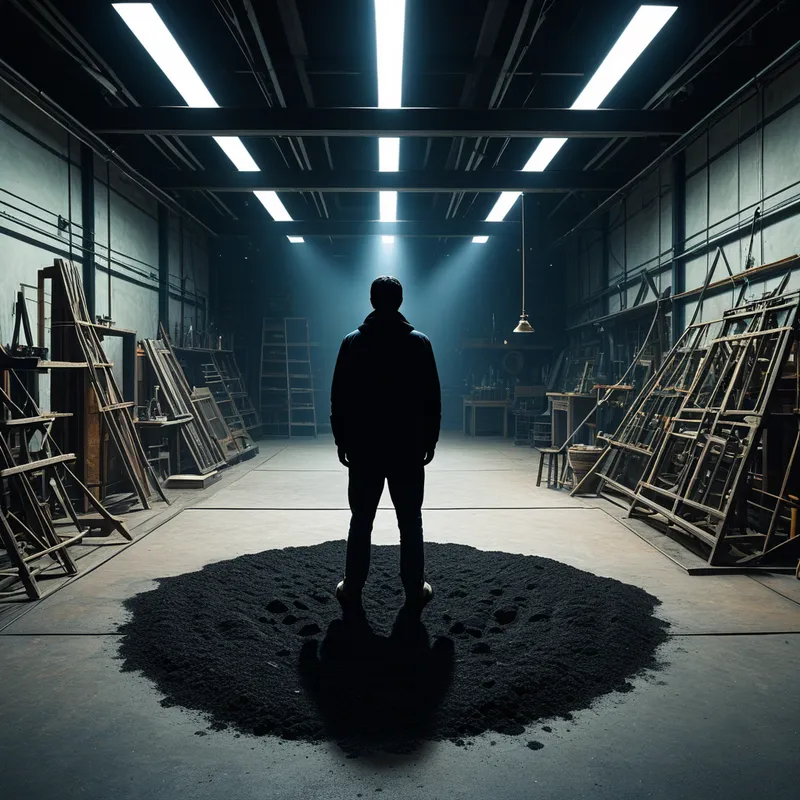
- Basements, caves, or underground workshops filled with fascinating, half-built machinery or art.
- Encountering skilled but taciturn figures in dark places, who are busy with an important task.
- Finding a perfectly crafted, powerful object in a pile of junk or debris.
- The feeling of being in a vast, dark, but strangely safe and purposeful space.
Somatically, this can correlate with a period of introspection, incubation, or feeling “in the dark” about a life direction. Psychologically, it indicates that autonomous processes in the unconscious are actively working on a problem, forging a new capacity, or repairing a psychic structure. The dream is an affirmation: the work is happening, even if you cannot yet see it. The “Loki-fly” of distraction and irritation in the myth may manifest as waking-life anxieties or self-sabotaging thoughts that test one’s focus during this vulnerable, creative period.
Alchemical Translation
The myth of Svartalfheim is a precise map for the alchemical process of individuation. The prima materia—the worthless, base starting material of the alchemists—is the chaotic, unacknowledged content of the personal and collective shadow. The journey to Svartalfheim is the stage of nigredo, the descent into darkness, the confrontation with what is buried.
The ego must become a supplicant at its own forge. It must acknowledge that the power to become whole lies not in what it already knows, but in what it has neglected or feared.
The focused work of the Svartálfar represents the opus, the long, often unconscious work of transformation. The heat of the forge is the intensity of felt experience—joy, grief, conflict, passion. The hammer is the discipline of attention and the repeated impact of reality upon the self. This process refines the raw ore of instinct and potential into a conscious form.
Finally, the return of the gods with their treasures symbolizes rubedo, the reddening, the integration of this newfound power into the light of consciousness. Gungnir is integrated will and purpose. Mjölnir is the capacity for decisive action and setting boundaries. Skidbladnir is the adaptable vehicle of the personality, capable of navigating any inner or outer sea. For the modern individual, this alchemy means that our greatest gifts, our most potent strengths, and our truest purposes are not found in perpetual light, but are forged in the respectful and courageous descent into our own personal Svartalfheim—the creative, potent, and essential darkness within.
Associated Symbols
Explore related symbols from the CaleaDream lexicon: