Svalinn Myth Meaning & Symbolism
The myth of the shield Svalinn, placed before the sun to protect the world from its consuming fire, a story of cosmic balance and necessary sacrifice.
The Tale of Svalinn
Hear now a tale not of thunder or slaughter, but of a silent, steadfast vigil. A story written not in blood, but in light and shadow, upon the very skin of [the world](/myths/the-world “Myth from Tarot culture.”/).
In the time before time’s memory, when the great tree [Yggdrasil](/myths/yggdrasil “Myth from Global/Universal culture.”/) was young and the wells of fate still deep, the gods looked upon their creation and saw a terrible flaw in its heart. For Sol, the sun, daughter of Mundilfari, rode her chariot across [the sky](/myths/the-sky “Myth from Persian culture.”/), pulled by the steeds Arvakr and Alsvid. Her light was life, her warmth a blessing upon the green things of [Midgard](/myths/midgard “Myth from Norse culture.”/). But her nature was fire, pure and unrelenting. Her radiance was not gentle, but a raging furnace, a devouring flame that would sear the mountains, boil the seas, and burn all life to ash if left unchecked.
A dread chill settled in the hall of Odin. The All-Father, who had sacrificed an eye for wisdom, saw the doom written in [the runes](/myths/the-runes “Myth from Norse culture.”/): a world born, only to be consumed by its own brightest star. The gods gathered—the mighty Thor, the cunning Loki, the wise [Forseti](/myths/forseti “Myth from Norse culture.”/). Yet no strength, no trick, no law could temper the essence of the sun itself.
Their hope turned downward, into the roots of the world, to the dark forges of [Svartalfheim](/myths/svartalfheim “Myth from Norse culture.”/). There, in caverns lit by molten rivers, dwelled the master smiths, [the dwarves](/myths/the-dwarves “Myth from Norse culture.”/), whose craft could bind the bones of mountains and the breath of dragons. To them, the gods brought their plea, not for a weapon, but for a salvation. A shield.
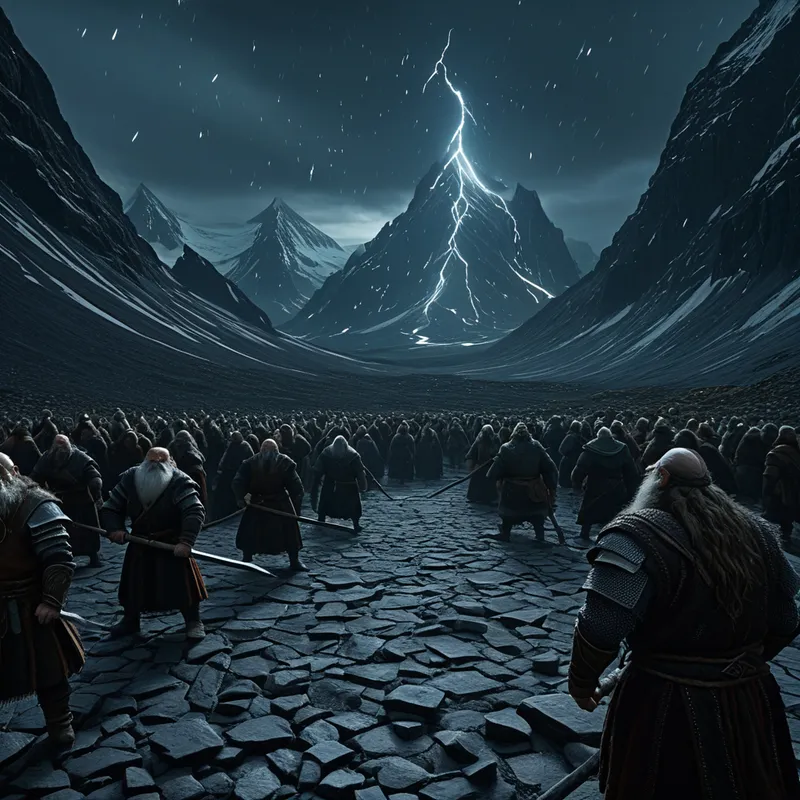
The dwarves listened, their eyes reflecting the forge-fire. They understood the task: to craft not a barrier against arrows or swords, but against destiny. Against entropy. They gathered ores unsmelted by mortal fire, ice from the well [Mímisbrunnr](/myths/mmisbrunnr “Myth from Norse culture.”/), and the breath of the frost-giants. Their hammers fell in a rhythm older than the gods, a song of binding and cooling.
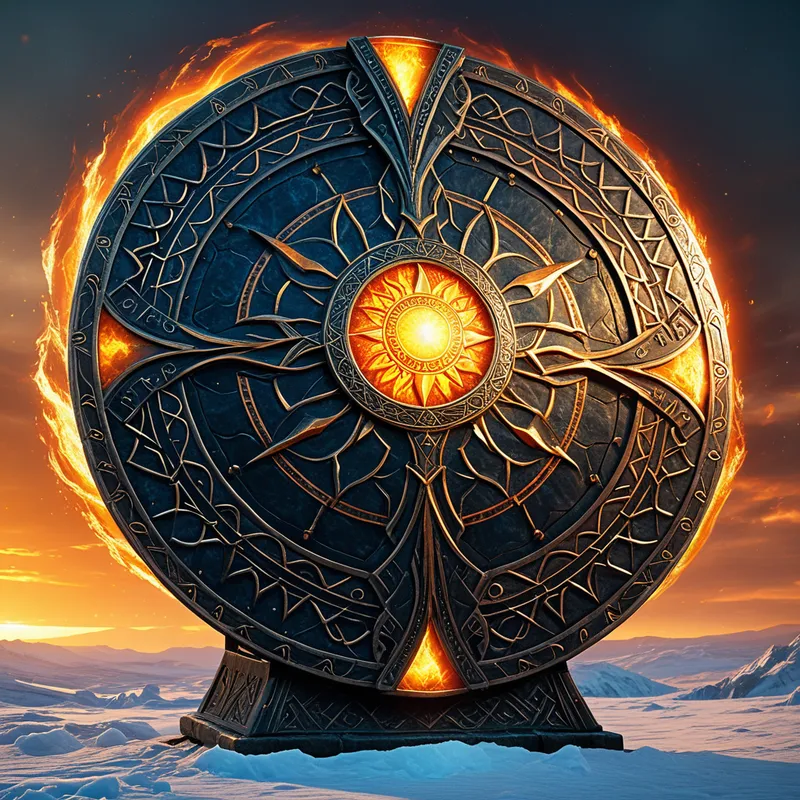
And so, Svalinn was born. It was not merely a disc of metal, but a concept given form. Vast, cold, and serene, its surface held the stillness of the deepest winter night, etched with [runes](/myths/runes “Myth from Norse culture.”/) that whispered of restraint and endurance. It was a paradox: a shield of profound cold, created to stand before the greatest heat.
With solemn ceremony, the gods placed Svalinn before [the chariot](/myths/the-chariot “Myth from Tarot culture.”/) of Sol. Not to block her light, but to filter her fury. The shield did not touch the sun, but hovered eternally between her fire and the tender world. Where Sol’s untamed radiance met Svalinn’s chill essence, the fire was tempered. The killing heat was drawn out, siphoned away into [the void](/myths/the-void “Myth from Buddhist culture.”/), leaving only the life-giving warmth and light to spill over the shield’s rim and cascade down upon the waiting earth.
And there it remains, in the silent reaches of the sky, the unsung guardian. No song is sung for Svalinn in the mead-halls, for it does not fight; it endures. It takes the full, annihilating love of the sun upon itself, so that the world below may know not a scorching kiss, but a nurturing embrace. Its vigil is the price of the dawn, the hidden sacrifice behind every golden hour.
Cultural Origins & Context
The myth of Svalinn is preserved primarily within the Poetic Edda, specifically in the poem Grímnismál (The Sayings of Grímnir). It is presented not as a grand narrative, but as a piece of cosmological fact, nestled among lists of mythical places, horses, and rivers. This tells us much about its function. Svalinn was not a hero for skalds to embellish, but a fundamental component of the Norse understanding of the universe—an answer to a practical, terrifying question: why does the sun not burn us all?
In a culture intimately acquainted with harsh climates, where the balance between the life-giving summer sun and the death-bringing winter was a matter of survival, Svalinn represented a necessary cosmological technology. It explained the stability of the world. The myth likely originated and was passed down among those who contemplated the heavens—chiefs, skalds, and perhaps wise women—as part of a larger body of knowledge about the machinery of the cosmos. Its societal function was one of reassurance. It presented the universe not as chaotic, but as ordered, maintained by unseen structures and sacrifices. The gods were not just warriors and lovers; they were engineers and stewards, employing dwarven craft to impose a fragile, vital balance upon the raw forces of creation.
Symbolic Architecture
Svalinn is the [archetype](/symbols/archetype “Symbol: A universal, primordial pattern or prototype in the collective unconscious that shapes human experience, behavior, and creative expression.”/) of the necessary filter, the mediating principle between a [source](/symbols/source “Symbol: The origin point of something, often representing beginnings, nourishment, or the fundamental cause behind phenomena.”/) of pure potency and a [reality](/symbols/reality “Symbol: Reality signifies the state of existence and perception, often reflecting one’s understanding of truth and life experiences.”/) too fragile to receive it directly. It symbolizes the essential [boundary](/symbols/boundary “Symbol: A conceptual or physical limit defining separation, protection, or identity between entities, spaces, or states of being.”/) that makes [relationship](/symbols/relationship “Symbol: A representation of connections we have with others in our lives, often reflecting our emotional state.”/) possible.
The unmediated encounter with the divine, the unconscious, or our own raw potential is an annihilating fire. Consciousness itself is a Svalinn, a cooling shield that translates the blinding brilliance of the Self into the bearable light of daily life.
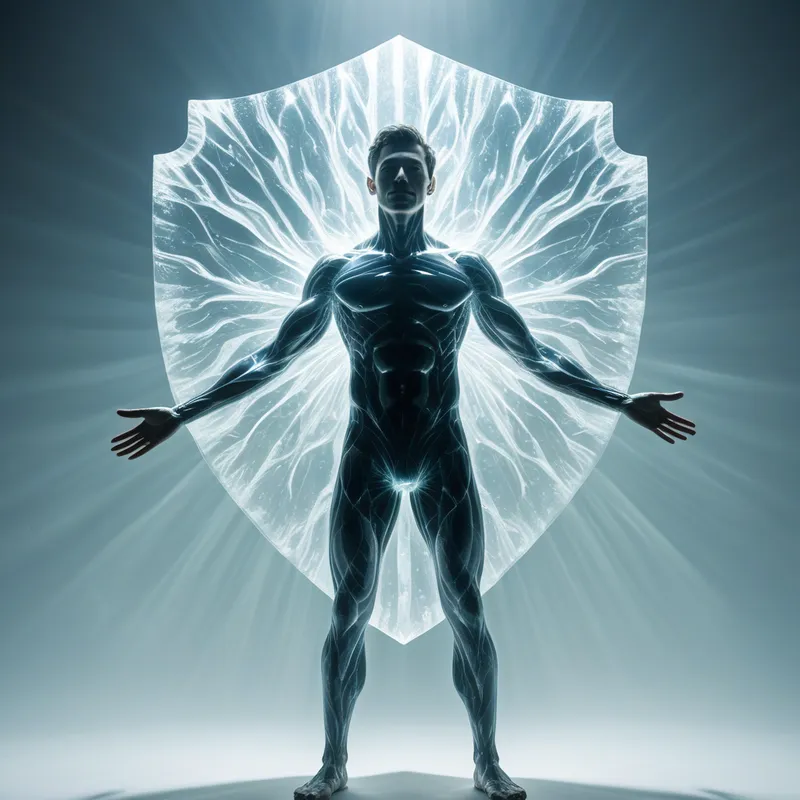
Psychologically, Svalinn represents the ego in its healthiest, most sacred function. Not as a [fortress](/symbols/fortress “Symbol: A fortress symbolizes security and protection, representing both physical and psychological safety from external threats.”/) of [separation](/symbols/separation “Symbol: A spiritual or mythic division between realms, states of being, or consciousness, often marking a transition or loss of connection.”/), but as a permeable, filtering [membrane](/symbols/membrane “Symbol: A thin, flexible barrier that separates, protects, or connects different spaces or states of being.”/). [The ego](/myths/the-ego “Myth from Jungian culture.”/) that identifies with the sun (the total [psyche](/myths/psyche “Myth from Greek culture.”/), or Self) becomes grandiose and destructive. The ego that rejects the sun lives in cold darkness. The conscious ego as Svalinn stands between, doing the sacred work of transduction: it receives the immense, often chaotic [energy](/symbols/energy “Symbol: Energy symbolizes vitality, motivation, and the drive that fuels actions and ambitions.”/) of the unconscious (the solar fire) and translates it into forms that can be integrated into conscious [life](/symbols/life “Symbol: The symbol of ‘Life’ represents a journey of growth, interconnectedness, and existential meaning, encompassing both the joys and challenges that define human experience.”/)—into art, relationship, and purposeful [action](/symbols/action “Symbol: Action in dreams represents the drive for agency, motivation, and the ability to take control of situations in waking life.”/). It takes the heat so the [personality](/symbols/personality “Symbol: Personality in dreams often symbolizes the traits and characteristics of the dreamer, reflecting how they perceive themselves and how they believe they are perceived by others.”/) does not burn.
Furthermore, Svalinn embodies [the principle](/symbols/the-principle “Symbol: A fundamental truth, law, or doctrine that serves as a foundation for a system of belief, behavior, or reasoning, often representing moral or ethical standards.”/) of sacrificial containment. It does not destroy the fire, nor does it run from it. It absorbs the destructive [aspect](/symbols/aspect “Symbol: A distinct feature, quality, or perspective of something, often representing a partial view of a larger whole.”/) so that the creative aspect may pass. This is the model of the [caregiver](/symbols/caregiver “Symbol: A spiritual or mythical figure representing nurturing, protection, and unconditional support, often embodying divine or archetypal parental energy.”/) who must metabolize [anxiety](/symbols/anxiety “Symbol: Anxiety in dreams reflects internal conflicts, fears of the unknown, or stress from waking life, often demonstrating the subconscious mind’s struggle for peace.”/), pain, or [chaos](/symbols/chaos “Symbol: In Arts & Music, chaos represents raw creative potential, uncontrolled expression, and the breakdown of order to forge new artistic forms.”/) to provide a safe [space](/symbols/space “Symbol: Dreaming of ‘Space’ often symbolizes the vastness of potential, personal freedom, or feelings of isolation and exploration in one’s life.”/) for another’s growth. It is the [artist](/symbols/artist “Symbol: An artist symbolizes creativity, expression, and the exploration of the human experience through various forms of art.”/) who must endure the [searing heat](/symbols/searing-heat “Symbol: Searing heat evokes intense emotional and physical states, often symbolizing overwhelming passion or internal conflict.”/) of inspiration to give [birth](/symbols/birth “Symbol: Birth symbolizes new beginnings, transformation, and the potential for growth and development.”/) to a beautiful form. The [shield](/symbols/shield “Symbol: A symbol of protection, defense, and boundaries, representing personal security, resilience, and the need to guard against external threats or emotional harm.”/) itself is forever changed, bearing the scars of its eternal [office](/symbols/office “Symbol: Dreaming of an office often symbolizes a space of responsibility, work-related stress, or the pursuit of goals in one’s waking life.”/), becoming [the thing](/myths/the-thing “Myth from Norse culture.”/) that stands between wholeness and annihilation.
The Dreamer’s Resonance
When the pattern of Svalinn stirs in the modern dreamer’s psyche, it often manifests in dreams of overwhelming light or heat, and the desperate search for a buffer. One might dream of a blinding spotlight on a stage, a nuclear blast on [the horizon](/myths/the-horizon “Myth from Various culture.”/), or a house on fire, coupled with the discovery of a hidden wall, a sheet of ice, or a sudden, cool shadow that provides sanctuary.
Somatically, this can correlate with feelings of being “fried,” overstimulated, or emotionally scorched—states of burnout, anxiety, or hyper-vigilance where the nervous system feels exposed to raw, unmodulated input. Psychologically, this dream motif signals that a powerful content from the unconscious—a burst of creative energy, a long-buried trauma, a tidal wave of emotion, or an inflating inflation—is threatening to break into consciousness without a proper vessel to hold it. The psyche is sounding an alarm: the mediating function is failing. The dream is a call to forge or repair one’s own Svalinn—to establish boundaries, find grounding practices, or begin the therapeutic work of building a conscious ego strong enough to relate to, but not be identified with, the powerful forces within.
Alchemical Translation
The alchemical journey mirrored in the Svalinn myth is the opus contra naturam—the work against nature, which here means the work against pure, undifferentiated expression. It is the process of creating the Philosopher’s Stone not as a weapon, but as a vessel.
The initial state is sol niger, the black sun: the raw, undifferentiated libido or life force that, in its pure state, is as destructive as it is vital. This is the sun before Svalinn. The alchemical operation is the creation of the vas ([the vessel](/myths/the-vessel “Myth from Alchemical culture.”/)). This is not an act of suppression, but of sacred craftsmanship. The dreamer must, like the dwarves, descend into the dark, earthy realm of the body and instinct (Svartalfheim) to gather the “ores” of discipline, the “ice” of reflection, and the “breath” of conscious breathwork or somatic awareness. From these, one forges a capacity for containment.
Individuation is not about becoming the sun, but about becoming the shield that can stand before it. The goal is not to emit blinding light, but to create the conditions under which life can flourish in its warmth.
The [triumph](/myths/triumph “Myth from Roman culture.”/) is the establishment of a permanent, dynamic relationship. The integrated Self is not a fusion where ego and unconscious become one blazing fire—that is psychosis. It is a stable, resonant system where the conscious personality (Svalinn) and the central archetype of wholeness (the Sun/Self) are in constant, creative dialogue. The heat of transformation is continually absorbed and transmuted into the warmth of wisdom and compassionate action. The individual becomes a living crucible, a point of balance where the fires of the deep psyche are safely translated into the light of a meaningful life. They carry the cool, enduring shadow of Svalinn within them, making the world, and their own inner world, habitable.
Associated Symbols
Explore related symbols from the CaleaDream lexicon: