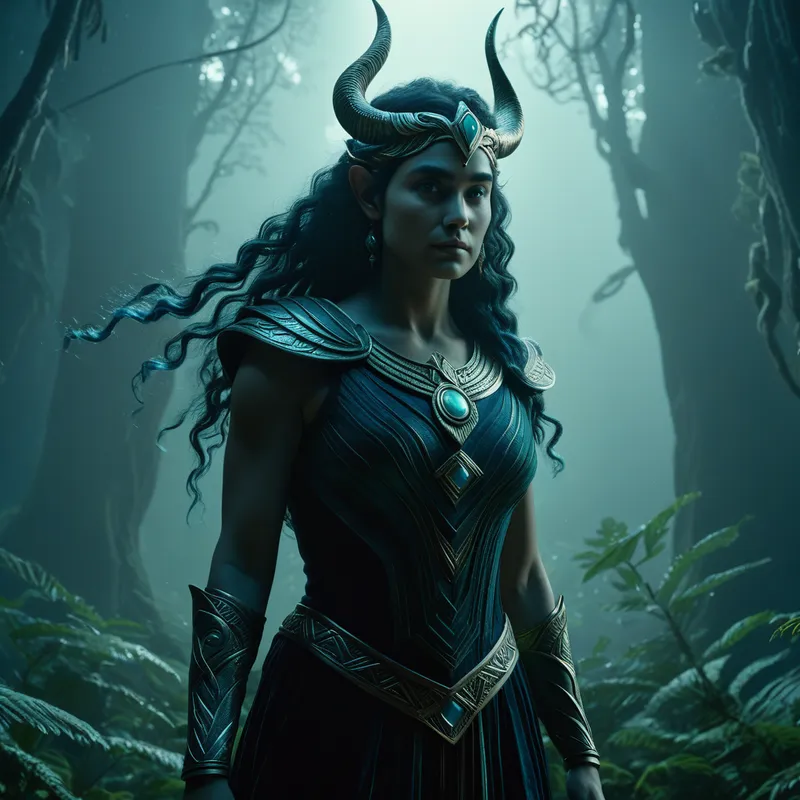
Susanoo Slays Yamata no Orochi
The storm god Susanoo defeats the monstrous eight-headed serpent Yamata no Orochi through trickery and valor, a pivotal myth in Shinto tradition.
The Tale of Susanoo Slays Yamata no Orochi
The tale begins in exile. [Susanoo](/myths/susanoo “Myth from Japanese culture.”/), the impetuous storm god, brother to the sun goddess [Amaterasu](/myths/amaterasu “Myth from Japanese Shinto culture.”/), had been cast from the heavenly plain of Takamagahara. His violent grief and chaotic tantrums had shattered the divine order, and for this, he was banished. Descending to the earthly realm of Ashihara no Nakatsukuni, he wandered, a divine force of nature untethered, his power a raw and untamed river seeking a channel.
His wandering brought him to the headwaters of [the River](/myths/the-river “Myth from Buddhist culture.”/) Hi, in the land of Izumo. There, he heard a sound woven from sorrow—the soft, broken weeping of humans. He followed the sound and came upon an elderly couple, the earthly deities Ashinazuchi and Tenazuchi, who cradled their youngest daughter, Kushinada-hime, in despair. They told the imposing stranger of their plight: once they had eight daughters, but for seven years, the monstrous eight-headed, eight-tailed serpent, Yamata no Orochi, had come from across [the sea](/myths/the-sea “Myth from Greek culture.”/) to devour one each year. Now, only Kushinada-hime remained, and the serpent’s arrival was imminent.
Susanoo’s stormy gaze fell upon the maiden, and in her, he saw a reflection not of a victim, but of a purpose. A fire kindled within his exiled heart—not the rage of [chaos](/myths/chaos “Myth from Greek culture.”/), but the focused fury of a protector. He declared he would slay the beast, but on one condition: that Kushinada-hime become his bride. The desperate parents agreed.
Here, the raw force of the storm god met the cunning of [the trickster](/myths/the-trickster “Myth from Various culture.”/). He did not merely prepare for battle; he orchestrated a scene. He instructed the couple to brew sake of surpassing potency, to build a fence with eight gates, and to place at each gate a vat filled to the brim with the sacred, intoxicating brew. Then, he transformed Kushinada-hime into a many-toothed comb, which he tucked safely into his hair—a symbolic act of taking her essence into his own being, protecting her by making her part of his divine form.
[The earth](/myths/the-earth “Myth from Hindu culture.”/) trembled. Yamata no Orochi arrived, a mountain of scaled flesh in motion, its eight heads drinking from eight valleys, its eight tails scraping the heavens, its body draped with moss and ancient cypress trees. The scent of the sake, however, proved more potent than the scent of the maiden. Each of the eight great heads dipped into a vat and drank deeply, gulping the divine liquor until the monstrous consciousness was submerged in a stupor. The serpent, this embodiment of insatiable, cyclical consumption, was laid low by its own gluttony.
Only then did Susanoo move. Drawing his Totsuka no Tsurugi, he fell upon the drunken beast. His blade was a tempest given edge, cutting through scale and sinew, severing head after tail until the great serpent lay dead in the river, its blood so profuse it turned the waters of the Hi to a deep crimson. As he cleaved the fourth tail, his sword struck something hard within the flesh. Curious, he cut open the flesh to find a magnificent blade, untainted by blood or gore, gleaming with its own [inner light](/myths/inner-light “Myth from Buddhist culture.”/). This was the sword Ame-no-Murakumo-no-Tsurugi (later called [Kusanagi-no-Tsurugi](/myths/kusanagi-no-tsurugi “Myth from Japanese culture.”/)). Recognizing its profound divinity, Susanoo offered it as a gift of reconciliation to his sister Amaterasu, a seed of order born from his conquest of chaos.
With the serpent slain and the sacred sword discovered, Susanoo built a palace at Suga. The clouds parted, and a sense of peace settled over the land. He brought forth Kushinada-hime from the comb in his hair, restoring her to human form, and made her his wife, singing a song of joy that marked the founding of a divine lineage in Izumo. The exiled god had, through an act of cunning violence, carved out a place for himself and established a new order on earth.
Cultural Origins & Context
This myth is primarily recorded in two of Japan’s oldest chronicles: the Kojiki (712 CE) and the Nihon Shoki (720 CE). It is a foundational narrative of the Izumo cycle of myths, which centers on the deities and lineage of that region, later integrated into the broader Shinto [pantheon](/myths/pantheon “Myth from Roman culture.”/) centered on Amaterasu and the Yamato line.
The story operates on multiple cultural levels. Historically, it can be read as a mythologized account of the taming of a mighty river (the Hi), with the serpent representing its destructive, flooding power, and Susanoo’s victory symbolizing successful land reclamation and agricultural control—the sake vats echoing irrigation pools. Theologically, it marks Susanoo’s transition from a purely chaotic, heavenly force to a kami (spirit/deity) of the earthly realm who engages with and protects humanity. His offering of the Kusanagi sword to Amaterasu is a crucial act of re-integration, symbolizing the submission (or harmonious incorporation) of the powerful Izumo spiritual tradition to the imperial lineage descended from the Sun Goddess. The myth thus narrates a divine diplomacy, where valor and cunning resolve cosmic strife and forge the sacred instruments of sovereignty.
Symbolic Architecture
At its core, the myth is an alchemical [drama](/symbols/drama “Symbol: Drama signifies narratives, emotional expression, and the exploration of human experiences.”/) of transformation. Susanoo begins as exiled [chaos](/symbols/chaos “Symbol: In Arts & Music, chaos represents raw creative potential, uncontrolled expression, and the breakdown of order to forge new artistic forms.”/) and ends as a founding, ordering principle. The Orochi is not merely a [monster](/symbols/monster “Symbol: Monsters in dreams often symbolize fears, anxieties, or challenges that feel overwhelming.”/) but a [symbol](/symbols/symbol “Symbol: A symbol can represent an idea, concept, or belief, serving as a powerful tool for communication and understanding.”/) of undifferentiated, cyclical, and devouring [nature](/symbols/nature “Symbol: Nature symbolizes growth, connectivity, and the primal forces of existence.”/)—an eight-fold repetition that signifies an endless, unconscious process. The confrontation is not between good and evil, but between two types of power: the [serpent](/symbols/serpent “Symbol: A powerful symbol of transformation, wisdom, and primal energy, often representing hidden knowledge, healing, or temptation.”/)’s blind, repetitive consumption and the storm god’s intelligent, strategic force that channels [chaos](/symbols/chaos “Symbol: In Arts & Music, chaos represents raw creative potential, uncontrolled expression, and the breakdown of order to forge new artistic forms.”/) into creative [action](/symbols/action “Symbol: Action in dreams represents the drive for agency, motivation, and the ability to take control of situations in waking life.”/).
The eight heads of the Orochi represent a fragmented, monstrous multiplicity—consciousness split and scattered by appetite. Susanoo’s trick with the eight vats is a mirror: he presents a structured multiplicity (the gates and vats) that reflects and entraps the serpent’s own nature, forcing its disparate attentions into a single, fatal focus.
The transformation of Kushinada-hime into a comb is a profound metaphysical act. The comb (kushi) is associated with purification and binding in Shinto ritual. By turning her into this object and placing her in his hair—the seat of life force and power in ancient Japanese belief—Susanoo does not hide her; he internalizes the principle of beauty, order, and sacred life, making it the driving motive for his heroic act. He fights not just for her, but from the place within him where she now resides.
The [discovery](/symbols/discovery “Symbol: The act of finding something previously unknown, hidden, or lost, often representing personal growth, new opportunities, or hidden aspects of the self.”/) of the Kusanagi sword within the serpent’s [tail](/symbols/tail “Symbol: A tail in dreams can symbolize instincts, connection to one’s roots, or the hidden aspects of personality.”/) is the myth’s ultimate [revelation](/symbols/revelation “Symbol: A sudden, profound disclosure of truth or insight, often through artistic or musical means, that transforms understanding.”/): the [instrument](/symbols/instrument “Symbol: An instrument symbolizes creativity, communication, and the means by which one expresses oneself or influences the world.”/) of supreme order and sovereignty is born from the [heart](/symbols/heart “Symbol: The heart symbolizes love, emotion, and the core of one’s existence, representing deep connections with others and self.”/) of chaos itself. The victory is not the annihilation of the chaotic principle, but its mastery and the extraction of its hidden, most refined essence.
The Dreamer’s Resonance
For the individual [psyche](/myths/psyche “Myth from Greek culture.”/), the myth of Susanoo and the Orochi maps the journey of confronting a monstrous, repetitive pattern—an addiction, a consuming grief, a cyclical rage, or a complex that seems to have a life of its own with many heads (excuses, manifestations, triggers). Like the yearly sacrifice, the pattern promises to devour what is most precious, one’s vitality or future (Kushinada-hime).
Susanoo represents the aspect of [the Self](/myths/the-self “Myth from Jungian culture.”/) that, though initially exiled (feeling cast out from one’s own center or society), can mobilize. His strategy is instructive. He does not meet the monster with raw, untempered force initially; that was the nature of his exile. Instead, he uses observation (learning its habits), cunning (the sake), and preparation (the eightfold fence). He creates a container—a ritual space—to manage the encounter. The dreamer is called to build their own “fence with eight gates”: a structured, conscious approach to a problem that seems overwhelmingly multifaceted.
The transformation of the maiden symbolizes the need to internalize one’s vulnerable, beautiful, and creative potential as a sacred, protected value before engaging the battle. The fight then becomes one of defense of an inner sanctum, not just an external rescue. The “drunken stupor” of the serpent is that moment when the compulsive pattern, lured by its own nature, becomes visible, sluggish, and vulnerable to decisive, conscious action.
Alchemical Translation
The myth is a perfect allegory for psychological alchemy. The [prima materia](/myths/prima-materia “Myth from Alchemical culture.”/), the base matter to be transformed, is Susanoo himself—the exiled, raw, emotional storm. The Orochi is [the shadow](/myths/the-shadow “Myth from Jungian culture.”/), the monstrous, undifferentiated content of the unconscious that must be engaged. The vas or vessel is the constructed ritual space of the fence and vats, the conscious ego setting the stage for transformation.
The potent sake is the symbol of spiritus, the intoxicating spirit or numinous insight that can dissolve rigid structures. Poured into the vessels of conscious preparation, it serves to “soften” the hardened, repetitive complex, making it penetrable.
The battle is the [nigredo](/myths/nigredo “Myth from Alchemical culture.”/), the blackening—a necessary, violent confrontation and dissolution. The river running red with blood signifies this stage of mortification. From this darkness, within the very flesh of the slain beast, emerges the [lapis philosophorum](/myths/lapis-philosophorum “Myth from Alchemical culture.”/), the philosopher’s stone: the gleaming Kusanagi sword. This is the [rubedo](/myths/rubedo “Myth from Alchemical culture.”/), the reddening, the creation of a new, enduring, and potent principle of consciousness (the empowered will, the clarified purpose) from the conquered chaos. Susanoo’s subsequent marriage and palace-building represent the citrinitas, the yellowing or integration of this new principle into a stable, fruitful life.
Associated Symbols
Explore related symbols from the CaleaDream lexicon:
- Serpent — The multi-headed form of primal, cyclical, and devouring nature, representing an unconscious complex or undifferentiated life force that consumes without order.
- Trickster — The aspect of the divine or psyche that uses cunning, misdirection, and intelligence to overcome brute force, here embodied by Susanoo’s strategic preparation.
- Sword — The discerning, cutting power of consciousness that separates, defines, and ultimately extracts sacred order from the flesh of chaotic experience.
- Chaos — The raw, exiled, and untamed divine force as well as the monstrous, repetitive disorder represented by the Orochi, the essential material for transformation.
- Ritual — The structured, intentional act (building the fence, preparing the vats) that creates a sacred container to safely engage with overwhelming powers.
- Sacrifice — The cyclical offering demanded by the unconscious pattern, and the ultimate sacrifice of the old, monstrous form to birth a new reality.
- Rebirth — Susanoo’s rebirth as a founding deity and husband, and the symbolic rebirth of Kushinada-hime from comb to human, marking a new beginning.
- Storm — The volatile, powerful, and cleansing nature of Susanoo’s essence, representing turbulent emotion that can both destroy and purify.
- Bridge — Susanoo’s act serves as a bridge between heavenly chaos and earthly order, and between the human plight and divine intervention.
- Primal Chaos — The fundamental, undifferentiated state from which both the monstrous serpent and the god of storms emerge, the essential ground of being.