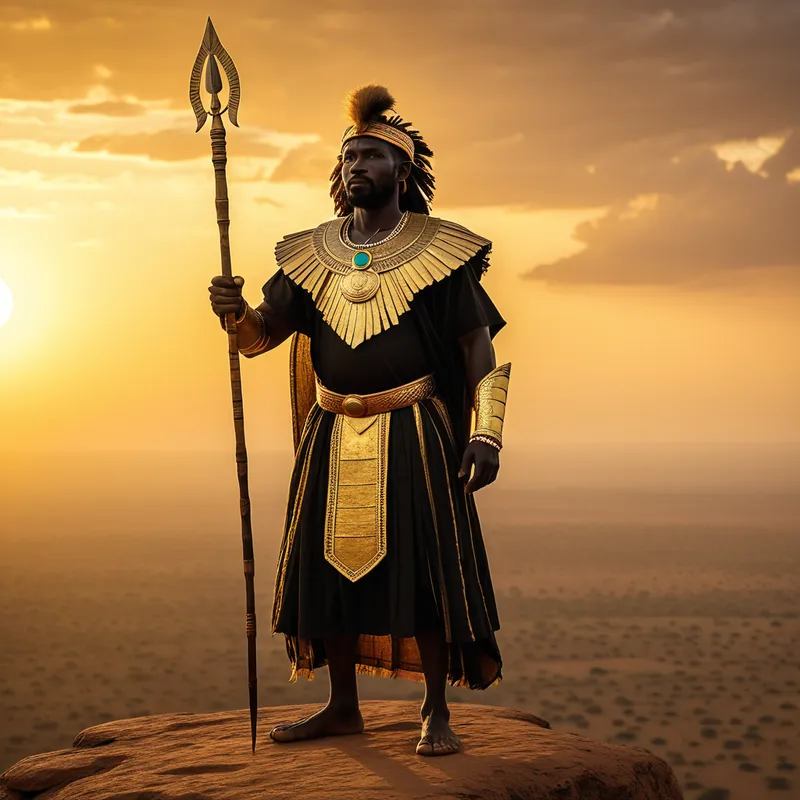
Sundiata Keita Epic Myth Meaning & Symbolism
The epic of a prophesied child, crippled and exiled, who overcomes destiny to reclaim his throne and forge the great Mali Empire through wisdom and strength.
The Tale of Sundiata Keita Epic
Listen, and hear the story that the griot sings under the vast, star-scattered sky of the Sahel. It begins not with a roar, but with a silence. In the kingdom of Manding, a prophecy hangs in the air, thick as the harmattan dust. A hunter from afar comes to King Maghan Kon Fatta, bearing a strange and powerful message: a woman of great ugliness will bear him the son who will become a mighty king, a sun of glory for the Mandinka people. The king marries the hunchbacked woman, Sogolon Kedjou, and from this union, a son is born. They name him Sundiata.
But the sun is slow to rise. Sundiata does not walk. For seven long years, he crawls upon the earth, his legs weak and useless. The court whispers. His father’s first wife, the jealous Sassouma Bérété, mocks Sogolon and her “crippled” child, while her own son, Dankaran Touman, is groomed for the throne. The air in the palace is poisoned with scorn. When the old king dies, the prophecy seems a cruel joke. Sassouma’s faction seizes power, and Sogolon, with her children, is cast out into the world, a fugitive from her own home.
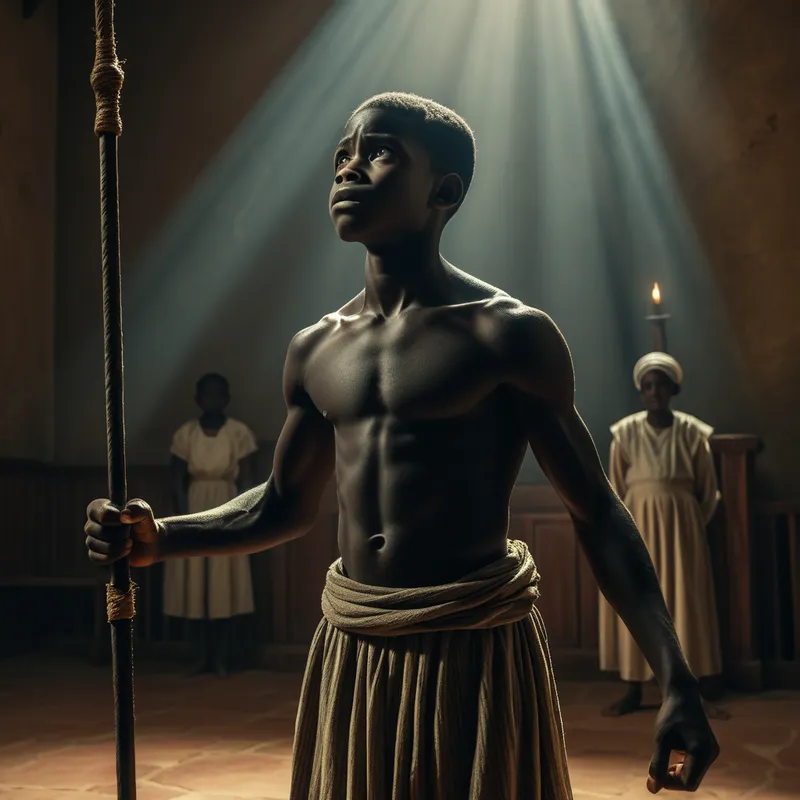
Their exile is a long, bitter road—a journey through kingdoms and wilderness, a tasting of humiliation and a gathering of strength. Sundiata crawls, then, one fateful day, his mother’s despair reaches a breaking point. She cries out her shame. And something in the boy, the lion cub, stirs. With a mighty effort that shakes the very ground, he grasps a massive iron rod and pulls himself upright. The rod bends, but Sundiata stands. He walks. The cripple is no more.
Now the lion begins his journey in truth. From court to court, Sundiata grows in wisdom, in strength, in charisma. He learns the arts of war and the deeper arts of leadership. He forges unbreakable alliances, binding powerful figures like the fierce hunter Fakoli and the sorcerer-king Soumaoro Kanté—who later becomes his nemesis. For a dark shadow has fallen over Manding. The sorcerer-king Soumaoro, with his magic and his cruelty, has seized Sundiata’s homeland. His tower in Sosso is a place of terror, lined with the skins of his vanquished foes.
The call to liberation sounds. Sundiata assembles his army, a tapestry of the diverse peoples he has won over. The final confrontation is not of brute force alone. To defeat a sorcerer, one must know his secret. Sundiata learns that Soumaoro’s power resides in a sacred grigri. In the great Battle of Kirina, the armies clash like thunder. Sundiata, guided by wisdom, fits an arrow tipped with the spur of a white rooster—the only thing to which Soumaoro is vulnerable. He lets it fly. It strikes the sorcerer-king’s grigri, and all his power drains away. Soumaoro vanishes, turned to stone on a distant mountainside.
Victorious, Sundiata returns to a liberated Manding. He does not merely reclaim a throne; he forges an empire. The Manden Charter is proclaimed, establishing laws of justice, social responsibility, and environmental stewardship. The crippled child, the exiled wanderer, has become Mansa Sundiata, the Lion King, the unifier of the Mali Empire. His roar brings not fear, but order, prosperity, and a legacy that echoes through centuries.
Cultural Origins & Context
This is not merely a story; it is the living spine of a people’s memory. The Epic of Sundiata is the foundational national narrative of the Mandinka people and the Mali Empire, passed down orally for over seven centuries by the griots (or jeli). These master oral historians were not entertainers alone but the custodians of law, genealogy, and ethical philosophy. To hear a griot perform the epic was to participate in a ritual of cultural identity, a reinforcement of social values, and a lesson in the qualities of just leadership.
The epic exists in many variants across West Africa, reflecting the fluid and dynamic nature of oral tradition. Each performance is unique, tailored to the occasion and the audience, yet the core architecture of the tale—the prophesied birth, the childhood disability, the exile, the gathering of allies, the magical confrontation, and the founding of a just state—remains constant. It functions as a mytho-historical document, blending verifiable historical figures and events (Sundiata Keita is widely accepted as the actual 13th-century founder of the Mali Empire) with archetypal, supernatural elements. This blend served to sacralize history, rooting political authority in a divine or destined order, and providing a template for what a true ruler should be: resilient, wise, strategic, and fundamentally connected to the well-being of all his people.
Symbolic Architecture
At its [heart](/symbols/heart “Symbol: The heart symbolizes love, emotion, and the core of one’s existence, representing deep connections with others and self.”/), the Sundiata epic is a masterful map of the [individuation process](/symbols/individuation-process “Symbol: The psychological journey toward self-realization and wholeness, integrating conscious and unconscious aspects of personality.”/), the [journey](/symbols/journey “Symbol: A journey in dreams typically signifies adventure, growth, or a significant life transition.”/) to become who one is destined to be against all apparent odds.
The true king is not born on a throne, but forged in the crucible of exile and scorn. His legitimacy comes not from blood alone, but from the bending of the iron rod of fate.
Sundiata’s [childhood](/symbols/childhood “Symbol: Dreaming of childhood often symbolizes nostalgia, innocence, and unresolved issues from one’s formative years.”/) [paralysis](/symbols/paralysis “Symbol: A state of being unable to move or act, often representing feelings of powerlessness, fear, or being trapped in waking life.”/) is the ultimate [symbol](/symbols/symbol “Symbol: A symbol can represent an idea, concept, or belief, serving as a powerful tool for communication and understanding.”/) of latent potential. He is the unmanifested self, the [puer aeternus](/symbols/puer-aeternus “Symbol: The eternal youth archetype representing perpetual adolescence, divine child energy, and resistance to mature adulthood.”/) trapped in a state of powerlessness. His crawling represents a profound [connection](/symbols/connection “Symbol: Connection symbolizes relationships, communication, and bonds among individuals.”/) to the [earth](/symbols/earth “Symbol: The symbol of Earth often represents grounding, stability, and the physical realm, embodying a connection to nature and the innate support it provides.”/) [mother](/symbols/mother “Symbol: The symbol of ‘Mother’ represents nurturing, protection, and the foundational aspect of one’s emotional being, often associated with comfort and unconditional love.”/), but one that must be transcended to enter the vertical, sovereign world of [action](/symbols/action “Symbol: Action in dreams represents the drive for agency, motivation, and the ability to take control of situations in waking life.”/) and order. The iron rod is the will itself—the unyielding, masculine principle of [consciousness](/symbols/consciousness “Symbol: Consciousness represents the state of awareness and perception, encompassing thoughts, feelings, and experiences.”/) that must be engaged, and in being engaged, is transformed (bent) by the [effort](/symbols/effort “Symbol: Effort signifies the physical, mental, and emotional energy invested toward achieving goals and personal growth.”/). His standing is the first and most critical act of self-creation.
[Exile](/symbols/exile “Symbol: Forced separation from one’s homeland or community, representing loss of belonging, punishment, or profound isolation.”/) is not [punishment](/symbols/punishment “Symbol: A dream symbol representing consequences for actions, often tied to guilt, societal rules, or internal moral conflicts.”/) but [initiation](/symbols/initiation “Symbol: A symbolic beginning or transition into a new phase, status, or awareness, often involving tests, rituals, or profound personal change.”/). It is the necessary journey into the unknown, where the ego (the [prince](/symbols/prince “Symbol: A prince symbolizes nobility, leadership, and aspiration, often representing potential or personal authority.”/) of a single [kingdom](/symbols/kingdom “Symbol: A kingdom symbolizes authority, belonging, and a sense of identity within a larger context or community.”/)) is dissolved so that the larger Self (the emperor of a diverse coalition) can be assembled. Each ally Sundiata gathers—the hunter, the sorcerer-[king](/symbols/king “Symbol: A symbol of ultimate authority, leadership, and societal order, often representing the dreamer’s inner power or external control figures.”/), the displaced princes—represents an [aspect](/symbols/aspect “Symbol: A distinct feature, quality, or perspective of something, often representing a partial view of a larger whole.”/) of his own psyche he must integrate: instinctual prowess, mystical [knowledge](/symbols/knowledge “Symbol: Knowledge symbolizes learning, understanding, and wisdom, embodying the acquisition of information and enlightenment.”/), and the shared wounds of [injustice](/symbols/injustice “Symbol: A perceived violation of fairness, rights, or moral order, often evoking a sense of imbalance or ethical breach.”/). His [nemesis](/symbols/nemesis “Symbol: The Greek goddess of retribution and divine justice, representing inevitable consequences for hubris and moral imbalance.”/), Soumaoro Kanté, is his own [shadow](/symbols/shadow “Symbol: The ‘shadow’ embodies the unconscious, repressed aspects of the self and often represents fears or hidden emotions.”/) in magnified form: a ruler who uses power for domination and [terror](/symbols/terror “Symbol: An overwhelming, primal fear that paralyzes and signals extreme threat, often linked to survival instincts or deep psychological trauma.”/), the dark potential of the [king](/symbols/king “Symbol: A symbol of ultimate authority, leadership, and societal order, often representing the dreamer’s inner power or external control figures.”/) [archetype](/symbols/archetype “Symbol: A universal, primordial pattern or prototype in the collective unconscious that shapes human experience, behavior, and creative expression.”/) Sundiata must consciously overcome.
The Dreamer’s Resonance
When this mythic pattern stirs in the modern dreamer, it speaks to a profound somatic and psychological process of claiming one’s authority. To dream of being crippled or unable to walk, yet feeling a fierce, undeniable destiny, mirrors Sundiata’s early years. The body in the dream often holds the memory of a disempowerment—a familial “curse,” a societal dismissal, an internalized shame that has grounded one’s potential.
Dreams of long, arduous journeys through unfamiliar landscapes, seeking aid or refuge, reflect the exile phase. This is the psyche’s way of orchestrating a necessary departure from old, constricting identities (the “palace” of conditioned life). The gathering of strange allies in dreams—powerful animals, enigmatic guides, or fellow travelers—signals the unconscious assembling the resources needed for the coming integration. A dream confrontation with a terrifying, magical, or tyrannical figure (a Soumaoro) often appears when the dreamer is on the cusp of a major life change, representing the final, formidable internal resistance—the fear of one’s own power, the addictive pull of old weaknesses, or the “tower” of a rigid, defensive complex that must be dissolved.

Alchemical Translation
The alchemy of the Sundiata epic is the transmutation of the prima materia of suffering and exclusion into the gold of sovereign wholeness and social harmony.
The empire is built first within. The external kingdom is but a reflection of the internal order achieved through the integration of shadow, ally, and exiled part.
The process begins with Nigredo, the blackening: the crippled state, the humiliation, the exile into darkness. This is the essential dissolution of the ego’s pretensions. The act of standing on the iron rod is the first Albedo, the whitening—a flash of conscious will that illuminates the path. The long exile and alliance-building represent Citrinitas, the yellowing, the slow, often confusing work of gathering and understanding the disparate elements of the self from the wilderness of the unconscious.
The final battle is the Rubedo, the reddening or culmination. Soumaoro is not destroyed in a blaze of hatred, but neutralized by a precise, knowing strike at the source of his power (the rooster-spur arrow). This symbolizes the conscious integration of the shadow: understanding its vulnerability and transforming its energy, rather than engaging in a futile war of repression. The vanished sorcerer-king turned to stone signifies a complex that has lost its animating power and become a fixed, historical monument in the psyche, no longer a ruling force.
The founding of the Mali Empire and the proclamation of the Manden Charter represent the ultimate goal of individuation: the establishment of a conscious, ethical order within the self. The once-crippled child now administers a kingdom where all internal “tribes” (instincts, emotions, thoughts, intuitions) have a rightful place and function under a just, unifying consciousness. The epic teaches that personal destiny is fulfilled not in solitary triumph, but in the creation of a world—inner and outer—where life can flourish.
Associated Symbols
Explore related symbols from the CaleaDream lexicon:
- Lion — The central archetype of Sundiata, representing royal authority, fierce courage, and the awakened, sovereign self that emerges from a state of latent potential.
- Journey — The essential structure of the epic, symbolizing the initiatory path of exile, trials, and the gathering of wisdom necessary for transformation and the claiming of one’s throne.
- Destiny — The prophetic force that guides Sundiata’s life, representing the pull of the Self, the inescapable call to become what one is fundamentally meant to be, despite all obstacles.
- Mother — Embodied by Sogolon, the unlikely but destined queen mother, representing the nurturing, protective, and sometimes shamed feminine force that sustains the hero until he can stand on his own.
- Shadow — Manifest in the sorcerer-king Soumaoro Kanté, representing the tyrannical, magical, and terrifying aspect of power that the hero must confront, understand, and integrate to become whole.
- Hero — The archetypal pattern Sundiata fulfills: rising from lowly or impaired beginnings, overcoming monumental trials, and achieving a victory that benefits not just himself but his entire community.
- Tree — Reflected in the sacred Sobo tree, symbolizing life, resilience, connection to ancestral wisdom, and the organic growth of a kingdom from deep roots.
- Mountain — The distant, rocky place where Soumaoro is turned to stone, representing the final, immutable integration of the shadow complex into the landscape of the self.
- Crown — The rightful sovereignty Sundiata reclaims and redefines, symbolizing the achieved integration of the personality and the conscious assumption of responsibility for one’s inner and outer kingdom.
- Iron — The material of the rod Sundiata uses to stand, representing will, strength, resilience, and the transformative power of applied effort that bends fate itself.
- Dance — The celebration of victory and unity, symbolizing the harmonious order (the Manden Charter) established after the struggle, where all parts of the community move in sync.
- Fate — The intertwined threads of prophecy and action that guide the narrative, representing the mysterious dialogue between predetermined destiny and the free will required to enact it.