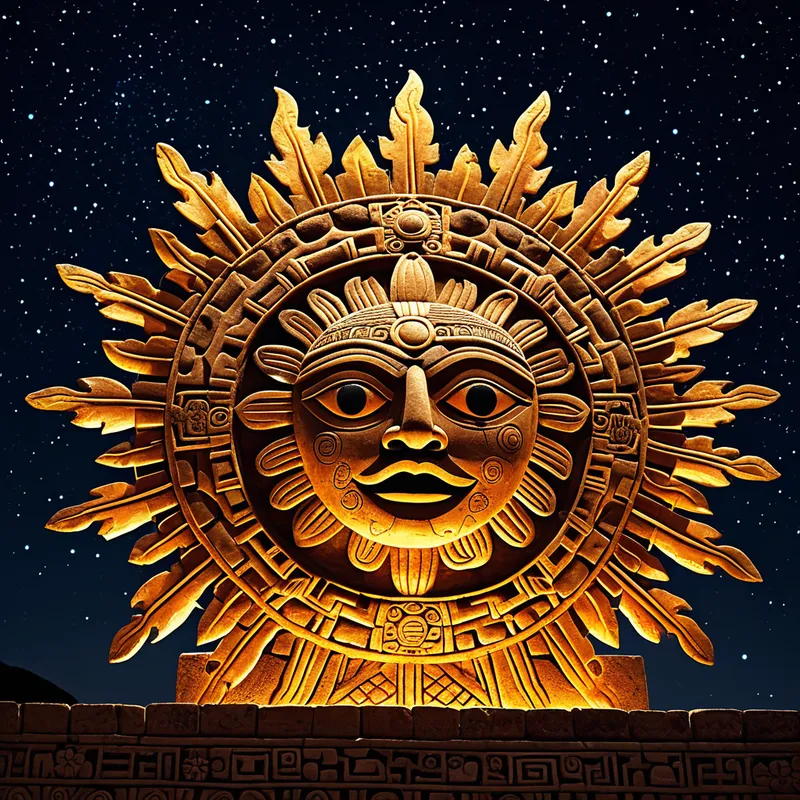
Sun Stone Myth Meaning & Symbolism
The myth of the Fifth Sun, where the gods sacrifice themselves to create the current world, demanding perpetual human devotion to keep the cosmos moving.
The Tale of Sun Stone
In the beginning, there was only the black, starless water. From its depths, the primordial duality, Ometecuhtli and Omecihuatl, dreamed the gods into being. But their creation was a void, a canvas without light or time. The gods gathered in the sacred city of Teotihuacan, not a city of men, but a divine forge. Their purpose: to birth a Sun, to set the wheel of ages in motion.
The first attempt was the Sun of Earth. The proud god Tlaloc was chosen. He was cast into the divine fire, and for a time, giants walked the earth under his dim light. But this world was destroyed by jaguars, creatures of the eternal night. The second Sun, the Sun of Wind, was ruled by Quetzalcoatl. It ended when great hurricanes scoured the earth, and people were turned into monkeys. The third, the Sun of Fire Rain, presided over by the god of the evening star, was consumed by a rain of fire. The fourth, the Sun of Water, governed by Chalchiuhtlicue, was drowned in a global flood, its people becoming fish.
Now, the gods stood in the twilight of the fourth destruction. The void yawned, hungry. To create a Fifth Sun, a new, greater sacrifice was needed. Not just one god, but all. Two volunteered to become the sun itself: the vain, wealthy Tecciztecatl, adorned in quetzal feathers and gold, and the humble, diseased Nanahuatzin, covered in sores, clad in paper.
A great bonfire was lit, a pyramid of flame that touched the heavens. Tecciztecatl approached first, but four times he recoiled from the terrible heat, his courage failing. Then Nanahuatzin, without hesitation, closed his eyes, steadied his heart, and walked resolutely into the inferno. His body crackled, his spirit ignited. Shamed by this humble courage, Tecciztecatl finally leaped in after him.
From the ashes, two suns rose in the east. One, brilliant and fierce—Nanahuatzin, now Tonatiuh. The other, just as bright—Tecciztecatl. This would not do. The cosmos could not bear two equal suns. An angry god took a rabbit and hurled it at the face of Tecciztecatl, dimming his glory, turning him into the Moon, forever chasing the sun he failed to become.
But Tonatiuh hung motionless in the sky. He demanded payment, sustenance. "You have created me through your sacrifice," his light seemed to say. "Now, you must feed me, or I will not move. The world will remain in dawn, then freeze in eternal night." So the other gods offered their own blood and hearts. Only with this ultimate offering did the sun begin its first journey across the sky, establishing the cycle of day and night, of life and death. The Fifth Sun, Nahui Ollin, the Sun of Movement, had begun. But its movement, its very life, was bought with a debt that could never be fully repaid, only continually honored.
Cultural Origins & Context
This is not a single myth but the foundational cosmology of the Mexica, the people we know as the Aztecs. It was the sacred narrative that justified the very structure of their empire. The story was preserved in codices like the Codex Chimalpopoca and recounted by elders and priest-scholars known as tlamatinime. It was not merely entertainment; it was a cosmic operating manual.
The myth explained the precariousness of existence. The world had been destroyed four times before. The current age, the Fifth Sun, was inherently unstable, destined to end in catastrophic earthquakes. The only thing postponing that end was the energy of the sun, and that energy required fuel: the most precious substance in the universe, the tonalli (animating spirit) found in human blood and hearts. The state-sponsored warfare, the Flowery Wars, and the constant sacrifices atop the Templo Mayor were not acts of wanton cruelty, but acts of cosmic maintenance. They were feeding Tonatiuh, literally keeping the world in motion. The great Sun Stone itself is a sculptural embodiment of this myth, with Tonatiuh's face at the center, his clawed hands demanding hearts, surrounded by the glyphs of the four previous, destroyed eras.
Symbolic Architecture
At its core, this myth is about the unbearable cost of consciousness and order. The sun is not just a celestial body; it is the principle of discernment, of time, of differentiated reality emerging from undifferentiated chaos.
The birth of light is always preceded by a descent into the consuming darkness of the furnace. There is no dawn without a prior, total offering.
Nanahuatzin represents the wounded healer archetype. His power does not come from perfection, but from his acknowledgment of his own brokenness. His sacrifice is one of total humility and acceptance. In contrast, Tecciztecatl is the ego, adorned in the trappings of worth but ultimately unable to surrender its self-image to the transformative fire. His fate is to become the Moon—a reflective, lesser light, a permanent reminder of hesitation.
The central symbol, the Nahui Ollin (Four Movement), is profound. It signifies that this age is defined by precarious, earthquake-like motion. Stability is an illusion; existence is dynamic, demanding, and costly. The myth posits that the cosmos is not a gift, but a loan with a brutal interest rate paid in life essence.
The Dreamer's Resonance
When this myth stirs in the modern psyche, it often manifests as dreams of immense, impersonal systems that demand payment. You may dream of a vast, silent machine that requires you to feed it your most prized possessions to keep it running. Or you may be Nanahuatzin, standing before a personal or professional "bonfire"—a career change, a relational commitment, a creative leap—knowing you must walk in, even if it means the dissolution of your current form.
Somatically, this can feel like a pressure in the chest, a literal "heart-heavy" burden. Psychologically, it is the recognition of a profound debt: the cost of maintaining your own "world"—your identity, your relationships, your life's work. The dream asks: What are you sacrificing to keep your personal sun moving? Is it your authenticity (feeding the machine)? Or is it your ego, your vanity, your comfort (the Nanahuatzin sacrifice)? The myth in dreams highlights the non-negotiable economy of psychic energy.
Alchemical Translation
For the individual, the Sun Stone myth maps the alchemical opus, the great work of individuation. The first four destroyed suns are the failed psychological configurations—the identities, complexes, and life-phases that we outgrow or that collapse under their own weight. The ego, like Tecciztecatl, may wish to be the radiant center of the psyche, but it is too attached to its own adornments to undergo the necessary mortificatio, the death of the old self in the fire.
Individuation begins not when we polish our persona, but when, like Nanahuatzin, we offer our wounds—our shame, our sickness, our humble reality—to the transformative flame.
Becoming the Tonatiuh of one's own psyche means achieving a conscious, guiding center. But this center is not static. It demands constant nourishment. In psychological terms, this is the ongoing process of self-reflection, shadow-work, and conscious living. We must "feed the sun" not with the hearts of others, but with our own attention, our own disciplined effort, our own willingness to sacrifice lesser impulses for greater integrity. The "movement" of Nahui Ollin is the individuation journey itself—never complete, always dynamic, sometimes seismic, and sustained only by our courageous and continual offering of conscious engagement with the depths of our own being.
Associated Symbols
Explore related symbols from the CaleaDream lexicon: