Sumo Dohyo Myth Meaning & Symbolism
A sacred circle where gods wrestled for dominion, establishing the ritual of sumo as a divine act of purifying the world and stabilizing the self.
The Tale of Sumo Dohyo
In the age when [the world](/myths/the-world “Myth from Tarot culture.”/) was still soft, when the islands of Ashihara trembled with unformed spirit, the gods themselves grew restless. The land was fertile but wild, the people numerous but scattered. A deep unease, a kegare—a spiritual pollution—crept like mist from the mountains and rose from the unsettled earth. It was a time without a center, a world without a stage upon which order could be enacted.
The great Amatsukami looked down and saw the need. Not for a sword to cleave, nor a word to command, but for a contest. A trial of pure, embodied force. They sent forth a vision to the most steadfast of earthly kami, Nomi no Sukune and Taima no Kehaya. The message was not heard, but felt—a pull in the marrow, a heat in the palms. It drew them to a particular clearing, where [the earth](/myths/the-earth “Myth from Hindu culture.”/) was firm and [the sky](/myths/the-sky “Myth from Persian culture.”/) opened wide.
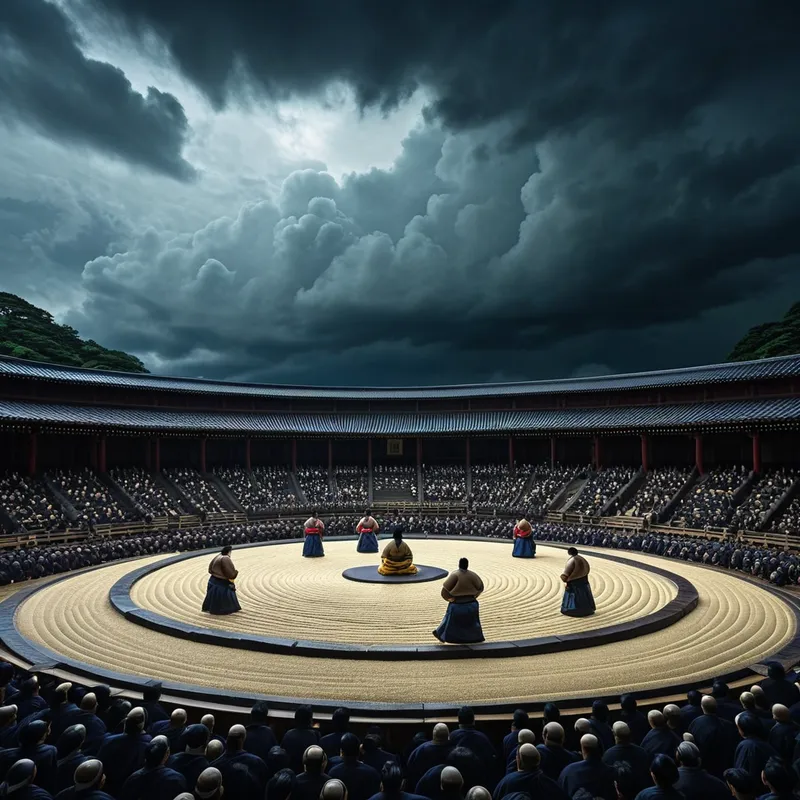
There, without word or ceremony, they began to prepare the ground. Not building, but defining. They took pure clay, packed by hand and foot, and formed a perfect circle. They blessed it with salt, scattering the white crystals like frost to drive away impurity. They raised a simple roof above it, its four pillars marking the cardinal directions. This was the dohyo. It was not an arena; it was an altar. Its boundary was not a line, but a cliff between the sacred and the profane.
The two kami entered the circle. The air grew still and heavy. This was no brawl. It was a ceremony of collision. When Sukune and Kehaya clashed, the sound was not of flesh, but of mountains shifting root. They gripped each other’s mawashi, not as cloth, but as the very strands of fate. The ground, the sacred dohyo, trembled but held. For days and nights they strained, a monument to dynamic tension. The conflict was not of hatred, but of necessity—the universe testing its own balance.
The resolution came not with a crash, but with a terrible, final grace. Sukune, finding a reserve of power drawn from the very earth of the circle, lifted Kehaya. In that lift was the whole motion of the world—the tide rising, the sun ascending. He did not throw his rival down in malice. He placed him outside the circle. As Kehaya’s foot touched the unblessed earth, a great sigh seemed to move through the land. The creeping kegare recoiled, repelled by the clarity of the outcome. Order was not imposed; it was won. And in the center of the dohyo, standing alone, the victor did not roar in [triumph](/myths/triumph “Myth from Roman culture.”/). He bowed, to the circle, to the sky, to the resolved tension. The first bout was over. The ritual was now eternal.
Cultural Origins & Context
The mythic origins of sumo are deeply entwined with Shinto, the animistic heart of Japanese culture. While the specific, deified bout between Nomi no Sukune and Taima no Kehaya is recorded in ancient texts like the Nihon Shoki, the ritual’s roots are far older. It likely began as a form of divination and agricultural magic. Matches were performed at harvest festivals to entertain the kami, ensuring fertility and thanking them for the bounty. The violent, physical struggle was a sympathetic ritual—a display of human vitality meant to stimulate the life-force of the land.
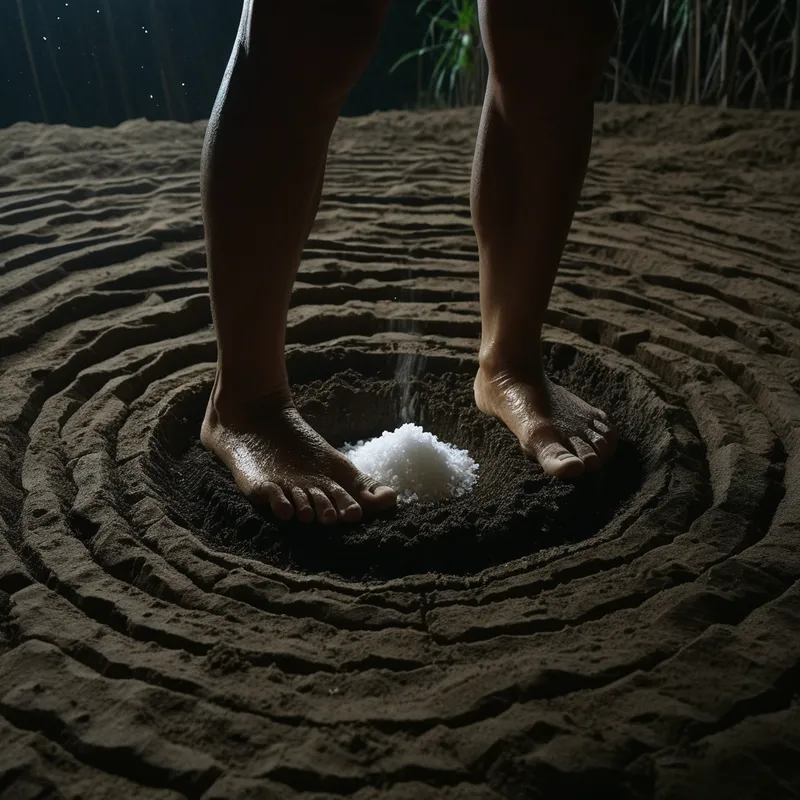
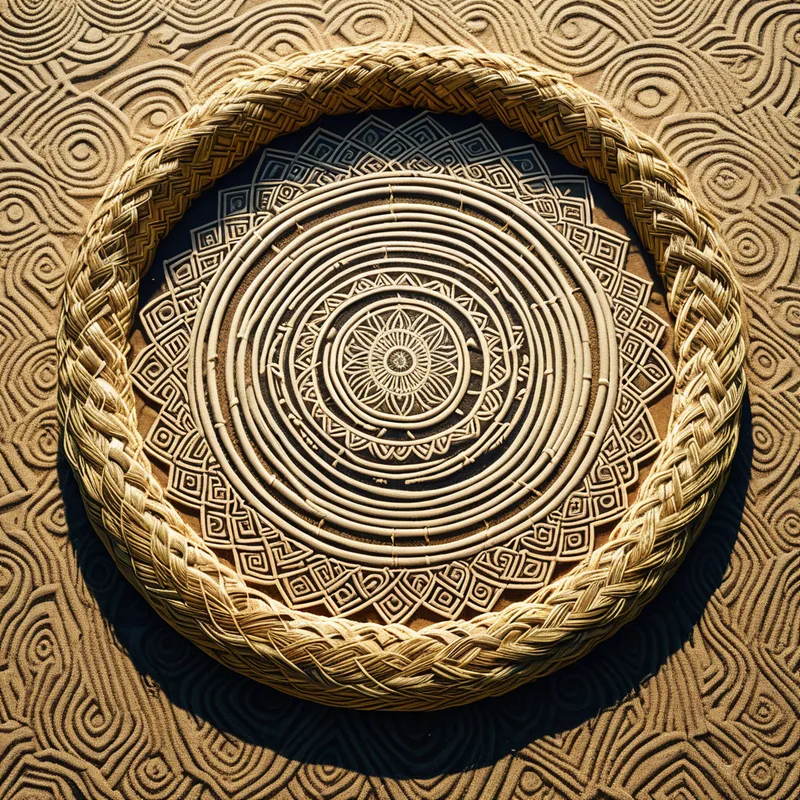
The dohyo itself is a microcosm of the Shinto worldview. Its construction is a meticulous act of purification and consecration. The clay is special, often taken from a ritually clean location. The straw bales marking its boundary symbolize a rice field, the source of life. The throwing of salt purifies the space, much as it does at the entrance of a shrine. This transforms the bout from a sport into a matsuri—a festival for the gods. The wrestlers, or rikishi, are not merely athletes; for the duration of the ritual, they are temporary vessels of immense, concentrated energy, channeling the primordial struggle of the kami to purify the world anew with every stomp and clash.
Symbolic Architecture
The dohyyo is the ultimate [symbol](/symbols/symbol “Symbol: A symbol can represent an idea, concept, or belief, serving as a powerful tool for communication and understanding.”/) of contained confrontation. It is a [paradox](/symbols/paradox “Symbol: A contradictory yet true concept that challenges logic and perception, often representing unresolved tensions or profound truths.”/): a defined, peaceful [space](/symbols/space “Symbol: Dreaming of ‘Space’ often symbolizes the vastness of potential, personal freedom, or feelings of isolation and exploration in one’s life.”/) where violent struggle is not only permitted but required. It represents the [human](/symbols/human “Symbol: The symbol of a human represents individuality, complexity of emotions, and social relationships.”/) necessity to create a formal [vessel](/symbols/vessel “Symbol: A container or structure that holds, transports, or protects something essential, representing the self, emotions, or life journey.”/) for our chaotic, aggressive, and competitive energies. Without the circle, the struggle is mere brawling, destructive and polluting. Within the circle, it becomes [ritual](/symbols/ritual “Symbol: Rituals signify structured, meaningful actions carried out regularly, reflecting cultural beliefs and emotional needs.”/), meaningful and world-sustaining.
The sacred circle does not prevent the storm; it grants the storm a meaning, transforming blind force into a dialogue with the cosmos.
The two wrestlers symbolize the fundamental duality of existence: order and [chaos](/symbols/chaos “Symbol: In Arts & Music, chaos represents raw creative potential, uncontrolled expression, and the breakdown of order to forge new artistic forms.”/), [stability](/symbols/stability “Symbol: A state of firmness, balance, and resistance to change, often represented by solid objects, foundations, or steady tools.”/) and change, self and other. Yet, they are identical in form, wearing the same mawashi, following the same rules. This reveals that the conflict is often internal, a battle between aspects of the same [psyche](/myths/psyche “Myth from Greek culture.”/). The stomp at the bout’s start drives away malevolent spirits; psychologically, it is an act of grounding, of declaring [presence](/symbols/presence “Symbol: Presence in dreams often signifies awareness or acknowledgment of something significant in one’s life.”/) and intent in the face of inner demons.
Victory is achieved not by annihilation, but by expulsion. The goal is to force the opponent out of the sacred space or make him touch the ground with anything but his [feet](/symbols/feet “Symbol: Feet symbolize our foundation, stability, and the way we connect with the world around us, often reflecting our sense of direction and purpose.”/). This is profoundly different from a fight to the [death](/symbols/death “Symbol: Symbolizes transformation, endings, and new beginnings; often associated with fear of the unknown.”/). It symbolizes the psychological process of setting boundaries, of identifying what does not belong within the sanctum of [the self](/myths/the-self “Myth from Jungian culture.”/) and removing it with decisive, non-lethal force.
The Dreamer’s Resonance
To dream of the sumo dohyo is to encounter the psyche’s own arena for decisive confrontation. The dreamer may find themselves standing in the ring, often alone at first, feeling the packed earth underfoot. The atmosphere is one of immense pressure and solemn anticipation. This dream emerges at life’s thresholds—before a major decision, a necessary conflict, or a moment of self-definition.
The somatic experience is key. One may feel the heavy, grounded stance, the focus in the hara (the belly, center of spiritual power). The opponent who eventually appears is rarely a stranger. It may be a shadowy version of the self, a personified fear, a memory given weight and form, or an aspect of one’s character that has grown unruly. The dream bout is slow, deliberate, a grappling with something that cannot be outrun, only directly engaged and moved.
The resolution in the dream is critical. A clean victory (witnessing the opponent expelled) signals a readiness to resolve an inner conflict. A loss or an endless stalemate suggests [the ego](/myths/the-ego “Myth from Jungian culture.”/) is not yet strong enough to integrate or exile the opposing force. The dream is the unconscious staging the confrontation the conscious mind avoids, insisting that certain battles must be met squarely, within a self-created container of awareness.
Alchemical Translation
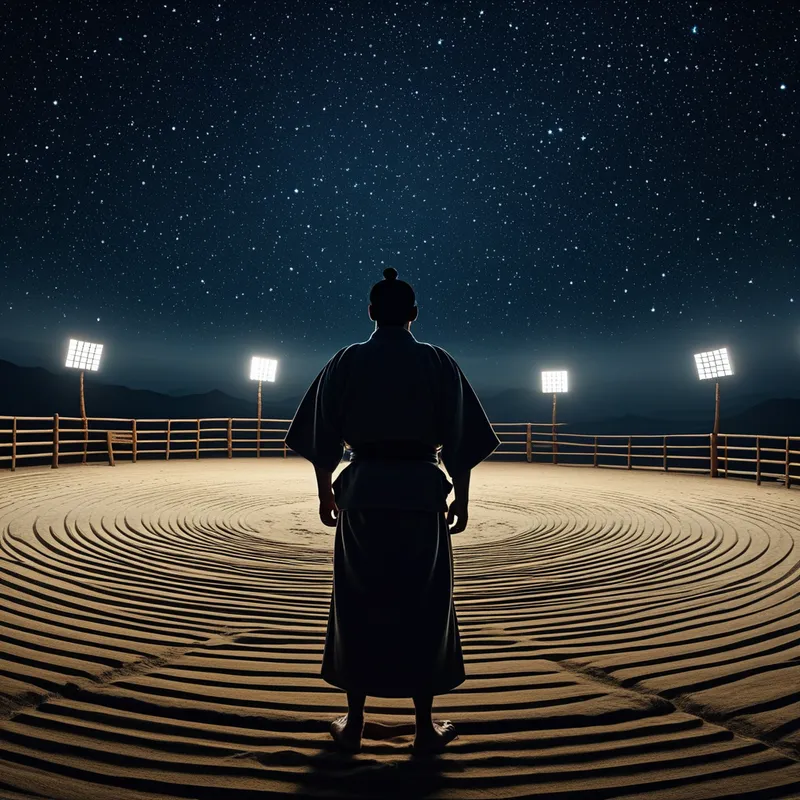
The myth of the dohyo models the alchemical individuation process with stark, physical clarity. The first step is consecration: building your own inner dohyo. This is the act of conscious self-reflection, creating a sacred, non-judgmental space within the psyche where opposing forces can be acknowledged. It is a commitment to face oneself without fleeing.
The second step is the confrontatio—the summoning and facing of [the shadow](/myths/the-shadow “Myth from Jungian culture.”/). The rival kami in the ring is that part of oneself which is powerful, perhaps feared or despised, but which holds vital energy. In psychological terms, this is the bout with the shadow. One does not fight to destroy it, but to wrestle with it, to know its strength and its nature intimately.
Individuation is not the victory of one side over the other, but the ritual that transforms their endless war into a sacred, contained dance.
The final, alchemical stage is transmutation through expulsion or integration. Forcing the shadow out of the ring corresponds to setting a firm, conscious boundary against a destructive habit or thought pattern. Alternatively, if the bout ends in a draw or a newfound respect, it may symbolize the integration of that shadow energy—harnessing its raw power for the ego’s purposes. The victor’s bow at the end is essential. It represents the ego’s humility before the Self, acknowledging that this struggle is a perpetual ritual of purification. The dohyo remains. The salt must always be thrown. The self is not a static monument, but an arena where order is continually, ritually won.
Associated Symbols
Explore related symbols from the CaleaDream lexicon: