Stribog Myth Meaning & Symbolism
The story of Stribog, the ancient Slavic deity of winds, whose breath shapes the world, whispers fate, and embodies the primal force of change.
The Tale of Stribog
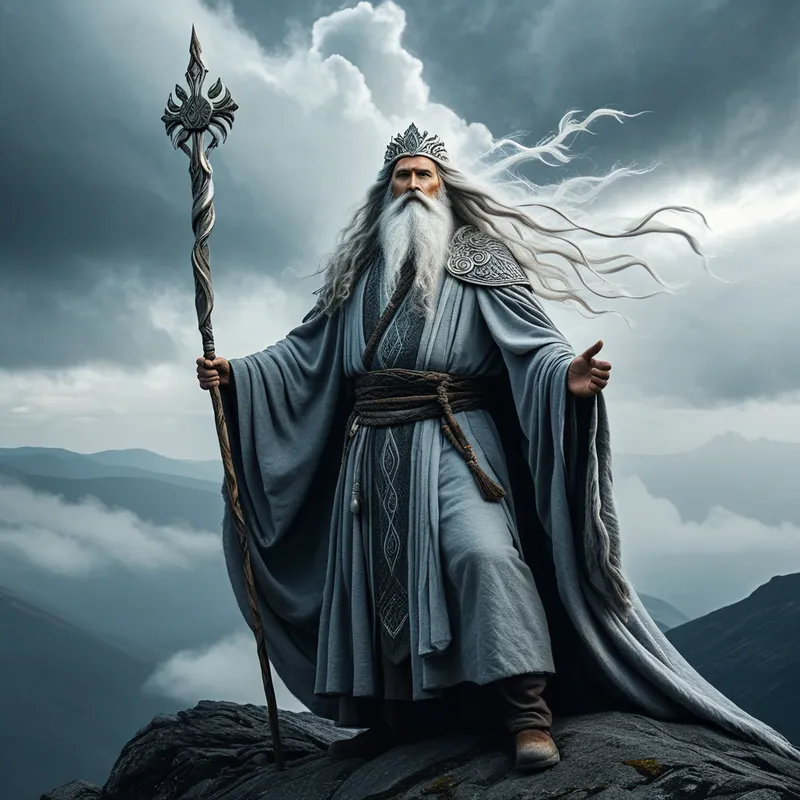
Listen, child of the earth, to the whisper that carved the valleys and the shout that felled the ancient woods. Before the plow cut the soil and the hearth-fire was lit, there was the Breath. Not the gentle sigh of a mother, but the vast, untamed exhalation of the world itself. They called him Stribog.
He was not born of flesh, but of the space between things. In the time before time, when [Svarog](/myths/svarog “Myth from Slavic culture.”/) hammered the sun on his celestial anvil and [Perun](/myths/perun “Myth from Slavic culture.”/)’s first shout was still a rumble in the deep earth, the silence was broken by a single, endless sigh. From the northern ice, it came as a blade of cold, shearing rock. From the southern seas, it arrived as a salt-thick blanket, heavy with the promise of rain. From the east at dawn, it carried the scent of unknown flowers; from the west at dusk, it brought the smoke of distant fires.
Stribog had no single form. To the shepherd on the high steppe, he was the invisible hand that pushed the great herds across the endless grass. To the sailor on the Pontus, he was the filled sail and the crushing wave. His children were the winds, each with a name and a temper: the fierce Pozvist, the swift Posvist, and the myriad breezes that lived in the leaves of the sacred oak.
His conflict was not with spear or flame, but with stillness. His rising action was the gathering of breaths—the sigh of the forest, the exhalation of the marsh, the sharp gasp of the mountain peak—into a single purpose. He would argue with Dazhbog, scattering his careful warmth to the four corners. He would challenge Volos, drying his damp, fertile underworld and carrying seeds far from their destined soil.
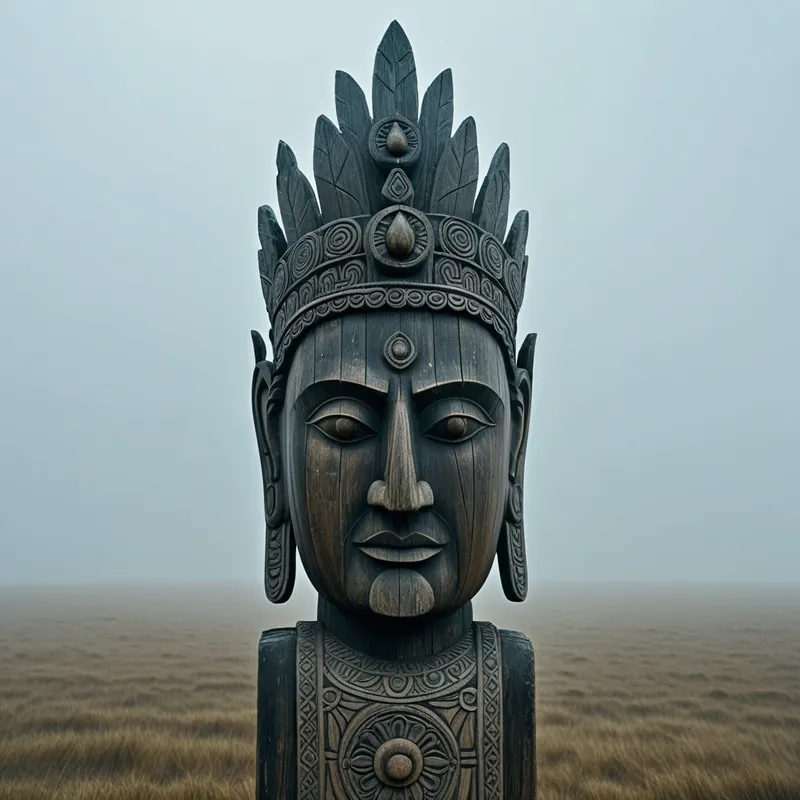
The resolution was never final, for Stribog was resolution itself—the dissolving force. He resolved the fog into clarity and the stagnant pond into ripples. He resolved the fate of seeds, of words, of souls. His breath was the carrier of Rozhanitsy’s threads, the unseen current upon which all things journey. When the people raised their idols to him, carved with eight faces to watch all pathways, they did not ask for an end to his chaos. They asked to hear his whisper, to know the direction of his will, to feel the awe of the invisible hand that turns the world.
Cultural Origins & Context
The figure of Stribog emerges from the fragmented, often Christian-suppressed tapestry of pre-Christian Slavic belief. He is listed among the primary gods in the Povest Vremennykh Let, his idol standing alongside those of Perun and Dazhbog in Kyiv before their destruction. This places him firmly in the princely, martial pantheon of the East Slavs, yet his essence is far more ancient and universal.
Unlike thunder or sun, the wind is an immediate, daily, and profoundly ambiguous experience for an agricultural and pastoral people. Stribog’s worship was likely less about grand temples and more about constant, intimate observation. His myth was passed down not as a single epic tale, but as a thousand practical proverbs, weather lore, and ritual gestures. The elder pointing to the sky, reading the clouds; the farmer spitting into the wind to gauge its shift; the offering of grain scattered to the breeze before sowing—these were the living texts of Stribog’s story.
His societal function was as a master of boundaries and communication. As the god of the airy expanse, he governed the space between villages, between worlds, and between human prayer and divine ear. He was the breath that carried smoke from sacrificial fires upward, the wind that brought omens, and the storm that could just as easily destroy a harvest as pollinate it. To honor Stribog was to acknowledge the fundamental unpredictability of life and the necessity of aligning oneself with forces greater than human will.
Symbolic Architecture
At its core, the myth of Stribog is an archetypal personification of the psyche’s animating principle—the [breath](/symbols/breath “Symbol: Breath symbolizes life, vitality, and the connection between the physical and spiritual realms.”/) of [life](/symbols/life “Symbol: The symbol of ‘Life’ represents a journey of growth, interconnectedness, and existential meaning, encompassing both the joys and challenges that define human experience.”/) and [spirit](/symbols/spirit “Symbol: Spirit symbolizes the essence of life, vitality, and the spiritual journey of the individual.”/) itself. He is the personified Pneuma, the invisible force that moves matter and [consciousness](/symbols/consciousness “Symbol: Consciousness represents the state of awareness and perception, encompassing thoughts, feelings, and experiences.”/).
Stribog represents the fundamental truth that emptiness is not void, but a field of potential and connection. The space between thoughts, the pause between heartbeats, the distance between people—this is his domain.
Psychologically, he symbolizes the function of [intuition](/symbols/intuition “Symbol: The immediate, non-rational understanding of truth or insight, often described as a ‘gut feeling’ or inner knowing that bypasses conscious reasoning.”/) in its purest form: [knowledge](/symbols/knowledge “Symbol: Knowledge symbolizes learning, understanding, and wisdom, embodying the acquisition of information and enlightenment.”/) carried on an unseen current, a sudden knowing from an unknown [direction](/symbols/direction “Symbol: Direction in dreams often relates to life choices, guidance, and the path one is following, emphasizing the importance of navigation in personal journeys.”/). He is the wind that “blows where it wishes,” as the gospel [metaphor](/symbols/metaphor “Symbol: A figure of speech where one thing represents another, often revealing hidden connections and deeper truths through symbolic comparison.”/) describes the spirit. His eight faces symbolize all-seeing [awareness](/symbols/awareness “Symbol: Conscious perception of self, surroundings, or internal states. Often signifies awakening, insight, or heightened sensitivity.”/), the [capacity](/symbols/capacity “Symbol: A measure of one’s potential, limits, or ability to contain, process, or achieve something, often reflecting self-assessment or external demands.”/) to perceive from every [angle](/symbols/angle “Symbol: An angle represents change, perspective, and the multifaceted nature of situations.”/), unbound by a single, fixed [perspective](/symbols/perspective “Symbol: Perspective in dreams reflects one’s viewpoints, attitudes, and how one interprets experiences.”/). His children, the specific winds, represent the differentiated aspects of this one great force: the cutting [insight](/symbols/insight “Symbol: A sudden, deep understanding of a complex situation or truth, often arriving unexpectedly and illuminating hidden connections.”/) (north wind), the inspiring new [idea](/symbols/idea “Symbol: An ‘Idea’ represents a spark of creativity, innovation, or realization, often emerging as a solution to a problem or a new outlook on life.”/) (east wind), the emotional burden (south wind), and the wisdom of closure (west wind).
His eternal conflict with [stillness](/symbols/stillness “Symbol: A profound absence of motion or sound, often representing inner peace, creative potential, or existential pause in artistic contexts.”/) is the psyche’s struggle between stagnation and growth. The calm is [safety](/symbols/safety “Symbol: Safety represents security, protection, and the sense of being free from harm or danger, both physically and emotionally.”/), but it is also rot and inertia. Stribog’s [chaos](/symbols/chaos “Symbol: In Arts & Music, chaos represents raw creative potential, uncontrolled expression, and the breakdown of order to forge new artistic forms.”/) is destructive, but it is also the only [source](/symbols/source “Symbol: The origin point of something, often representing beginnings, nourishment, or the fundamental cause behind phenomena.”/) of renewal, [dispersal](/symbols/dispersal “Symbol: The act of scattering, spreading, or breaking apart. Often represents release, transition, or loss of cohesion.”/), and new combinations.
The Dreamer’s Resonance
When the archetype of Stribog stirs in the modern dreamer, it often manifests as dreams of powerful, transformative winds. One may dream of being in a house where all the windows and doors blow open at once, papers and belongings flying in a whirlwind. This somatic experience points to a psychological process of sudden, involuntary ventilation.
The psyche’s closed system—stale with old ideas, repressed emotions, or rigid patterns—is being forcibly aired out. The dreamer is not in control of this process; Stribog’s force is autonomous. One might dream of hearing a profound whisper or message on the wind that cannot be fully grasped, indicating intuitive knowledge or a call from the unconscious trying to break through. Dreams of flying or being lifted by a gust symbolize a desire or a need to transcend a current, earth-bound situation, to gain a broader, eagle-eyed perspective. The anxiety in such dreams is the ego’s fear of being scattered, of losing its cohesive identity to this dispersing force. The healing lies in learning to set sail rather than build a wall.
Alchemical Translation
The alchemical journey modeled by Stribog is the stage of Solutio—dissolution. In the work of individuation, after the confronting of shadow (the underworld of Volos) and the application of will and clarity (the fire of Perun), the psyche’s hardened structures must be dissolved so their essence can be freed and recombined.
The individual must allow the breath of the Self to scatter the carefully arranged pieces of the personality, trusting that a greater pattern will emerge from the chaos.
This is the terrifying yet necessary process of de-integration. The modern individual clings to identity, career, relationships, and beliefs as fixed forms. Stribog’s myth teaches that these are but temporary arrangements of dust in the wind. The alchemical translation is to become like the sacred oak that learns to bend, to let its leaves become instruments of the wind’s song, and to allow its seeds—its potential—to be carried far beyond the safety of its own shadow.
To invoke Stribog consciously is to practice surrender to the larger currents of life, to develop intuition by listening to the subtle whispers of change, and to find courage in the face of necessary endings. It is to understand that one’s destiny is not a carved stone, but a path of scattered seeds, each planted by a different wind, each requiring faith in an unseen process of growth. The goal is not to become the wind, but to learn its direction, respect its power, and ultimately, to breathe in conscious harmony with the great breath of the world.
Associated Symbols
Explore related symbols from the CaleaDream lexicon:
- Wind — The primary manifestation of Stribog, representing invisible force, change, communication between realms, and the breath of spirit or life itself.
- Sky — Stribog’s domain, the vast and boundless arena of his activity, symbolizing freedom, perspective, and the realm of the celestial and spiritual.
- Bird — The creature most allied with Stribog, embodying the freedom of the air, messages from the divine, and the soul’s capacity to travel on the winds of consciousness.
- Tree — Often the sacred oak, representing the earthly form that must withstand and interact with Stribog’s force, symbolizing resilience, growth, and the connection between heaven and earth.
- Seed — Carried and dispersed by Stribog’s winds, symbolizing potential, destiny, new beginnings, and the scattering of ideas or life into unknown futures.
- Chaos — The essential nature of Stribog’s power, representing the creative and destructive potential of the unformed, the breakdown of old orders necessary for new creation.
- Spirit — Stribog as the personification of the animating life force (pneuma), the invisible essence that moves through all things and connects them.
- Journey — Facilitated by the winds, representing fateful movement, pilgrimage, the course of a life, and the soul’s progression carried by unseen currents.
- Whisper — The way Stribog’s will is often communicated, symbolizing intuition, subtle knowledge, omens, and the quiet voice of the unconscious or the divine.
- Breath — The core metaphor of Stribog’s being, linking the cosmic wind to the individual’s life force, inspiration, and the vital exchange between inner and outer worlds.