Straw Roofs of Fólkvangr Myth Meaning & Symbolism
A myth of a sacred hall's vulnerable roof, revealing the profound tension between divine protection and the necessary, humble openness of the soul.
The Tale of Straw Roofs of Fólkvangr
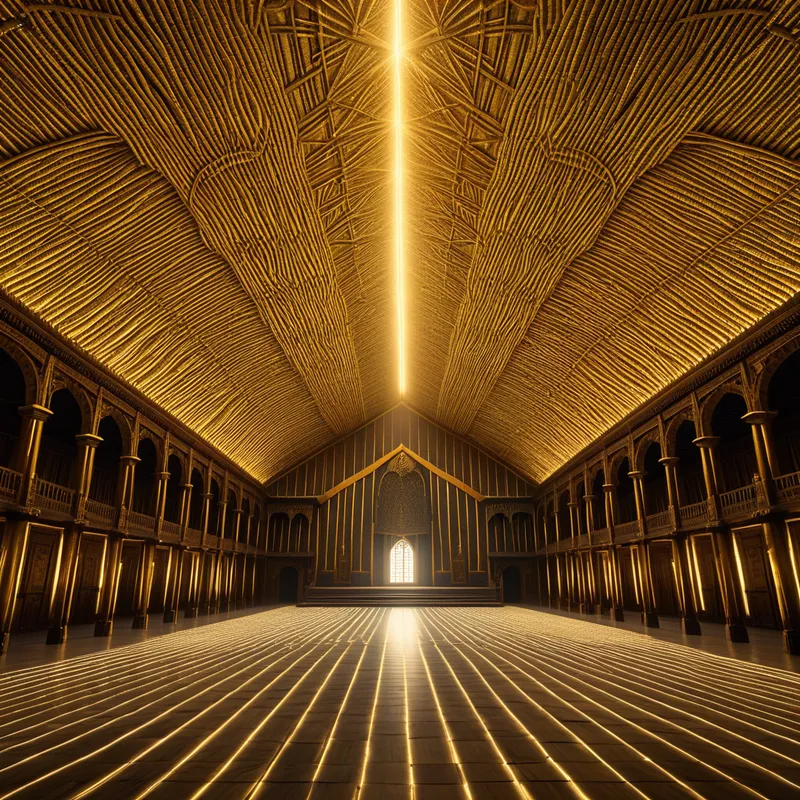
Listen, and hear the whisper of the straw in the wind of Fólkvangr. In that field where the slain are chosen not for glory alone, but for a deeper worth, stands Sessrúmnir. Its walls are of silvered ash-wood, its pillars carved with the deeds of those who lived by heart as much as by blade. But look up, traveler. Look up to its roof, vast as a harvested field. It is not forged of iron or plated with gold, as in other divine dwellings. It is thatched, thick and deep, with straw—golden, sun-bleached, humble straw.
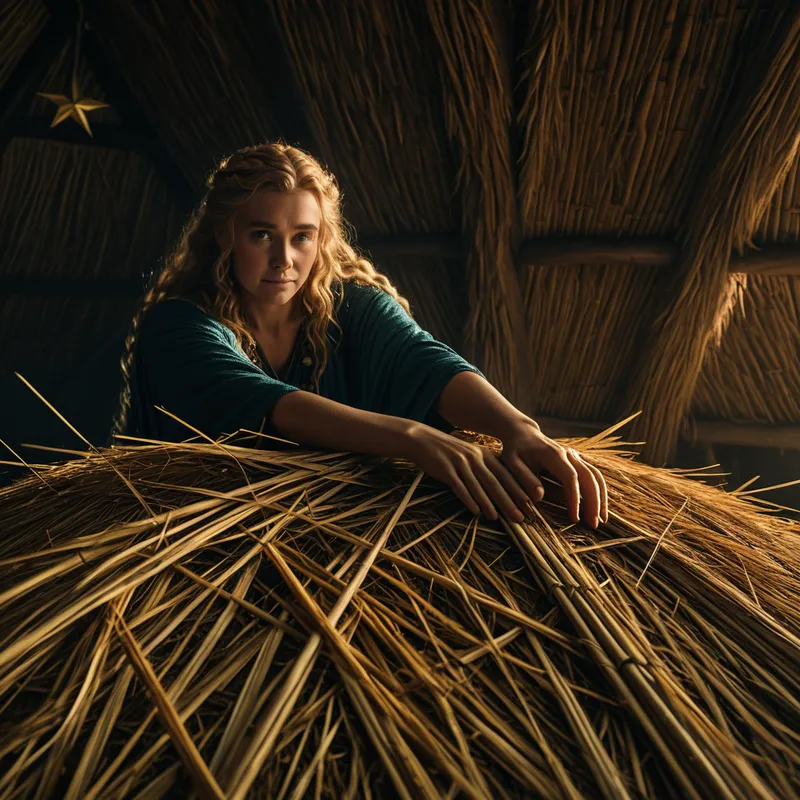
This was the will of Freyja, she who weeps tears of red gold. When the hall was first conceived in the mind of the gods, the smiths offered adamant tiles. The dwarves whispered of a living roof of raven feathers. But Freyja walked the Midgard fields after the harvest, where the last sheaves stood like silent sentinels. She knelt, took the straw in her hands, and felt its hollow strength, its memory of sun and soil. “This,” she said, her voice the sound of a hearth-fire catching, “this will be our shield and our sieve.”
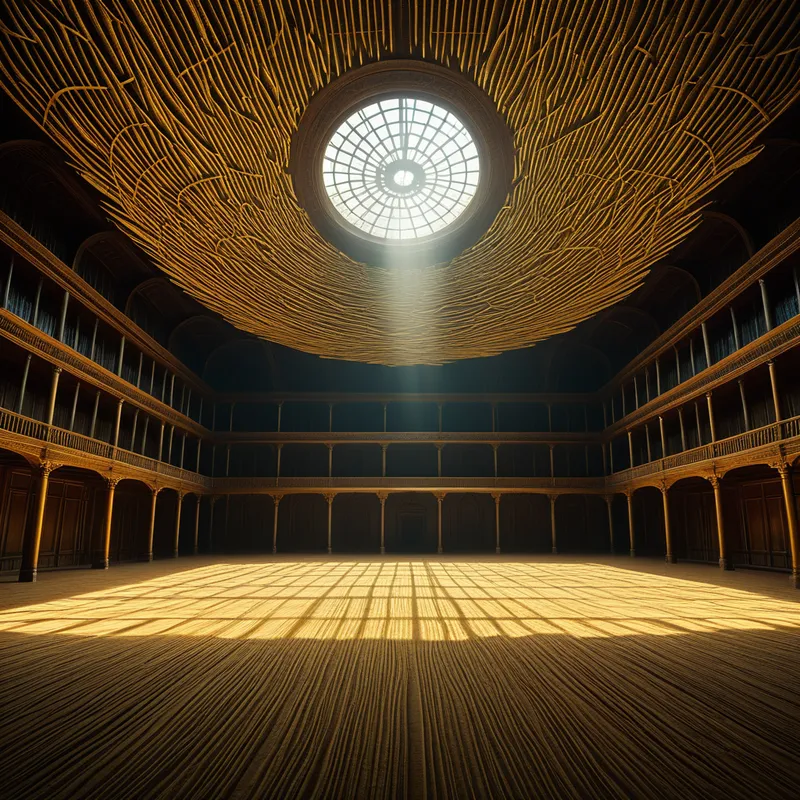
So the roof was woven. Not a solid barrier, but a living, breathing skin. The winds of the nine worlds sighed through it, carrying scents of pine from Midgard and cold mist from Jötunheimr. Moonlight dripped through its gaps like molten silver, pooling on the floor where the einherjar and honored dead rested. Rain, when it came from the weeping skies, would not be turned away utterly; it would seep through, drop by sacred drop, a gentle baptism for the souls within. It was a roof that received as much as it protected.
The conflict was not one of clashing armies, but of cosmic principle. Odin, the All-Father, from his high seat in Valhalla, looked upon this straw roof and saw not poetry, but peril. “A hall of the chosen, vulnerable to every arrow of fate, every spear of frost?” his one eye gleamed. “A roof must be a fortress.” He sent his ravens, Huginn and Muninn, to counsel strength. The warrior dead themselves, some freshly arrived, would test the thatch with a skeptical hand, wondering at its give.
But Freyja stood beneath her woven sky. When the great wolf’s breath, Hräsvelgr, howled, the straw sang a whistling song of resilience. When the heat of Muspelheimr threatened, the hollow stems held a pocket of cool air. The resolution came not in a battle, but in a moment of understanding. A wounded shieldmaiden, her spirit barely clinging to form, was brought to Sessrúmnir. As she lay beneath the straw, a single shaft of starlight, piercing the thatch, fell upon her brow. In that precise, admitted light—not a glaring sun, but a chosen star—her spirit knit itself back together, not into a harder warrior, but into a whole being. The roof had not kept the world out; it had let the right piece of the cosmos in. And in that moment, all within Fólkvangr knew the profound truth of their shelter: it was strong because it was vulnerable, it was safe because it was open. It was a roof that breathed with the universe.
Cultural Origins & Context
The motif of the Straw Roofs of Fólkvangr is not a myth narrated in a single surviving Eddic poem, but a profound symbolic thread woven from the tapestry of attested Norse cosmology and Freyja’s unique domain. Our understanding is pieced together from the descriptions of Fólkvangr and Sessrúmnir in the Prose Edda, and the cultural ethos surrounding hospitality (gestrisni) and the feminine spheres of protection.
In a society framed by the unforgiving elements and the constant threat of conflict, the concept of shelter was sacred. The longhouse roof was the boundary between the warmth of the kin-group and the chaotic outside. For Freyja, a goddess who presides over love, fertility, seidr (magic), and receives half the battle-slain, her hall’s nature reflects her complex sovereignty. While Odin’s Valhalla prepares for the final, defensive battle of Ragnarök, Freyja’s Fólkvangr suggests a different purpose: integration, rest, and a different kind of preparation of the soul.
This myth likely lived in the kennings (poetic metaphors) of skalds and the teachings of seidr practitioners. It was a story told not to glorify impervious strength, but to illustrate the Norse understanding of a more nuanced, receptive power. The straw roof served as a cultural counterpoint, emphasizing that true sanctuary—be it in a hall, a community, or a self—requires a degree of permeability. It legitimized the strength found in softness, a concept as vital to surviving a Norse winter (where a house that did not breathe would suffocate) as it was to the journey of the soul.
Symbolic Architecture
The straw roof is an unparalleled symbol of conscious vulnerability. It represents a boundary that is active, intelligent, and discerning, rather than one that is merely defensive and rigid.
The strongest sanctuary is not the one that excludes the world, but the one that knows what to admit and what to transform.
The straw itself, the harvested stalk, symbolizes the essence of life cycled through death—the grain is taken for nourishment, the husk remains, transformed into protection. It speaks of using what is left after life’s great harvest, the seemingly humble and discarded, to create a sacred space. Freyja’s choice is an alchemical act: she transmutes the common (straw) into the consecrated (cosmic filter).
The hall, Sessrúmnir, is the Self in its potential wholeness. The silvered walls are the conscious structures of identity and persona. But the roof is the threshold between the conscious self and the vast unconscious—the collective psyche of the nine worlds. A solid roof would be repression, a total barrier to the inner cosmos. The straw roof is the ego’s healthy permeability; it allows for the necessary “weather” of the unconscious—dreams, intuitions, creative sparks, even necessary sorrows (the rain)—to seep through in a mediated, manageable way. It protects from psychic floods (overwhelm) but welcomes the nourishing dew (insight).

The Dreamer’s Resonance
When this myth stirs in the modern dreamer, it often manifests as dreams of houses with unusual, fragile, or porous roofs. One might dream of lying in bed watching stars through holes in the thatch, or of anxiously trying to patch a straw roof as a storm approaches, only to find the patches are also made of straw.
Somatically, this can correlate with sensations in the crown of the head—pressure, tingling, or a feeling of being “wide open.” Psychologically, the dreamer is navigating a process of renegotiating their boundaries. The conscious mind (the dream-ego) may fear this permeability, interpreting it as a dangerous weakness, much like Odin’s skepticism. The conflict in the dream mirrors the internal struggle between a desire for total, fortress-like control and the soul’s deeper need for authentic connection and reception.
The dream is an indicator that the psyche is attempting to build or acknowledge a “Freyja-sanctuary”—a space within where one can receive the full spectrum of experience without being destroyed by it. It is the soul’s move away from brittle, armored isolation toward a resilient, breathing wholeness. The anxiety present is the birth pang of this new, more sophisticated form of self-protection.
Alchemical Translation
The individuation process modeled here is the transmutation of the boundary. The initial state is often a psychic structure built for total defense, born of legitimate wounding. This is the leaden, heavy roof of the fortress. The alchemical work, guided by the anima (Freyja), is not to tear this roof down in a violent act of exposure, but to patiently, artfully re-weave it into something both strong and discerning.
The goal is not to have no roof, but to have a roof that sings with the wind and filters the starlight.
The “straw” is found in the humble, everyday materials of our lived experience—our memories, our sensory impressions, our simple acts of attention. The opus is to gather these and, with conscious intent (Freyja’s will), weave them into a new threshold between the ego and the Self. This requires accepting that some “rain” (grief, uncertainty) and some “wind” (the unsettling voices of the unconscious) will get through. But in this admitted experience lies the healing, specific “starlight”—the pinpoint insights and connections that can only reach us through a permeable boundary.
The triumph is the realization, like the healed shieldmaiden, that wholeness comes from integration, not exclusion. The individuated Self does not live in an impregnable citadel, but in Sessrúmnir—a hall with a golden, straw roof. It is secure precisely because it is in a living, breathing, receiving relationship with the entire cosmos of the psyche. It is protected not by walls that keep everything out, but by a wise, woven membrane that knows the difference between a threat and a gift, and has the courage to let the gifts in.
Associated Symbols
Explore related symbols from the CaleaDream lexicon: