Steam Engine Myth Meaning & Symbolism
A myth of Promethean fire, chained water, and iron will forging a new world from pressure and sacrifice, birthing the modern age.
The Tale of Steam Engine
Listen. Before the hum of wires and the glow of silent screens, [the world](/myths/the-world “Myth from Tarot culture.”/) had a heartbeat. It was a deep, rhythmic chug-chug-chug, a metallic breath that fogged the skies and shook the very bones of [the earth](/myths/the-earth “Myth from Hindu culture.”/). This is the tale of its birth, a story not of gods on Olympus, but of elements in [the crucible](/myths/the-crucible “Myth from Alchemical culture.”/).
In the beginning, there was the deep, sleeping [Water](/myths/water “Myth from Chinese culture.”/), dreaming in its caverns and seas. And there was the wild, dancing Fire, leaping in hearths and forges, untamed and fleeting. Between them stood the stubborn, silent Iron, patient in the mountain’s womb. They were separate, sovereign, and the world moved at the pace of muscle, wind, and tide.
Then came the Dreamer-Smith. He was no king, but a soot-faced priest of the forge, whose eyes saw not just metal, but potential. He heard the argument of the elements—the hiss of water quenching fire, the groan of iron under heat. He dreamed of a pact, a terrible and glorious marriage.
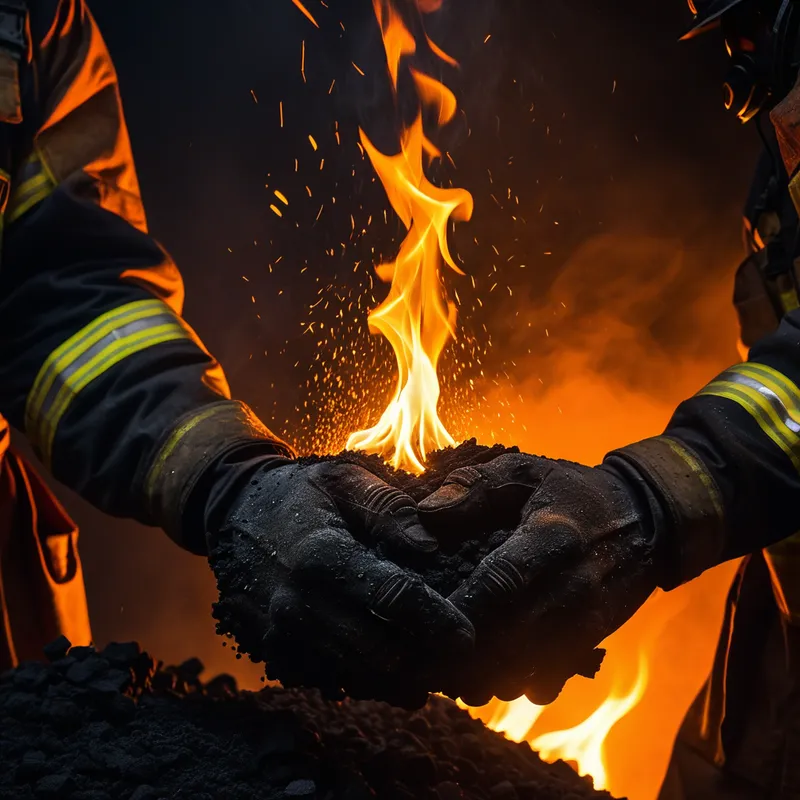
He descended to the realm of Water, not to draw a bucket, but to capture its very soul, its expansive desire to become vapor. He built a Belly of Iron, a sealed, riveted womb stronger than any before. Into this belly, he invited the Water, but as a prisoner. Then, he called to Fire. Not to warm, but to rage. He fed the Fire the black bones of ancient forests—Coal—until it roared with imprisoned fury beneath the Iron Belly.
Here was the great conflict: Fire hated its cage, Water loathed its boiling torment, and Iron strained at its seams, screaming in metallic protest. The pressure built—a silent, screaming tension that threatened to shatter creation. This was the agony of potential, the birth-pang of a new world.
The Dreamer-Smith did not relent. He forged a Piston, a rod of polished steel, and placed it against the throbbing Belly. He crafted a Great Wheel. And at the moment of greatest tension, when the scream within was universal, he opened a way. Not a rupture, but a valve.
With a sound like the first breath of a titan, the agonized Steam—the transmuted child of Fire and Water—rushed forth. It pushed the Piston with a force that could level mountains. The Piston turned the Wheel. The Wheel, connected by arms of iron, turned other wheels. The chug-chug-chug began. Fire’s rage was translated into motion. Water’s expansion became power. Iron’s endurance became structure.
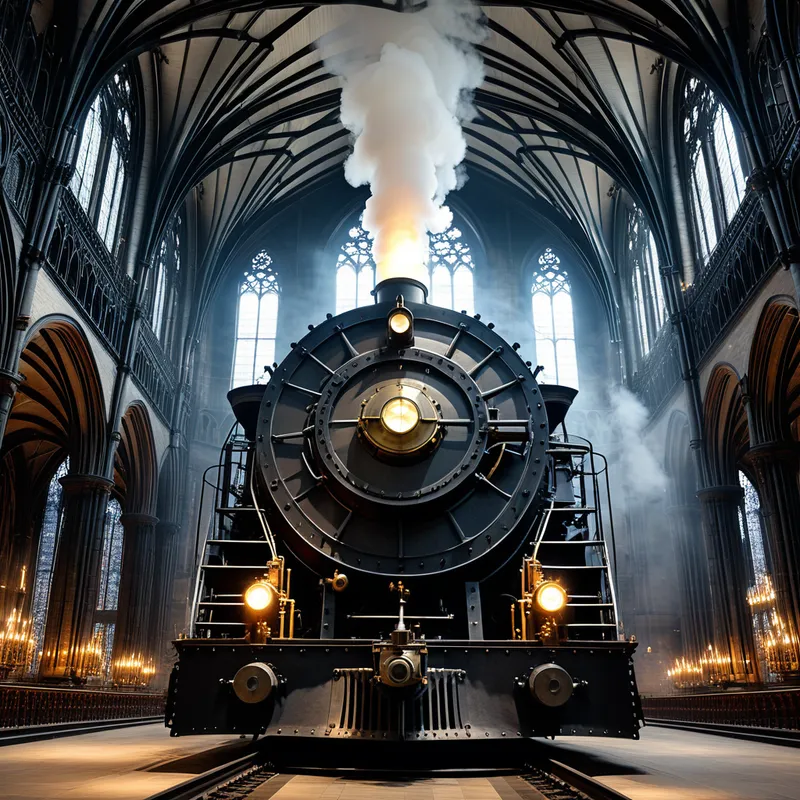
And thus, the Steam Engine lived. It breathed plumes of white breath into [the sky](/myths/the-sky “Myth from Persian culture.”/), a signal fire of a new age. It drew carriages of iron across the land faster than horses could dream, and pushed ships against [the wind](/myths/the-wind “Myth from Various culture.”/)‘s will. It was not a gentle god. It demanded constant sacrifice—coal, water, vigilance. It was hot, loud, and dangerous. But it worked. It moved. It transformed. From the terrible marriage of opposing forces, it gave birth to relentless, rhythmic, world-altering work.
Cultural Origins & Context
This myth did not spring from a single poet’s tongue but was forged in the collective experience of the 18th and 19th centuries—the dawn of the Industrial age. Its bards were the engineers, the factory owners, the navvies, and even the fearful Luddites. It was passed down not in epic verse, but in technical manuals, in the folk songs of railway workers, in the awe and terror of the public witnessing their first locomotive.
Its societal function was dual: it was a hymn of progress and a cautionary tale. For the capitalist and the engineer, it was a Promethean narrative of human ingenuity triumphing over nature’s limits, bringing light, power, and prosperity. For the common laborer and the poet, it was a story of a new, demanding, and often cruel deity that reshaped time, space, and human relations, demanding the sacrifice of old ways, clean air, and pastoral rhythms. The myth served to explain and sacralize the overwhelming, incomprehensible force that was suddenly the engine of society.
Symbolic Architecture
At its core, the [Steam](/symbols/steam “Symbol: Steam often symbolizes manifestation and transformation, representing the transition from potential to reality through energy and heat.”/) Engine is a perfect [symbol](/symbols/symbol “Symbol: A symbol can represent an idea, concept, or belief, serving as a powerful tool for communication and understanding.”/) of the coniunctio oppositorum. It represents the psychic apparatus necessary to harness raw, unconscious [energy](/symbols/energy “Symbol: Energy symbolizes vitality, motivation, and the drive that fuels actions and ambitions.”/) (Fire/[Water](/symbols/water “Symbol: Water symbolizes the subconscious mind, emotions, and the flow of life, representing both cleansing and creation.”/)) into directed, conscious work (rotational force).
The Steam Engine is the psyche’s first great model of sublimation: the boiling chaos of instinct and emotion, contained by the ego (Iron Vessel), and channeled into the piston-stroke of purposeful action.
The Belly of Iron symbolizes the necessary, often painful, container of [the ego](/myths/the-ego “Myth from Jungian culture.”/) or the conscious [attitude](/symbols/attitude “Symbol: Attitude symbolizes one’s mental state, perception, and posture towards life, influencing emotions and actions significantly.”/). Without this strong, defined [vessel](/symbols/vessel “Symbol: A container or structure that holds, transports, or protects something essential, representing the self, emotions, or life journey.”/), the internal pressures—our passions, anxieties, and creative urges—simply dissipate or explode destructively. The Coal represents the libidinal energy, the stored [life](/symbols/life “Symbol: The symbol of ‘Life’ represents a journey of growth, interconnectedness, and existential meaning, encompassing both the joys and challenges that define human experience.”/)-force (often from the “ancient forests” of the personal or collective past) that must be consciously fed into the process. The Steam itself is the sublimated energy, the potent but invisible force that results from the [tension](/symbols/tension “Symbol: A state of mental or emotional strain, often manifesting physically as tightness, pressure, or unease, signaling unresolved conflict or anticipation.”/) of opposites.
The true [hero](/symbols/hero “Symbol: A hero embodies strength, courage, and the ability to overcome significant challenges.”/) is not the [machine](/symbols/machine “Symbol: Machines in dreams often represent systems, control, and the mechanization of life, highlighting issues of productivity and efficiency.”/), but the process itself. The myth maps the [journey](/symbols/journey “Symbol: A journey in dreams typically signifies adventure, growth, or a significant life transition.”/) from undifferentiated, opposing forces ([chaos](/symbols/chaos “Symbol: In Arts & Music, chaos represents raw creative potential, uncontrolled expression, and the breakdown of order to forge new artistic forms.”/)) through a [period](/symbols/period “Symbol: Periods in dreams can symbolize cyclical patterns, renewal, and the associated emotions of loss or change throughout life.”/) of intense, contained pressure ([crisis](/symbols/crisis “Symbol: A crisis symbolizes turmoil, urgent challenges, and the need for immediate resolution or change.”/), neurosis) to a final, regulated release that performs meaningful work (individuated [action](/symbols/action “Symbol: Action in dreams represents the drive for agency, motivation, and the ability to take control of situations in waking life.”/)).
The Dreamer’s Resonance
When this myth stirs in the modern dreamer, it often manifests in periods of immense internal pressure or before a significant life transformation. To dream of a steam engine—especially one that is broken, overheating, or running out of control—is to dream of one’s own psychic machinery.
Somatically, it may connect to feelings of being “under pressure,” of “boiling over” with anger or anxiety, or of a rhythmic, compulsive drive (the chug-chug of relentless thought or duty). A dream of shoveling coal into a hungry furnace may reflect a sense that one’s vital resources are being consumed by a demanding job or relationship. Dreaming of a leaking boiler or failing valves speaks to a fear of containment failure—an emotional outburst or a collapse of one’s coping structures.
Psychologically, these dreams signal that powerful, elemental forces within (the Fire of ambition or anger, the Water of emotion or intuition) are in conflict and seeking a new, more efficient mode of expression. The dream engine calls for an alchemical operation: to become the Dreamer-Smith of one’s own soul, to inspect [the vessel](/myths/the-vessel “Myth from Alchemical culture.”/), regulate the fire, and channel the steam toward a purposeful wheel.
Alchemical Translation
The myth of the Steam Engine provides a robust, mechanical model for the alchemical process of individuation. The entire procedure is an [nigredo](/myths/nigredo “Myth from Alchemical culture.”/) and albedo enacted in iron and steam.
First, the [separatio](/myths/separatio “Myth from Alchemical culture.”/): the Dreamer-Smith must differentiate the elements within himself—identifying the fiery drives, the fluid emotions, and the rigid structures of personality. Then, the coniunctio: he must consciously bring them into a sealed container (the therapeutic vessel, the creative project, the disciplined practice), where they can interact under intense pressure. This is the dark, boiling nigredo, the state of depression, confusion, or creative block where opposites war.
The triumph is not in avoiding the pressure, but in building a vessel strong enough to withstand it, and then crafting a valve precise enough to harness it.
The release of steam—the albedo—is the moment of insight, the creative breakthrough, or the new adaptive behavior. The turning wheel is the new pattern of life, the sustained, rhythmic expression of a previously conflicted self. The soot, the ash, the spent coal are the sacrifices made—the outdated identities, the comfortable illusions, the raw time and energy—that fueled the transformation.
For the modern individual, the myth teaches that power and progress are born not from avoiding internal conflict, but from engineering a sophisticated relationship with it. We are called to be both the fireman, stoking our passions with discernment; the engineer, maintaining the integrity of our boundaries and values; and the driver, setting the direction for the immense power we have learned to generate. In the rhythmic chug-chug-chug of a well-integrated life, we hear the echo of that first, world-breaking breath of steam—the sound of chaos forged into purpose.
Associated Symbols
Explore related symbols from the CaleaDream lexicon: