Stars of Artemis Myth Meaning & Symbolism
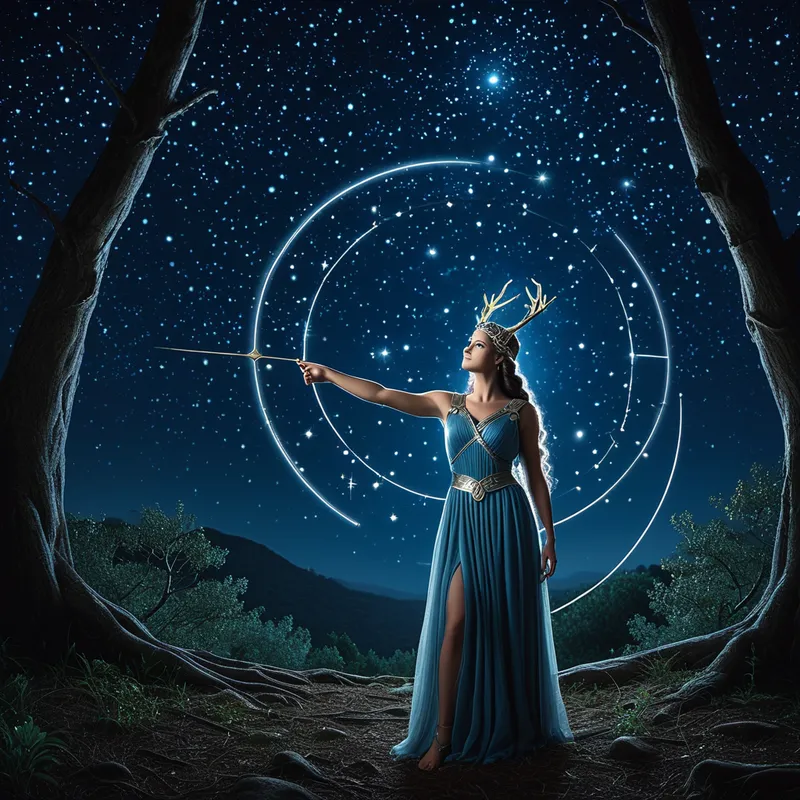
The myth of Artemis transforming her hunting companions into stars to protect them from a mortal king's wrath.
The Tale of Stars of Artemis
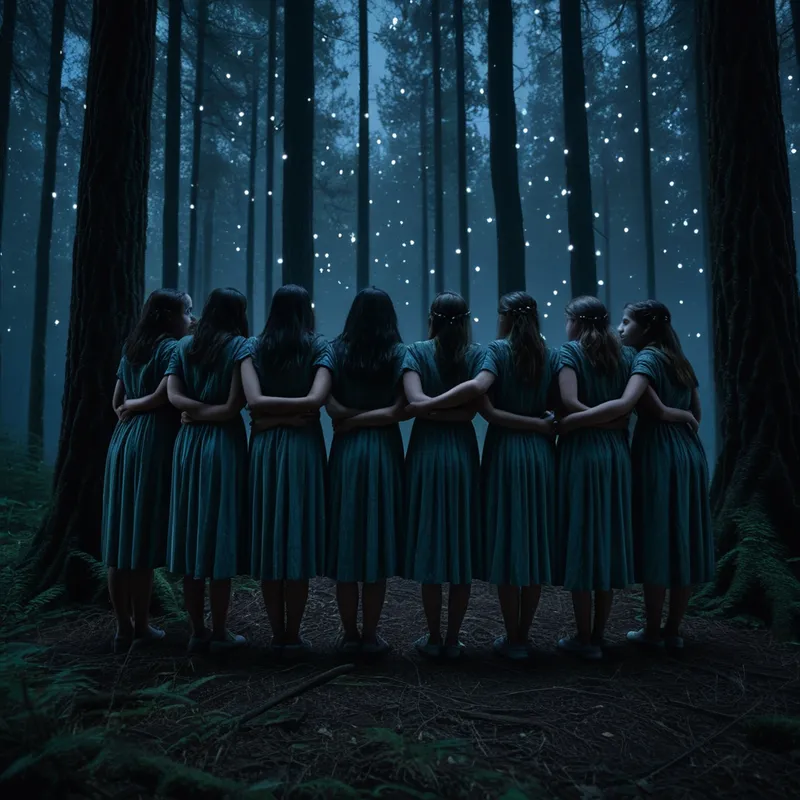
Hear now a tale spun from moonlight and the cold breath of the mountain peaks. It begins not in the sun-drenched halls of Zeus, but in the deep, shadowed forests where the only law is the whisper of leaves and the pad of soft feet on damp earth. Here, Artemis reigns, a silver silhouette against the trunks of ancient oaks. Her companions are not Olympian courtiers, but a band of [nymphs](/myths/nymphs “Myth from Greek culture.”/)—the daughters of [the river](/myths/the-river “Myth from Buddhist culture.”/) and the rock, whose laughter is the sound of clear [water](/myths/water “Myth from Chinese culture.”/) over stone.
They lived in a sacred covenant of chase and chastity, their lives a perfect circle of tracking the stag, bathing in hidden pools, and dancing under the gaze of the crescent moon. Their world was bounded by the forest’s edge, a wall of green they had no wish to cross. But [the world](/myths/the-world “Myth from Tarot culture.”/) of men has a long reach, and desire casts a shadow that can darken even the deepest grove.
[The shadow](/myths/the-shadow “Myth from Jungian culture.”/) had a name: [Orion](/myths/orion “Myth from Greek culture.”/). A giant of a man, a hunter whose skill nearly rivaled the goddess’s own, he strode into their realm. At first, there was a wary truce, a recognition of shared prowess. But [Orion](/myths/orion “Myth from Greek culture.”/)’s gaze grew hot, and it fell upon the nymphs, upon Artemis’s sacred companions. His desire was a crude, grasping [thing](/myths/thing “Myth from Norse culture.”/), a fire that sought to consume their cool, autonomous light. He pursued them, his great footsteps crashing through the undergrowth, shattering their peace.
The nymphs fled to their mistress, their breath coming in terrified gasps, the scent of fear sour on the air where once there was only pine and moss. Artemis heard their pleas, saw the violation in their wide eyes. A cold fury, sharper than any arrowhead, settled in her heart. This was not a matter for debate or divine diplomacy. This was a violation of her most sacred space—the sanctuary of her chosen sisters.
She looked from the trembling nymphs to the boastful giant, then upward, to the vast, dark velvet of the night sky. A resolution, both terrible and beautiful, crystallized within her. She would not wage a war that might see her companions harmed. She would not merely hide them. She would make them utterly untouchable.
Raising her hand, not in wrath but in an act of profound, creative protection, she spoke a word that was not a word, but a sigh of cosmic will. Where the nymphs stood, a brilliant, cold light began to emanate from their very beings. Their forms grew luminous, translucent. The forest floor faded beneath them as they began to ascend, not as bodies, but as essences. Their fear melted away, replaced by a serene, eternal watchfulness. They dissolved into points of pure, silver-white light, rising, rising, until they found their resting places in the black expanse above. There they settled, a tight cluster of stars—a new constellation, forever safe, forever chaste, forever part of the wild night that was their goddess’s true domain. Orion was left below, his target vanished into a realm he could never hope to conquer, under the silent, judging gaze of the stars that were once his prey.
Cultural Origins & Context
The myth of the Stars of Artemis is not a single, codified epic, but a narrative thread woven into the larger tapestry of Artemisian lore. It finds its primary home in the later literary traditions, particularly in the works of mythographers like Pseudo-Hyginus and in the scholia (ancient commentaries) on classic texts. This suggests it was a tale that flourished in the oral tradition, a “just-so” story explaining the origin of a specific star cluster, most commonly identified with the [Pleiades](/myths/pleiades “Myth from Greek culture.”/).
Its societal function was multifaceted. On one level, it was an aetiological myth, giving a divine and memorable reason for the existence of a recognizable feature of the night sky. On a deeper level, it reinforced the core values associated with Artemis: the inviolability of sacred spaces (particularly those of women outside the oikos), the power of female autonomy, and the severe consequences of transgressing divine law (hubris). Told in women’s quarters or during nocturnal rites, it served as a powerful narrative of protection and a warning against the violent imposition of male desire, sanctifying the choice of a life dedicated not to marriage, but to a different kind of community and purpose.
Symbolic Architecture
The myth is a profound symbolic [drama](/symbols/drama “Symbol: Drama signifies narratives, emotional expression, and the exploration of human experiences.”/) of [psyche](/myths/psyche “Myth from Greek culture.”/) and [cosmos](/symbols/cosmos “Symbol: The entire universe as an ordered, harmonious system, often representing the totality of existence, spiritual connection, and the unknown.”/). Artemis represents the archetypal principle of [the Self](/myths/the-self “Myth from Jungian culture.”/) in its untamed, whole, and protective [aspect](/symbols/aspect “Symbol: A distinct feature, quality, or perspective of something, often representing a partial view of a larger whole.”/). She is not a [mother](/symbols/mother “Symbol: The symbol of ‘Mother’ represents nurturing, protection, and the foundational aspect of one’s emotional being, often associated with comfort and unconditional love.”/) [goddess](/symbols/goddess “Symbol: The goddess symbolizes feminine power, divinity, and the nurturing aspects of life, embodying creation and wisdom.”/), but a [virgin](/symbols/virgin “Symbol: The virgin represents purity, innocence, and new beginnings, often echoing themes of untainted potential.”/) goddess—a [symbol](/symbols/symbol “Symbol: A symbol can represent an idea, concept, or belief, serving as a powerful tool for communication and understanding.”/) of psychological completeness and autonomy, belonging to herself alone. Her band of nymphs symbolizes the vulnerable, instinctual, and natural parts of the [psyche](/myths/psyche “Myth from Greek culture.”/) that are devoted to this Self-principle.
Orion embodies the heroic ego at its most inflated—raw, acquisitive, and seeking to possess and dominate what it does not understand. His [pursuit](/symbols/pursuit “Symbol: A chase or being chased in dreams often reflects unresolved anxieties, unfulfilled desires, or internal conflicts demanding attention.”/) is [the ego](/myths/the-ego “Myth from Jungian culture.”/)’s attempt to capture and assimilate autonomous instinct (the nymphs) for its own gratification, a violation of the natural order of the psyche.
The transformation into stars is the ultimate act of psychic defense: to render the vulnerable eternal and untouchable by translating it into a symbolic language beyond the reach of the literal mind.
The stars themselves are the perfect symbol. They are distant, cold, luminous, and observational. They cannot be grasped, only witnessed. They represent the process of [sublimation](/symbols/sublimation “Symbol: Transforming base impulses into creative or socially acceptable outlets, often seen in artistic expression.”/)—the [transmutation](/symbols/transmutation “Symbol: A profound, alchemical process of fundamental change where one substance or state transforms into another, often representing spiritual evolution or personal metamorphosis.”/) of vulnerable, earthly contents (instincts, fears, cherished inner figures) into enduring symbolic forms. They become permanent fixtures in the inner firmament, guiding lights that are part of the psyche’s [architecture](/symbols/architecture “Symbol: Architecture in dreams often signifies structure, stability, and the framing of personal identity or life’s journey.”/) but no longer subject to its petty conflicts.
The Dreamer’s Resonance
When this myth stirs in the modern dreamer, it often signals a critical moment of psychic threat and the need for radical protection. To dream of being pursued through a wild landscape by a looming, overpowering figure may directly echo the nymphs’ flight. The dream ego feels its autonomy and sacred space are under siege, perhaps by an overbearing external demand, an internal critic, or a life situation that feels violently encroaching.
The somatic experience is one of constriction, panic, and the adrenaline of flight. Psychologically, it is the feeling of being seen in a way that feels predatory, of having one’s core identity or values threatened with assimilation or destruction. The dream may not resolve with a stellar transformation; it may end in the terror of the chase. This indicates the psyche is in the crisis, crying out for the Artemisian intervention—for the Self to activate a transformative defense. The dream is a plea for the dreamer to find a way to elevate their vulnerable essence out of the reach of the crushing, literal world.

Alchemical Translation
The alchemical process modeled here is not the fiery coniunctio (union) of opposites, but the cooler, silvered process of fixatio—making the volatile permanent, and sublimatio—raising the base to the heights.
The “base material” is the cluster of vulnerable, instinctual life (the nymphs) threatened by the corrosive force of unintegrated egoic desire (Orion). The “alchemical vessel” is the sacred, bounded space of the Artemisian forest—the therapeutic container, the spiritual practice, the creative solitude one must fiercely protect. The goddess-artificer, Artemis as the guiding Self, applies the “[quintessence](/myths/quintessence “Myth from Alchemical culture.”/)”: not a weapon, but a transcendent perspective.
The struggle for individuation often requires not conquering the threat, but outgrowing the plane of engagement altogether. Wholeness is achieved by changing the state of what must be protected, not by winning the war on its original terms.
The triumphant “philosopher’s stone” is the constellation itself—the once-threatened contents now fixed as eternal, guiding symbols within the psyche. They are no longer passive victims or objects of desire; they are active, luminous points of [reference](/myths/reference “Myth from Global/Universal culture.”/). For the modern individual, this translates to the work of taking a deeply vulnerable part of oneself—a creative impulse, a non-conforming identity, a traumatic memory—and, through the art of symbolization (art, writing, ritual, deep reflection), lifting it out of the realm of daily struggle. It becomes a “star”: a source of meaning, identity, and navigation that cannot be taken away, because it has been integrated into the very fabric of one’s being. One learns to protect by elevating, to save by transmuting, finding safety not in walls, but in meaning.
Associated Symbols
Explore related symbols from the CaleaDream lexicon: