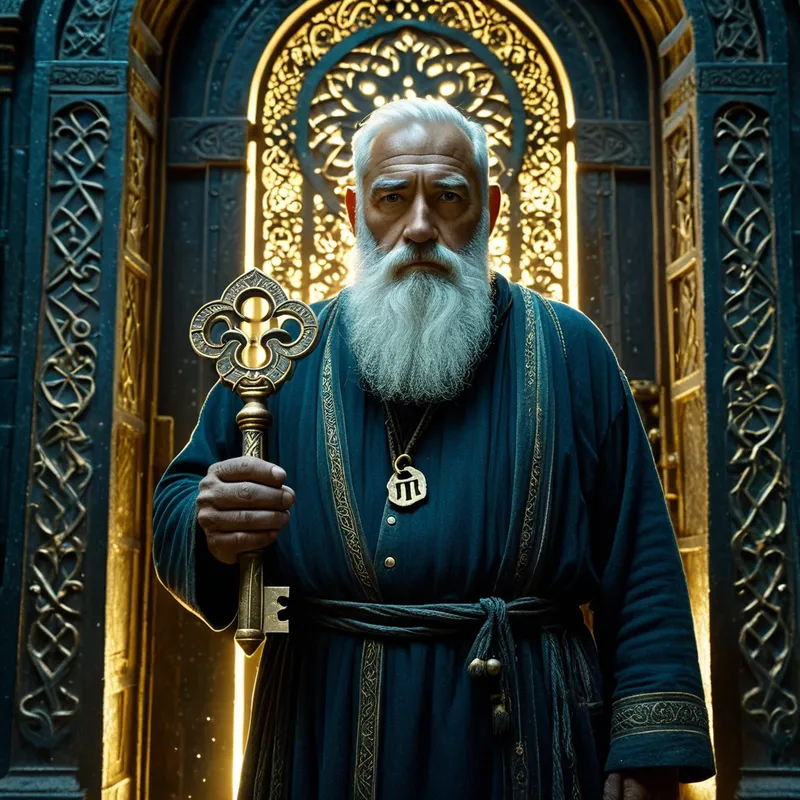
St. Peter Myth Meaning & Symbolism
The fisherman who denied his master thrice, yet was entrusted with the keys to the kingdom, embodying the paradox of flawed humanity chosen for divine purpose.
The Tale of St. Peter
Listen. There was a man of [the sea](/myths/the-sea “Myth from Greek culture.”/), a man of nets and salt and the heaving deck. His name was Simon, son of John, and his world was the grey waters of Gennesaret. He was a man of substance, of muscle and will, yet his heart was a restless sea. Then came the Rabbi from Nazareth, who stood on the shore and spoke not of fish, but of men. “Follow me,” he said, “and I will make you [fishers of men](/myths/fishers-of-men “Myth from Biblical culture.”/).” And in that moment, the nets fell from Simon’s hands as if they were cobwebs. He followed.
He walked on dust and doctrine, witnessed [water](/myths/water “Myth from Chinese culture.”/) turned to wine and storms stilled by a word. He was the first to speak the dangerous truth aloud: “You are the Christ.” And the Rabbi looked at him, his gaze seeing through the fisherman’s bravado to the bedrock beneath. “You are Petros,” he declared, “and on this rock I will build my church.” The words were a promise and a weight, a crown of stone placed upon a head of flesh.
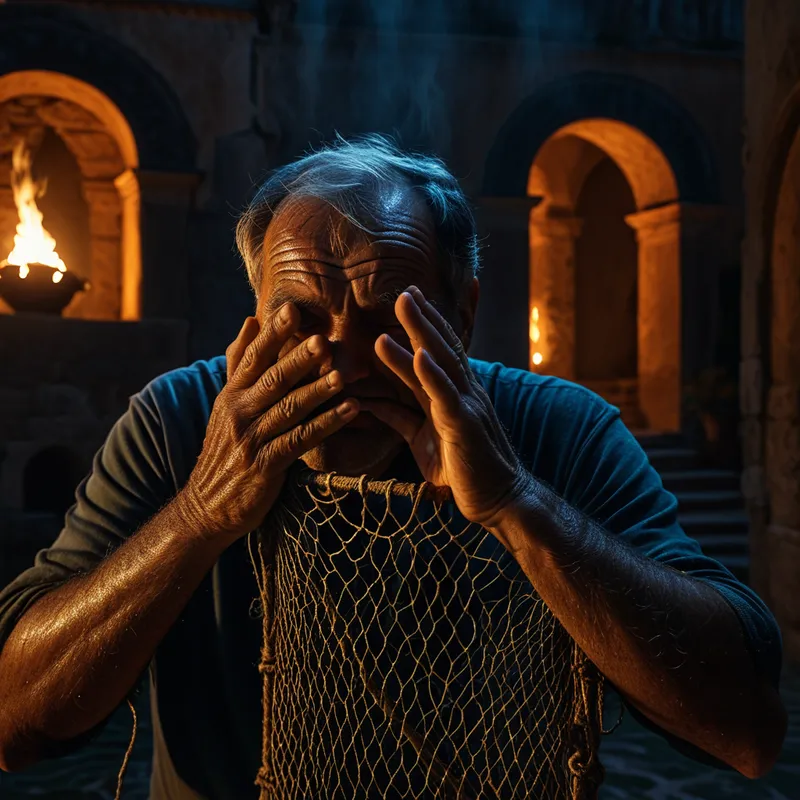
But flesh is weak. In the gathering dark of an olive grove, the Rabbi was taken. [The world](/myths/the-world “Myth from Tarot culture.”/) of miracles collapsed into the clatter of Roman armor. Simon, now called [Peter](/myths/peter “Myth from Biblical culture.”/), followed at a distance, a shadow among shadows, drawn to the firelight of the high priest’s courtyard. The night was cold. A servant girl peered at him. “You were with him,” she said. The words were a spark in tinder. “Woman, I do not know him,” he barked. Once. Then again. A third time, with curses, he denied the man he had called Lord. And as the last oath left his lips, a rooster crowed, slicing the dawn like a blade.
The sound was the sound of his soul breaking. He met the eyes of his master, being led across the courtyard. And he went out and wept bitterly, his sobs the only prayer he could muster.
Yet the story did not end in that ash-filled dawn. After the unthinkable—the cross, the tomb, the impossible empty morning—the risen Christ sought out the broken rock. On a shore of another dawn, by another charcoal fire, he asked the question three times: “Simon, son of John, do you love me?” With each agonized “Yes, Lord,” a denial was undone. With each command—“Feed my lambs, tend my sheep”—the weight of the keys was placed back into his trembling hands. The rock, shattered by its own failure, was remade not by its own strength, but by a love that asked for nothing but love in return.
Cultural Origins & Context
The myth of Peter is not a single, polished tale but a living narrative woven from the threads of early Christian community memory, recorded in the Gospels and the Acts of the Apostles. It emerged from a culture of oral testimony among Aramaic-speaking Jews in Roman-occupied Judea and Galilee, for whom fishing was not mere metaphor but daily life. The story was told and retold in house churches and clandestine gatherings, serving a crucial sociological function: it legitimized the authority of the emerging Church (traced to Peter) while simultaneously offering a profound theology of grace for a community all too aware of its own failings and persecutions.
Peter became the archetypal “everyman” of the faith—impulsive, fervent, cowardly, yet ultimately restored. His story was a comfort to converts who had denied Christ under threat, and a warning against pride to those in leadership. The symbol of the Keys of the Kingdom and his role as the gatekeeper of heaven solidified in later Catholic tradition, but the core psychological drama—the transformation of Simon the fisherman into [Peter the Rock](/myths/peter-the-rock “Myth from Abrahamic culture.”/)—resonated universally, making him one of the most relatable and human figures in the Christian [pantheon](/myths/pantheon “Myth from Roman culture.”/) of [saints](/myths/saints “Myth from Christian culture.”/).
Symbolic Architecture
At its [heart](/symbols/heart “Symbol: The heart symbolizes love, emotion, and the core of one’s existence, representing deep connections with others and self.”/), the myth of Peter is an alchemical map of the [psyche](/myths/psyche “Myth from Greek culture.”/)’s [journey](/symbols/journey “Symbol: A journey in dreams typically signifies adventure, growth, or a significant life transition.”/) from identified ego to responsible Self. Simon represents the natural man, [the ego](/myths/the-ego “Myth from Jungian culture.”/) rooted in profession, [family](/symbols/family “Symbol: The symbol of ‘family’ represents foundational relationships and emotional connections that shape an individual’s identity and personal development.”/), and tangible [reality](/symbols/reality “Symbol: Reality signifies the state of existence and perception, often reflecting one’s understanding of truth and life experiences.”/). The call to follow is the summons of the Self, which disrupts [the ego](/myths/the-ego “Myth from Jungian culture.”/)’s comfortable orbit.
The rock is not a symbol of inflexible strength, but of the foundational crisis that precedes true stability.
The triple denial is not merely a moral failure; it is the catastrophic shattering of the ego’s identification with the heroic ideal. Peter believed he was the rock, and in that presumption lay his downfall. The crowing rooster is the voice of conscience, the brutal, awakening call of reality that forces the ego to confront its [shadow](/symbols/shadow “Symbol: The ‘shadow’ embodies the unconscious, repressed aspects of the self and often represents fears or hidden emotions.”/)—its [capacity](/symbols/capacity “Symbol: A measure of one’s potential, limits, or ability to contain, process, or achieve something, often reflecting self-assessment or external demands.”/) for [betrayal](/symbols/betrayal “Symbol: A profound violation of trust in artistic or musical contexts, often representing broken creative partnerships or artistic integrity compromised.”/) and cowardice. His bitter weeping is the essential [nigredo](/myths/nigredo “Myth from Alchemical culture.”/), the blackening, the [dissolution](/symbols/dissolution “Symbol: The process of breaking down, dispersing, or losing form, often representing transformation, release, or the end of a state of being.”/) of the old [personality](/symbols/personality “Symbol: Personality in dreams often symbolizes the traits and characteristics of the dreamer, reflecting how they perceive themselves and how they believe they are perceived by others.”/).
The restoration by the sea is the [albedo](/symbols/albedo “Symbol: In alchemy, the whitening stage representing purification, spiritual ascension, and the emergence of consciousness from darkness.”/), the whitening. The threefold question meticulously deconstructs the threefold denial, not through [punishment](/symbols/punishment “Symbol: A dream symbol representing consequences for actions, often tied to guilt, societal rules, or internal moral conflicts.”/), but through the painful, loving reintegration of [the shadow](/myths/the-shadow “Myth from Jungian culture.”/). The command to “feed my [sheep](/symbols/sheep “Symbol: Sheep often symbolize innocence, vulnerability, and the idea of conforming to societal norms.”/)” transmutes the personal failure into a transpersonal [responsibility](/symbols/responsibility “Symbol: Responsibility in dreams often signifies the weight of duties and the expectations placed upon the dreamer.”/). He is not given the keys because he is perfect, but because he knows the price of the lock. He becomes the [caregiver](/symbols/caregiver “Symbol: A spiritual or mythical figure representing nurturing, protection, and unconditional support, often embodying divine or archetypal parental energy.”/) precisely because he knows what it is to be lost.
The Dreamer’s Resonance
When the pattern of Peter’s myth stirs in the modern dreamer, it signals a profound crisis of identity and commitment. To dream of denying someone or something of great importance—a mentor, a principle, one’s own truth—points to a lived experience where the ego felt forced to betray its deepest allegiance for survival, approval, or fear. The somatic sensation is often one of choking, of a throat constricted, unable to speak the necessary word.
Dreaming of keys, especially if they are heavy, lost, or offered by an ambiguous authority figure, speaks to the dreamer standing at a threshold of responsibility they feel both called to and unworthy of. A dream-rooster’s cry is the psyche’s alarm clock, a jarring insistence that it is time to face a truth that has been avoided. The dream is not condemning the denial; it is initiating the process of the weeping—the necessary, humbling dissolution of a self-image that has become unsustainable. The psyche is preparing the ground for a question to be asked at its own dawn-fire: “Do you love what you have betrayed? And if so, how will you tend to it now?”

Alchemical Translation
The individuation process modeled by Peter is the transformation of the ego from a solitary actor into the steward of [the Self](/myths/the-self “Myth from Jungian culture.”/). We all begin as Simon, identified with our roles—the thinker, the artist, the professional. The call of vocation, of a deeper life, inevitably leads us to a promise we make to ourselves: “I will be the rock. I will be steadfast.” This is the ego’s heroic inflation.
The inevitable failure—the project abandoned, the addiction succumbed to, the promise broken—is our courtyard denial. It is not the end of the journey but its crucial, dark center.
The keys are not granted for flawless loyalty, but for the wisdom forged in the furnace of forgiven failure.
The alchemical work is in the weeping. One must fully inhabit the nigredo, the feeling of being utterly broken and unworthy, without rushing to self-justification or renewed inflation. This is the dissolution of the old “rock” identity. Then comes the dawn encounter—the gentle, relentless questioning by the inner, guiding Self. “Do you love this path? Do you love this truth?” Not “Are you strong enough?” but “Do you love it?”
The final transmutation is the shift from “I am the rock” to “I am the keeper of the gate.” The energy is no longer invested in maintaining a perfect self-image, but in service to [the thing](/myths/the-thing “Myth from Norse culture.”/) itself—the art, the relationship, the community, the inner truth. The flawed, forgiven ego becomes the caregiver, the responsible steward holding the keys that bind and loose, that open [the way](/myths/the-way “Myth from Taoist culture.”/) for oneself and others. One becomes foundational not through impenetrable strength, but through having been shattered and reconstituted around a central, loving “yes.”
Associated Symbols
Explore related symbols from the CaleaDream lexicon: