St. James the Greater Myth Meaning & Symbolism
A fisherman apostle, the first martyr, whose bones call pilgrims across Europe, transforming a warrior's zeal into a path of sacred journey and spiritual alchemy.
The Tale of St. James the Greater
Hear now the tale of the Son of Thunder, a man of fire and water, whose story is written in blood, sea-salt, and starlight.
In the beginning, there was the lake, and the nets. Two brothers, James and John, their hands calloused from hauling the day’s silver catch from the deep. The air smelled of fish and wet rope. Then, a shadow fell across their boat, not from a cloud, but from a man standing on the shore. He spoke no long sermon, only two words: “Follow me.” And they did. They left the nets, the boat, their father Zebedee—the whole known world of the lake—to walk into the unknown dust of the teacher’s road. He named them Boanerges, for the storm of zeal that raged in their hearts.
He walked with the teacher, saw the blind see and the lame walk. He stood on the mountain and witnessed the unseeable: the teacher’s face shining like the sun, his clothes whiter than any fuller on earth could bleach them, talking with Moses and Elijah. He felt the terror and the glory. His fire burned brighter; he asked for a seat at the right hand in glory, not understanding the cup he must first drink.
Then came the garden. The scent of olives crushed underfoot, the cold sweat of dread. The teacher was taken. The fire in James turned to ash, scattered by fear. But from the ash, an ember was rekindled by a rumor: the tomb was empty. He saw the risen one. The fire was no longer for earthly glory but for a proclamation that would scorch the earth.
He carried this fire to the ends of the known world, to the wild, Celtic-edged land of Hispania. His words fell like seeds on stony ground, or so it seemed. Returning to Jerusalem, the fire of his proclamation met the cold steel of a king’s decree. Herod Agrippa raised his sword. James, the Son of Thunder, became the first of the twelve to drink the cup of martyrdom, his blood the first apostolic seed sown in the thirsty earth.
But the tale does not end with the fall of the sword.
His loyal disciples, under cover of night, gathered his sacred remains. With prayers and tears, they placed them in a marble tomb. And then, a miracle of guidance: a ship was provided, not of oak and nail, but of stone, without sail or rudder. They laid the tomb within this vessel of mystery. The stone boat, guided by angelic hands or the currents of fate, sailed for seven days across the Middle Sea, past the Pillars of Hercules, into the fierce Atlantic. It came to rest in a forgotten creek in the land where he had once preached, the green, mist-shrouded coast of Galicia.
Centuries passed. The tomb was lost, swallowed by bramble and time. Until a hermit, led by a field of stars, saw a celestial light pulsing from a forgotten thicket. The bones of the Thunderer were found. A cathedral rose over the spot, and a road was born—not just a road, but a river of humanity, a thousand thousand footsteps beating a path to his resting place. The fire of the apostle was transmuted into the light of the Campus Stellae, the Field of Stars, guiding pilgrims to Compostela. The fisherman, the thunder-son, the martyr, had become the Pilgrim Saint, his final resting place not an end, but a beginning for every soul that seeks.

Cultural Origins & Context
The myth of St. James is a palimpsest, written and rewritten over centuries. Its earliest layer is scriptural: the brief, potent mentions in the Gospels and Acts of a zealous apostle martyred by Herod. This historical kernel, thin as parchment, was fertile ground for legend.
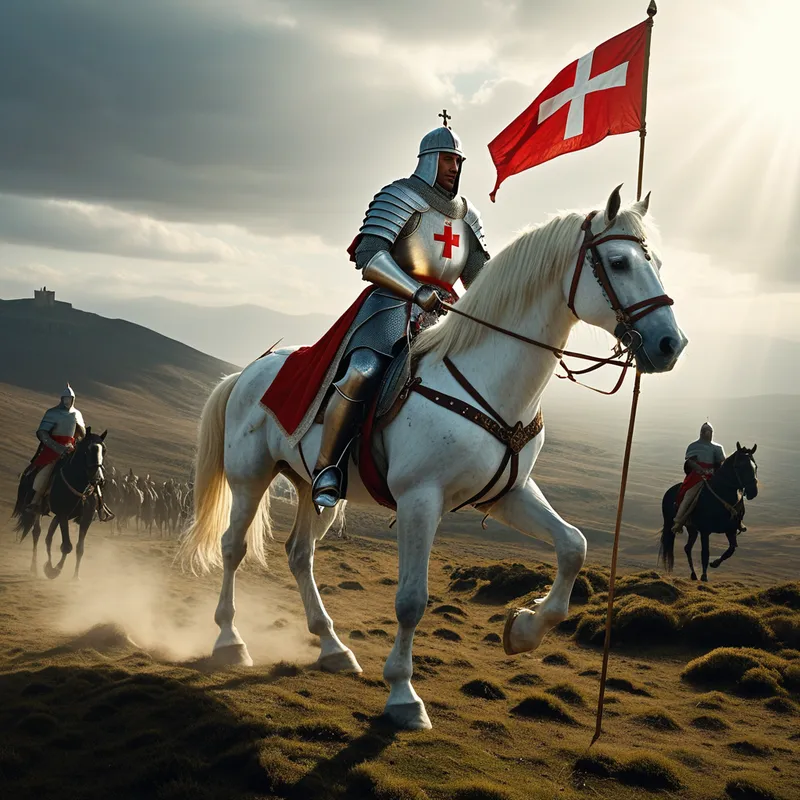
The critical cultural leap occurred in the 9th century in the Kingdom of Asturias, a Christian foothold in a peninsula largely under Al-Andalus. The “discovery” (or inventio) of the apostle’s tomb in Compostela was a geopolitical and spiritual lightning strike. It provided a divine patron for the Reconquista, a celestial ally in a terrestrial war. The myth was propagated by monastic chroniclers and kings, transforming James from a pacific apostle into Santiago Matamoros, the heavenly knight who appeared at pivotal battles.
Simultaneously, the myth was carried on the soles of pilgrims. The Camino de Santiago became the greatest narrative engine. Pilgrims’ guides, like the 12th-century Codex Calixtinus, codified the miracles, the routes, and the saint’s power. The myth’s societal function was multifaceted: it was a unifying force for Christendom, an economic catalyst for northern Spain, a penitential system for the faithful, and a colossal story that gave meaning to immense personal hardship. It was passed down not just from pulpit to pew, but from walker to walker, in hostels and on dusty roads, making every pilgrim a living cell in the body of the myth.
Symbolic Architecture
At its core, the myth of James is an alchemical narrative of transformation, where base elements of human character are subjected to the fire of spirit and the water of fate to produce spiritual gold.
The Fisherman represents the conscious ego, working within the known waters of tradition and daily life. The Apostle is the called Self, leaving the known for the unknown, animated by a fiery, often immature, zeal for transcendence. The Martyr is the ultimate sacrifice of the ego to the transcendent principle; the conscious personality is “decapitated” so the symbolic essence can live on.
The pilgrimage does not begin at the tomb; the tomb is the destination. The true pilgrimage is the life that leads to it—the willing drinking of the cup, the surrender of the known self.
The Stone Boat is a profound symbol of the paradox of divine guidance: it is utterly passive (no sail, no rudder) yet moves with perfect purpose. It represents the vessel of tradition, or the body itself, carrying the sacred relic of one’s essence through the unpredictable seas of life and history, guided by an intelligence beyond the ego.
Finally, the Pilgrim Saint is the fully realized symbol. He is no longer the actor but the goal. His bones are not a morbid end but a magnetic north for the soul’s journey. The Scallop Shell mirrors this: its grooves, converging at a single point, map the many paths of human experience converging upon the central, numinous Self.

The Dreamer's Resonance
When this myth stirs in the modern dreamer, it often signals a profound crossroads in the process of individuation. To dream of a long, arduous road (the Camino) speaks to a somatic feeling of being in a necessary but exhausting life transition—a career change, the end of a relationship, a spiritual crisis. The body feels the weight of the pack, the ache in the feet.
Dreams of being a fisherman suddenly called ashore echo a summons from the Self. It is an unsettling, disruptive energy, often preceding a major life decision that feels both irrational and imperative. The dream-ego may resist, clinging to the “nets” of security.
A dream of martyrdom is rarely literal. It is the psyche’s dramatic portrayal of an ego-death in process: the sacrifice of an old identity, a cherished belief, or a way of life. It feels like a violent loss, but within the mythic structure, it is the necessary prelude to a more authentic existence. Finding a glowing shell or following a path of stars in a dream indicates the emergence of guidance from the deep unconscious, a hint that the arduous journey has a sacred destination, even if the waking self cannot yet see it.

Alchemical Translation
The myth of James is a precise manual for psychic transmutation. The Nigredo, the blackening, is found in the martyrdom—the brutal, disillusioning death of the ego’s initial, fiery project (“I will sit at your right hand!”). The naive zeal of the Son of Thunder is burned away.
The Albedo, the whitening, is the purification of the stone boat’s journey. It is the period of passive suffering, of being carried by currents one does not control (illness, loss, depression), where the conscious mind must relinquish control. The sacred contents (one’s core values, the “bones” of one’s truth) are preserved but isolated, afloat in a vast unknown.
The alchemy occurs not in the fire of zeal, but in the patience of the journey and the stillness of the arrival. The Self is not achieved by conquest, but by becoming a worthy destination for one’s own long seeking.
The Rubedo, the reddening or culmination, is the discovery of the tomb and the establishment of the pilgrimage. This is the stage of integration. The once-scattered, martyred self is rediscovered as a central, organizing principle. The individual’s life experiences, once seen as random sufferings or efforts, are now understood as a “camino”—a path with meaning. The ego, having died to its selfish ambitions, now serves as the humble keeper of the shrine, the guide for others (and other parts of oneself) on their journey. The fire of James is not extinguished but is transformed into the steady, guiding light of the stars, and the magnetic pull of the sacred center. One becomes, at last, both the pilgrim and the saint, the seeker and the sought.
Associated Symbols
Explore related symbols from the CaleaDream lexicon: