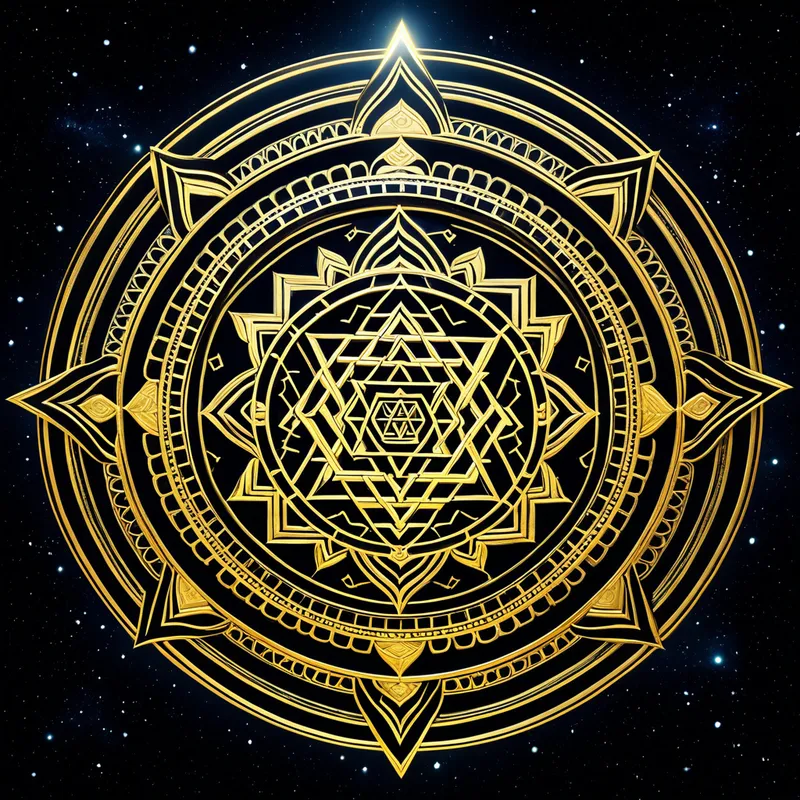
Sri Yantra Myth Meaning & Symbolism
A sacred geometric myth of the cosmos emerging from a single point, weaving divine masculine and feminine into a map of ultimate reality and consciousness.
The Tale of Sri Yantra
Before time was measured, before form was born, there existed only the One—a silent, boundless ocean of potential, a profound and pregnant void. This was Brahman, not as a god but as the very ground of being. And within this stillness, a desire stirred. A single, primal vibration, the sacred syllable AUM, echoed in the absolute quiet. It was the first thought, the first movement—the wish to become many.
From this vibrational seed, a point of blinding luminosity emerged. [Shiva](/myths/shiva “Myth from Hindu culture.”/), the transcendent consciousness, pure and unchanging, awoke. And from his being, as heat radiates from fire, flowed [Shakti](/myths/shakti “Myth from Hindu culture.”/), the cosmic power, the urge to create. She was the dance, the sound, the pulse of life itself. They were not two, but one being experiencing itself in duality.
Shakti, [the great mother](/myths/the-great-mother “Myth from Jungian culture.”/) of all that is, began her creative dance. Her movement traced the first lines of reality in [the void](/myths/the-void “Myth from Buddhist culture.”/). From the central point, the Bindu, she spun outward. With a sound like a million [lotus](/myths/lotus “Myth from Hindu culture.”/) petals unfurling, she drew the first triangle, pointing downward, a symbol of her own yoni, [the womb](/myths/the-womb “Myth from Various culture.”/) of the cosmos. It was the element of [water](/myths/water “Myth from Chinese culture.”/), of flow, of becoming.
In response, from the same Bindu, the consciousness of Shiva manifested as a triangle pointing upward, the symbol of steady focus and transcendent fire. Their points met, interlocked, and did not consume each other. This was the first sacred union, the marriage of stillness and motion. From this embrace, more triangles blossomed—fourteen in total, weaving a complex, mesmerizing web of nine interlocking chambers, the Navayoni Chakra.
Around this blazing core of interlocked triangles, Shakti drew three concentric circles, like the ripples of her creative impulse across the waters of existence. Then, she enclosed the entire luminous, humming [mandala](/myths/mandala “Myth from Buddhist culture.”/) within a square fortress with four majestic gates facing the cardinal directions. This was Bhupura, the earthly plane, the city of manifestation.
The sound settled. The light stabilized. There it hung in the void—the Sri Yantra. It was not merely a picture. It was the living body of the Goddess, the architectural blueprint of the universe, and the map of the soul’s journey from the outer world of multiplicity to the inner point of singular unity. It was the story of everything, told not in words, but in angles, intersections, and sacred geometry. The cosmos had found its perfect, silent name.
Cultural Origins & Context
The myth of the Sri Yantra is not a narrative passed down in a single epic like the Itihasas. Its origins are esoteric, emerging from the Tantric and Shakta traditions, likely between the 6th and 12th centuries CE. It is a knowledge system transmitted from guru to disciple, a visual and meditative technology rather than a spoken tale.
Its primary “storytellers” were the Tantrikas and Rishis who, in deep states of meditation ([Samadhi](/myths/samadhi “Myth from Buddhist culture.”/)), perceived the underlying geometric patterns of consciousness and cosmos. They encoded this perception into the Yantra as a tool for others to replicate that visionary state. Its societal function was dual: for [the adept](/myths/the-adept “Myth from Alchemical culture.”/), it was a means of spiritual ascent and union with the divine; for the community and kingdom, it was a powerful symbol of cosmic order (Dharma), prosperity, and protection, often installed in temples and palaces.
Symbolic Architecture
The Sri [Yantra](/symbols/yantra “Symbol: A geometric diagram used in Hindu and Buddhist traditions for meditation, representing cosmic principles and divine energy.”/) is a [multi](/symbols/multi “Symbol: Multi signifies multiplicity and diversity, often representing various aspects of life or identity in dreams.”/)-layered symbolic [universe](/symbols/universe “Symbol: The universe symbolizes vastness, interconnectedness, and the mysteries of existence beyond the individual self.”/). Its central point, the [Bindu](/symbols/bindu “Symbol: A sacred point or dot representing the origin of creation, consciousness, and the universe in Hindu and Buddhist traditions.”/), represents the unmanifest [source](/symbols/source “Symbol: The origin point of something, often representing beginnings, nourishment, or the fundamental cause behind phenomena.”/), the [soul](/symbols/soul “Symbol: The soul represents the essence of a person, encompassing their spirit, identity, and connection to the universe.”/), or the [seeker](/symbols/seeker “Symbol: A person actively searching for meaning, truth, or a higher purpose, often representing the dreamer’s own quest for identity or fulfillment.”/)‘s true self. The [outward](/symbols/outward “Symbol: Movement or orientation away from the self or center; expansion, expression, or externalization of inner states into the world.”/) [expansion](/symbols/expansion “Symbol: A symbol of growth, increase, or extension beyond current boundaries, often representing personal development, opportunity, or overwhelming change.”/) through the interlocking triangles symbolizes the process of creation (Srishti), where the One becomes the many. The upward-pointing Shiva triangles and downward-pointing Shakti triangles represent the inseparable duality inherent in [reality](/symbols/reality “Symbol: Reality signifies the state of existence and perception, often reflecting one’s understanding of truth and life experiences.”/): [consciousness](/symbols/consciousness “Symbol: Consciousness represents the state of awareness and perception, encompassing thoughts, feelings, and experiences.”/) and [energy](/symbols/energy “Symbol: Energy symbolizes vitality, motivation, and the drive that fuels actions and ambitions.”/), [static](/symbols/static “Symbol: Static represents interference, disruption, and the breakdown of clear communication or signal, often evoking feelings of frustration and disconnection.”/) and dynamic, male and female.
The journey from the outer square to the inner point is the soul’s pilgrimage from the fragmented world of the senses to the integrated truth of the Self.
The nine enclosures (Navayoni) correspond to stages of spiritual evolution, cosmic planes, and aspects of the [Goddess](/symbols/goddess “Symbol: The goddess symbolizes feminine power, divinity, and the nurturing aspects of life, embodying creation and wisdom.”/). They map a descent of divine energy into matter and a corresponding [ascent](/symbols/ascent “Symbol: Symbolizes upward movement, progress, spiritual elevation, or striving toward higher goals, often representing personal growth or transcendence.”/) of consciousness back to the source. The three circles represent the three fundamental qualities (Gunas) that constitute all phenomenal reality. [The square](/myths/the-square “Myth from Platonic culture.”/) with its gates represents the bounded, earthly existence, the starting point of the spiritual [quest](/symbols/quest “Symbol: A quest symbolizes a journey or search for purpose, fulfillment, or knowledge, often representing life’s challenges and adventures.”/).
The Dreamer’s Resonance
When the pattern of the Sri Yantra, or its felt sense, appears in a modern dream, it often signals a profound process of psychic reorganization. The dreamer is not merely seeing a symbol; they are experiencing the architecture of their own [psyche](/myths/psyche “Myth from Greek culture.”/) being reconfigured.
Somatically, this can feel like a centering, a pulling-together, or a powerful harmonic vibration in the chest or head. Psychologically, it indicates a movement toward inner synthesis. The conflicting triangles may represent opposing life forces—career and family, logic and intuition, independence and connection—seeking a new, harmonious integration. The dream may occur during a life transition where one’s identity feels fragmented, and the unconscious is providing a blueprint for wholeness. To dream of successfully navigating from the outer gates to the luminous center is to dream of achieving profound self-coherence and inner peace.
Alchemical Translation
For the modern individual, the Sri Yantra models the alchemical process of Individuation—the psychic transmutation of the lead of a fragmented personality into the gold of an integrated Self. The outer square is the [persona](/myths/persona “Myth from Greek culture.”/), the social mask we present to [the world](/myths/the-world “Myth from Tarot culture.”/), full of gates and defenses.
The journey inward is the confrontation with the unconscious. The interlocking triangles are the dynamic interplay of archetypal opposites within us: the Animus and Anima, [the Shadow](/myths/the-shadow “Myth from Jungian culture.”/) and the Persona, the conscious ego and the vast unconscious. The struggle is not to defeat one side, but to find the precise point of sacred interlock, where opposites unite to generate something new—conscious wholeness.
The central Bindu is the Self, the undiscovered totality that was there all along, waiting to be recognized as the source and destination of the entire journey.
Each layer shed, each harmonious integration of an inner opposite, brings one closer to this center. The process is rarely linear; it is a circling, deepening meditation. The ultimate alchemical [triumph](/myths/triumph “Myth from Roman culture.”/) is not acquiring something external, but realizing that the complex, beautiful, and sometimes chaotic mandala of one’s life has always been organized around a silent, central point of pure being—the individual’s own participation in the divine.
Associated Symbols
Explore related symbols from the CaleaDream lexicon: