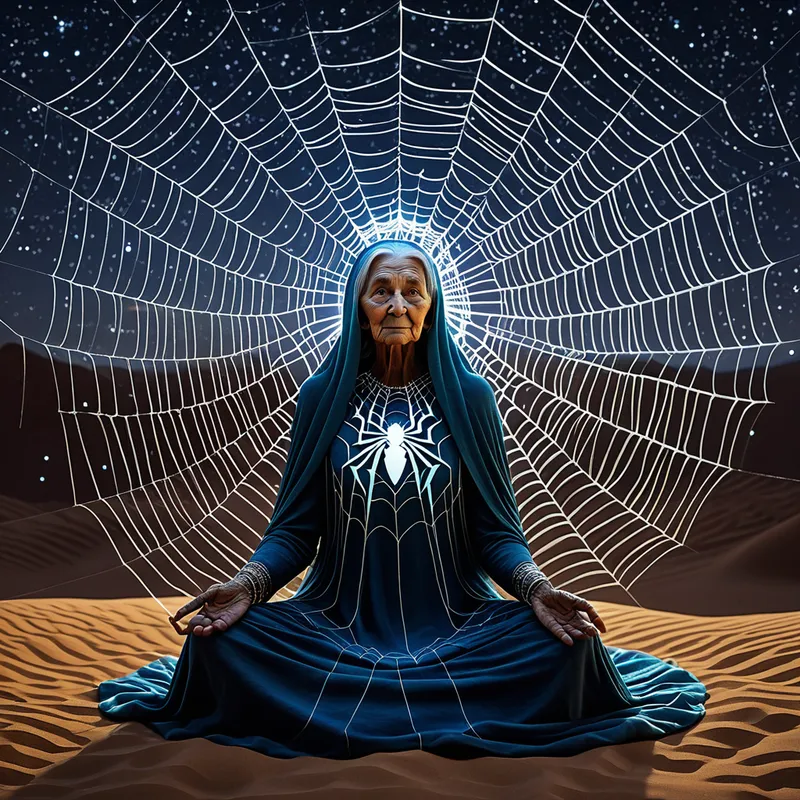
Spider Grandmother / Weaver Myth Meaning & Symbolism
The cosmic weaver who spins the world from thought, guides souls through darkness, and teaches that creation and connection are the same sacred act.
The Tale of Spider Grandmother / Weaver
In the time before time, there was only the dark, silent breath of the void. No sun carved the sky, no earth held firm beneath foot. There was only potential, humming in the infinite deep. And in that deep, a thought began to stir. It was not a loud thought, but a patient one, a vibration of intention. From this stirring, Spider Grandmother awoke.
She was old, older than memory, her eight eyes holding the patience of eternity. She looked upon the emptiness and saw not absence, but a field of unspun possibility. From within herself, she drew out the first substance: a thread of her own being, glistening with inner light. With her forelegs, which were also hands of infinite skill, she began to spin. She sang as she worked, a soft, clicking hum that was the first song. The thread became a line, the line a cross, and the cross the beginning of a web.
But this was no web to catch flies. This was the World Loom. Onto its growing structure, she wove the dust of stars to make the land. She wove the breath of wind to make the sky. She spun clouds, rivers, and the first seeds. Yet the world was beautiful and empty. So, from the sacred clay of the new earth, she formed the First People. She shaped them with care, but they were lifeless, silent figures.
Then came the great journey. The People needed to emerge into this world, but they dwelt in a place of darkness, the Sipapu. Spider Grandmother descended to them on a thread of her web. "Come," her voice whispered in the dark, a sound like rustling leaves. "I will guide you, but you must be brave. The way is narrow and the climb is long."
She led them upward, through layer upon layer of underworlds. Some were realms of mist, others of echoing caverns. Monsters of doubt and fear lurked in the shadows. Whenever the People faltered, Spider Grandmother was there. She wove bridges of light across chasms of despair. She spun cocoons of safety around the weary. She taught them the songs to sing to make their hearts strong. Finally, they saw a pinprick of light above—the opening to the world she had woven for them.
As the first dawn broke, spilling gold across the mesas, the People emerged. Spider Grandmother breathed upon them, and the clay of their bodies warmed. Her breath entered them, and they drew their first breath of the morning air. They were alive. She did not leave them then. She taught the women to weave baskets and pots, showing them how the spiral pattern holds the story of emergence. She taught all people to weave their words into stories, their lives into community. "See," she hummed, tapping the vast, nearly invisible web that connected the pine tree to the mountain, the river to the cloud, the heart of one person to another. "All is connected. To create is to connect. Remember the thread, and you will never be lost."

Cultural Origins & Context
The figure of Spider Grandmother, or Spider Woman, is not the property of a single tribe but a profound archetype woven through the oral traditions of many Southwestern and some Plains Indigenous nations, including the Hopi, Navajo, Pueblo, and Cherokee. She is a foundational being in the Origin Myths. These stories were not mere entertainment; they were the sacred history, cosmology, and social charter of the people, recited during ceremonies, taught to children, and invoked in times of need by elders and medicine people.
Her transmission was always relational—spoken from elder to youth, often during the communal acts of weaving, potting, or gathering. The story was embedded in the practice. To learn to weave a basket with the proper coil was to physically enact Spider Grandmother's creative act. Her myth served multiple societal functions: it explained the origin of the world and human life, it encoded vital survival knowledge (like weaving and agriculture), and most importantly, it modeled the core ethical principle of reciprocity. If she wove the world, then humans must care for it. If she connected all things, then humans must honor those connections.
Symbolic Architecture
Spider Grandmother is the ultimate symbol of the Cosmic Creator who is not a distant, patriarchal ruler, but an immanent, feminine, and tactile force. Her medium is not command, but craft.
The universe is not built; it is woven. Reality is a tapestry of relationships, and consciousness is the shuttle.
The web is the master symbol. It represents the interconnectedness of all life, the delicate balance of ecosystems, the threads of fate and relationship, and the neural networks of thought itself. The center of the web, where she sits, is the still point of the self, from which one perceives and engages with the whole.
Her role as psychopomp in the emergence story is equally critical. The journey from the dark Sipapu to the world of light is the universal journey of birth, of consciousness awakening from the unconscious, and of the soul navigating trauma or a dark night of the psyche. She provides the silken thread—a symbol of intuition, ancestral wisdom, or the therapeutic process—that prevents us from being utterly lost in the chaos.

The Dreamer's Resonance
When Spider Grandmother or her web appears in modern dreams, she often arrives during periods of profound re-creation or disorientation. The dreamer may be feeling fragmented, their life feeling like a collection of unrelated events. To dream of weaving, or of being at the center of a web, signals a somatic process of integration. The psyche is attempting to consciously connect disparate parts of the self—career, relationships, trauma, creativity—into a coherent whole.
Conversely, to dream of being caught in a web, or of a threatening spider, may point to the shadow side of interconnection: feelings of being trapped by responsibilities, enmeshed in toxic relationships, or paralyzed by the complexity of one's own life. The dream is presenting the raw material of the web—the connections exist, but they feel like bindings. This is the call to find the center, to become the weaver of one's own life rather than the ensnared fly. The somatic sensation is often one of subtle tension across the body, a literal feeling of being "strung out," pointing to a need to re-weave one's nervous system into a state of regulated safety.

Alchemical Translation
For the modern individual striving toward individuation, Spider Grandmother models the complete alchemical cycle. The prima materia is the formless chaos of our unlived life, our potential, and our wounds. Her first act—spinning thread from her own body—is the crucial first step of introversion: turning inward to find one's own substance, one's authentic voice and medium.
The thread of destiny is spun from the silken substance of the self. There is no other source material.
The weaving of the world is the act of conscious creation. It is the patient, daily effort to build a life of meaning, to craft a career, a home, a family, a piece of art. It insists that our creative acts are not separate from our spiritual development; they are its expression.
Finally, her guidance through the emergence is the stage of transmutation. This is the therapeutic or spiritual journey into the personal underworld—confronting childhood shadows, ancestral trauma, or deep fear. The silken thread is the lifeline of self-compassion, therapeutic alliance, or spiritual faith that allows us to navigate this inner darkness without disintegration. To emerge, breathing and alive, is to achieve a new level of psychic integration. We realize we are not just a creature on the web, but, in our own sphere, the weaver at its center, responsible for the beauty and strength of the connections we spin, mend, and tenderly hold.
Associated Symbols
Explore related symbols from the CaleaDream lexicon: