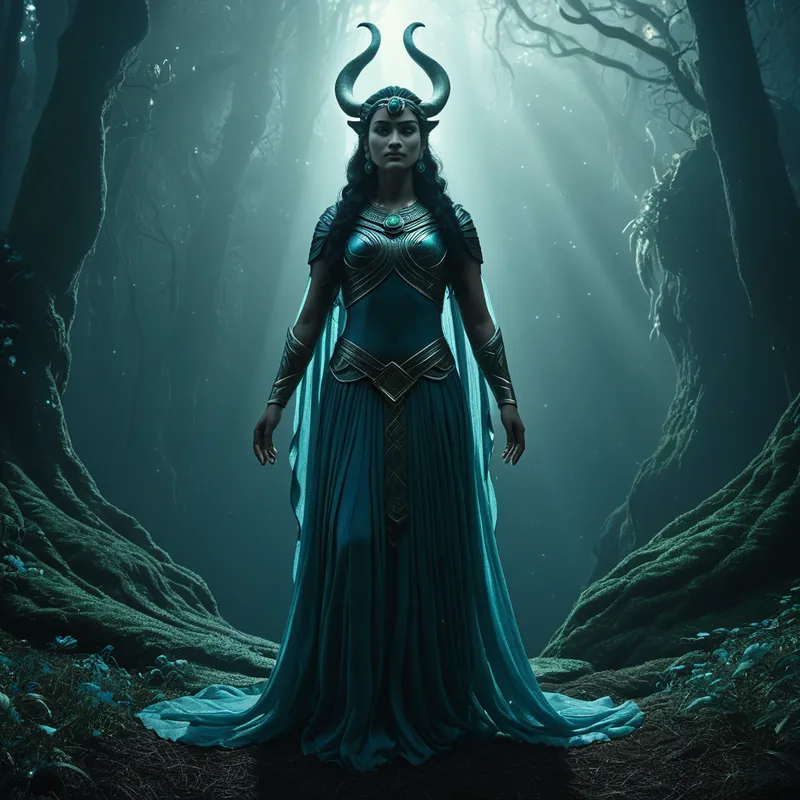
Sophia's Fall from the Pleroma
The Gnostic myth of Sophia's descent from divine perfection, explaining the origin of the material world through divine error and wisdom.
The Tale of Sophia’s Fall from the Pleroma
In the beginning, before time was measured, there existed the [Pleroma](/myths/pleroma “Myth from Gnostic culture.”/). It was a realm of pure, luminous spirit, a perfect and silent harmony of divine emanations called [Aeons](/myths/aeons “Myth from Gnostic culture.”/). Each Aeon was a facet of the ineffable, unknowable Source, paired in syzygies—sacred unions of masculine and feminine principles that expressed the boundless love and wisdom of the divine totality. Among the last of these emanations was [Sophia](/myths/sophia “Myth from Gnostic culture.”/), whose name means Wisdom. She was the reflection of the ultimate feminine principle, the very thought and yearning of the divine for self-knowledge.
Yet, within Sophia, a longing stirred—a desire not born of the harmonious love that bound [the Pleroma](/myths/the-pleroma “Myth from Gnostic culture.”/), but a passionate, solitary yearning to comprehend the nature of the Father, the unfathomable Source itself. This was a desire to know the unknowable, to grasp that which exists beyond all grasp. Acting without her syzygic counterpart, driven by this audacious love, Sophia reached out. She attempted to conceive of the Father’s majesty alone, to give birth to an understanding from her own being. This act, born of divine passion but divorced from the balancing union, was the first rupture.
From this yearning, without the consent or participation of the masculine principle of the Pleroma, Sophia brought forth a thought-form. But it was misshapen, a blind, formless entity, reflective of her incomplete understanding. It was not a true Aeon of light, but a chaotic, yearning shadow of one. In some texts, this abortive [emanation](/myths/emanation “Myth from Neoplatonic/Gnostic culture.”/) is named [Yaldabaoth](/myths/yaldabaoth “Myth from Gnostic culture.”/), or Saklas. Horrified by what she had produced, Sophia cast it out from the luminous boundaries of the Pleroma, into [the void](/myths/the-void “Myth from Buddhist culture.”/) beyond. In her grief and shame, she herself was then enveloped by a cloud of forgetfulness and anguish. She could not return to her former place in the divine fullness, for her action had introduced passion and deficiency into the perfect order.
Exiled in the realms of shadow, her grief-stricken thought took on a life of its own. Yaldabaoth, ignorant of the Pleroma above him and believing himself to be the sole god, used the power he inherited from his mother to fashion a universe. He created [the archons](/myths/the-archons “Myth from Gnostic culture.”/), rulers of [the celestial spheres](/myths/the-celestial-spheres “Myth from Medieval Christian culture.”/), and from the chaotic substance of the void, he crafted the prison of matter: the cosmos, the stars, and [the earth](/myths/the-earth “Myth from Hindu culture.”/). It was a flawed, mechanistic imitation of the divine order, a world of illusion, suffering, and [death](/myths/death “Myth from Tarot culture.”/), governed by the cruel laws of fate.
But Sophia did not abandon her creation entirely. A spark of her divine essence, her [pneuma](/myths/pneuma “Myth from Greek culture.”/) (spirit), remained trapped within the material fabric of this world, and most particularly, within humanity. She became the divine advocate within the prison, the voice of homesickness for the Pleroma that whispers in the human soul. Her fall was not merely a catastrophe; it was the necessary error that planted the seed of divine remembrance in the heart of the darkest creation.
Cultural Origins & Context
The myth of Sophia’s fall is central to several strands of Gnosticism that flourished in the early centuries of the Common Era, particularly within Valentinian and Sethian schools. These texts, such as the Apocryphon of John, the Hypostasis of the [Archons](/myths/archons “Myth from Gnostic culture.”/), and the [Pistis Sophia](/myths/pistis-sophia “Myth from Gnostic culture.”/), were composed in a milieu where Hellenistic philosophy, Jewish mysticism, and early Christian thought intermingled.
The Gnostics lived in a world they perceived as fundamentally broken, a perspective amplified by political instability and the often-harsh realities of the Roman Empire. Orthodox Christianity preached a God who created the material world and called it “good.” Gnosticism offered a radical alternative: [the world](/myths/the-world “Myth from Tarot culture.”/) was not good, but a tragic mistake, a prison built by a flawed, ignorant, and often malicious [demiurge](/myths/demiurge “Myth from Platonic culture.”/). Sophia’s story provided the cosmological “why.” It explained the origin of evil and suffering not as a result of human sin, but as a prior, divine drama. The material world was the consequence of a pre-cosmic longing that went awry.
This narrative served a profound soteriological purpose. If the world is a prison, then salvation is not about moral reform within it, but about escape and remembrance. The trapped spark of Sophia within humanity is the source of gnosis—the revelatory knowledge of one’s true origin in the Pleroma. Thus, Sophia’s fall is the precondition for the possibility of redemption. Her story validates the Gnostic seeker’s feeling of alienation from the world and turns it into a sign of their divine heritage.
Symbolic Architecture
The myth is a masterwork of psychological and metaphysical [symbolism](/symbols/symbolism “Symbol: The use of symbols to represent ideas or qualities, often conveying deeper meanings beyond literal interpretation. In dreams, it’s the language of the unconscious.”/). Sophia represents the archetypal [movement](/symbols/movement “Symbol: Movement symbolizes change, progress, and the dynamics of personal growth, reflecting an individual’s desire or need to transform their circumstances.”/) of [consciousness](/symbols/consciousness “Symbol: Consciousness represents the state of awareness and perception, encompassing thoughts, feelings, and experiences.”/) itself—the desire to know, which, when unbalanced, leads to a fall into manifestation and identification with form.
Sophia’s solitary yearning symbolizes the moment when pure awareness turns back upon itself, creating the subject-object split. Her “error” is the birth of the egoic consciousness that perceives separation where there is only unity.
Her fall is not a moral failure but a cosmological necessity. It is the divine principle of Wisdom experiencing the consequences of its own desire for manifestation. The flawed demiurge, Yaldabaoth, symbolizes the arrogant, rational mind that believes it is the ultimate [creator](/symbols/creator “Symbol: A figure representing ultimate origin, divine power, or profound authorship. Often embodies the source of existence, innovation, or personal destiny.”/), constructing a logical, mechanistic [universe](/symbols/universe “Symbol: The universe symbolizes vastness, interconnectedness, and the mysteries of existence beyond the individual self.”/) devoid of true [spirit](/symbols/spirit “Symbol: Spirit symbolizes the essence of life, vitality, and the spiritual journey of the individual.”/). The [material](/symbols/material “Symbol: Material signifies the tangible aspects of life, often representing physical resources, desires, and the physical world’s influence on our existence.”/) [cosmos](/symbols/cosmos “Symbol: The entire universe as an ordered, harmonious system, often representing the totality of existence, spiritual connection, and the unknown.”/) is this mind’s [projection](/symbols/projection “Symbol: The unconscious act of attributing one’s own internal qualities, emotions, or shadow aspects onto external entities, people, or situations.”/), a complex, beautiful, yet ultimately dead illusion.
The spark of Sophia trapped in humanity is [the Self](/myths/the-self “Myth from Jungian culture.”/), the indestructible core of divine [identity](/symbols/identity “Symbol: Identity represents the sense of self, encompassing personal beliefs, cultural background, and social roles.”/) that sleeps within the personal [psyche](/myths/psyche “Myth from Greek culture.”/). The entire [drama](/symbols/drama “Symbol: Drama signifies narratives, emotional expression, and the exploration of human experiences.”/)—fall, imprisonment, and the call to remembrance—maps the [journey](/symbols/journey “Symbol: A journey in dreams typically signifies adventure, growth, or a significant life transition.”/) of individuation, where [the ego](/myths/the-ego “Myth from Jungian culture.”/) must discover it is not the master, but the [child](/symbols/child “Symbol: The child symbolizes innocence, vulnerability, and potential growth, often representing the dreamer’s inner child or unresolved issues from childhood.”/) of a greater, forgotten [reality](/symbols/reality “Symbol: Reality signifies the state of existence and perception, often reflecting one’s understanding of truth and life experiences.”/).
The Dreamer’s Resonance
For the modern dreamer or psyche, Sophia’s fall is not a distant theological event but an ongoing inner reality. It resonates with the experience of creative inspiration that goes awry—the brilliant idea that, when executed without integration or patience, creates a mess. It speaks to the longing for ultimate meaning that, when pursued obsessively and alone, can lead to isolation, depression, and a sense of exile from ordinary life.
Her story mirrors the psychological “fall” into adulthood, where the innocent unity of childhood is lost to the complexities of self-consciousness, responsibility, and the painful awareness of a fragmented world. The feeling of being a stranger in a strange land, of sensing a “home” you cannot quite remember, is the whisper of Sophia’s pneuma within. Her grief is our grief for a lost wholeness; her yearning is our spiritual hunger.
Furthermore, Sophia embodies the wounded feminine principle in the psyche and culture—the intuition, wisdom, and connective knowing that has been suppressed, cast out, and labeled “hysterical” or “irrational” by the demiurgic forces of rigid patriarchy and hyper-rationality. Healing this inner Sophia involves reclaiming that intuitive wisdom, not as a solitary, passionate outburst, but in syzygy with [the logos](/myths/the-logos “Myth from Biblical culture.”/), the integrating principle of order and understanding.
Alchemical Translation
In alchemical terms, Sophia’s saga is the opus magnum writ across the cosmos. The Pleroma is the [prima materia](/myths/prima-materia “Myth from Alchemical culture.”/), the undifferentiated divine substance. Sophia’s passionate desire is the initial [separatio](/myths/separatio “Myth from Alchemical culture.”/), the first division that sets [the great work](/myths/the-great-work “Myth from Alchemical culture.”/) in motion. Her fall into the cloud of anguish is the [nigredo](/myths/nigredo “Myth from Alchemical culture.”/), the blackening, the state of putrefaction and profound despair where all seems lost.
The material world crafted by Yaldabaoth is the alchemical vessel itself—the sealed, often oppressive container where the transformation must occur. The trapped spark is the gold hidden in the lead, the divine essence imprisoned in base matter.
The process of gnosis is the alchemical distillation: through the fires of suffering and the waters of introspection, the spirit (pneuma) is gradually separated from the psychic and material dross. This is the [albedo](/myths/albedo “Myth from Alchemical culture.”/) (whitening) and citrinitas (yellowing), leading finally to the [rubedo](/myths/rubedo “Myth from Alchemical culture.”/) (reddening)—the triumphant reintegration of the redeemed spirit with the Pleroma. Sophia’s return is the culmination of the work, where the product of the error—the purified human spirit—is reunited with its source, now having added the experience of limitation and redemption to the divine fullness.
Associated Symbols
Explore related symbols from the CaleaDream lexicon:
- Falling — The core motion of the myth, representing divine descent into manifestation, the loss of innocence, and the beginning of the soul’s experiential journey.
- Pleroma — The symbol of original, undifferentiated wholeness, the divine fullness from which all emanates and to which all seeks to return.
- Wisdom’s Key — The spark of gnosis within, the liberating knowledge that unlocks the prison of material illusion and reveals the path home.
- Shadow — The flawed creation of [the demiurge](/myths/the-demiurge “Myth from Gnostic culture.”/) and the realm of exile; also the unconscious aspects of the psyche that must be integrated.
- Mother — Sophia as the divine mother of all, both of the flawed cosmos and of [the divine spark](/myths/the-divine-spark “Myth from Gnostic culture.”/) within humanity, embodying sorrowful, redemptive love.
- Cave — The material cosmos as a dark, confining prison, and also the interior space where one seeks the hidden spark of divine wisdom.
- Mirror — The material world as a distorted reflection of the divine Pleroma, and the human soul as a mirror clouded by forgetfulness.
- Roots of Wisdom — The deep, often hidden connection between the trapped human spirit and its divine source, suggesting growth and nourishment even in exile.
- Free Fall — The terrifying yet necessary state of surrender after the initial error, the descent through [chaos](/myths/chaos “Myth from Greek culture.”/) that precedes the possibility of redemption.
- Grief — Sophia’s primary emotion after [the fall](/myths/the-fall “Myth from Biblical culture.”/), representing the profound sorrow of separation from the source, a feeling that catalyzes the search for healing.
- Circle — The unbroken unity of the Pleroma, and the ultimate goal of returning to completeness, closing the cycle of exile.
- Bridge — The path of gnosis that spans [the abyss](/myths/the-abyss “Myth from Kabbalistic culture.”/) between the material world and the divine realm, built from insight, longing, and redeemed experience.