Solomon's Circle Myth Meaning & Symbolism
A legendary king uses a sacred circle to bind chaotic spirits, a story of divine order imposed upon primal chaos through wisdom and will.
The Tale of Solomon's Circle
Hear now a tale from when the world was younger, and the veil between the seen and the unseen was thin as morning mist. It is the story of Solomon, son of David, to whom the divine voice whispered secrets of the cosmos. His wisdom was not merely of men and laws, but of the very architecture of creation—the names of things, the paths of stars, and the hierarchies of spirits that dwell in the unseen winds.
In those days, the Djinn walked freely, beings of smokeless fire and capricious will. They built magnificent palaces in the blink of an eye and tore them down in a fit of pique. They whispered lies into the ears of the jealous and rode the desert storms in wild revelry. The world of men trembled at their passing, for chaos was their currency.
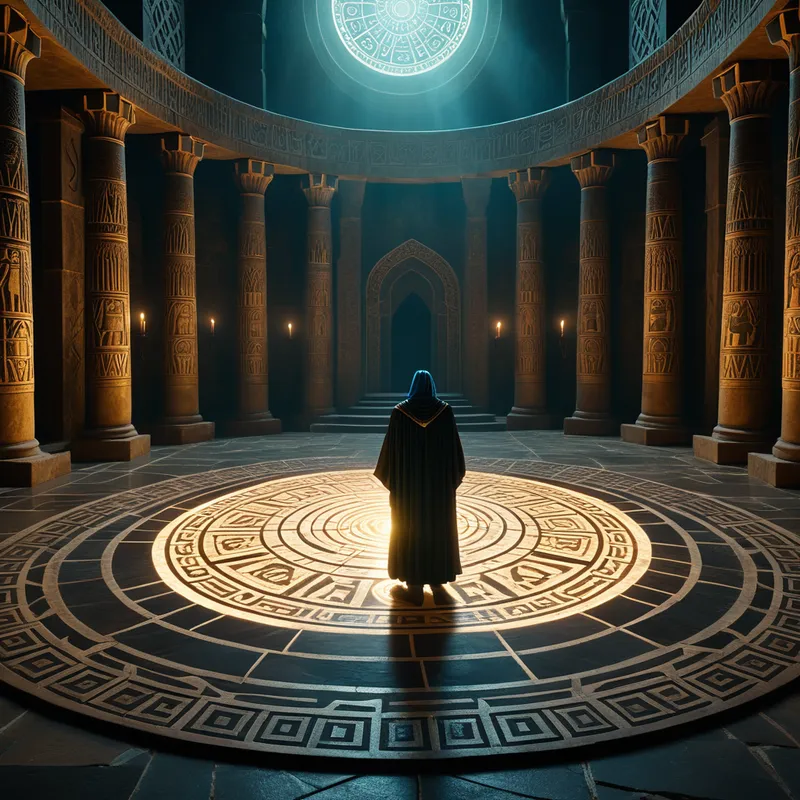
Solomon, sitting upon his ivory throne, felt the tremors of this disorder in the very stones of his kingdom. He sought not to destroy these primal forces, for they too were part of creation, but to invite them to a greater order. From the deep well of his granted wisdom, he drew forth a supreme secret: the pattern of containment, the geometry of command. He took his signet ring, upon which was carved the sacred name, and with it, he traced a circle upon the earth.
This was no ordinary circle. As his ring completed its circuit, the line ignited with a cool, silver fire. The air within it grew still and heavy, charged with a palpable silence. Then, he called them. He spoke the hidden names, the true names that bind essence to form. From the whirlwinds and the hidden places of the earth, they came—the Djinn, great and small, howling in protest and awe. They amassed outside the glowing perimeter, a seething storm of shadow and flame, but not a single one could cross that luminous line. The circle held. It was a boundary not of stone, but of will made manifest, of logos imposed upon chaos.
With the spirits thus gathered and bound by the law of the circle, Solomon, the ruler, could now speak. His voice was not thunder, but clarity itself. He offered a covenant: their boundless energy, directed. Their chaotic power, given form. In exchange for their service—to raise pillars, to delve deep into the earth, to carry messages across the world in an instant—they would be acknowledged, their existence given a place within the grand design. And so, the most powerful among them bowed, not in defeat, but in recognition of a greater authority. Solomon’s circle became the crucible where wildness was tempered into purpose, where the whispers of chaos were woven into the tapestry of a kingdom’s peace.
Cultural Origins & Context
The myth of Solomon’s Circle is a powerful strand woven from two great cultural tapestries: the Judeo-Christian scriptural tradition and the expansive lore of the Islamic and Arabic world. In the Tanakh, Solomon is celebrated for his unparalleled wisdom and wealth, with hints of a mysterious power over creation. This seed blossomed richly in later Midrashic literature and, most prominently, in the Islamic tradition, where he is known as Sulayman, a prophet-king.
In the Qur'an and subsequent Hadith and folklore, Solomon’s power over the Djinn, birds, and winds is explicit. The myth of the circle, often linked to his signet ring (the Khatam Sulayman), became a central motif. It was passed down not just in religious texts, but in the rich oral storytelling traditions of the Middle East and, through trade and cultural exchange, into the grimoires and occult folklore of medieval and Renaissance Europe. Here, it merged with Kabbalistic thought and ceremonial magic, transforming Solomon into the archetypal Magus-King. The function of the myth was dual: it explained the origin of ancient wonders (attributing them to spirit labor) and, more importantly, it served as a foundational parable of sacred kingship and cosmic order, teaching that true authority stems from divine wisdom and the ethical containment of raw power.
Symbolic Architecture
At its heart, Solomon’s Circle is a myth about the birth of consciousness from the womb of the unconscious. The chaotic, elemental Djinn represent the untamed, primal forces of the psyche—raw emotion, instinctual drives, creative madness, and the shadowy contents of the personal and collective unconscious. They are powerful, necessary, but inherently disorganized and potentially destructive.
The circle is the first act of consciousness: the creation of a sacred space where the "I" can stand separate from, and in relation to, the swirling "all."
Solomon, the ego endowed with wisdom (a connection to the Self), does not seek to annihilate these forces. That would be psychic suicide, a loss of vitality and depth. Instead, he constructs a boundary—the circle. This circle symbolizes the discriminating function of consciousness, the ability to say "this, not that." It is the vessel of the personality, the temenos or sacred precinct where integration can safely occur. The ring and the sacred name are the tools of this discrimination, representing the focused will and the authentic identity that must be invoked to establish true sovereignty over one’s inner world.
The Dreamer's Resonance
When this myth stirs in the modern dreamer, it often manifests as a profound somatic experience of containment versus eruption. One might dream of being in a familiar room that suddenly reveals a bottomless pit in the floor, or of holding a vial containing a swirling, violent storm that threatens to shatter the glass. The dream ego is often engaged in a desperate, precise activity: drawing a line in the sand as a tide approaches, locking a door against a pounding force, or trying to remember a crucial password or pattern.
These dreams signal a critical phase in psychological life where unconscious contents—a long-repressed grief, a rising tide of anger, a burst of chaotic inspiration, or the pressures of the collective shadow—are threatening to overwhelm the conscious standpoint. The body may feel it as tension, anxiety, or a sense of fragmentation. The mythic pattern emerges as the psyche’s innate blueprint for dealing with this crisis: not through brute suppression, but through the creation of a conscious container. The dream is the psyche’s attempt to forge its own Solomon’s Ring, to find the sacred geometry of awareness that can hold the charge without being destroyed by it.

Alchemical Translation
The process modeled by the myth is the alchemical solve et coagula—to dissolve and coagulate—applied to the soul. First, Solomon must "solve" or call forth the disparate, hidden spirits (the unconscious complexes). This is the stage of honest introspection, of bringing the shadow to light. The danger is total dissolution, being consumed by chaos.
The circle is the instrument of coagula, the coagulation. It represents the establishment of a conscious attitude strong enough to relate to these forces without being identified with them.
Individuation is not the elimination of the inner Djinn, but the development of a throne from which to wisely administer their energies.
The covenant Solomon offers is the key to transmutation. It is the act of finding a purpose for one’s demons. The furious anger, once bound by the circle of conscious acknowledgment, can be redirected as fierce protection or passionate advocacy. The tricksterish chaos can be enlisted for creative problem-solving. The deep sorrow can become a well of empathy. The modern individual walking this path is not building a physical temple with spirit labor, but constructing a coherent Self. They are performing the ultimate act of sacred rulership: governing the inner kingdom with a justice born of wisdom, transforming the raw ore of primal psyche into the gold of integrated being. The circle is never broken, for consciousness is a perpetual act of maintenance, a sacred geometry we must etch anew each day upon the shifting grounds of our existence.
Associated Symbols
Explore related symbols from the CaleaDream lexicon: