Solar Chariot of Sol Myth Meaning & Symbolism
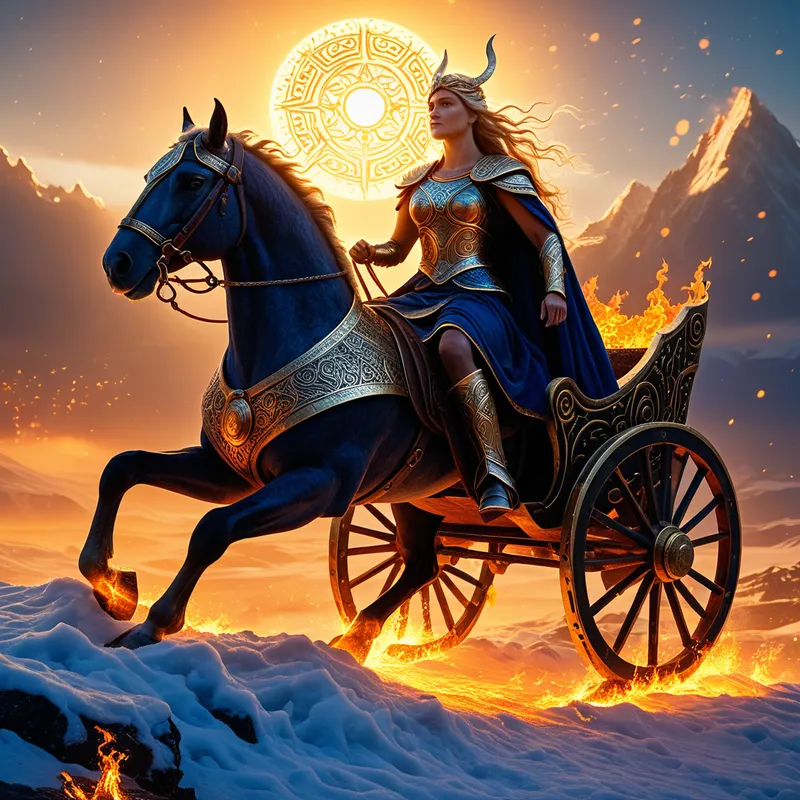
The goddess Sol drives the sun's chariot across the sky, pursued by a relentless wolf, in a daily cycle of light, flight, and fate.
The Tale of Solar Chariot of Sol
Hear now, and feel the chill of the void before dawn. In the time before time, when the great tree Yggdrasil was young and the wells of fate still bubbled with newness, there was a terrible price paid for light. Not the gentle, given light of southern tales, but a hard-won, fleeing brilliance, bought with eternal vigilance.
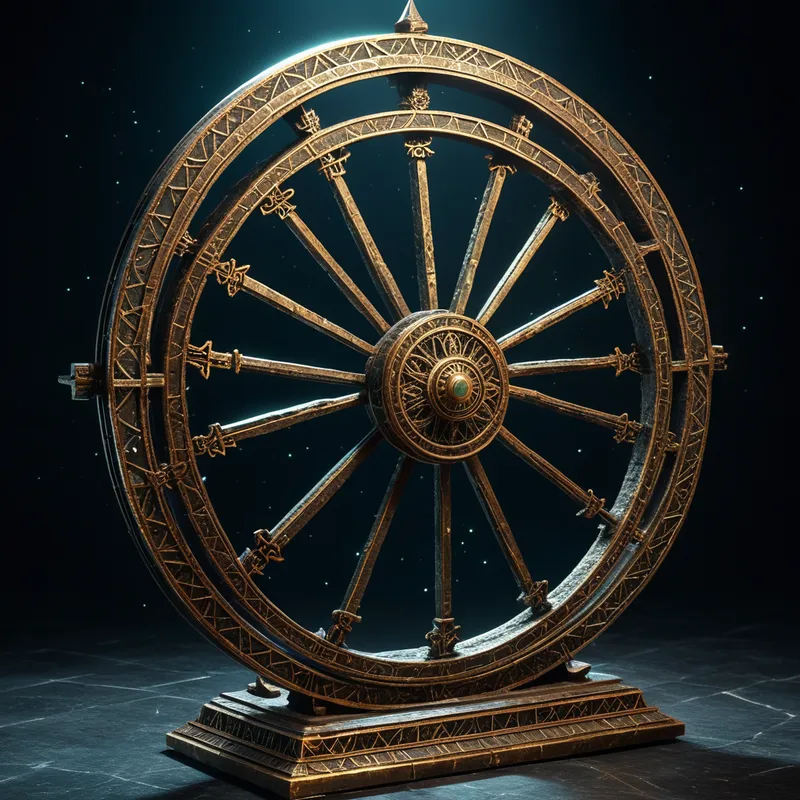
Her name is Sol. She is not a lounging deity upon a throne, but a driver, a bearer of an unbearable burden. Each morning, from the eastern gates, she grasps the reins. Before her stands <abbr title=‘“Early Awake,” one of the horses that pulls the sun’s chariot’>Arvakr, the “Early-Waker,” and <abbr title=‘“Rapid Goer,” the second horse of the sun’s chariot’>Alsvidr, the “All-Swift.” Their manes are not hair, but licks of pale flame; their breath steams not in cold air, but in the primal cold of Ginnungagap itself. The chariot they pull is a forge of the heavens, its wheels crafted by dwarven hands in sunken smithies, its body holding the gathered fire of a world’s need.
She whips the reins, not in cruelty, but in desperate necessity. The chariot lurches forward, and the sun—a great, blazing shield—is hauled into the sky. Its light is a wound in the darkness, a glorious, painful rent. It spills over the mountains of Midgard, thawing the night’s frost, waking the sleepers. But Sol feels no warmth from her cargo. She feels only the immense weight, the scorching heat that would consume a lesser being, and the piercing, unblinking gaze from below.
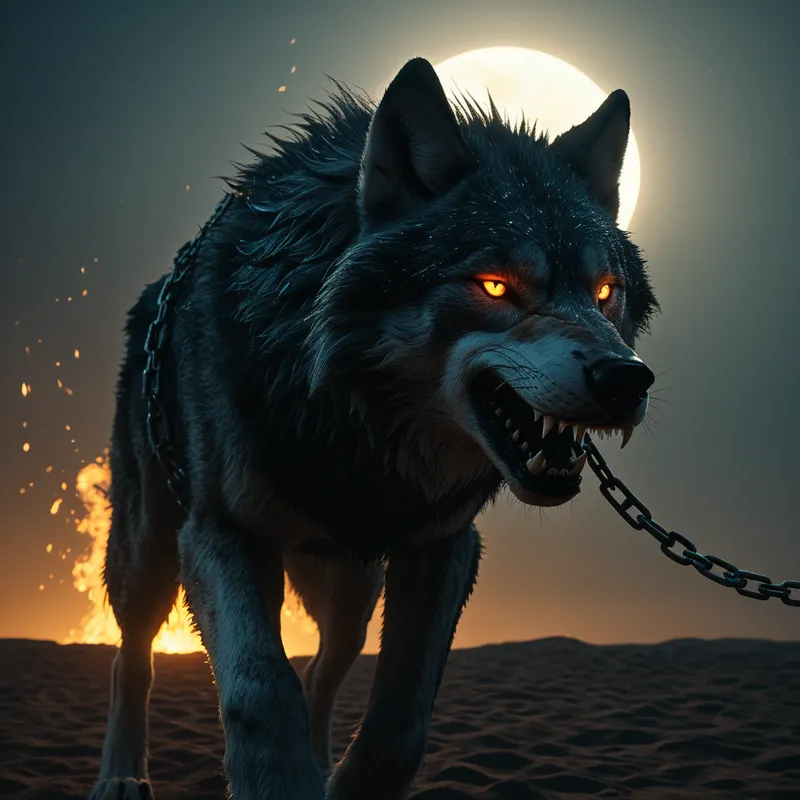
For as her brother Mani drives the moon and flees his own pursuer, so too does Sol feel the hot breath of destiny on her neck. This is the rising action, the daily terror: Skoll, the wolf of shadow, runs. He is hatred for light given form, entropy with jaws. He does not sleep. He does not tire. He strains against the fetters that, for now, hold him just at the edge of capture, his howl the sound of a universe winding down. The entire arc of the sky is a race, a desperate flight from east to west.
And you, mortal, watching the sunset—you see beauty. You see gold and purple and peace. Sol sees the western gates, Ran’s hall looming in the cosmic deep. She sees the end of her strength. The chariot dips, the great shield of the sun sinking, bleeding its fire into the sea. This is no rest. For Sol must then guide her team through the hidden, root-tangled paths of the underworld, through Hel’s dim realms, to begin again at the eastern gate. The resolution is not victory, but repetition. The cycle is the story. The flight is the life. And the wolf, always, is one day closer.
Cultural Origins & Context
This stark narrative comes to us from the Eddas, primarily the Gylfaginning section of the Prose Edda. Snorri Sturluson, a 13th-century Icelandic scholar, codified these myths, drawing from older skaldic poetry and oral traditions that stretched back into the Viking Age and beyond. The tale of Sol was not a bedtime story for comfort; it was a cosmological explanation born of a people intimately acquainted with harsh cycles—the endless struggle against winter, the fleeting preciousness of summer light in the North.
The myth was likely told by skalds and elders, not to inspire hope of eternal day, but to instill a profound understanding of the world’s nature. The sun was not a “god” in a dominant, patriarchal sense, but a goddess performing a crucial, perilous duty. This reflects a worldview where cosmic order is maintained not by omnipotent decree, but by the relentless, vulnerable labor of divine beings. The myth functioned to explain the diurnal cycle, yes, but more importantly, it modeled a core Norse value: to perform one’s doomed duty with courage, for as long as fate allowed. The inevitability of Ragnarok—when Skoll will finally catch and devour the sun—casts every sunrise as an act of profound, tragic defiance.
Symbolic Architecture
The Solar Chariot is not merely a vehicle; it is the very embodiment of conscious luminosity moving through the unconscious field of time and space. Sol represents the principle of differentiated consciousness—the ego, the “I” that brings light, order, and perception to the dark, undifferentiated mass of the unconscious.
The light-bearer does not own the light; she is consumed by the very fire she carries, a servant to a reality greater than herself.
The chariot is the structure of the psyche—the complexes, defenses, and personal history—that must be strong enough to contain this brilliant, dangerous cargo. The horses, Arvakr and Alsvidr, symbolize the instinctual energies and vital forces that pull consciousness forward; they are the libido, the will to live and perceive. The path across the sky is the arc of a single day, a single life, a single act of awareness. And Skoll, the pursuing wolf, is the ultimate shadow. He is not mere evil, but the pull back into non-existence, the entropy of meaning, the unconscious’s reclaiming of the light of consciousness. He is the inevitable dissolution of all formed things, the truth that every act of consciousness is temporary, pursued by the night.
The Dreamer’s Resonance
When this myth stirs in the modern dreamer, it often manifests as dreams of being chased while carrying something precious and fragile—a child, a flame, a vital secret. The dreamer is Sol. The somatic experience is one of breathless urgency, a burning in the chest and legs, a sense of glorious purpose intertwined with inescapable dread.
Psychologically, this dream pattern surfaces when one has taken on a profound responsibility—for a creative project, a leadership role, a healing journey, or the care of another. The “light” is the new awareness, the talent, the love, or the truth that has been kindled. The “wolf” is the shadow of that undertaking: the fear of failure, the weight of expectation, the lurking depression or anxiety that whispers, “You cannot sustain this.” The dream confirms the mythic truth: to carry light is to be pursued by darkness. It is not a sign of failure, but an archetypal map of the process itself. The dream asks: What is the precious cargo you are driving across the sky of your life? And what form does your Skoll take?
Alchemical Translation
The alchemical work modeled here is the opus contra naturam—the work against nature, or more precisely, the work of sustaining consciousness against the innate pull of psychic entropy. The individual’s journey of individuation is Sol’s daily ride.
The first stage is separatio: harnessing the horses (instincts) and mounting the chariot (the conscious personality) to lift the sol niger, the black sun of latent potential, from the eastern depths of the unconscious. This is the dawn of a new realization. The long journey across the sky is the coagulatio—the solidification and application of this insight in the world of Midgard (daily life), where it brings warmth and growth.
The ultimate alchemy is not in evading the wolf, but in understanding that the wolf’s chase is what gives the flight its sacred meaning.
The setting of the sun is the necessary mortificatio—the death of the ego’s identification with the light. Sol must descend into the underworld, the nigredo, where the light is processed, stripped, and renewed in darkness. This is the crucial, invisible night-sea journey where the psyche integrates the day’s experiences, where consciousness is humbled and cleansed. To avoid this descent is to burn out. The triumph is in the return, the solificatio—the rebirth at the eastern gate, not as a new sun, but as the same driver, wiser, wearier, recommitted to the duty of light. The modern individual’s alchemy is this: to learn to drive the chariot without burning up in it, to accept the wolf as part of the landscape of fate, and to find, in the eternal cycle of flight and renewal, the meaning of a life fully, consciously lived.
Associated Symbols
Explore related symbols from the CaleaDream lexicon: