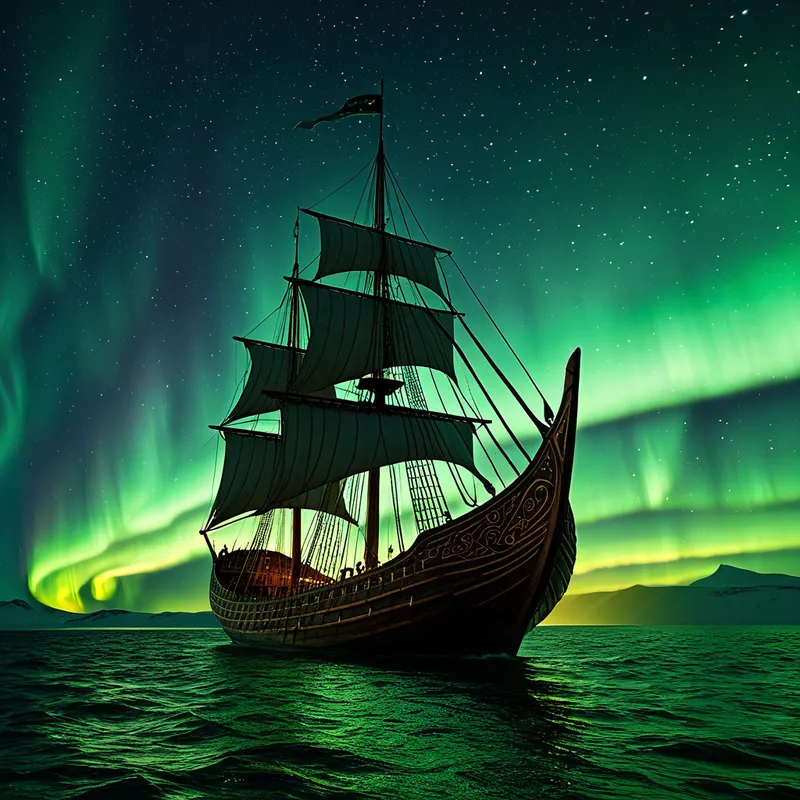
Skíðblaðnir Myth Meaning & Symbolism
The tale of a magical ship, crafted by trickster gods, that can sail any sea, fold into a pocket, and always finds a favorable wind.
The Tale of Skíðblaðnir
Hear now, a tale not of thunder or bloodshed, but of cunning and craft. It begins not on a battlefield, but in the flickering light of a forge, where the air smells of hot metal and ambition.
The great god Thor had a wife, Sif, whose hair was like a field of ripe wheat under the sun. But in a fit of mischief, the trickster Loki sheared those golden locks clean away. Thor’s rage shook the halls of Asgard. To save his own skin, Loki swore an oath: he would procure for Sif a new head of hair, finer than before, spun from living gold.
His path led him down, down into the smoky realms of Svartálfheimr, the home of the dwarves. He found the sons of Ivaldi, and with silver words and promised favors, he compelled them to their forges. And they did not just spin gold for hair. From the bellows’ breath and the anvil’s song, they wrought three masterworks: Mjölnir, the unerring hammer for Thor; Gungnir, the spear that never misses for Odin; and a ship.
But this was no ordinary ship. They called it Skíðblaðnir. Its hull was of the finest oak, its planks fitted so tightly no seam could be seen. Its sails, when raised, caught not just the wind, but the very will of the sea. It could sail over ocean, fjord, or even a dew-laden meadow, and always, always would it find a favorable wind to fill its sails. And when its journey was done, it could be folded—like the most intricate cloth—and placed inside a pouch.
Pleased but prideful, Loki boasted that no better smiths existed. This boast reached the ears of another dwarf, Brokkr, who wagered his own head that his brother Eitri could make greater treasures. The gods would judge. As Eitri worked the magic at the forge, Brokkr manned the bellows. Loki, in the form of a fly, stung Brokkr’s eyelid, then his neck, trying to break his rhythm. Blood and sweat mingled, but Brokkr did not falter.
From that trial emerged wonders: a living boar with golden bristles that lit the darkest night, a ring that dripped eight identical rings every ninth night, and a mighty hammer. The gods assembled. Odin, Thor, and Freyr judged. The hammer, Mjölnir, was deemed greatest, for it would be Asgard’s chief defense. Brokkr had won. He moved to claim his prize: Loki’s head.
But Loki, the weaver of words, argued the wager was for his head, not his neck. Enraged but bound by the letter of the law, Brokkr took an awl and stitched the trickster’s lips shut. For a time, there was silence.
And Skíðblaðnir? It was given to Freyr, the god of sunshine and fertile rains. For him, the ship that could sail anywhere and be carried anywhere became the perfect vessel—a symbol of benevolent reach and self-contained potential, sailing always toward abundance, always ready for the next journey, its destiny woven into its very grain.
Cultural Origins & Context
This myth is preserved primarily in the Prose Edda, written by Snorri Sturluson in the 13th century. While Snorri was a Christian writing centuries after the widespread practice of the old faith, his work is our most systematic window into these narratives, likely drawing on older oral traditions and poetic fragments.
The story of Skíðblaðnir’s creation sits within a larger cycle of tales about the gods acquiring their iconic attributes. In a culture where seafaring was lifeblood, geography, and destiny, the concept of a perfect ship held profound resonance. This was not just a story about magical objects; it was a myth about the sourcing of divine power and cultural capital. The gods do not inherently possess these tools; they must be procured from the chthonic masters of craft, the dwarves, through a blend of trickery, oath, and wager. The myth reflects a worldview where power is not merely innate but is forged through complex relationships—and often, through cunning and competition.
Its societal function was multifaceted. It explained the origin of sacred objects, celebrated the value of unparalleled skill (craft), and served as a cautionary tale about pride and the binding nature of oaths. Told in halls during long winters, it reinforced the cultural ideals of resourcefulness, the respect for master artisans, and the understanding that even the gods are subject to the laws of bargain and consequence.
Symbolic Architecture
Skíðblaðnir is more than a magical vessel; it is a perfect symbol of realized potential. Its core attributes map onto profound psychological and cosmological principles.
First, its foldability. It embodies the principle of essential, compact intelligence. The vast capability—the ability to cross any sea—can be contained in a pocket. This speaks to the seed potential within the self, the blueprint of the soul that contains the entirety of one’s possible journey.
Second, its guaranteed favorable wind. This is not mere luck; it is an attribute of its perfect design. It moves in harmony with the fundamental currents of the world, with ørlög. The ship does not fight the cosmos; its construction aligns it with the cosmos’s flow.
The true vehicle of destiny is not one that conquers the waves, but one whose very form compels the wind to serve it.
Finally, its bestowal upon Freyr, the god of peace, prosperity, and sensual life. It is not a weapon of war but a tool of fertile expansion. This connects the symbol to the life-force itself—the energy that seeks growth, connection, and abundance, that navigates the world not to plunder but to cultivate.
Psychologically, Skíðblaðnir represents the constructed Self—the ego structure built with conscious effort (the dwarves' craft) that is capable of navigating the vast unconscious (the sea). It is a vessel built to specifications so perfect that it aligns with the deeper currents of the psyche, the "favorable wind" of the Self’s intent.
The Dreamer's Resonance
When the image of Skíðblaðnir sails into modern dreams, it rarely appears as a literal Viking longship. Instead, one might dream of a perfectly engineered tool that performs an impossible function with elegant simplicity, a vehicle that transforms to fit any space, or a map that folds into a single, potent symbol.
To dream of such a vessel signifies a somatic and psychological process of integration and readiness. The psyche is signaling that it has assembled, or is in the final stages of assembling, a new internal structure. This structure is designed for a specific phase of the life journey. The dreamer may be feeling a nascent sense of "fit"—a new skill, perspective, or level of self-understanding that seems to make navigating life's challenges suddenly more fluid.
The folding aspect is crucial. If the dreamer struggles to "fold" the ship, it points to difficulty integrating this new capability into everyday life; the grand vision feels unwieldy. If the ship unfolds seamlessly to meet a vast ocean, it indicates a readiness to embark on a significant new life chapter, supported by an inner conviction that the tools for the journey are now at hand. The dream is an affirmation from the depths: "You are built for this."
Alchemical Translation
The myth of Skíðblaðnir models the alchemical process of coagulatio—the stage where the refined spirit is given a durable, operative form. It is the embodiment of the philosopher's stone not as a stone, but as a vehicle.
The individuation journey often begins in chaos or deficit (Sif’s shorn hair). This forces a descent into the underworld of the psyche (Loki’s journey to Svartálfheimr), where our inner "trickster" must negotiate with the deep, instinctual forces of craft (the dwarves). These forces are ambivalent; they can produce both sublime creations and deadly curses, depending on the attitude and integrity of the ego that engages them.
The creation of the ship involves a wager and an ordeal. Brokkr’s suffering at the bellows under Loki’s attacks mirrors the necessary suffering in any act of profound creation. The ego (Loki) will test and torment the commitment to the work, offering distractions, doubts, and pains. Enduring this ordeal is what imbues the final product with its resilient power.
The psyche’s most precious artifacts are always forged in the tension between creative impulse and resistant doubt.
For the modern individual, "building your Skíðblaðnir" means consciously crafting the vessel of your personality and life-direction with such integrity and alignment to your deepest nature (your ørlög) that it generates its own "favorable wind." It is the move from being tossed by fate to being designed for destiny. The ship is not given; it is won through cunning, risk, ordeal, and judgment. When completed, it allows you to navigate the world not as a passive passenger, but as a sovereign voyager, carrying your full potential within you, ready to unfold it onto the seas of becoming. You become, like Freyr, the benevolent ruler of your own journey, sailing toward the shores of your own fertile fulfillment.
Associated Symbols
Explore related symbols from the CaleaDream lexicon:
- Skateboard
- Ice Breaker Ship
- Abandoned Car
- Longboard
- Intergalactic Freight Ship
- Starship
- Boots of Swiftness
- Celestial Ship
- Kiteboard
- Norse Viking Ship
- Viking Ship
- Airship
- Polar Icebreaker
- Convertible Car
- Rocket Powered Skateboard
- Blimp
- Hovercraft
- Speedboat
- Icebreaker Ship
- Massive Cargo Ship
- Racing Jet Ski
- Autonomous Pod Car
- Viking Longship