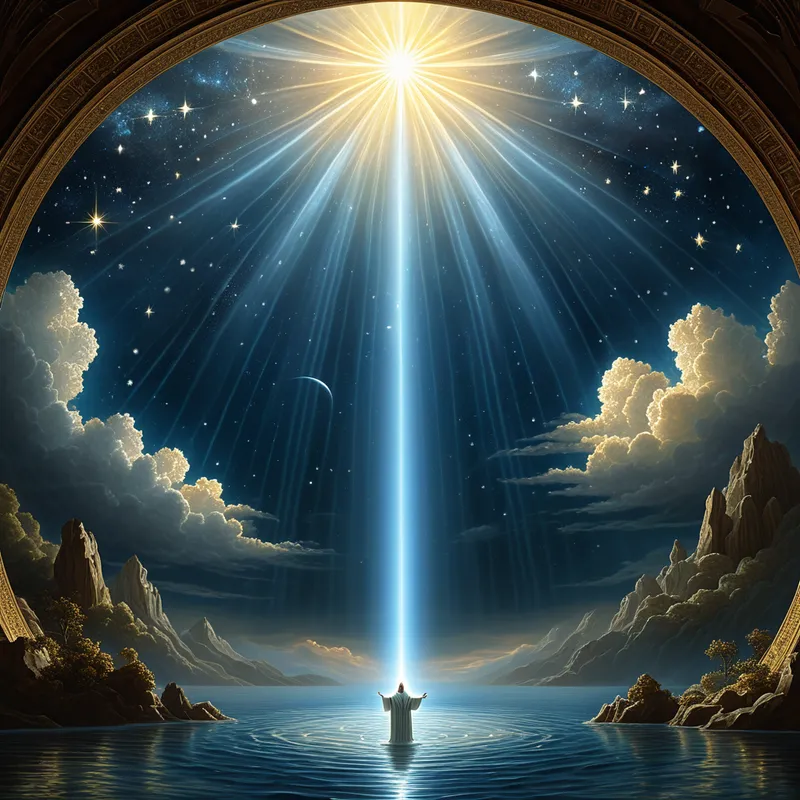
Six Days of Creation Myth Meaning & Symbolism
A primordial myth of divine ordering, where light, life, and consciousness emerge from a formless void through a sacred, rhythmic act of will.
The Tale of Six Days of Creation
In the beginning, there was no before. There was only the deep—a formless, soundless, sightless abyss, a Tehom of infinite potential and absolute absence. Over the face of these waters, a wind from Elohim moved, a breath of intent stirring in the boundless dark.
And then, a Word. Not a sound, but a command that was its own execution. “Let there be light.” And there was. Not the light of sun or flame, but light itself, the first child of distinction, violently and beautifully tearing the seamless void into Day and its retreating sibling, Night. This was the first day, the birth of rhythm from stillness.
On the second day, the Word spoke to the waters. A firmament, a raqia, was hammered in the mind of God, a vast dome to hold back the upper seas from the lower. The breath now had a chamber in which to resonate.
Then, on the third day, the command went down into the deep. “Let the waters under the heaven be gathered.” And they receded, pulling back like a curtain to reveal the naked, damp body of the Earth. But this was not enough. A second command followed, and the soil itself quickened. Grass, herbs, trees—each yielding seed according to its kind—burst forth in a silent, verdant explosion. The land was clothed.
The fourth day turned the gaze upward. Into the expanse of the firmament, great lights were set—the greater light to rule the day, the lesser to rule the night, and with them, a scattering of stars. They were not yet named sun and moon, but they were appointed. Timekeepers. Witnesses. The rhythm of evening and morning now had its celestial metronome.
The fifth day stirred the gathered waters and the new sky. “Let the waters swarm.” And they teemed. Great sea monsters, tanninim, and every living creature that moves, filled the seas. Then, with a sweep of the divine will, the sky was filled with wings. Every bird according to its kind. The silent world now held the splash of leviathans and the cry of the first eagle.
Finally, the sixth day. The earth brought forth living creatures—cattle, creeping things, beasts of the field. But then, a pause. A consultation within the Godhead. “Let us make humankind in our image, after our likeness.” From the dust of the adorned earth, Adam was fashioned, and into his nostrils was breathed the very breath of life. He was given dominion—not as a tyrant, but as an image-bearer, a steward of the glorious, singing, thriving world that now stood complete. And God saw all that was made, and behold, it was very good.
On the seventh day, the breath rested. The work was complete. The rhythm found its final, silent beat: not an ending, but a sanctified pause, a hallowed space where creation could simply be.
Cultural Origins & Context
This foundational narrative opens the book of Genesis, a text whose final form was shaped during the Babylonian Exile (6th century BCE) and the subsequent Persian period. It is not a scientific treatise but a theological and cosmological polemic, composed by priestly scribes (the "P" source). Its primary function was to assert a radical monotheism against the surrounding polytheistic cultures, particularly Mesopotamia.
In those cultures, creation was often a violent, chaotic struggle between rival gods. Here, the Genesis account presents a serene, sovereign, and utterly singular God who creates by effortless, authoritative word. The world is not born from divine corpse or conflict, but from divine intention. It was told and retold not merely as history, but as identity: it established the covenant God as the sole, benevolent source of all order, life, and moral structure. It was a story that defined a people’s place in a cosmos governed by purpose and pronouncement, not capricious fate.
Symbolic Architecture
Psychologically, this is the myth of consciousness itself arising from the unconscious. The formless void and dark waters represent the undifferentiated, potential-laden state of the primal psyche—the unus mundus or the oceanic unconscious.
The first act of consciousness is not to see, but to distinguish. To say "light" is to create the possibility of knowing.
Each "day" is not a chronological unit but a stage in the structuring of reality. Light is the dawn of awareness. The firmament is the necessary separation between the conscious mind (the lower waters/known) and the vast, unknown depths of the collective unconscious (the upper waters). The ordering of land and sea represents the emergence of stable ground—the ego—from the fluid, emotional waters of the psyche. The plants symbolize autonomous, organic growth of complex thought and feeling.
The celestial lights are the archetypal patterns and guiding principles (the Self, the anima/animus) that now govern the inner life. The creatures of sea and air are the personified instincts, emotions, and intuitions that populate the inner world. Finally, the creation of humankind "in the image" of God symbolizes the birth of the ego that can reflect upon itself and the whole—the part of the psyche that can witness, name, and steward the totality of its own inner creation.
The Dreamer's Resonance
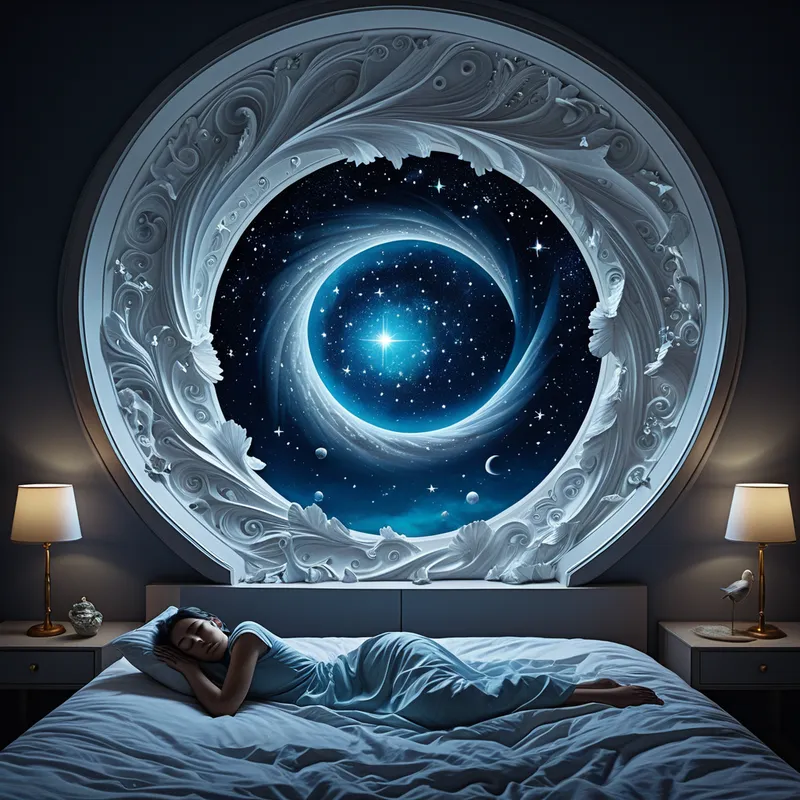
When this mythic pattern stirs in modern dreams, it signals a profound process of psychic (re)organization. One might dream of being in a featureless, dark space that slowly gains definition; of a chaotic room being meticulously ordered; of lights turning on in a vast, unknown house; or of barren land suddenly blooming.
Somatically, this can feel like a deep, structural settling—a release of chronic tension as inner conflicts find their proper place. Psychologically, it is the experience of moving from a state of confusion, depression, or "brain fog" (the formless void) toward clarity, purpose, and integration. It is the dream-work of the Self, orchestrating a new inner hierarchy, bringing latent potentials (the "kinds" of creatures) into manifest form, and ultimately establishing the dreamer as the responsible steward of their own renewed psyche. The dream often carries a palpable sense of awe and rightness—the "it was very good" of the soul.
Alchemical Translation
The alchemical opus, the journey of individuation, is perfectly mirrored in the six days. It begins with the nigredo—the blackening, the formless void of despair or dissolution where all previous structures fail. The first light is the albedo, the whitening, the initial glimpse of meaning and distinction.
Individuation is the divine imperative spoken to the soul: "Let there be light." It is the command to become distinct from one's own primordial chaos.
The subsequent days map the stages of building the vas, the vessel of the Self. Separating waters (managing emotions), forming the earth (building a stable ego-complex), planting seeds (nurturing new attitudes), setting the lights (integrating archetypal guidance), and populating the inner world (acknowledging and organizing the multitude of sub-personalities and drives) are all acts of psychic transmutation.
The creation of the "image-bearer" is the culmination: the emergence of the conscious ego that is no longer identified with the chaos nor tyrannical over the instincts, but serves as a reflective, responsible center for the whole personality. The seventh day, the Sabbath, is the final goal—not inactivity, but the conjunctio oppositorum, the sacred state where the tension of opposites is held in harmonious balance, and the psyche rests in its own wholeness. To live this myth is to engage in the perpetual, sacred work of bringing order from your own inner chaos, and then learning the holy art of rest within that creation.
Associated Symbols
Explore related symbols from the CaleaDream lexicon: