
Sisyphus eternally pushing his Myth Meaning & Symbolism
A king condemned by the gods to eternally roll a boulder up a hill, only for it to fall each time, embodying the futility and rebellion of the human condition.
The Tale of Sisyphus eternally pushing his
Hear now the tale of the cleverest of men, whose wit was a match for the gods and whose pride became his eternal chain. In the sun-drenched realm of Corinth, there ruled a king named Sisyphus. His mind was a labyrinth, his tongue silver, and his ambition boundless. He saw the threads of fate and dared to pull them.
He witnessed a secret of the gods—the abduction of the nymph Aegina by Zeus himself. When her father came searching, Sisyphus, ever the bargainer, traded the secret for a spring of fresh water for his citadel. This was his first sin: turning divine transgression into mortal currency. Zeus, enraged, sent Thanatos to chain the impudent king and drag him to Tartarus.
But Sisyphus was not done. He greeted the pale god not with fear, but with cunning curiosity. “These shackles,” he said, “their craftsmanship is divine. Show me how they work.” Flattered or bemused, Thanatos demonstrated. In a flash, the clever king turned the chains upon Death himself, binding him fast. For a time, no mortal on earth could die. Wars raged without end, the wounded writhed in unending agony, and the gods’ due order was undone.
The tumult brought Ares, furious that his battles had lost their savor. He freed Thanatos, and Sisyphus was finally seized. Yet, even then, the king whispered one last scheme to his wife, Merope. “When I am gone,” he instructed, “do not perform the funeral rites. Leave my body unhonored.”
In the sunless halls of Hades, Sisyphus approached the throne of Hades and his queen, Persephone. With a performance of profound outrage, he lamented. “My wife defies the sacred laws! She leaves me dishonored among the dead. Grant me but three days to return to the world of light and chastise her, to ensure the rites are done.” Moved by this apparent plea for piety, the rulers of the dead consented.
Sisyphus returned to the sun. He breathed the air of Corinth, felt its warmth, and laughed. He had cheated Death twice. He made no move to scold his wife, for she had followed his plan perfectly. He simply lived, refusing to return.
His triumph was brief. The gods’ patience, thin as parchment, finally tore. Hermes, the swift messenger, descended, his grip inescapable. There would be no third trick. The final judgment was pronounced: not mere torment, but a punishment that mirrored the essence of his crime—a futile, endless labor that mocked his cleverness and ambition.
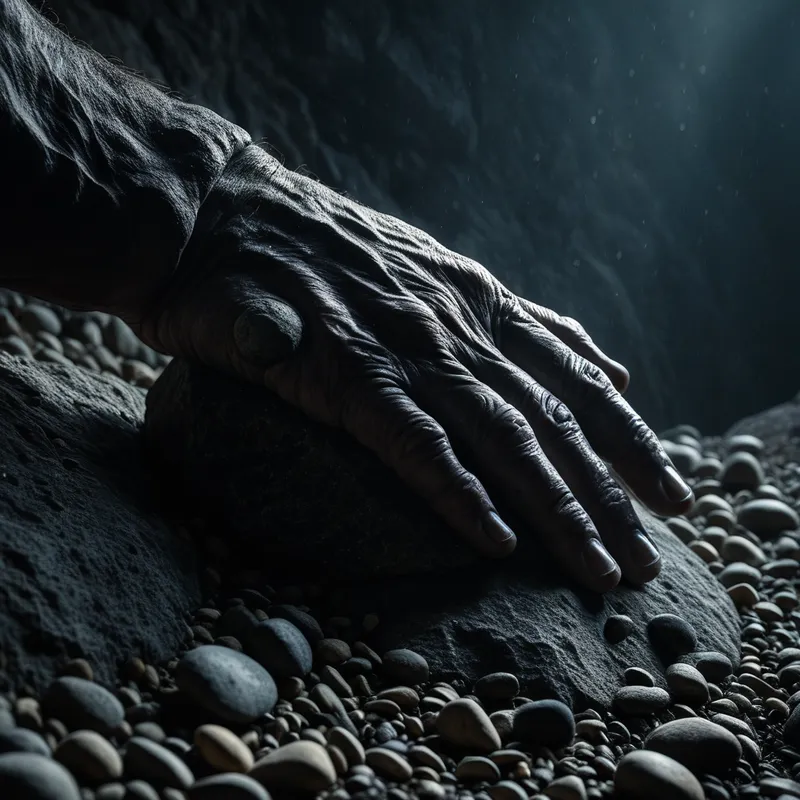
They led him to a barren mountain in the deepest pit of Tartarus. Before him lay a massive boulder, perfectly hewn, impossibly heavy. “Your task,” came the divine decree, “is to push this stone to the summit.” Sisyphus set his shoulder to the cold rock. He strained, muscles cracking, breath a ragged saw. Inch by agonizing inch, he fought the slope, the weight, the gravity of the cosmos itself. For days he pushed, until finally, sweating and trembling, he neared the crest. Hope, that final betrayer, flickered. Then, as his hands reached for the summit’s edge, the weight shifted. The boulder trembled, rolled back from his bleeding fingers, and with a gathering roar, plunged down the mountainside, leaving him in a cloud of dust at the base.
There was no rest. The Fates had woven his thread into this pattern forever. He must turn, descend, and begin again. And again. And again. For all eternity, Sisyphus pushes his boulder.
Cultural Origins & Context
This stark myth originates from the rich tapestry of ancient Greek oral tradition, most famously crystallized in the epic poetry of Homer’s Odyssey and later elaborated by poets like Pindar and the tragedians. It was not a religious doctrine but a cultural story, told to explore the boundaries of the human condition in relation to the divine and cosmic order. Bards and poets would recount it as a cautionary tale about hubris—the dangerous overreach of mortal ambition—and the absolute, unchanging nature of divine punishment. In a society deeply concerned with proper rites, hospitality (xenia), and knowing one’s place, the story of Sisyphus served as a dark mirror. It asked the audience: what happens when human cunning, our greatest asset, is turned against the very laws of nature and the gods? It functioned as a societal pressure valve, affirming that even the most brilliant transgression would be met with an order-restoring, eternal consequence.
Symbolic Architecture
The myth is a perfect, brutal symbol. Sisyphus represents the conscious human ego in its most defiant, self-aware, and ultimately isolated state. His crime is not mere evil, but intelligence applied to subvert the natural order (death, the will of the gods). His punishment is the archetypal image of futility.
The boulder is the weight of existence itself—the burden of consciousness, of responsibility, of a life that must be lived despite its inherent lack of ultimate, pre-ordained meaning.
The hill is the slope of time and effort, the inevitable resistance of the world. The eternal repetition is the core of the symbol: the meaningless labor from which there is no reprieve, no completion, no final victory. It is the nightmare of a life reduced to pure process without progress, a perfect metaphor for the absurd. Psychologically, it depicts the ego’s struggle with an impossible task, often one of its own making—a grinding obsession, a unresolved complex, or the sheer daily weight of being.
The Dreamer's Resonance
When this myth surfaces in modern dreams, it rarely appears as a classical Greek tableau. Instead, the dreamer becomes Sisyphus in a personalized landscape. They may dream of pushing a stalled car up an endless hill, stacking papers that forever fall, or running on a treadmill that speeds up toward a receding goal. The somatic feeling is one of profound exhaustion, frustration, and trapped agency. The “boulder” is the dreamer’s current most burdensome, repetitive, and seemingly futile life struggle.
This dream pattern signals a profound engagement with what psychology calls a complex—an emotionally charged cluster of ideas and memories that acts as an autonomous “splinter psyche.” The dreamer is pushing against an inner structure that will not budge through sheer force of will. The dream is not a prophecy of failure, but an unconscious snapshot of the psyche’s current state: it is caught in a loop, applying conscious effort (Sisyphus) to an unconscious weight (the boulder) on a predetermined slope (the hill). The work is to stop pushing for a moment, to turn and examine the boulder and the hill.

Alchemical Translation
The modern, psychological triumph lies not in escaping the task, but in transmuting one’s relationship to it. This is the alchemical gold hidden in the base lead of the myth. The first step is the full, conscious acknowledgment of the absurdity—the realization that the boulder will roll back. This is the death of naive hope and the birth of lucidity.
The moment Sisyphus acknowledges the futility is the moment he becomes superior to his fate. His freedom is found in the descent, in the pause before he begins again.
The alchemical work is to inject meaning into the meaningless motion. To push not in hope of reaching the summit, but for the sake of the strain in one’s muscles, the feel of the stone, the clarity of the mountain air in Hades. This is the individuation process: embracing one’s unique, often burdensome fate with conscious acceptance, thereby robbing the “gods” (the unconscious complexes, societal expectations, innate absurdity) of their power to torture. The eternal labor becomes a chosen discipline. The rebel’s defiance is turned inward, not against an external fate, but against the internal despair that fate can provoke. In this translation, Sisyphus is no longer a condemned soul, but a silent, steadfast mystic, performing the only ritual left: the sacred, meaningless effort of being authentically, consciously human.
Associated Symbols
Explore related symbols from the CaleaDream lexicon: