Sirens/Muses Myth Meaning & Symbolism
A tale of voices that can enchant and destroy or inspire and create, revealing the soul's journey between oblivion and conscious artistry.
The Tale of Sirens/Muses
Listen. Beyond the crash of the wine-dark sea, on an island of white bones and sun-bleached rock, there is a silence that hums. It is the silence before the song. Here dwell the Sirens, daughters of the river god or of the sea itself, depending on who tells the tale. They are not mermaids of the deep, but creatures of the air and the deadly shore, with the bodies of great birds and the heads of women of unbearable beauty.
Their power is not in claw or tooth, but in throat. They sing. And their song is the sum of all knowledge. They promise the sailor who hears it that he will know everything: every secret of the war at Troy, every fate of the heroes, every hidden truth of the gods and the earth. It is a song of perfect, fatal knowing. To hear it is to forget home, wife, child, duty, life itself. The ship turns, inexorably, toward the jagged rocks. The men, ears filled with divine melody, leap into the foam, and the Sirens feast on their flesh, leaving their skeletons to join the grim garden of their island.
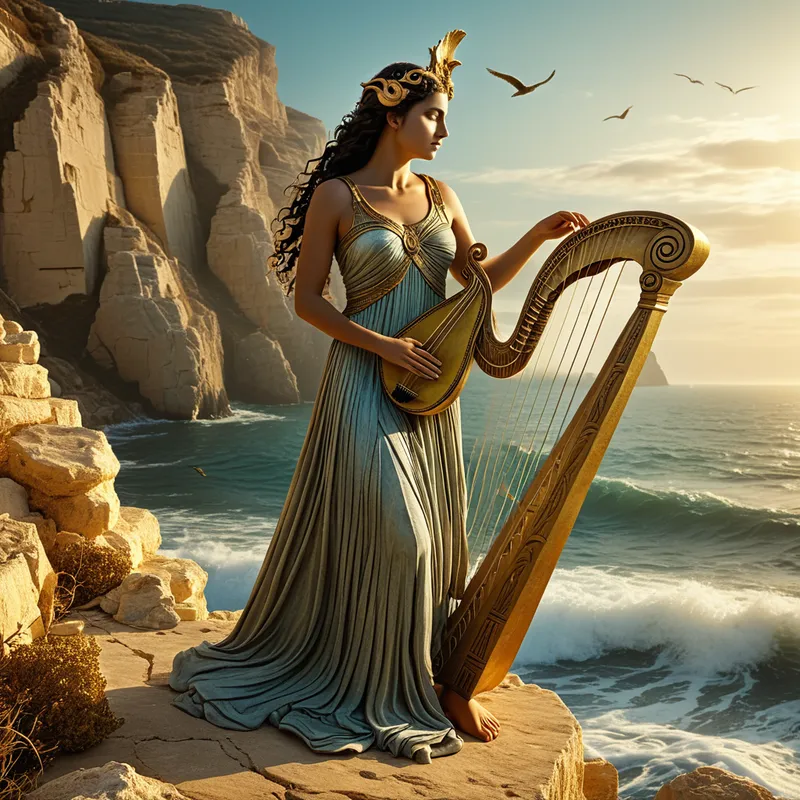
But there is another song in the world. It echoes not from a lethal shore, but from the clear springs of Helicon and the slopes of Olympus. Here dance the Muses, daughters of Zeus and Mnemosyne. Their names are Calliope, Clio, Euterpe—each a vessel for a different strand of creation. Their song does not promise omniscience. It grants inspiration. It is a call not to oblivion, but to craft. Where the Siren’s song ends in dissolution, the Muse’s song begins in formation. The bard who drinks from their spring does not lose his mind; he finds his voice.
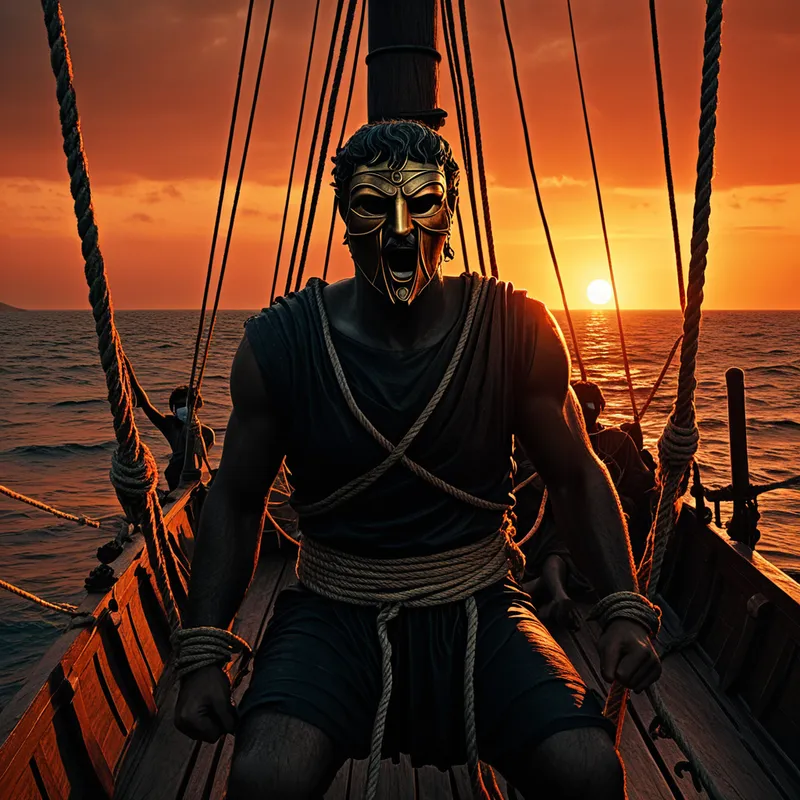
Two heroes navigate these powers. Odysseus, warned by the sorceress Circe, stuffs his crew’s ears with beeswax. For himself, craving the knowledge yet fearing the consequence, he orders his men to bind him tightly to the ship’s mast with unyielding ropes. He commands them: no matter how he begs, pleads, or threatens, they must not untie him. The ship passes the island. The song washes over him. It is more beautiful than he imagined, a torrent of truth and longing. He screams to be released, his body straining against the cords, his eyes wild with a desire to join that perfect knowing. His loyal crew, deaf to the enchantment, see only their captain’s madness and row harder, binding him tighter until the terrible island fades behind them and the song dies in the wind. He is saved, but he is weeping.
The other hero is Orpheus. When his ship, the Argo, must pass the same perilous strait, he does not block his ears or seek bonds. He takes up his lyre. And he plays. He plays a song of such piercing beauty, of such profound and human grief—for he has been to the Underworld and back—that it drowns out the Sirens’ call. His music, a gift from the Muses themselves, is a greater enchantment. It does not resist; it transcends. The Sirens, for the first time, are silenced by a superior art. In some tales, they fling themselves into the sea in defeat, transformed into rocks. Orpheus sails on, his crew unharmed, carried by a melody that affirms life rather than promising a fatal epiphany.
Cultural Origins & Context
These intertwined myths emerged from the rich oral tradition of ancient Greece, crystallized in epic poems like Homer’s Odyssey (8th century BCE) and later elaborated by poets such as Hesiod and Apollonius of Rhodes. They were not static tales but evolving narratives, told and retold by bards (rhapsodes) who were themselves invoking the Muses at the start of every performance. The Sirens represented a very real danger to the Greek worldview: the allure of the unknown, the temptation of shortcuts to ultimate wisdom, and the peril of the sea journey (nostos). The Muses, conversely, were central to the culture’s self-conception. They presided over all forms of memory and artistic expression, the very tools used to build civilization, history, and identity. The myth served a societal function of delineating dangerous, chaotic knowledge from productive, cultural knowledge. It taught that inspiration must be channeled through discipline and form (the lyre, the poem, the history) rather than consumed in a raw, overwhelming state.
Symbolic Architecture
At its core, this dual myth maps the psyche’s relationship with the numinous—the overwhelming power of the unconscious. The Siren and the Muse are two faces of the same archetypal force: the captivating voice of the deep self.
The Siren symbolizes the lure of unconscious identification. Her song is the promise of total, passive knowing—a regression to a state where the ego is dissolved in the oceanic feeling of the unconscious. It is the temptation to abandon the difficult journey of individuation for the bliss of oblivion. The rocky island and the skeletons are the psychic stagnation and spiritual death that result.
The Siren’s call is the soul’s nostalgia for the womb, a longing to know everything by becoming nothing.
The Muse symbolizes the call to conscious creativity. She represents the same deep, unconscious content, but now mediated and given form. She is the daughter of Memory (Mnemosyne), implying that true creation requires remembering, shaping, and bringing latent patterns to light. Her inspiration demands a vessel—the poet, the artist, the thinker—who must actively engage and labor.
Odysseus and Orpheus model two responses to this archetypal energy. Odysseus represents the ego’s binding. He uses cunning (wax) and will (ropes) to forcibly restrain himself from being swept away. He hears the song but does not succumb, integrating the experience through suffering and restraint. Orpheus represents the ego’s mastery through art. He does not resist; he answers. He meets the unconscious power with a greater, more conscious power of his own crafting, transforming the deadly lure into a surpassed challenge.
The Dreamer’s Resonance
When this myth pattern stirs in modern dreams, it signals a critical crossroads in the dreamer’s relationship with an alluring but potentially consuming force. Dreaming of being lured by a beautiful, disembodied voice towards a cliff or a wreck may not be about literal temptation, but about a psychological process of enchantment. One may be dangerously captivated by an ideology, a romantic fantasy, a numbing addiction, or even a spiritual bypass that promises wholeness without work. The somatic feeling is often one of passive, euphoric drifting toward a point of no return.
Conversely, dreaming of finding a guiding voice, a inspiring figure, or suddenly being able to sing or play an instrument with profound skill points to the Muse’s activation. This is the psyche’s signal that deep, formative material is ready to be channeled into conscious life—into a project, a new career path, or a creative solution to a problem. The somatic feeling here is one of energized focus and flowing agency.

Alchemical Translation
The psychic alchemy modeled here is the transmutation of enchantment into inspiration. The base material is the raw, seductive, and chaotic content of the unconscious (the Siren’s song). The goal is the philosophical gold of conscious, life-affirming creation (the Muse’s gift).
The first stage is confinement (Odysseus at the mast). The ego must establish a container strong enough to encounter the overwhelming material without being dissolved. This is the discipline of therapy, meditation, or any practice that allows one to “hear the madness” without acting it out. The ropes are the conscious commitments and structures that hold the self together during the ordeal.
The second, higher stage is transmutation through response (Orpheus with his lyre). This is the active, creative engagement with the deep self. One learns to “sing back” to the inner Siren. The grief, the longing, the chaotic knowledge is not blocked or merely endured; it is taken up as the very substance of one’s art—the song of one’s own life. The lyre is the developed talent, the personal craft, the unique perspective through which the unconscious is translated into culture.
Individuation is not the silencing of the Siren, but the learning of her melody so well that you can compose a greater song.
The ultimate triumph is not escape, but integration. The hero who navigates this strait carries the memory of both songs: the terrifying beauty of the abyss and the disciplined grace of the creative act. He becomes, in a sense, his own Muse, capable of drawing from the depths without falling in, transforming the call that destroys into the call that creates.
Associated Symbols
Explore related symbols from the CaleaDream lexicon: