Sir Gawain's Green Girdle Myth Meaning & Symbolism
A knight's quest for honor becomes a lesson in humility when a magical green girdle reveals the inescapable, yet forgivable, flaw of self-preservation.
The Tale of Sir Gawain’s Green Girdle
Hear now a tale from the time when [the world](/myths/the-world “Myth from Tarot culture.”/) was woven with wonder, when the mists clung to the Camelot towers and the breath of beasts spoke in riddles. It began not with a war-cry, but with a challenge, delivered on a midwinter’s day when the great hall was heavy with feasting and the firelight danced on the [Round Table](/myths/round-table “Myth from Arthurian culture.”/).
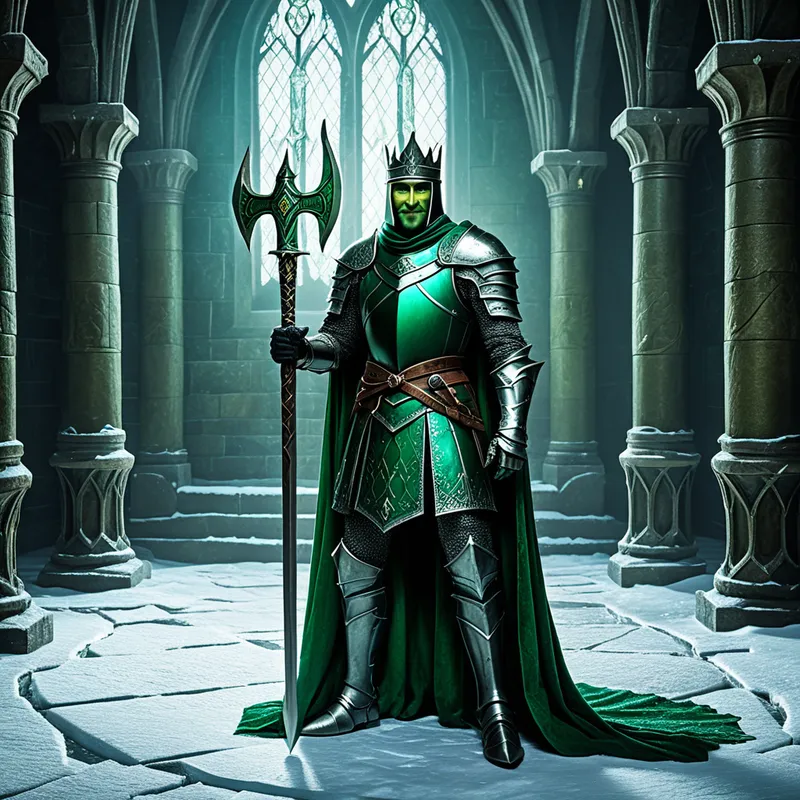
The doors burst open, not by wind, but by a presence. He rode in, a giant of a man, his skin and hair the deep, impossible green of a summer forest, his garments rich and strange. His horse, too, was green as moss, and in his hand he held not a sword, but a great axe of green steel, and a holly bob, green and eternal. This was the [Green Knight](/myths/green-knight “Myth from Arthurian culture.”/), and his voice was like stone rolling in a deep river.
“A game,” he proposed, his smile unsettling. “I shall offer my neck to any knight brave enough to strike me with this axe. But in a year and a day, that knight must seek me out at the Green Chapel and receive a strike in turn.”
A stunned silence fell. Then, to protect the honor of his king and court, [Sir Gawain](/myths/sir-gawain “Myth from Arthurian culture.”/) rose. “Let this game be mine.” With a single, mighty blow, he cleaved [the Green Knight](/myths/the-green-knight “Myth from Arthurian culture.”/)’s head from his shoulders. The head rolled on the rushes, the court gasped. But the green body did not fall. It strode forward, picked up its own head by the hair, and the eyes opened, the lips spoke: “Remember your vow, Gawain. Find me at [the Green Chapel](/myths/the-green-chapel “Myth from Arthurian culture.”/) when the year turns.”
The seasons wheeled. Gawain’s quest began as the leaves fell. He journeyed through a dying world, through wolf-haunted forests and over mountains sharp with ice, until he found a fair castle where the lord, Bertilak, offered him shelter. For three days, while Bertilak hunted, Gawain agreed to a covenant: each evening, they would exchange whatever they had “won” during the day.
Each dawn, Bertilak rode out. And each dawn, his beautiful lady came to Gawain’s chamber. With silken words and gentle pressure, she tested his famed courtesy, offering kisses. True to his chivalry, Gawain accepted the kisses but refused her deeper advances. Each evening, he faithfully exchanged the kisses for Bertilak’s boar, deer, and fox.
On the third day, the lady offered a final gift: a simple girdle of green silk. “It possesses no magic,” she said, “save this: any man who wears it cannot be killed by any blow.” Here, Gawain’s courage wavered. Facing the axe-blow of the Green Knight, fear coiled in his belly. He accepted the girdle. And that evening, he gave Bertilak the three kisses, but he kept the girdle secret, breaking his covenant.
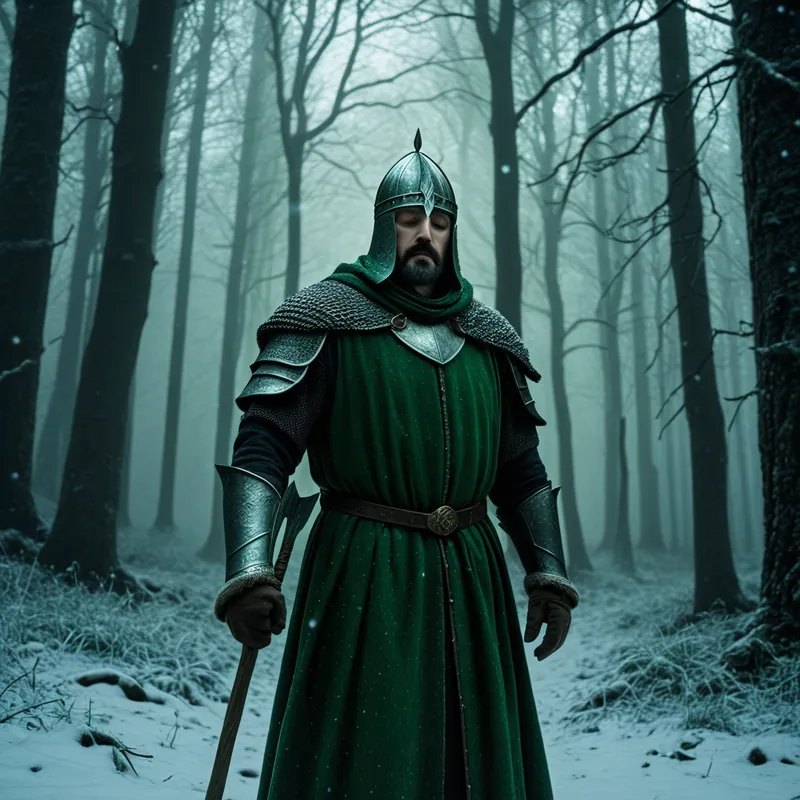
The final morn arrived, iron-cold. Gawain found the Green Chapel, a mere mossy mound by a freezing stream. The Green Knight emerged, axe in hand. Gawain bared his neck. The axe swung once, twice, each time feinting, making Gawain flinch. The third swing bit, but only nicking Gawain’s skin, drawing a single drop of blood.
Then the Green Knight laughed, and his form shifted—he was Bertilak himself. The entire game was a test devised by the enchantress [Morgan le Fay](/myths/morgan-le-fay “Myth from Celtic culture.”/). The three swings were for the three days of honest exchange; the nick was for the one day of deceit, for hiding the green girdle. “You failed, but only in a little,” said the now-familiar lord. “You loved your life, and I blame you not a whit.”
Shame hotter than any wound washed over Gawain. He returned to Camelot, not in [triumph](/myths/triumph “Myth from Roman culture.”/), but in humility, wearing the green girdle not as a trophy, but as a badge of his fault. And the court, in solidarity with their flawed brother, adopted the green silk as a symbol, not of perfection, but of the shared, human struggle for honor.
Cultural Origins & Context
The myth of Sir Gawain and the Green Knight survives in a single, exquisite manuscript from the late 14th century, a product of the rich alliterative revival in Middle English poetry. Its anonymous poet was likely a cleric or a courtier steeped in the chivalric ideals of the time, yet possessing a sharp, almost psychological insight that transcends mere romance.
The tale functions as a sophisticated critique and exploration of the very chivalric code it portrays. In an era where Arthurian legends were used to model ideal behavior for the knightly class, this story introduces a profound complication. It asks: What happens when the perfect, public virtues of courage (fortitudo) and courtesy (curteisie) collide with the private, instinctual virtue of survival? The story was likely recited in halls not just for entertainment, but as a moral and philosophical puzzle, a reminder that the quest for perfection is itself a human, and therefore flawed, endeavor.
Symbolic Architecture
At its [heart](/symbols/heart “Symbol: The heart symbolizes love, emotion, and the core of one’s existence, representing deep connections with others and self.”/), the myth is a profound map of the [psyche](/myths/psyche “Myth from Greek culture.”/)’s confrontation with its own [shadow](/symbols/shadow “Symbol: The ‘shadow’ embodies the unconscious, repressed aspects of the self and often represents fears or hidden emotions.”/). The Green [Knight](/symbols/knight “Symbol: The knight symbolizes honor, chivalry, and the pursuit of noble causes, reflecting the ideal of the noble warrior.”/) is not a [villain](/symbols/villain “Symbol: A character representing opposition, moral corruption, or suppressed aspects of self, often embodying fears, conflicts, or societal threats.”/), but an agent of [the Self](/myths/the-self “Myth from Jungian culture.”/)—the wholeness of the [psyche](/myths/psyche “Myth from Greek culture.”/)—issuing a call to [initiation](/symbols/initiation “Symbol: A symbolic beginning or transition into a new phase, status, or awareness, often involving tests, rituals, or profound personal change.”/). He is the wild, untamed, and immortal [aspect](/symbols/aspect “Symbol: A distinct feature, quality, or perspective of something, often representing a partial view of a larger whole.”/) of [nature](/symbols/nature “Symbol: Nature symbolizes growth, connectivity, and the primal forces of existence.”/) and the unconscious that disrupts the ordered, civilized world of Camelot (the conscious ego).
The Green Knight is the question the soul must answer, not with a sword, but with surrendered vulnerability.
Gawain’s [journey](/symbols/journey “Symbol: A journey in dreams typically signifies adventure, growth, or a significant life transition.”/) is the [hero](/symbols/hero “Symbol: A hero embodies strength, courage, and the ability to overcome significant challenges.”/)’s descent, not into a [monster](/symbols/monster “Symbol: Monsters in dreams often symbolize fears, anxieties, or challenges that feel overwhelming.”/)’s lair, but into the ambiguous, testing [landscape](/symbols/landscape “Symbol: Landscapes in dreams are powerful symbols representing the dreamer’s emotional state, personal journey, and the broader context of life situations.”/) of his own integrity. The castle and its [lord](/symbols/lord “Symbol: The symbol of ‘Lord’ represents authority, mastery, and control, along with associated power dynamics in relationships.”/) represent a liminal [space](/symbols/space “Symbol: Dreaming of ‘Space’ often symbolizes the vastness of potential, personal freedom, or feelings of isolation and exploration in one’s life.”/) of trial, where the rules are both clear and deceptive. The exchange game is a beautiful [symbol](/symbols/symbol “Symbol: A symbol can represent an idea, concept, or belief, serving as a powerful tool for communication and understanding.”/) of the psyche’s economy: what we receive from the unconscious (the [lady](/symbols/lady “Symbol: The symbol of the ‘Lady’ often signifies femininity, grace, and the complexities of the female experience, representing aspects of nurturing, intuition, and empowerment.”/)’s advances, symbolic of temptation and eros) must be consciously integrated and acknowledged (given to the [lord](/symbols/lord “Symbol: The symbol of ‘Lord’ represents authority, mastery, and control, along with associated power dynamics in relationships.”/), the ruling principle).
The green girdle is the central, transformative symbol. It begins as a promise of invulnerability, a magical [solution](/symbols/solution “Symbol: A solution symbolizes resolution, clarity, and the overcoming of obstacles, often representing a sense of accomplishment.”/) to the [problem](/symbols/problem “Symbol: Dreams featuring a ‘problem’ often symbolize internal conflicts or challenging situations that require resolution and self-reflection.”/) of [mortality](/symbols/mortality “Symbol: The awareness of life’s finitude, often representing transitions, impermanence, or existential reflection in dreams.”/) and fear. It represents [the ego](/myths/the-ego “Myth from Jungian culture.”/)’s desire to cheat [fate](/symbols/fate “Symbol: Fate represents the belief in predetermined outcomes, suggesting that some aspects of life are beyond human control.”/), to avoid the necessary wounding that leads to growth. By accepting and hiding it, Gawain chooses a literal [life](/symbols/life “Symbol: The symbol of ‘Life’ represents a journey of growth, interconnectedness, and existential meaning, encompassing both the joys and challenges that define human experience.”/)-preserver over symbolic integrity.
The girdle transmutes from a charm of cowardice into a token of consciousness, its value lying not in its power, but in the shame it evokes.
His “failure” is his greatest initiation. The nick on his [neck](/symbols/neck “Symbol: The neck in dreams often symbolizes communication, vulnerability, and the connection between thoughts and emotions.”/) is the sacred wound, the precise, minimal cut that marks him not as a fallen hero, but as an initiated [human](/symbols/human “Symbol: The symbol of a human represents individuality, complexity of emotions, and social relationships.”/). The girdle, worn openly thereafter, ceases to be a secret [talisman](/myths/talisman “Myth from Global culture.”/) and becomes the symbol of the flaw accepted. It is the [integration](/symbols/integration “Symbol: The process of unifying disparate parts of the self or experience into a cohesive whole, often representing psychological wholeness or resolution of internal conflict.”/) of [the shadow](/myths/the-shadow “Myth from Jungian culture.”/)—the part of himself that valued life over perfect honor.
The Dreamer’s Resonance
When this myth stirs in the modern dreamer, it often manifests as a pattern of hidden bargains and impending reckonings. You may dream of preparing for a crucial test or interview, only to discover you have secretly—and shamefully—brought a forbidden aid. You may dream of being caught in a polite but intensely pressured social exchange where you must hide a growing sense of panic or desire. The somatic feeling is one of constriction around the waist or chest, a literal “girding” that is both protective and suffocating.
Psychologically, this dream pattern signals a confrontation with what Carl Jung called the shadow. The dreamer is in a “Bertilak’s castle” phase of life—a period of testing where the stakes of personal integrity are high. The process underway is the painful, necessary realization that one’s self-image of perfect control, honesty, or courage is about to be compromised by a very human instinct: fear, desire, or self-preservation. The dream is the psyche’s way of rehearsing the inevitable “nick,” the small, revealing flaw that must be acknowledged to prevent a far greater psychic split.
Alchemical Translation
The alchemy of this myth models the transformation of shame into humility, and perfectionism into wholeness. The [prima materia](/myths/prima-materia “Myth from Alchemical culture.”/) is Gawain’s ideal, stainless ego—the “Knight of [the Round Table](/myths/the-round-table “Myth from Arthurian culture.”/).” The shocking arrival of the Green Knight is the [nigredo](/myths/nigredo “Myth from Alchemical culture.”/), the blackening, the dissolution of that certainty by the chaotic, life-giving force of the unconscious.
The year-long quest and the three days of testing are the albedo, the whitening, a purification not through fire, but through cold, honest scrutiny. The exchanges are the careful weighing of psychic contents. The critical moment of alchemical transmutation occurs not when Gawain faces the axe, but in the quiet chamber when he accepts the girdle. This is the secret, flawed coagulatio—the embodiment of the solution is itself the problem.
The true gold is forged not in the avoidance of error, but in the conscious wearing of its symbol.
The final revelation at the Green Chapel is the [rubedo](/myths/rubedo “Myth from Alchemical culture.”/), the reddening, achieved through the sacrificial drop of blood. The integration is complete when Gawain returns to Camelot. He does not cast the girdle away in disgust; he wears it. The court does not shun him; they adopt the symbol. This is the alchemical goal of individuation: the conscious self, wounded and humbled, is re-assimilated into the community of the psyche (the Round Table) not as a perfect hero, but as a complete person. The green girdle, once a token of hidden fear, becomes the [lapis philosophorum](/myths/lapis-philosophorum “Myth from Alchemical culture.”/)—the philosopher’s stone—of this inner work: the enduring, visible proof that wholeness includes the flaw, and that consciousness itself is the only true protection.
Associated Symbols
Explore related symbols from the CaleaDream lexicon: