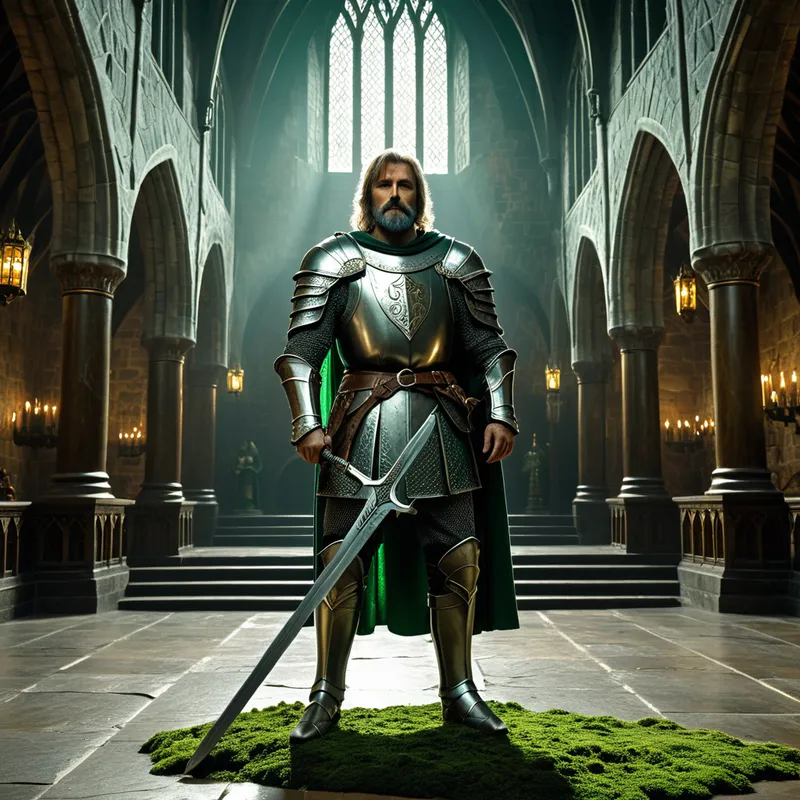
Sir Gawain Myth Meaning & Symbolism
A knight's quest to face a supernatural challenger becomes a profound test of honor, mortality, and the raw, untamed power of nature.
The Tale of Sir Gawain
Listen, and hear a tale of the turning year, of a hall of light and a visitor from [the world](/myths/the-world “Myth from Tarot culture.”/)’s dark, green heart. In the high hall of Camelot, where the fire roared and the wine flowed like summer rivers, a shadow fell across the Yuletide feast. The laughter of King Arthur and his knights stilled, frozen in their throats. For through the great doors, unannounced and unafraid, rode a figure the likes of which no man had seen.
He was a giant, a mountain of a man upon a horse as green as deep forest shade. His skin held the hue of weathered oak, his hair and great beard like cascading moss. In one hand, a holly bob, token of peace. In the other, a Danish axe, its edge gleaming with cold promise. This was the [Green Knight](/myths/green-knight “Myth from Arthurian culture.”/), and his voice rumbled like stone grinding beneath [the earth](/myths/the-earth “Myth from Hindu culture.”/). He came not for war, but for a game. A Christmas game. He offered his bare neck to any knight brave enough to strike him with his own axe, on condition that the challenger seek him out in one year and one day to receive a blow in return.
A stunned silence gripped the hall. The challenge was an absurdity, a riddle wrapped in menace. Then, from the high table, Sir Gawain rose. “My king, let this folly be mine.” With Arthur’s grim nod, Gawain took the great green axe. [The Green Knight](/myths/the-green-knight “Myth from Arthurian culture.”/) knelt, bared his neck, and Gawain swung. The blade sheared clean through flesh and bone, and the knight’s head tumbled across the flagstones. But the body did not fall. It stood, walked calmly to its head, plucked it from the floor, and held it aloft. The eyes opened, the lips spoke: “One year and a day, Gawain. Seek me at the Green Chapel. Do not fail.” Then he mounted his steed and was gone, leaving a hall steeped in dread.
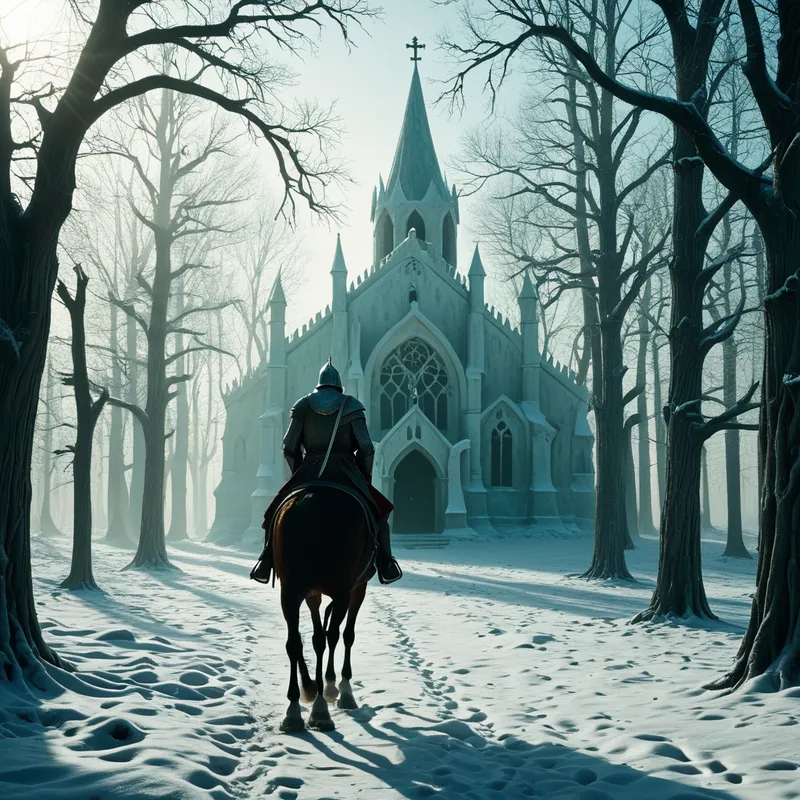
The seasons turned. Summer’s pride gave way to autumn’s melancholy, and autumn to winter’s cruel grip. True to his word, Gawain donned his armor, shield emblazoned with the pentangle, and rode out from Camelot into the dying world. His journey was a crucible of cold and despair, through haunted forests and over mountains that scraped a leaden sky. He fought beasts and spirits, but his true foe was the creeping doubt: where was [the Green Chapel](/myths/the-green-chapel “Myth from Arthurian culture.”/)? Who was this knight he must meet?
Near death from exposure, he stumbled upon a castle, a haven of warmth and light. Its lord, a jovial, red-faced giant named Bertilak, welcomed him with open arms. Here, Gawain learned the Chapel was but two miles hence. He could rest until the appointed day. Bertilak proposed a game: each day, he would go hunting, and Gawain would stay at the castle. At day’s end, they would exchange what they had won.
For three days, as Bertilak hunted the deer, the boar, and the fox, Gawain was hunted in turn—by the lord’s beautiful, cunning wife. In the quiet chambers, she pressed upon him kisses, and gifts, testing his courtesy and his chastity. True to his knightly vows, Gawain accepted the kisses but refused her greater favors. Each evening, he faithfully exchanged the kisses for Bertilak’s game. But on the third day, the lady offered a green silk girdle, enchanted, she whispered, to protect its wearer from all harm. Thinking of the axe soon to fall, Gawain, in a moment of mortal fear, accepted it. And that evening, he gave Bertilak the three kisses, but kept the girdle secret. He had broken the covenant.
The fateful dawn arrived. Gawain, the green girdle hidden beneath his armor, came to the Green Chapel—a mere grassy mound, an ancient barrow by a rushing stream. From within came the sound of a blade being sharpened. “Welcome, Gawain,” boomed the voice of the Green Knight, emerging whole once more, axe in hand. Gawain knelt, bared his neck, and flinched as the blade whistled down. Twice the Knight feinted, and on the third stroke, the blade bit—but only nicking Gawain’s skin, drawing a single drop of blood.
The Green Knight stood revealed as Bertilak himself, transformed by the magic of [Morgan le Fay](/myths/morgan-le-fay “Myth from Celtic culture.”/) to test the pride of Camelot. “You are a good man, Gawain,” he said, not unkindly. “You failed only once, for love of your life. The nick is for the girdle, kept in secret. The rest of your honor stands true.” Shame flooded Gawain. He returned to Camelot, not in [triumph](/myths/triumph “Myth from Roman culture.”/), but in humility, wearing the green girdle not as a trophy, but as a badge of his fault. The court, to ease his pain, adopted it as a symbol of honor. But Gawain knew the truth of the green lace, and the truth of the man who wore it.
Cultural Origins & Context
The tale of Sir Gawain and the Green Knight is a pinnacle of the Alliterative Revival in 14th-century England. Composed by an anonymous poet in a rich, dialect-heavy Middle English, it exists in a single manuscript alongside other morally complex poems like [Pearl](/myths/pearl “Myth from Chinese culture.”/). This was not a folk tale told around hearths, but a sophisticated literary romance, likely performed in the halls of the nobility. Its audience lived in a world where the chivalric ideal—a fusion of martial prowess, Christian piety, and courtly love—was the aspirational code for the aristocratic class.
The myth served a dual societal function. On one level, it was a thrilling adventure that reinforced the cultural importance of honor, fidelity, and courage. On a deeper, more critical level, it functioned as a profound interrogation of that very code. By placing its paragon of knightly virtue, Gawain, in a situation where the rules contradict and human fear intervenes, the poem asks: Can idealized perfection survive contact with the messy, amoral, and terrifying forces of the natural world and human psychology? It is a story from the edge of the medieval mind, where Christian doctrine met the older, pagan memory of the Wild Man and the cyclical, unforgiving laws of nature.
Symbolic Architecture
At its core, the myth is a masterful dialectic between two profound symbolic orders: the Court and the [Forest](/symbols/forest “Symbol: The forest symbolizes a complex domain of the unconscious mind, representing both mystery and potential for personal growth.”/), the [Human](/symbols/human “Symbol: The symbol of a human represents individuality, complexity of emotions, and social relationships.”/) and the Natural, the Conscious and the Unconscious.
The Green [Knight](/symbols/knight “Symbol: The knight symbolizes honor, chivalry, and the pursuit of noble causes, reflecting the ideal of the noble warrior.”/) is no mere [monster](/symbols/monster “Symbol: Monsters in dreams often symbolize fears, anxieties, or challenges that feel overwhelming.”/). He is the incarnate [spirit](/symbols/spirit “Symbol: Spirit symbolizes the essence of life, vitality, and the spiritual journey of the individual.”/) of the untamed, cyclical world. His color is the green of [life](/symbols/life “Symbol: The symbol of ‘Life’ represents a journey of growth, interconnectedness, and existential meaning, encompassing both the joys and challenges that define human experience.”/), decay, and relentless [regeneration](/symbols/regeneration “Symbol: The process of renewal, restoration, and growth following damage or depletion, often representing emotional healing, transformation, or a fresh start.”/). He is the [Green Man](/myths/green-man “Myth from Celtic culture.”/), the Fisher [King](/symbols/king “Symbol: A symbol of ultimate authority, leadership, and societal order, often representing the dreamer’s inner power or external control figures.”/) of the [wilderness](/symbols/wilderness “Symbol: Wilderness often symbolizes the untamed aspects of the self and the unconscious mind, representing a space for personal exploration and discovery.”/), who arrives not to destroy the court, but to test its vitality. His beheading game mirrors the agricultural and solar cycles—the “[death](/symbols/death “Symbol: Symbolizes transformation, endings, and new beginnings; often associated with fear of the unknown.”/)” of the [year](/symbols/year “Symbol: A unit of time measuring cycles, growth, and passage. Represents life stages, progress, and mortality.”/) at [winter](/symbols/winter “Symbol: Winter symbolizes a time of reflection, introspection, and dormancy, often representing challenges or a period of transformation.”/), with the promise of its return. He represents the part of the [psyche](/myths/psyche “Myth from Greek culture.”/) that is ancient, amoral, and unconcerned with human notions of honor, concerned only with [truth](/symbols/truth “Symbol: Truth represents authenticity, honesty, and the quest for knowledge beyond mere appearances.”/) and consequence.
The Green Knight does not demand perfection; he demands presence. He seeks not to kill the knight, but to awaken the man.
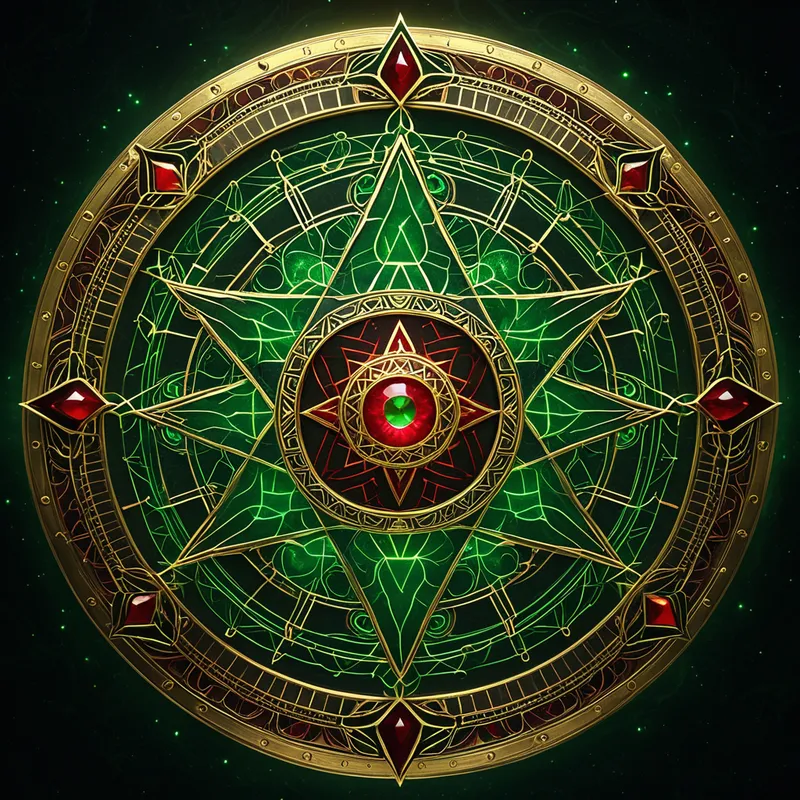
Gawain’s pentangle symbolizes the human aspiration toward a perfect, closed [system](/symbols/system “Symbol: A system represents structure, organization, and interrelated components functioning together, often reflecting personal or social order.”/) of [virtue](/symbols/virtue “Symbol: A moral excellence or quality considered good, often representing inner character, ethical principles, or spiritual ideals in dreams.”/)—his five fives of faultless chivalry. It is a geometric ideal. Its failure is not in its design, but in its inability to account for the serpentine, living complexity of the green girdle, which represents instinctual survival fear. The girdle is the flaw in the system, the crack through which the unconscious (his fear of death) enters. His [journey](/symbols/journey “Symbol: A journey in dreams typically signifies adventure, growth, or a significant life transition.”/) is a descent from the geometric ideal of the pentangle into the organic, muddy, and ambiguous [reality](/symbols/reality “Symbol: Reality signifies the state of existence and perception, often reflecting one’s understanding of truth and life experiences.”/) of the forest and the castle’s [bedroom](/symbols/bedroom “Symbol: The bedroom symbolizes intimacy, privacy, and the subconscious mind, serving as a refuge for personal thoughts and emotions.”/)—the realms of instinct and desire.
The Dreamer’s Resonance
When this myth stirs in the modern dreamer, it often signals a profound encounter with [the Self](/myths/the-self “Myth from Jungian culture.”/)’s own “Green Knight.” This may manifest as a dream of being presented with an impossible, paradoxical challenge by a formidable, earthy, or unnaturally vibrant figure. The dreamer, like Gawain, may feel compelled to accept out of a sense of duty or pride.
The somatic experience is key: the chilling dread in the hall, the exhausting, lonely journey through a frozen landscape, the tense, claustrophobic exchanges in the castle. These dream sensations point to a psychological process of initiatory ordeal. The dreamer is being called to leave the comfortable “Camelot” of their conscious identity and [persona](/myths/persona “Myth from Greek culture.”/) to face a foundational truth about themselves. The “axe-blow” they fear is often not a physical death, but the death of an illusion—a cherished self-image, a long-held belief about their own perfection or control. The nick on the neck is the precise, necessary wounding of [the ego](/myths/the-ego “Myth from Jungian culture.”/) that allows for a more authentic, integrated self to emerge. To dream of hiding a protective [talisman](/myths/talisman “Myth from Global culture.”/) (like the girdle) is to dream of one’s own secret compromises, the small dishonesties we employ to shield our vulnerability from life’s inevitable trials.
Alchemical Translation
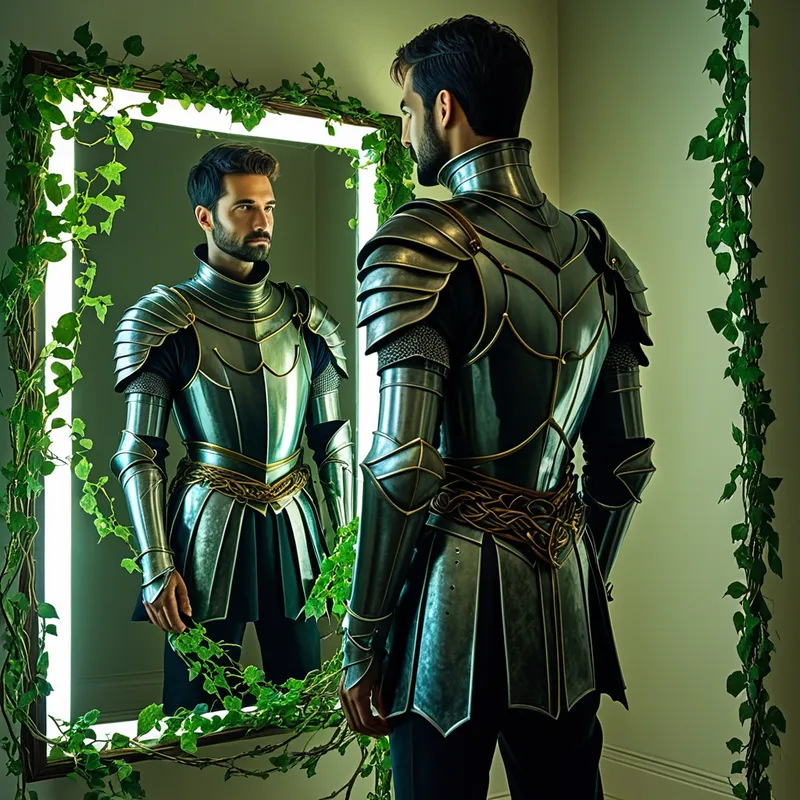
The Gawain myth is a near-perfect allegory for the Jungian process of individuation. The alchemical operation at its heart is [Nigredo](/myths/nigredo “Myth from Alchemical culture.”/)—the blackening, the descent into the unknown, the confrontation with [the shadow](/myths/the-shadow “Myth from Jungian culture.”/).
Camelot represents the initial, conscious persona: brilliant, ordered, and full of collective pride. The Green Knight is the eruption of the shadow, the autonomous psychic content that shatters this order to initiate growth. Gawain’s acceptance of the game is the ego’s reluctant agreement to engage with the unconscious. His long winter journey is the [via dolorosa](/myths/via-dolorosa “Myth from Christian culture.”/) of the psyche, where the old identities are stripped away by hardship and isolation.
The castle of Bertilak is the liminal temenos, the sacred space where the most delicate alchemy occurs. Here, the raw instincts (the hunted game) are consciously exchanged for the subtle temptations of the soul (the kisses, the girdle).
The three days of testing represent the integration of complex opposites: courtesy and desire, honesty and self-preservation. Gawain’s “failure”—his secret retention of the girdle—is the crucial moment. In alchemical terms, it is the discovery of the [prima materia](/myths/prima-materia “Myth from Alchemical culture.”/), the base, flawed, but real substance from which the gold of the Self is made. Perfection (the pentangle) is an abstract ideal; the flaw (the girdle and the nick) is human, concrete, and transformative.
His return is not with a boon of power, but with the symbol of the integrated conflict: the green girdle worn openly as a mark of shame transformed into wisdom. He returns to the collective (Camelot) having been irrevocably changed by the individual encounter with the wild (the Green Chapel). The court misunderstands it as a badge of honor, but Gawain carries the deeper, private knowledge. This is the alchemical gold: not flawless victory, but hard-won self-knowledge, the humility that comes from seeing one’s own beautiful, necessary imperfection. The myth teaches that wholeness is not the absence of the flaw, but the conscious wearing of it.
Associated Symbols
Explore related symbols from the CaleaDream lexicon: