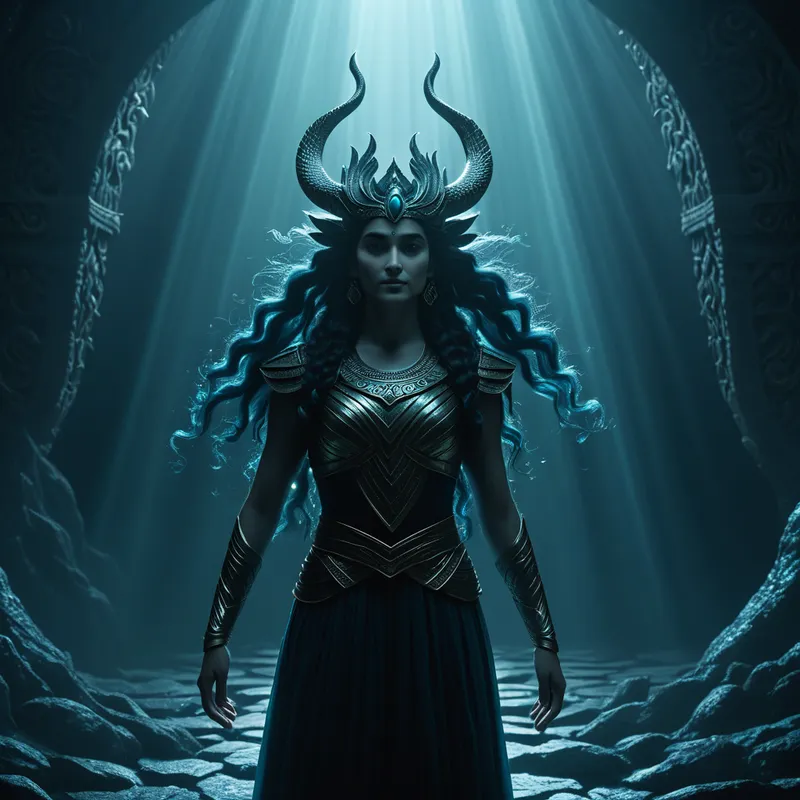
Sinbad's Seven Voyages
A legendary sailor's seven epic voyages through fantastical lands, facing monstrous creatures and supernatural challenges in classic Arabian folklore.
The Tale of Sinbad’s Seven Voyages
The tale begins not at sea, but in the dusty streets of Baghdad, where a humble porter, wearied by his load, laments his lot before the opulent gate of a great merchant. From within, the porter’s namesake, [Sinbad the Sailor](/myths/sinbad-the-sailor “Myth from Islamic culture.”/), hears this cry against fate and invites the man in. To justify his fortune, the old sailor unfurls the tapestry of his life, woven from seven threads of peril and wonder.
His First Voyage is one of innocence lost. Seeking trade, his ship is becalmed upon what they believe to be a verdant island, only for the land itself to shudder and dive—it is the back of a colossal sleeping whale. Sinbad alone escapes, clinging to a piece of driftwood, and is cast upon a shore of a strange kingdom. Here, he learns that fortune favors the bold, returning to Baghdad wealthy from the sale of rare goods gifted by the island’s king.
The Second Voyage strands him in a valley of impossible riches and impossible terror. Abandoned by his crew, he finds himself amidst nests of gigantic Roc eggs, diamonds that glitter like captured stars, and serpents that haunt the shadows. His escape is an act of desperate ingenuity, tying himself to a piece of meat carried aloft by the mighty bird, a human seed borne from a valley of stone.
On the Third Voyage, he encounters the embodiment of brute appetite: the one-eyed, cannibalistic giant, the [Cyclops](/myths/cyclops “Myth from Greek culture.”/)-like creature of the island. This voyage speaks of cunning over strength, as Sinbad and his companions blind the monster with a heated iron spike and flee on makeshift rafts, only for Sinbad to be captured next by a great serpent, a guardian of a tomb of ivory and ebony.
The Fourth Voyage brings a different kind of entombment. Shipwrecked on an island whose natives practice a horrifying funeral rite, Sinbad is buried alive with a dead king, left with only a crust of bread and a flask of [water](/myths/water “Myth from Chinese culture.”/) in a cavern of bones. His will to live drives him to follow a hidden animal track, which becomes a river leading him back to [the world](/myths/the-world “Myth from Tarot culture.”/) of light and air, and ultimately, to a second marriage in a foreign land.
In the Fifth Voyage, his hubris is punished. Against his own wiser counsel, he sets sail again, only to have his new ship destroyed by the furious parents of a Roc, whose egg his crew had shattered. Washed ashore on the Island of the Old Man of [the Sea](/myths/the-sea “Myth from Greek culture.”/), he is enslaved by a [sinister](/myths/sinister “Myth from Roman culture.”/) creature who wraps its legs around his neck and will not let go. His liberation comes through intoxication and violence, as he tricks the creature with wine and dashes its head against the rocks.
The Sixth Voyage is a journey into the belly of despair. His ship is dashed against the cliffs of a mountainous island, a place of utter desolation. All his companions perish from starvation, and Sinbad, preparing his own tomb, discovers a hidden river flowing underground. Building a raft, he surrenders to its current, passing through caverns of darkness until he emerges in a paradisiacal land, the kingdom of Serendib, where he is received as a marvel and a messenger.
The Seventh and Final Voyage is a test of spiritual obedience. Commanded by the Caliph to carry gifts to the King of Serendib, Sinbad is once more waylaid by fate, captured by pirates, and sold into slavery. Forced to hunt elephants with a bow in a dense jungle, he discovers a secret passage the elephants use to file their tusks against the rocks. By sharing this secret with his master, he wins his freedom and returns home, his fortune multiplied, but his soul finally sated. He vows never to tempt the sea again, having learned that the greatest treasure is the peace found in one’s own home.
Cultural Origins & Context
The voyages of Sinbad are embedded within the grand narrative architecture of the One Thousand and One Nights (or Arabian Nights), a compilation that evolved over centuries across the Middle East, Persia, and South Asia. Sinbad’s tales, however, stand as a distinct cycle, likely originating from seafaring lore of the Indian Ocean and the vibrant trade routes connecting Baghdad to the coasts of East Africa, India, and beyond. They are a product of the Abbasid [Golden Age](/myths/golden-age “Myth from Universal culture.”/), a time when Baghdad was the cosmopolitan center of the world, and tales of distant lands, strange creatures, and immense fortunes captivated the merchant and the commoner alike.
These are not merely adventure stories but profound reflections on the Islamic worldview of the time. The constant interplay between qadar (divine decree) and human agency is the sea upon which Sinbad sails. His survival is never solely due to his own wit or strength; it is always coupled with the phrase “by the grace of Allah,” acknowledging that fortune and fate are ultimately in divine hands. The stories also mirror the real perils and wonders encountered by Arab and Persian sailors—whales mistaken for islands, encounters with great birds, and the allure of unknown islands—mythologized into encounters with the monstrous and the miraculous. Sinbad embodies the archetype of the merchant-adventurer, a figure central to the era’s identity, for whom risk and reward were the twin poles of existence.
Symbolic Architecture
Sinbad’s seven voyages are not a [linear](/symbols/linear “Symbol: Represents order, predictability, and a direct, step-by-step progression. It symbolizes a clear path from cause to effect.”/) [progression](/symbols/progression “Symbol: Symbolizes forward movement, development, or advancement through stages toward a goal or state of being.”/) but a spiral, each [journey](/symbols/journey “Symbol: A journey in dreams typically signifies adventure, growth, or a significant life transition.”/) delving deeper into the [psyche](/myths/psyche “Myth from Greek culture.”/)’s [relationship](/symbols/relationship “Symbol: A representation of connections we have with others in our lives, often reflecting our emotional state.”/) with the unknown. The sea is the primordial unconscious, teeming with both [life](/symbols/life “Symbol: The symbol of ‘Life’ represents a journey of growth, interconnectedness, and existential meaning, encompassing both the joys and challenges that define human experience.”/)-giving [opportunity](/symbols/opportunity “Symbol: The symbol ‘opportunity’ signifies potential for advancement, growth, and new beginnings in various life aspects.”/) and annihilating [chaos](/symbols/chaos “Symbol: In Arts & Music, chaos represents raw creative potential, uncontrolled expression, and the breakdown of order to forge new artistic forms.”/). Each [island](/symbols/island “Symbol: An island represents isolation, self-reflection, and the need for separation from the external world.”/) is a complex of the [psyche](/myths/psyche “Myth from Greek culture.”/)—the Island of the [Whale](/symbols/whale “Symbol: Whales symbolize emotional depth, intuition, and communication, representing a profound connection to the subconscious mind.”/) (the deceptive [stability](/symbols/stability “Symbol: A state of firmness, balance, and resistance to change, often represented by solid objects, foundations, or steady tools.”/) of [the ego](/myths/the-ego “Myth from Jungian culture.”/)), the [Valley](/symbols/valley “Symbol: A valley often symbolizes a period of transition or a place of respite between two extremes.”/) of Diamonds (the glittering but dangerous treasures of the [shadow](/symbols/shadow “Symbol: The ‘shadow’ embodies the unconscious, repressed aspects of the self and often represents fears or hidden emotions.”/)), the [Island](/symbols/island “Symbol: An island represents isolation, self-reflection, and the need for separation from the external world.”/) of the Old Man (the paralyzing grip of a negative complex).
The act of being swallowed—by a whale, by a valley, by a tomb, by a serpent—is the universal motif of the night sea journey. Sinbad does not conquer these depths; he is digested by them, stripped of his previous identity, and forcibly reborn, each time integrating a fragment of the world’s wildness into his soul.
The [number](/symbols/number “Symbol: Numbers in dreams often symbolize meaning, balance, and the quest for understanding in the dreamer’s life, reflecting their mental state or concerns.”/) seven is itself a complete cycle, a cosmic number in Islamic and older traditions signifying perfection, totality, and spiritual completion. His journey from a restless, [fortune](/symbols/fortune “Symbol: Fortune symbolizes luck, wealth, and opportunities that may be present or sought in one’s life.”/)-seeking [youth](/symbols/youth “Symbol: Youth symbolizes vitality, potential, and the phase of life associated with growth and exploration.”/) to a contented, wise elder in Baghdad traces the arc of individuation. He leaves as a merchant seeking external [wealth](/symbols/wealth “Symbol: Wealth in dreams often represents abundance, security, or inner resources, but can also symbolize burdens, anxieties, or moral/spiritual values.”/) and returns, time and again, as a man who has accrued internal wealth—[resilience](/symbols/resilience “Symbol: The capacity to recover quickly from difficulties, adapt to change, and maintain strength through adversity.”/), cunning, and a hard-won understanding of his place within a vast and capricious [cosmos](/symbols/cosmos “Symbol: The entire universe as an ordered, harmonious system, often representing the totality of existence, spiritual connection, and the unknown.”/).
The Dreamer’s Resonance
To dream of Sinbad is to dream of the part of oneself that is perpetually called to [the horizon](/myths/the-horizon “Myth from Various culture.”/). He represents the ego’s audacious project to engage with the boundless, instinctual forces of life. In the modern psyche, a “Sinbad voyage” may manifest as a sudden career shift, a plunge into a creative endeavor, or any undertaking where the outcome is shrouded in mist and the risks are profound. He is the spirit of the entrepreneur, the artist, and the explorer.
Yet, the tales also warn the dreamer. Each voyage begins with Sinbad growing “weary of an idle life,” a restlessness that borders on defiance of contentment. The psyche thus oscillates between the safety of the known (Baghdad) and the perilous lure of the unknown (the sea). The final vow to sail no more is a critical moment of psychic integration—the recognition that the endless outward quest must eventually give way to an inward harvest. The dreamer learns that not every call to adventure must be answered, and that true fortune includes the wisdom to stay home.
Alchemical Translation
The alchemical process is vividly mapped onto Sinbad’s ordeals. The initial [nigredo](/myths/nigredo “Myth from Alchemical culture.”/), the blackening, is the repeated shipwreck, the dissolution of all plans and comforts into the black sea or the dark tomb. The [albedo](/myths/albedo “Myth from Alchemical culture.”/), the whitening, is the moment of clarity and cunning in the depths—the idea to tie himself to the Roc, the discovery of the underground river. It is the silver insight that emerges from absolute black despair.
His journeys are a repeated solve et coagula: the ego is dissolved in the waters of chaos, only to be reconstituted, each time with a new element integrated—the diamond’s hardness, the elephant’s wisdom, the serpent’s knowledge of hidden passages.
The final [rubedo](/myths/rubedo “Myth from Alchemical culture.”/), the reddening or achievement of the philosopher’s stone, is not a pile of gold in Baghdad. It is the synthesis of his experiences into a coherent self, symbolized by his final, peaceful authority as a storyteller. He has transmuted the raw, terrifying [prima materia](/myths/prima-materia “Myth from Alchemical culture.”/) of monsters and magic islands into the gold of wisdom, his home now a vessel containing the entire world.
Associated Symbols
Explore related symbols from the CaleaDream lexicon:
- Ocean — The boundless, unconscious realm of potential, peril, and the unknown, across which [the self](/myths/the-self “Myth from Jungian culture.”/) must journey to achieve wholeness.
- Fate — The invisible thread woven through all action, representing both divine decree and the inescapable consequences of one’s choices and fortune.
- Serpent — A dual symbol of deadly danger and secret wisdom, often guarding profound treasures or hidden passages within the self.
- Cave — [The womb](/myths/the-womb “Myth from Various culture.”/) of [the earth](/myths/the-earth “Myth from Hindu culture.”/) and the psyche, a place of imprisonment, initiation, and profound transformation where old selves die and new insights are born.
- Journey — The fundamental process of moving through states of being, encompassing physical travel, psychological development, and spiritual quest.
- Transformation Cocoon — Any confined space or state of ordeal that necessitates the dissolution of the old form to allow for a new emergence.
- Treasure — The hard-won prize of the quest, which may be material wealth, integrated knowledge, or a redeemed aspect of the soul.
- Whirlwind Adventure — An experience of chaotic, uncontrollable forces that sweeps the individual out of ordinary life and into a realm of radical change.
- Circle — The symbol of completion, cycles, and return, reflecting the sevenfold structure of the voyages and the ultimate return to the origin point, transformed.
- Key — [The flash of insight](/myths/the-flash-of-insight “Myth from Alchemical culture.”/), the clever trick, or the discovered secret that unlocks the prison and provides escape from a seemingly hopeless predicament.
- [Death](/myths/death “Myth from Tarot culture.”/) — The ever-present shadow on the voyage, representing not just physical end but the necessary endings of ignorance, naivety, and outworn phases of life.
- Rebirth — The constant outcome of Sinbad’s ordeals; the cyclical emergence from each disaster as a wiser, more resilient, and more complex individual.