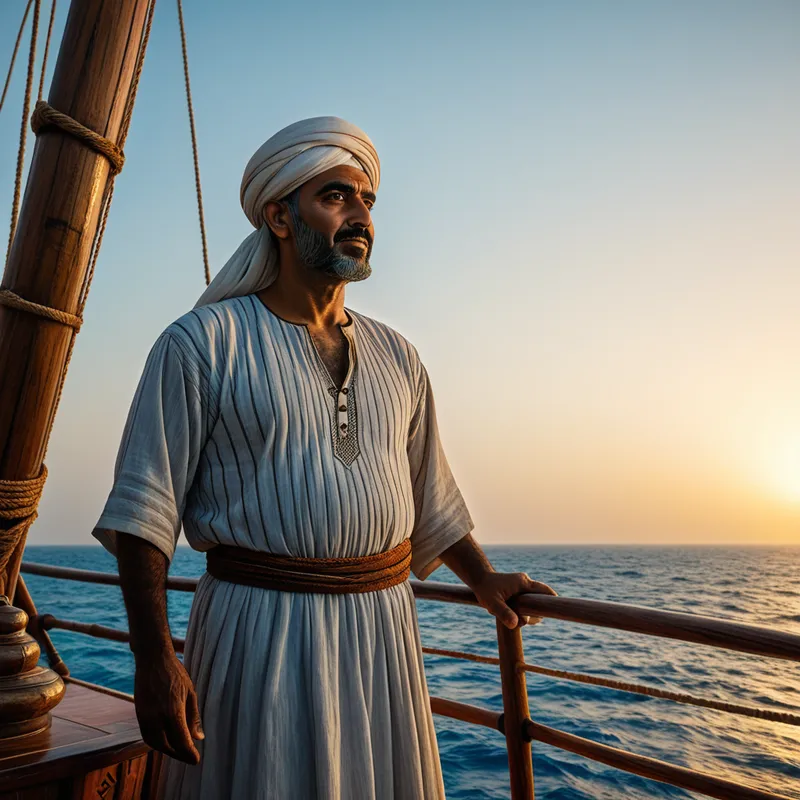
Sinbad the Sailor Myth Meaning & Symbolism
A legendary sailor from Baghdad recounts seven perilous voyages, each a confrontation with cosmic wonders, monstrous forces, and the depths of his own fortune and folly.
The Tale of Sinbad the Sailor
Hear now the tale whispered by the desert wind and carried on the salt-spray of distant seas—the tale of Sinbad the Sailor. In the jeweled city of Baghdad, under the reign of the great Caliph Harun al-Rashid, there lived a man who had squandered his inheritance. He sat in the dust of regret, listening to the stories of merchants whose robes smelled of frankincense and strange spices. The call of the unknown was a hook in his soul.
So he set sail from Basra, his heart a drumbeat against his ribs. The first voyage promised fortune, but the sea is a fickle god. His ship foundered on what the crew thought was a verdant island—only for the island to shudder, rise, and reveal itself as the colossal back of a slumbering sea-beast. The waves swallowed the vessel whole. Sinbad alone survived, clutching a wooden trough, washed onto the shores of a true island. There, he discovered a valley floor carpeted not with grass, but with diamonds, guarded by serpents as thick as palm trunks. And above, the merchants of the sky cast down great chunks of meat to which the precious stones adhered, to be carried off by their trained eagles. Tying himself to a slab of meat, Sinbad was snatched into the heavens, a terrified offering to the stratosphere, only to be dropped into a nest of unimaginable wealth. He returned to Baghdad laden with gems, his poverty erased, but his restlessness seeded.
And so the cycle began. Six more times he answered the siren song of the horizon. He was marooned on an island where a monstrous, one-eyed giant—a Ghul—devoured his crew nightly, until Sinbad blinded the beast with a red-hot iron spit and escaped clinging to the wool of a giant ram. He was buried alive in a cavern of the dead with his wealthy wife, only to discover a secret passage used by thieves, escaping with a fortune in funeral jewels. He encountered the Old Man of the Sea, a demonic creature who wrapped its sinewy legs around Sinbad’s shoulders and could not be dislodged, until Sinbad intoxicated it with wine and dashed its brains out. He saw ships crewed by apes, was carried through valleys of talking serpents by a Roc, and faced the terrors of the deep where fish had faces like owls.
Each voyage stripped him of companions, each ordeal scraped him raw to the essence of his will. He amassed kingdoms of wealth, yet each homecoming in Baghdad grew shorter, the silken cushions of his palace unable to contain the vastness now living behind his eyes. The seventh and final voyage, a penitential mission for the Caliph himself, cast him to the very edge of the map, to an island at the rim of the world where the inhabitants rode horses without bridles, controlled by the will of their riders. Here, at the zenith of his trials, he found not just treasure, but a profound reconciliation. He returned not merely as a wealthy merchant, but as a sage who had conversed with the extremities of creation, a man whose fortune was no longer in his chests, but etched into the very fabric of his soul. He finally rested, his journeys complete, his story a testament whispered from generation to generation: that the greatest treasure is the self, forged in the crucible of the unknown.

Cultural Origins & Context
The tales of Sinbad are part of the vast narrative ocean of One Thousand and One Nights, compiled during the Islamic Golden Age, primarily under the Abbasid Caliphate. They are not scripture, but secular folklore, told in coffeehouses and courts, woven by professional storytellers who were the keepers of collective wonder. The setting is the cosmopolitan world of 8th-10th century Baghdad and Basra, hubs of a mercantile empire whose trade routes stretched from China to Africa. Sinbad is the archetypal merchant-adventurer, a figure who embodies the era’s spirit of exploration, scientific curiosity, and the immense risks undertaken for material gain.
The stories function as more than mere entertainment. They are geographical and cosmological fantasies that map the psychological frontiers of a culture engaging with a suddenly vast and mysterious world. They served to explain the origin of strange goods, to warn of the perils of greed and hubris, and to ultimately affirm the Islamic worldview of Qadar—that while man strives, his ultimate fate rests with the will of Allah. Sinbad’s frequent prayers for deliverance are not mere ornamentation; they are the narrative anchor, reminding the listener that all fortune, good or ill, is a test and a blessing from the Divine. The tales were a societal container for anxiety about the unknown and a celebration of the ingenuity, faith, and resilience needed to navigate it.
Symbolic Architecture
The seven voyages are not a [linear](/symbols/linear “Symbol: Represents order, predictability, and a direct, step-by-step progression. It symbolizes a clear path from cause to effect.”/) biography but a spiraling [alchemy](/symbols/alchemy “Symbol: A transformative process of purification and creation, often symbolizing personal or spiritual evolution through difficult stages.”/) of the [soul](/symbols/soul “Symbol: The soul represents the essence of a person, encompassing their spirit, identity, and connection to the universe.”/). Sinbad’s ship is the conscious ego, setting out from the ordered world (Baghdad) into the chaotic, [unconscious depths](/symbols/unconscious-depths “Symbol: The hidden, primordial layers of the psyche containing repressed memories, instincts, archetypes, and collective wisdom beyond conscious awareness.”/) of the [Ocean](/symbols/ocean “Symbol: The ocean symbolizes the vastness of the unconscious mind, representing deeper emotions, intuition, and the mysteries of life.”/). Each [island](/symbols/island “Symbol: An island represents isolation, self-reflection, and the need for separation from the external world.”/) is not a physical place, but a complex of the psyche—an encounter with a specific [aspect](/symbols/aspect “Symbol: A distinct feature, quality, or perspective of something, often representing a partial view of a larger whole.”/) of the inner world that must be faced, outwitted, or integrated.
The monster is not merely an external threat, but the embodied shape of a psychic content too vast for ordinary consciousness to hold. To blind the Cyclops is to disable a monstrous, consuming aspect of the self; to escape the Old Man of the Sea is to free oneself from a paralyzing, parasitic complex.
The cycle of [wealth](/symbols/wealth “Symbol: Wealth in dreams often represents abundance, security, or inner resources, but can also symbolize burdens, anxieties, or moral/spiritual values.”/) gained and lost mirrors the process of [inflation](/symbols/inflation “Symbol: A dream symbol representing feelings of diminishing value, loss of control, or expansion beyond sustainable limits in one’s life or psyche.”/) and [deflation](/symbols/deflation “Symbol: A symbolic loss of energy, value, or purpose; often represents a draining of vitality or a collapse of expectations.”/) in the psyche. Each return to Baghdad represents a temporary reintegration of the ego, enriched by the [treasure](/symbols/treasure “Symbol: A hidden or valuable object representing spiritual wealth, inner potential, or divine reward.”/) (new psychological [insight](/symbols/insight “Symbol: A sudden, deep understanding of a complex situation or truth, often arriving unexpectedly and illuminating hidden connections.”/)) retrieved from the deep. Yet the call back to sea signifies that the [integration](/symbols/integration “Symbol: The process of unifying disparate parts of the self or experience into a cohesive whole, often representing psychological wholeness or resolution of internal conflict.”/) is incomplete; a deeper [layer](/symbols/layer “Symbol: Layers often symbolize complexity, depth, and protection in dreams, representing the various aspects of the self or situations.”/) of the unconscious demands [attention](/symbols/attention “Symbol: Attention in dreams signifies focus, awareness, and the priorities in one’s life, often indicating where the dreamer’s energy is invested.”/). The final voyage concludes not with the greatest [material](/symbols/material “Symbol: Material signifies the tangible aspects of life, often representing physical resources, desires, and the physical world’s influence on our existence.”/) haul, but with a symbolic mastery—the bridle-[less](/symbols/less “Symbol: The concept of ‘less’ often signifies a need for simplicity, reduction, or minimalism in one’s life or thoughts.”/) horse representing a will perfectly aligned with instinct, a sign that the heroic ego has learned to ride, rather than fight, the fundamental energies of the soul.

The Dreamer’s Resonance
When the pattern of Sinbad’s voyages appears in modern dreams, it signals a profound engagement with the Explorer archetype. The dreamer is likely in a prolonged life phase of risk, transition, or deep self-discovery. Somatic sensations might include vertigo (the fall from the Roc), constriction (the cave of the dead), or the terrifying paralysis of carrying an unbearable burden (the Old Man of the Sea).
Psychologically, this dream pattern indicates a confrontation with the Shadow in its most spectacular and monstrous forms. The dreamer is not facing small anxieties, but titanic, mythic-sized complexes—perhaps a “valley of diamonds” representing a dazzling but dangerous talent, or a “sea of serpents” symbolizing entangled fears or deceptions. The process is one of severance. The dream-ego, like Sinbad, is repeatedly stripped of its familiar supports (the ship, the crew) and forced to rely on cunning, faith, and raw survival instinct. This is the psyche’s way of forging resilience and compelling the conscious mind to develop new resources.
Alchemical Translation
The alchemical journey of Sinbad is a masterful map of individuation. The initial state is nigredo—the blackening, the despair of lost inheritance, the feeling of being worthless dust. The call to sea is the first stirring of the Self, pushing the ego into the solutio of the ocean for purification.
Each voyage is a stage of albedo and citrinitas, where a specific psychic content (a complex, an instinct) is encountered in its raw, monstrous form (massa confusa), battled, and transformed into a “treasure”—a piece of conscious understanding or a new strength. The Roc that carries him is the terrifying ascent of intuition; the cave of the dead is the necessary descent into the underworld of memory and legacy.
The sevenfold repetition is crucial. It is the spiral path, not the straight line. One does not conquer the unconscious in a single battle, but through repeated, deepening engagements. The treasure is not the goal; the process of seeking it is the transformation.
The final stage, rubedo, is achieved in the seventh voyage. Sinbad no longer seeks fortune; he acts in service (to the Caliph). He encounters a symbol of perfected unity (the horse and rider as one). He returns, finally, as the Lapis Philosophorum—not just a rich man, but a complete one. His restless spirit is quelled because the explorer has fully explored the territory of his own soul, and found it to be as vast, perilous, and wondrous as any ocean on God’s earth.
Associated Symbols
Explore related symbols from the CaleaDream lexicon:
- Ocean — The vast, unconscious psyche, the source of all life and terror, the realm of the unknown through which the conscious ego (the ship) must navigate.
- Journey — The core archetypal pattern of the myth, representing the soul’s necessary voyage away from security and into the depths of experience for transformation.
- Fortune — The dual nature of fate and wealth, representing both the material rewards of risk and the deeper, psychological “treasure” of self-knowledge retrieved from the unconscious.
- Bird — Specifically the Roc, symbolizing sudden, terrifying ascent, intuition that carries one to impossible heights (and dangers), and a connection to the celestial or spiritual realm.
- Cave — The womb of the earth and the tomb, representing regression, containment, and the necessary descent into the darkness of the underworld/ unconscious to find hidden wealth.
- Monster — The embodied Shadow, the terrifying yet valuable psychic content that must be confronted, outwitted, and integrated for growth (e.g., the Cyclops, the Old Man of the Sea).
- Ship — The vehicle of the conscious ego and its societal structures, fragile and often destroyed, forcing the individual to rely on their own resourcefulness in the sea of the unconscious.
- Key — Sinbad’s cunning and faith, which repeatedly unlock impossible situations, representing the inventive problem-solving capacity needed to navigate psychic imprisonment.
- Grief — The profound loss that initiates each voyage and is sustained with the death of every crew, the necessary mourning that accompanies the shedding of old selves.
- Rebirth — The core outcome of each voyage; Sinbad is symbolically drowned and resurrected with new wealth and wisdom, a cycle of death and renewal of the personality.
- Treasure — The symbolic prize of integration, which is both literal gold and the psychological insight, resilience, and expanded consciousness gained from facing the ordeal.
- Fate — The overarching Islamic concept of Qadar, the divine decree that Sinbad both rails against and prays to, representing the surrender to a pattern larger than individual will.