Sin the Moon God Myth Meaning & Symbolism
The story of Sin, the luminous god of the moon, who measures time, reveals fate, and illuminates the hidden depths of the night sky.
The Tale of Sin the Moon God
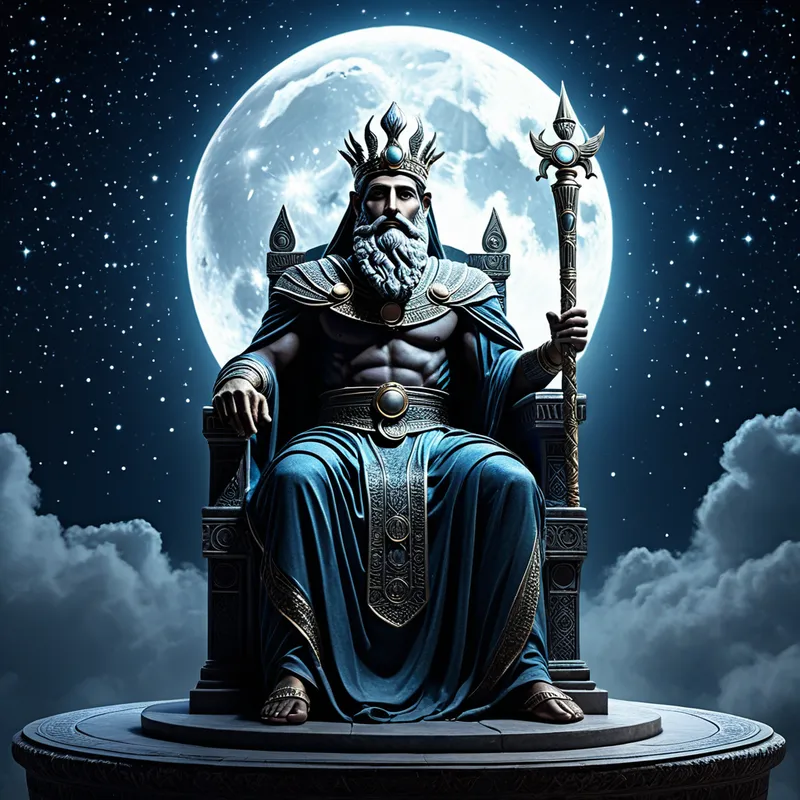
Before the sun claimed its throne, before the first word was etched into clay, there was the Apsu and the Tiamat. From their mingled waters, from the first stirrings of order within chaos, the great gods were born. Among them, a light was kindled not of fire, but of cool, watchful silver. This was Sin, whose very essence was the luminous disk that sailed the black river of the night.
He was the Measurer, the great bull of heaven whose horns were the crescent that carved the months from the formless dark. Each night, he embarked on his solemn journey across the vault of heaven in his crescent-shaped boat, a barge of pearlescent light. His passage was not silent; it was the rhythm of the world. The tides of the Lower Sea heaved with his breath. The barley in the field knew to swell by his waxing light. The womb of the ewe knew to quicken by his cycle.
His children were the very pillars of the sky: Shamash, the fierce and righteous sun, and Ishtar, the radiant and tempestuous morning star. Yet Sin’s power was of a different order. Where Shamash revealed what was, Sin revealed what would be. In the depths of his full, round face, the secrets of fate were written. Priests would climb the high ziggurats of Ur and Harran, their eyes straining to read the omens in his countenance. An eclipse was not mere shadow; it was the god turning his face away, a moment of divine wrath and cosmic peril that sent kings to their knees in desperate prayer.
But even the Measurer could be measured. In the great epic of generations, when the younger gods grew restless and their noise disturbed the primal slumber of Apsu, a conflict erupted that would shape the cosmos. Though Sin was a power of the elder generation, his fate, like all things, was woven into the tapestry of divine struggle. His light was a constant in the celestial court, a silent witness to the battles that established the Mes. He was the calm, enduring presence against which the dramas of creation and kingship unfolded, his cyclical disappearance and return a promise older than any empire: that even in the deepest darkness, the light would be reborn.
Cultural Origins & Context
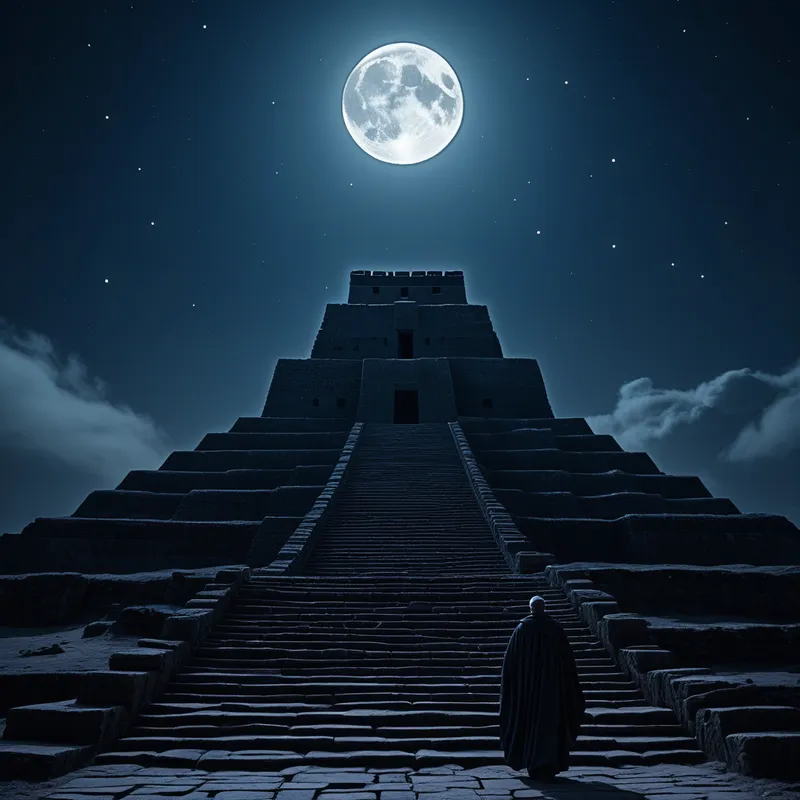
The worship of Sin, also known as Nanna, stretches back to the earliest strata of Mesopotamian civilization, rooted in the Sumerian city-states of the third millennium BCE. His primary cult centers were the great cities of Ur in the south and Harran in the north. These were not merely temples but the axis mundi where heaven met earth, where the god’s cyclical journey was mirrored in elaborate rituals performed by a powerful priesthood.
The myth of Sin was not a single, codified narrative like a Greek epic, but a living theological and cosmological framework expressed through hymns, prayers, omens, and royal inscriptions. It was told by the en priests and entu priestesses—the god’s human consorts—in sacred ceremonies tied to the lunar phases. Its societal function was profound and practical. Sin was the divine regulator of time, the basis of the calendar that governed agriculture, religious festivals, and legal contracts. To understand Sin was to understand the fundamental order of existence, to align human activity with the immutable rhythm of the cosmos. His myth provided a symbolic container for humanity’s relationship with time, change, and the mysterious, fateful night.
Symbolic Architecture
At its core, the myth of Sin is an archetypal drama of consciousness itself. The moon god is not the source of light, but its reflector. He does not generate; he illuminates with borrowed, softened light. This makes him the supreme symbol of the reflective mind, the unconscious as it receives and manifests the brilliant, often overwhelming, energies of the solar consciousness (Shamash).
The moon does not speak with its own voice, but reveals the hidden conversations of the night.
His cyclical nature—waxing, full, waning, dark—maps perfectly onto the rhythms of life: growth, fruition, decay, and the latent potential of the seed in the dark earth. He is the god of process, not product. The dark moon represents the necessary descent into the unconscious, a period of germination and unseen transformation that precedes any new beginning. The terrifying eclipse symbolizes the catastrophic intrusion of unconscious contents into the ordered realm of the ego, a divine "madness" that disrupts all predictable order.
Furthermore, Sin as the "father" of Shamash and Ishtar positions him as the primordial psychic matrix from which more differentiated conscious functions (solar judgment, venusian desire) emerge. He is the deep, timeless background of the psyche, the repository of ancestral memory and instinctual patterns that govern fate, often perceived as external "omens."
The Dreamer's Resonance
When the archetype of Sin stirs in the modern dreamer, it often manifests as an encounter with the deep, rhythmic, and fateful layers of the psyche. This is not the drama of the heroic ego, but the slow, tidal work of the soul.
Dreaming of a particularly brilliant or haunting moon, observing its phases in rapid succession, or finding oneself navigating a landscape by its silvery moonlight points to a process of coming into relationship with the unconscious. The dream ego is learning to see by a different light. A dream of an eclipse—the moon being swallowed—can feel profoundly somatic: a sense of being overwhelmed, of a known psychological function (clarity, mood, intuition) being suddenly extinguished by a shadow from within or without. It signifies a crisis of meaning, where old cycles are violently interrupted.
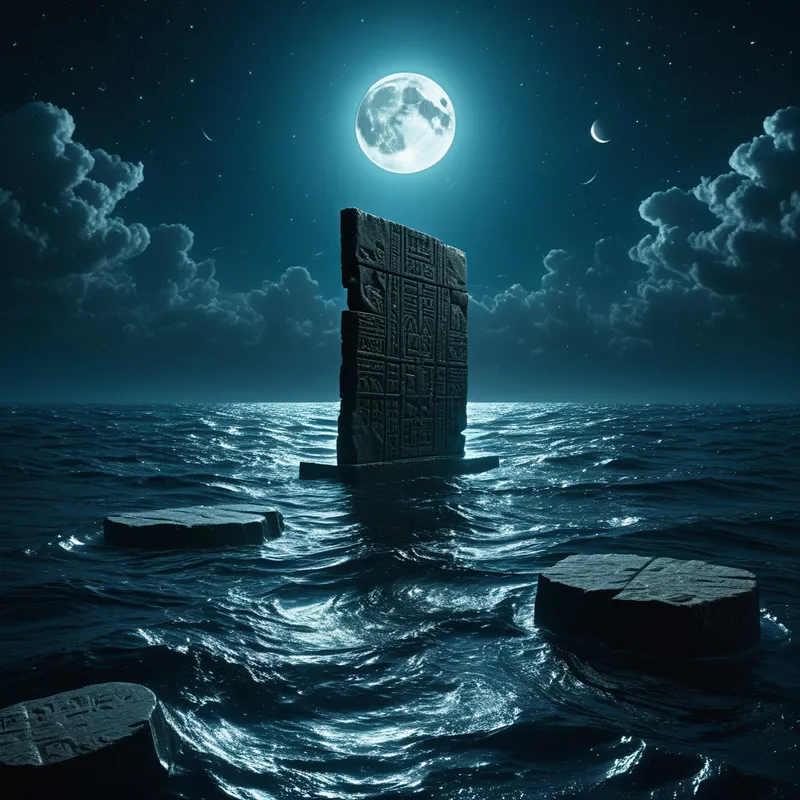
Recurring dreams set by a moonlit river or ocean suggest the dreamer is grappling with the fluid, emotional, and time-bound nature of their life process. To dream of ancient stone tablets or a temple under moonlight is to be shown the archaic, foundational structures of one’s personality, the "old laws" written in the soul that now demand recognition. These dreams call for receptivity, observation, and respect for timing, urging the dreamer to surrender to a process larger than conscious will.
Alchemical Translation
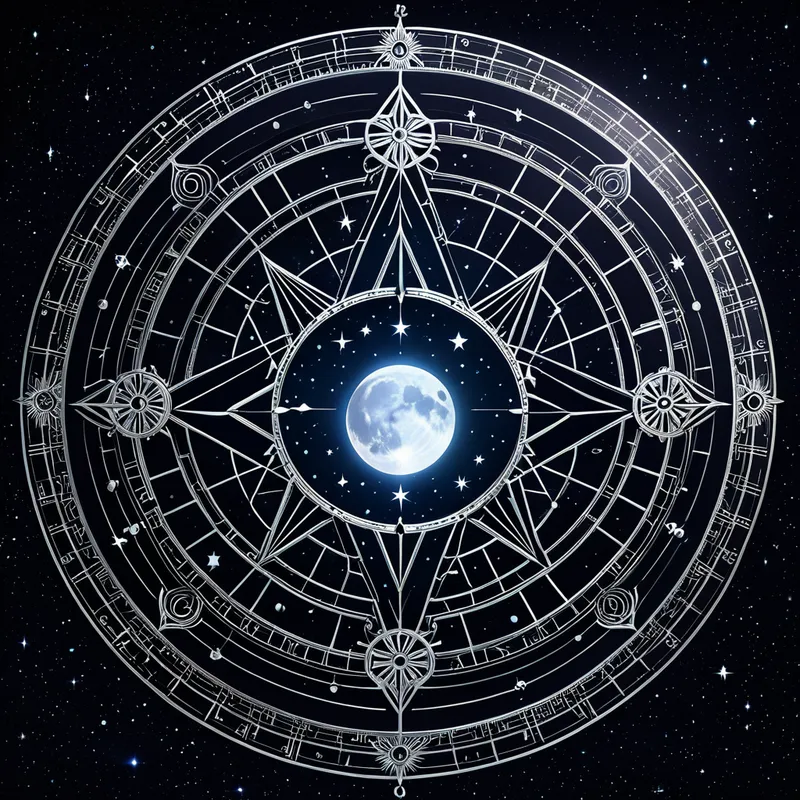
The individuation process, the alchemical journey toward psychic wholeness, is profoundly modeled in the lunar cycle of Sin. The goal is not to become perpetually "full" or solar, but to integrate the entire cycle—to own one's darkness, one's potential, one's fruition, and one's decay as parts of a sacred whole.
The first operation is observation (the crescent moon). One must learn to see by the moon's light, to attend to the subtle, reflective, and often symbolic communications of the unconscious—dreams, moods, intuitions, synchronicities. This is the stage of recording the omens.
Next comes the illumination (the full moon). Here, contents of the unconscious are fully brought into the light of consciousness. This can be a moment of profound insight or revelation, where a pattern of fate or a deep complex becomes clear. It is a peak of understanding, but one that is inherently temporary.
Then follows the crucial, often avoided, stage of dissolution (the waning moon). This is the alchemical mortificatio or nigredo. Conscious insights and identifications must be released, allowed to break down and return to the psychic soil. This is a time of grief, release, and surrender, symbolized by the god turning his face away.
The silver must be dissolved in the aqua permanens of the night before it can be reconstituted.
Finally, there is the concealment and germination (the dark moon). In this fertile void, in the Kur of the psyche, the prima materia is worked upon in total darkness. New life is seeded. From this essential night, the new crescent—the lapis, the nascent Self—is inevitably reborn. The modern individual undergoing this translation learns to trust the process itself, to find order not in rigid control, but in the faithful observance of their own inner rhythms, becoming, like Sin, both the Measurer and the Measured.
Associated Symbols
Explore related symbols from the CaleaDream lexicon:
- Moon — The primary symbol of Sin, representing cyclical time, reflective consciousness, the rhythms of nature, and the illuminated unconscious.
- Moon Phase — The core dynamic of the myth, symbolizing the inevitable processes of growth, fruition, decay, and rebirth in the psyche and in life.
- Eclipsed Moon — Symbolizes a catastrophic interruption of natural order, the overwhelming of consciousness by shadow contents, and a divine crisis demanding propitiation.
- Temple — Represents the ziggurat of Ur or Harran, the sacred space where humanity seeks to commune with the cosmic order and divine fate revealed by the moon.
- Fate — The domain of Sin, as the omens of destiny were read in his visage; symbolizes the deep, archetypal patterns that govern individual and collective life.
- Time — The essential gift and domain of Sin, the god who measured months and seasons, symbolizing the structured container of existence and personal development.
- Ocean — Connects to the primordial waters of Apsu and Tiamat, and the tides controlled by the moon, representing the deep, chaotic, and fluid unconscious.
- Stone — Evokes the ancient clay tablets inscribed with hymns to Sin and the enduring, archaic foundations of the psyche and civilization he oversees.
- Dream — The natural domain of moonlight, representing the messages from the unconscious that are revealed in the "night" of the soul, guided by the lunar principle.
- Order — The Mes upheld by Sin’s regular cycle, symbolizing the psychic need for rhythm, structure, and harmony with natural law.
- Shadow — Represented by the dark moon and the eclipse, the hidden, unseen, and potentially threatening aspects of the self that the moon’s light can eventually reveal.
- Silver — The metal of the moon, symbolizing the reflective, receptive, and intuitive quality of consciousness, as opposed to the generative gold of the sun.