Sigurd Myth Meaning & Symbolism
A hero slays a dragon, gains cursed wisdom, and is undone by a broken oath and love's betrayal—a saga of fate and the shadow of glory.
The Tale of Sigurd
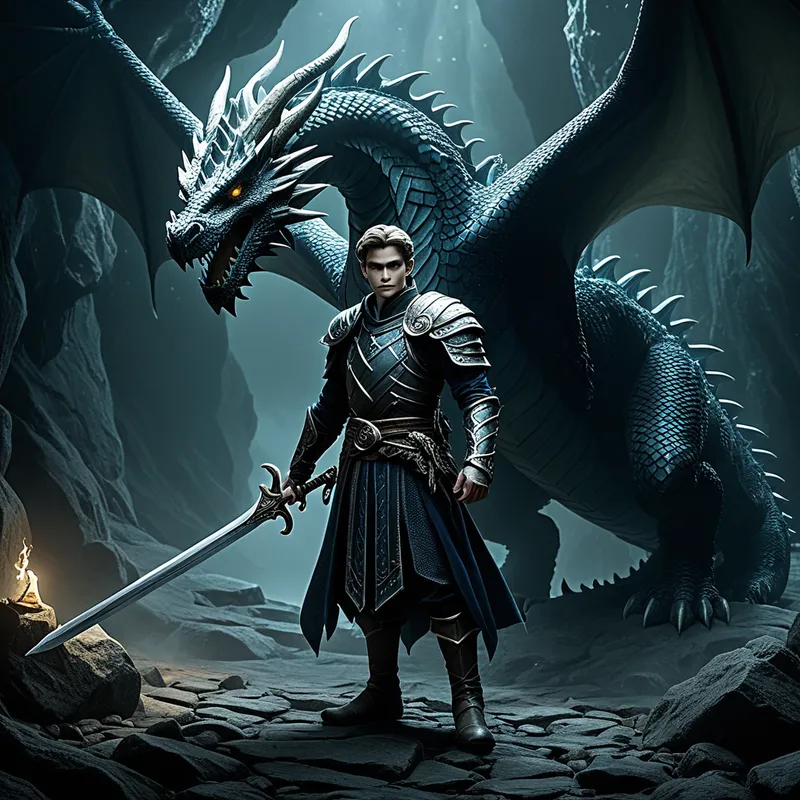
Hear now a tale of shining doom, of a hero born under a star of vengeance. In the halls of the Volsungs, a son was born, Sigurd, his fate woven by the Norns with threads of gold and blood. His father slain, he was forged in exile, tempered by the smith Regin, who whispered of a glittering wrong.
Regin’s brother, Fafnir, had become a worm, a serpent coiled upon a hoard of red gold, his heart poisoned by greed. In a hidden forge, Sigurd took the shattered shards of his father’s blade. The fire roared, the hammer sang, and from the fragments rose Gram, a fang of light, sharp enough to cleave an anvil. “Slay the dragon,” Regin hissed, “and the treasure is yours.”
Through mist-shrouded heaths, Sigurd tracked the beast to its lair, Gnitaheid. The air grew thick with the stench of rot and metal. There, in a river’s path, Sigurd dug a pit. He felt the earth tremble, heard the slow, grinding drag of scale on stone. As the monstrous shadow passed overhead, he thrust Gram upward into the soft underbelly. A scream tore the sky, a flood of black blood, and the great worm lay still.
Regin demanded the dragon’s heart roasted. As Sigurd turned the meat, a drop of blood seared his thumb. He brought it to his lips—and the world shifted. Suddenly, he understood the speech of the birds chattering in the trees above. “Foolish hero!” they sang. “The smith plots your death for the gold! Eat the heart yourself and be wise!” Sigurd saw the truth glinting in Regin’s eye. With a heavy heart, he slew his foster-father.
The treasure was his: a mountain of gold, the Helm of Awe, and a ring, Andvaranaut, around which the entire curse coiled. But the greatest prize was wisdom, a gift that tasted of ashes. His path led him to a fortress of fire, where the valkyrie Brynhild slept in a ring of flames, punished by Odin. He rode through the wall of flame, woke the warrior-maid, and they swore oaths of eternal love, sealed with the cursed ring.
Yet fate is a tangled skein. Journeying onward, Sigurd came to the hall of the Gjukungs. There, Grimhild, a queen skilled in dark arts, gave him a draught of forgetfulness. The memory of Brynhild faded like a dream. He wed the fair Gudrun, and in friendship, promised to win Brynhild for his blood-brother, Gunnar.
Disguised by magic as Gunnar, Sigurd once more rode through the flames. Brynhild, believing him another, accepted the stranger. But when she later saw the ring Andvaranaut on Gudrun’s hand, the terrible truth was unveiled. Her love was a lie, her oath broken. Consumed by a wrath that could only be cooled by death, she whispered lies of betrayal to her husband Gunnar. Honour bound, yet treacherous, the brothers struck. As Sigurd rested by a stream, the spear found his back. Dying, he hurled Gram at his murderer, cleaving him in two. The last thing he saw was Brynhild’s face, a mask of triumphant despair, before the light fled his eyes. She would join him on the pyre, the cursed gold placed between them, a final, fiery offering to their ruined fate.
Cultural Origins & Context
The legend of Sigurd is not a single, fixed story but a powerful current flowing through the oral traditions of the Germanic peoples, from the continental Nibelungenlied to the Scandinavian texts that preserved it. Our primary sources are the Icelandic Poetic Edda and the later Prose Edda and Volsunga Saga. These were written down in the 13th century, centuries after the Viking Age, by Christian scholars preserving a pagan past.
This was a story told in longhouses, its rhythms shaped by the crackle of the fire and the rhythm of the verse. It functioned as more than entertainment; it was a repository of cultural values. It explored the tension between individual glory (drengskapr) and the binding web of kinship and oath. It asked: What is the cost of a hero’s deed? Can one escape a fate decreed? The saga served as a grim mirror, reflecting a world where the highest virtues—courage, loyalty, wisdom—could, through the cruel mechanics of fate and human failing, lead directly to annihilation. The cursed gold is the ultimate MacGuffin, representing not just wealth, but the corrosive nature of power and the inescapable debts of the past.
Symbolic Architecture
At its heart, Sigurd’s myth is a profound map of the heroic ego’s journey into, and ultimate defeat by, the unconscious. Sigurd begins as the pure, orphaned Self, untainted but untested. The dragon Fafnir is not merely a monster to be slain; it is the ultimate symbol of the hoarded, reptilian psyche—the shadow in its most potent, consolidated form. It is greed incarnate, but also latent power. To slay it is the archetypal act of ego differentiation, conquering the primal, possessive instincts.
The dragon is not just a guardian of gold, but the guardian of a state of being. To slay it is to be initiated into its knowledge, to take its poison into your own blood.
The tasting of the dragon’s blood is the critical turning point. This is the moment of gnosis, a traumatic awakening to the language of the unconscious (the birds). The hero gains transcendent wisdom but is severed from naive trust. He sees the shadow in his mentor, Regin (the manipulative intellect), and must slay that, too. Now wise but isolated, he carries the treasure—the integrated power of the unconscious—which is simultaneously a curse. The ring Andvaranaut represents the binding nature of this integration; once you grasp the power of the Self, you are bound to its fateful consequences.
Brynhild is the anima, the soul-image of the hero. She is the warrior-maid, the embodiment of his highest spiritual aspiration and passionate destiny. To win her, he must pass through the ring of fire—a ritual of purification and commitment. The potion of forgetfulness represents the ego’s tragic capacity for self-betrayal, abandoning its deepest truth for social convenience (the Gjukungs). The final betrayal and murder are not just a plot twist, but the inevitable collapse of a personality structure built on a repressed foundation. The hero is killed by the very kinship bonds (the blood-brothers) he sought to uphold after forsaking his soul.

The Dreamer’s Resonance
When this myth stirs in the modern psyche, it rarely appears as Vikings and dragons. Instead, one may dream of discovering a vast, hidden cache—a forgotten bank account, a secret room filled with priceless art. This is the Fafnir’s hoard: the dreamer’s own untapped potential or repressed power, often feared as monstrous. The initial thrill gives way to a sense of unease, a whispering knowledge that this treasure changes everything and comes with a terrible responsibility.
Dreams of accidental understanding are key—overhearing a conversation that reveals a devastating truth (the birds’ speech), or suddenly comprehending a complex system intuitively. This is the somatic shock of the blood on the lip, the nervous system jolted into a new frequency of awareness. The betrayal by a trusted figure (a boss, a partner, a family member) who wants a piece of this newfound “gold” is a classic Regin-motif.
Most poignantly, dreams of a lost, fiery love or a forgotten oath speak to the Brynhild complex: the soul-calling we abandoned for a safer, more conventional path. The dreamer may find themselves at a literal crossroads, one path flaming, the other safe and familiar, feeling a profound, grief-stricken pull toward the fire. These dreams signal a critical juncture where the psyche demands acknowledgment of a repressed destiny, warning that to continue in forgetfulness is to invite a psychic “murder” from within.

Alchemical Translation
The alchemical journey mirrored in Sigurd’s saga is not of perfect triumph, but of the opus that ends in mortificatio—the necessary death of a current conscious attitude. The hero’s journey is the process of Individuation, and here it follows a brutally honest trajectory.
The Nigredo (Blackening): This is Sigurd’s origin—the slain father, the exile. It is the primal wound, the massa confusa of the psyche from which the work must begin. The reforging of Gram is the first coagulation: the will (the sword) is reconstructed from broken inheritance.
The Albedo (Whitening): The slaying of Fafnir is a brutal but necessary purification. The dragon, the prima materia of the shadow, is dissolved. Gaining the treasure and the wisdom is the acquisition of the lapis, the philosopher’s stone of self-knowledge. The hero is whitened, enlightened.
The Citrinitas (Yellowing) & Rubedo (Reddening): This is where the myth offers its deepest, most tragic lesson. The union with the anima (Brynhild) should be the culminating coniunctio, the sacred marriage of conscious and unconscious (reddening). But the potion of forgetfulness represents a fatal flaw: the conscious mind’s refusal to bear the full weight of its achieved integration. It opts for a conventional, collective life (the Gjukungs).
The curse of the gold is the curse of half-integration. To take the power of the dragon without accepting its fate—the full responsibility of the awakened Self—is to guarantee a catastrophic return of the repressed.
The final murder is the mortificatio. The half-realized, compromised ego-structure must die. It is killed by the very aspects of the psyche (the “brothers” of other complexes, loyalties, and personas) it tried to appease. This death, however, is not an end. In the alchemy of the soul, such a death is often the prerequisite for a more authentic rebirth. The pyre that consumes Sigurd and Brynhild together is a terrible, purifying fire. It burns away the deception, leaving only the truth of their original oath. For the modern individual, this translates to the collapse of a life built on a false premise—a career, a relationship, an identity—that does not align with the soul’s true calling. It is a devastating but ultimately purposeful crisis, forcing the psyche back to the drawing board of the Self, where the next cycle of the work can begin, perhaps with a little less forgetfulness.
Associated Symbols
Explore related symbols from the CaleaDream lexicon: