Sif's Golden Hair Myth Meaning & Symbolism
The god Loki cuts Sif's divine hair. To avert war, he must replace it, forging golden strands that grow like living grain from the earth's deepest forges.
The Tale of Sif’s Golden Hair
Listen, and hear a tale from the high halls of Asgard. It begins not with thunder, but with silence—the quiet, cruel mischief that lives in shadowed corners.
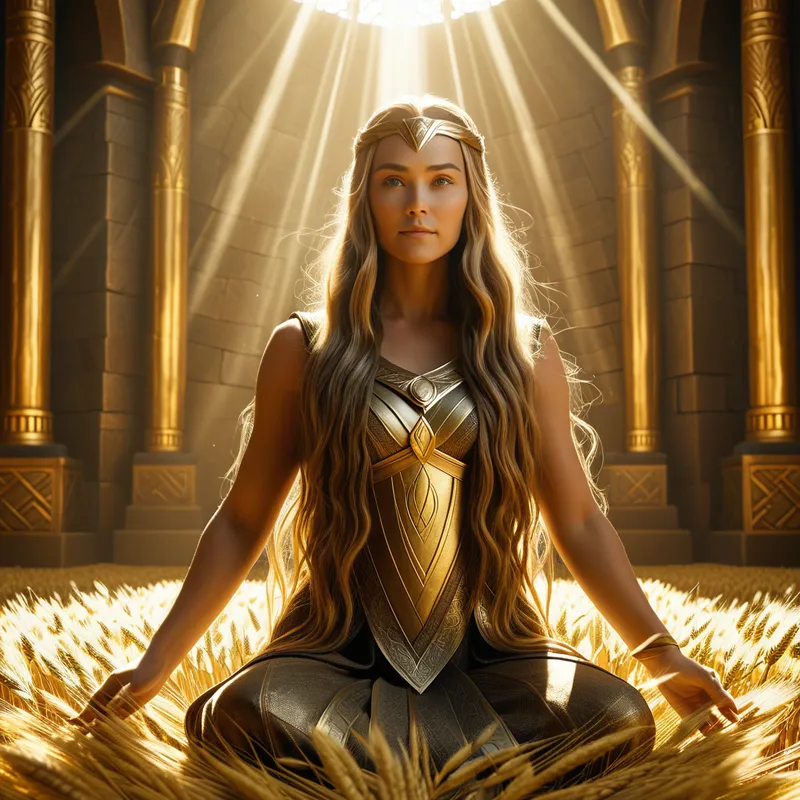
Sif, wife of the thunder-god Thor, was renowned for one surpassing glory: her hair. It was not mere hair, but a living field of sunlight, a cascade of ripened grain, flowing to her feet like a promise of endless harvest. It was her sovereignty, her divine essence made visible. While Thor rode to chase giants, Sif’s presence in the hall was a calm, golden light, a symbol of the earth’s fruitful abundance.
Into this radiance crept Loki, shape-shifter, weaver of schemes. Was it envy? Boredom? The simple, malicious delight in marring perfection? None can say for certain what moved in his heart of frost and fire. One night, as all of Asgard slept under the watch of the stars, he took shears of darkest iron. He stole to Sif’s bower and, with a thief’s swift hands, he did the unthinkable. He sheared it all away. The glorious mane fell in silent, lifeless heaps upon the stone floor, leaving Sif shorn, violated, her divine power shorn with it.
The dawn brought a cry that shook the very foundations of Valhalla. Thor awoke to his wife’s devastation, and his rage was a storm given form. He seized Loki, his grip like mountain roots, and promised to break every bone in the trickster’s body. Loki, in true form, squirmed and bargained. He swore an oath—not just to replace the hair, but to craft something greater, something beyond the work of gods themselves. He would journey to the Svartálfheim and commission a gift that would not only restore Sif, but surpass her former glory.
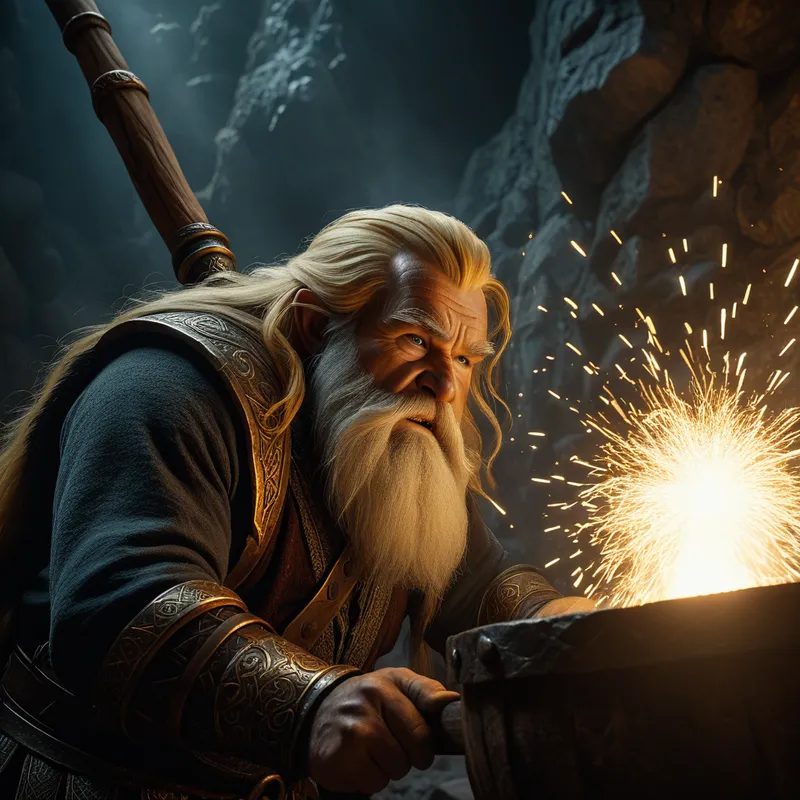
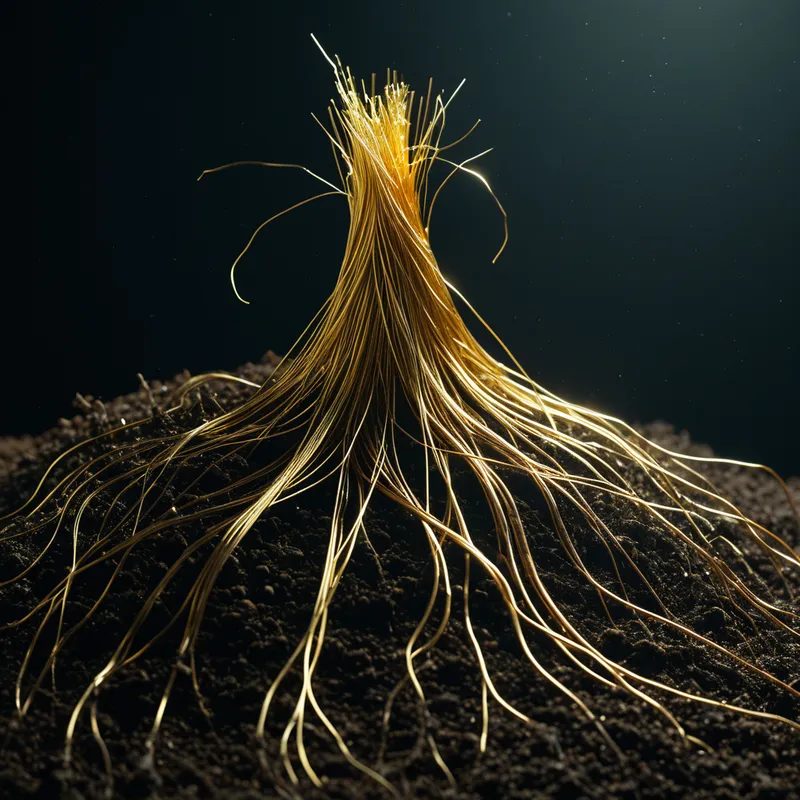
Thus, the chastened trickster descended into the world’s deep, dark roots. He sought out the sons of Ivaldi, master smiths who worked in the veins of the earth. To them, he presented his desperate plea and his cunning challenge. And they took up the task. In their forges, lit by the earth’s own heart-fire, they worked metals no god had touched. They did not weave hair; they grew it. From precious gold, they spun strands so fine, so imbued with magic, that they would fuse to Sif’s scalp and grow as if they were her own—living, breathing gold.
But Loki’s cunning was not spent. Seeing the sons of Ivaldi create other wonders—a ship that could fold into a pocket, a spear that never missed its mark—he wagered his own head with another dwarf, the fierce Brokkr, that his brother Eitri could not match such craft. As Eitri worked the bellows and the forge roared, Brokkr stood guard, swatting a gadfly—Loki in disguise—that bit him fiercely to spoil the work. Despite the torment, from that cosmic furnace emerged a living golden boar, a mighty ring that dripped gold, and most terrible of all, Thor’s hammer, Mjölnir.
Loki returned to Asgard, his pride a mix of triumph and trepidation. Before the assembled gods, he presented his reparations. To Sif, he offered the golden hair. As it was placed upon her head, it rooted itself, becoming part of her, flowing once more—a symbol not just restored, but transmuted. The gods judged the dwarves’ works, and though Loki tried to cheat his wager, he was bound by his own words. Sif stood whole again, her golden hair a testament not to an unchanging perfection, but to a hard-won, forged renewal. The violation was sealed not by vengeance, but by a creation born from the deepest dark.
Cultural Origins & Context
This myth survives primarily in the Prose Edda of Snorri Sturluson, written in the 13th century, a time when the Old Norse religion was fading under the light of Christianity. Snorri was a Christian scholar attempting to preserve the poetic traditions of his ancestors. His work is thus a complex lens: part compilation, part systematization of older, fragmented oral traditions that would have been told for centuries around hearth-fires in Iceland and Scandinavia.
The societal function of such a tale was multifaceted. On one level, it is an etiological myth, explaining the beauty of golden wheat fields as the literal hair of a goddess. It reinforced the sacred connection between divinity, sovereignty, and the fertility of the land. Sif’s hair is the grain; its loss is a blight, its restoration the promise of harvest. On another level, it served as a divine comedy and a moral lesson on the consequences of transgression, even for a god. Loki’s act is a violation of sacred order (ørlög), and the entire narrative arc is about restoring that balance through a perilous, creative process, not simple punishment. It was a story that acknowledged chaos and violation as part of the cosmic order, but affirmed that the response—driven by oath, craft, and deep-earth magic—could lead to an even greater state of wholeness.
Symbolic Architecture
At its core, this is a myth about the violation of the feminine sovranty—the autonomous, life-giving power symbolized by Sif’s hair. It is not merely beauty that is stolen, but a vital aspect of identity and generative power.
The theft of the golden hair is the primal wound to the authentic Self, the moment when an essential part of our nature is taken, mocked, or sheared away by life’s inevitable betrayals—be they external acts or the inner trickster’s sabotage.
Loki represents the shadow and the trickster archetype: the chaotic, envious, and destructive impulse within the psyche that attacks our most valued attributes. His journey to the dwarves signifies the necessary descent into the unconscious (Svartálfheim) to rectify the damage he himself caused. The dwarves are masters of psychic alchemy; they work in the dark, transforming base matter (gold) into a living, growing symbol. The hair they create is not a mere replica; it is an evolution. It is magic, it grows, it is more deeply integrated than the original. This symbolizes that healing from a profound violation does not mean returning to a naive, pre-wounded state. It means forging a new strength, a more conscious and resilient identity, born from the depths of the ordeal itself.
The Dreamer’s Resonance
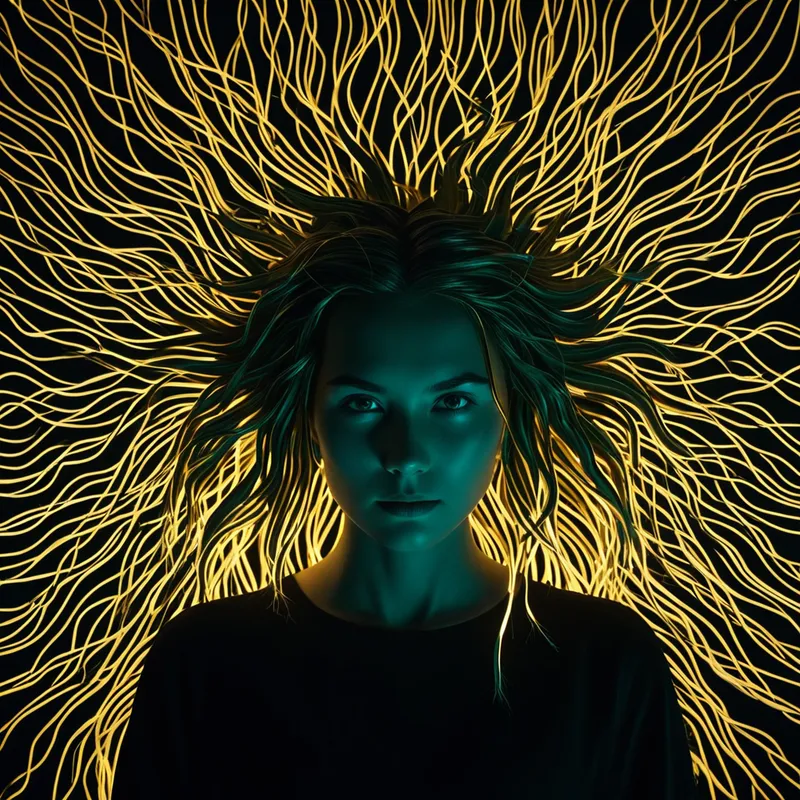
When this myth pattern stirs in the modern dreamer, it often manifests as dreams of sudden, shocking haircuts, of hair falling out in clumps, or of discovering one’s head shorn. Somatic sensations may accompany this—a feeling of vulnerability around the scalp, a chilling breeze where there should be warmth. Psychologically, this signals a process of violation and identity theft. The dreamer is experiencing, or has experienced, a situation where a core part of their self-expression, their fertility (of ideas, projects, relationships), or their public persona has been brutally compromised.
The dream is not merely reporting the injury; it is initiating the alchemical process. The feeling of exposure and shame is the Sif-stage. The subsequent dream imagery—perhaps of searching in deep, underground places, of encountering skilled but grim artisans, or of finding strands of metallic or glowing hair—marks the beginning of the Loki-quest. The psyche is mobilizing its own cunning and resourcefulness, descending into the personal unconscious (the dwarf-forge) to begin the laborious work of re-creation. The dreamer is in the liminal space between the wound and the forged solution.
Alchemical Translation
The myth of Sif’s hair is a perfect map for the Jungian process of individuation, specifically the transmutation of a narcissistic injury into a symbolic achievement. The process follows the alchemical stages: Nigredo, Albedo, Citrinitas, Rubedo.
The shearing is the Nigredo—the blackening, the mortification. A cherished ideal of the self (the beautiful, innocent hair) is destroyed, plunging the ego into despair and rage (Thor’s wrath). Loki’s oath and journey represent the beginning of the Albedo—the whitening. The conscious mind (the ego, chastened) must enlist the trickster (the unconscious, amoral drive) to engage with the deepest, most creative but shadowy parts of the psyche (the dwarves). This is active engagement with the complex, not passive suffering.
The forge of Svartálfheim is the crucible of the unconscious, where the raw material of pain and humiliation is subjected to the intense heat of attention and the hammer-blows of introspection.
The creation of the new, living gold hair is the Citrinitas—the yellowing, the dawn of a new consciousness. The restored attribute is no longer a naive possession; it is a conscious achievement, imbued with the magic of self-knowledge. It grows, meaning it is now a dynamic, integrated part of the personality, not a static ornament. Finally, the presentation to the assembled gods and Sif’s restoration is the Rubedo—the reddening, the attainment of a new, more complete level of being. The Self is whole again, but on a higher level. The hammer Mjölnir, created in the same process, signifies that from this deeply personal work of restoration emerges a newfound capacity for focused power and protection in the outer world. The individual is not just healed; they are forged.
Associated Symbols
Explore related symbols from the CaleaDream lexicon: