
Shika Myth Meaning & Symbolism
A tale of a sacred deer, a divine messenger, whose wounding and healing reveals the delicate covenant between the human and spirit worlds.
The Tale of Shika
Listen, and let the mists of Jindai part. In a time when the air itself was a prayer and every stone held a kami, there existed a forest so deep its heart was woven from twilight and silence. This was the domain of Shika. He was no ordinary beast. His coat held the sheen of a rain-wet stone, his eyes were pools of ancient, knowing calm, and his antlers rose like the bare, sacred branches of the world tree itself. He moved as a ripple of intention through the undergrowth, a silent guardian of the threshold where the mountain’s raw spirit met the realm of humans in the valley below.
To the villagers, Shika was a fleeting blessing, a sign of the mountain’s favor. They left offerings of salt and rice at the forest’s edge, and in return, the seasons turned with gentle precision. But in one village lived a young hunter named Takeo, whose eyes saw only meat and trophy, whose heart was loud with ambition and deaf to the forest’s whispered covenant. He scorned the old ways, boasting that he would bring the sacred deer down and prove man’s dominion.
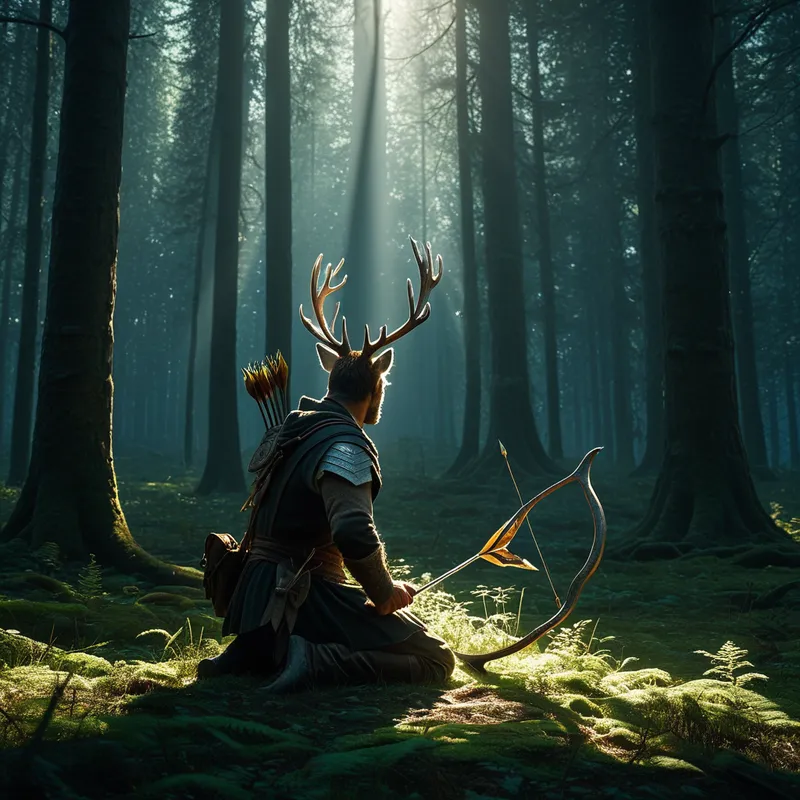
One autumn morning, when the maple leaves bled crimson onto the forest floor, Takeo ventured deep into the forbidden precincts. The air grew cold and still. Then, he saw him. Shika stood in a shaft of fractured sunlight, a vision of serene power. In that moment, Takeo felt not awe, but the sharp, hot spike of conquest. He drew his bow. The release of the string was a sound that shattered the world’s peace. The arrow found its mark, biting into the deer’s flank.
But no blood flowed like mortal blood. Instead, a light, gold and sorrowful, seeped from the wound. The light did not fall to the ground; it pooled in the air, humming with a profound, wounded vibration. Shika did not flee. He turned his great head and looked at Takeo. In that gaze was not anger, but an infinite, devastating sadness—the sadness of a broken promise older than humanity itself.
The forest groaned. The light from Shika’s wound spread, leaching the color from the leaves, silencing the birds. A chill wind, born of nowhere, swept through the trees. Takeo fell to his knees, his ambition extinguished, replaced by a terror that was also a kind of awakening. He understood, in his marrow, what he had done. He had not merely wounded an animal; he had severed a thread in the web of the world.
Driven by a remorse that was his first true prayer, Takeo tore strips from his own tunic. With hands that shook, he approached the luminous creature. Shika stood, allowing it. Takeo bound the wound, his touch clumsy but earnest. As he worked, he whispered apologies not just to the deer, but to the mountain, to the trees, to the very air. The golden light began to dim, drawn back into the deer’s form. Where the arrow had struck, a scar formed, not of flesh, but of what looked like woven moss and amber.
With a final, deep look, Shika turned and melted into the forest shadows. The unnatural chill lifted. Color returned, tentative and new. Takeo walked back to his village a different man, carrying not a trophy, but the weight of a sacred debt. From that day, he became the forest’s most devoted keeper, and it was said that on certain misty mornings, one might see Shika at the tree line, his amber scar glowing softly, a silent witness to the covenant that was broken, and painfully, lovingly remade.
Cultural Origins & Context
The figure of the sacred deer, or shika, is not confined to a single, standardized myth but is a pervasive archetype woven into the fabric of Japanese spiritual thought, primarily within Shinto. Its most famous living embodiments are the protected herds of Nara, considered messengers of the Kasuga kami. This mythic pattern—of the deer as a divine intermediary—stems from animistic foundations where animals were seen as vessels or visible forms of kami.
The tale, in its various oral forms, served a crucial societal function: it was a narrative enforcement of ecological and spiritual ethics. It taught kegare (ritual pollution) and kiyome (purification) through story. To harm a sacred being was to invite imbalance, a “pollution” that manifested as blight or unnatural events. The story was likely told by village elders and kannushi not as mere folklore, but as a living law, reinforcing the concept of a reciprocal relationship with the natural world. The deer symbolized the tangible presence of the mountain or forest kami; respecting it was synonymous with respecting the invisible order that granted life, harvest, and harmony.
Symbolic Architecture
At its core, the myth of Shika is a profound map of consciousness and relationship. The deer is the symbol of the numinous itself—the divine as it manifests in the natural world, beautiful, serene, and utterly other. It represents the soul of nature, or what the psychologist James Hillman might call the anima mundi (the world soul), made momentarily visible.
The sacred wound is not a punishment, but a revelation. It makes the invisible covenant visible, showing the cost of disconnection in the currency of light.
Takeo, the hunter, embodies the nascent human ego—consciousness separating from the unconscious, natural matrix. His initial act is one of heroic inflation, the ego seeking to conquer and define itself against the mystery. The bow and arrow symbolize directed, linear, penetrating consciousness, which, when used without reverence, becomes a weapon of alienation. The golden light that flows instead of blood signifies that what has been wounded is not biological life, but psychic life, the vital energy of the relationship itself.
The binding of the wound is the critical act of symbolic repair. It is not a magical undoing, but an acknowledgment and an integration. The scar of moss and amber is the new form of the relationship—a conscious, earned sacredness that replaces an unconscious, taken-for-granted one. It is the individuated connection, scarred but resilient.
The Dreamer’s Resonance
When this mythic pattern stirs in the modern dreamer, it often signals a profound encounter with what Jung termed the anima (in men) or the animus (in women) in its most spiritual, guiding form—or with the Self, the central archetype of wholeness. To dream of a majestic, wounded deer is to dream of a wounded aspect of one’s own deepest, most authentic nature or connection to the instinctual world.
Somatically, the dreamer may feel a sense of profound guilt or sorrow upon waking, not tied to a specific event, but a diffuse, existential remorse—a “soul ache.” Psychologically, they are likely at a point where a long-held, perhaps unconscious, way of relating to their own inner life or creativity (the “sacred forest”) has been violated by the demands of the ego, ambition, or societal pressures (the “hunter”). The dream presents the consequence: a luminous, vital energy is leaking away. The dream calls not for a frantic search for a cure, but for the slow, humble work of “binding the wound”—through ritual, creative expression, therapy, or a conscious return to nature. It is a dream of sacred accountability.

Alchemical Translation
The myth of Shika is a perfect allegory for the alchemical process of individuation. The initial state is the unio naturalis, the unconscious unity with the inner and outer world (the village in harmony). The nigredo, or blackening, is initiated by Takeo’s arrogant act—the conscious ego’s violent separation, leading to depression, alienation, and the “dark night of the soul” (the chilling, light-draining forest).
The goal is not to return to the unconscious garden, but to cultivate a conscious sacred grove, where the guardian bears the scars of your awakening.
The wounding and the flow of golden light represent the albedo, the whitening. Here, the true nature of the psychic substance is revealed. The raw lead of the ego’s ambition is exposed and begins its purification through the searing light of insight and remorse. The binding of the wound is the crucial work of coniunctio, the conscious re-marriage of the ego and the Self. It is an active, humble engagement with the wounded sacred, not to dominate it, but to serve it.
The resulting scar of moss and amber is the rubedo, the reddening, the final stone. It is the new, durable form of the personality. The individual no longer merely lives in nature or uses it; they have a conscious, symbolic, and responsible relationship with the inner source of life. They become, like Takeo transformed, the keeper of the threshold. The scar is the mark of individuation—a testament not to perfection, but to a wholeness that has consciously integrated its own capacity for violation and its profound capacity for healing. The divine messenger is no longer an external force to be feared or worshiped from afar, but an acknowledged resident of one’s own inner landscape.
Associated Symbols
Explore related symbols from the CaleaDream lexicon: