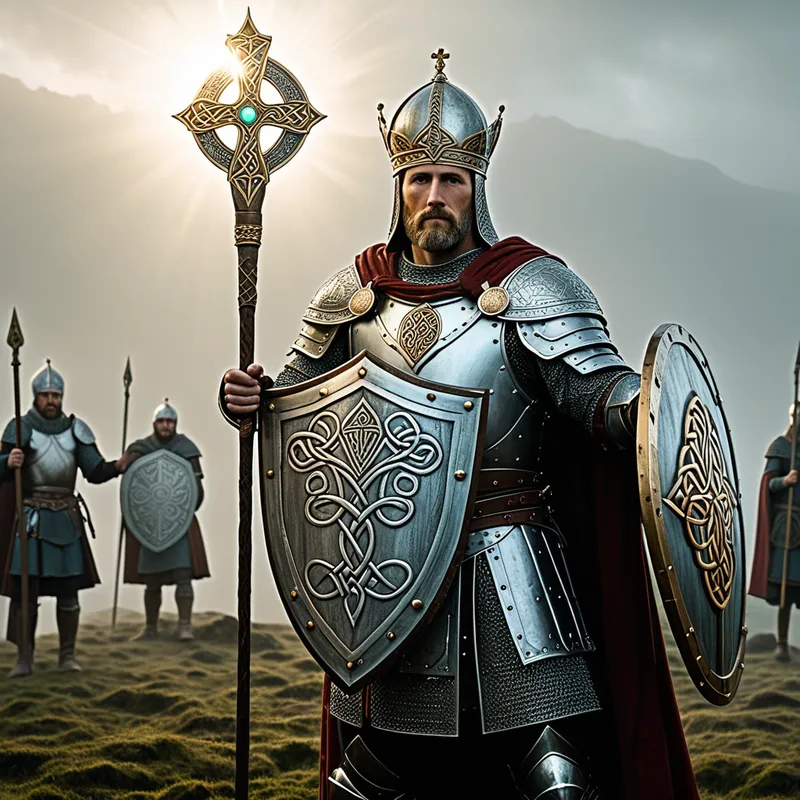
Shield of Pridwen Myth Meaning & Symbolism
The legendary shield of King Arthur, bearing the image of the Virgin Mary, representing divine protection, the king's sacred duty, and the luminous fortress of the psyche.
The Tale of the Shield of Pridwen
Hear now, and listen well, for [the wind](/myths/the-wind “Myth from Various culture.”/) carries a tale from the mists of Logres. It speaks not first of a sword, though Caliburn is mighty, but of a shield. In the high hall of Camelot, where torchlight dances on banners and the scent of mead hangs thick, there is a stillness around the king’s seat. And beside it, leaning against the carven wood, rests [Pridwen](/myths/pridwen “Myth from Arthurian culture.”/).
It was not forged in the fire of man’s ambition, but in the quiet forge of divine grace. The smiths say the metal was cooled in waters blessed by ancient prayers, its surface polished until it shone like a winter moon on a frozen lake. But its true power was painted, not pounded. Upon its broad, white face was rendered the image of the Holy Mother, her visage one of infinite compassion and unshakable resolve. To look upon it was not to see a tool of war, but a window into a celestial mercy that watches over the battlefield.
Arthur bore it not as a burden, but as a covenant. When he rode to his first crowning at the [Stone of Destiny](/myths/stone-of-destiny “Myth from Celtic culture.”/), Pridwen caught the dawn light, a promise made visible. In the clashing chaos of Badon, where Saxon axes rose like a deadly forest, the shield was not merely a barrier. It became a beacon. Men fighting in the mud and the blood would catch a glimpse of that white disc, the serene face upon it, and their breaking hearts would find a second wind. It was said that arrows turned aside from its face, and despair could not cling to the man who held it.
But every covenant has its price, and every light casts a shadow. The tale turns to the grim, fate-sodden field of Camlann. [The mist](/myths/the-mist “Myth from Celtic culture.”/) that day was not of [the earth](/myths/the-earth “Myth from Hindu culture.”/), but of betrayal and broken oaths. The glorious fellowship was shattered, brother against brother. And there, in the heart of the slaughter, Arthur stood with [Mordred](/myths/mordred “Myth from Arthurian culture.”/) before him. Pridwen, which had turned aside a thousand blows, now bore the scars of a kingdom’s fall. It did not break, for its magic was of a different order. But as the king fell, the shield’s luminous white was stained with [the earth](/myths/the-earth “Myth from Hindu culture.”/) and the life of the Rex Quondam Rexque Futurus. It did not shatter; it absorbed the tragedy, holding the story of a [golden age](/myths/golden-age “Myth from Universal culture.”/) within its silent, marred surface. And when the barge came to carry the wounded king to Avalon, the shield went with him, a final, fading glimmer of a world under protection, now passing into the realm of memory and dream.
Cultural Origins & Context
The Shield of Pridwen finds its earliest detailed description in the seminal 12th-century work Historia Regum Britanniae (History of the Kings of Britain) by Geoffrey of Monmouth. Geoffrey, blending Celtic folklore, pseudo-history, and his own literary imagination, provided Arthur with a magnificent arsenal. Pridwen was named alongside his sword Caliburn and his spear Rhongomyniad. This was not mere inventory; it was the construction of a symbolic kingly identity for a Norman audience fascinated with British antiquity.
The shield’s journey continues in the later, more mystical Welsh prose tale Culhwch and Olwen, where its name is listed among Arthur’s treasures. Here, it exists in a more primal, mythic landscape. By the time of Sir [Thomas](/myths/thomas “Myth from Christian culture.”/) Malory’s Le Morte d’Arthur in the 15th century, the specific iconography of [the Virgin Mary](/myths/the-virgin-mary “Myth from Christian culture.”/) is firmly attached, reflecting the high medieval period’s deep Marian devotion. The shield thus evolved from a possibly pagan Celtic [talisman](/myths/talisman “Myth from Global culture.”/) of sovereignty into a distinctly Christian emblem of divine kingship. It was passed down not by village bards alone, but by monks, chroniclers, and court poets, its function shifting from a hero’s gear in a warrior culture to a complex symbol of the king’s dual role as martial defender and sacred, almost priestly, vessel for God’s grace on earth.
Symbolic Architecture
At its core, the [Shield](/symbols/shield “Symbol: A symbol of protection, defense, and boundaries, representing personal security, resilience, and the need to guard against external threats or emotional harm.”/) of Pridwen is an [emblem](/symbols/emblem “Symbol: A symbolic design representing identity, authority, or ideals, often used in heraldry, logos, or artistic expression.”/) of the containing [vessel](/symbols/vessel “Symbol: A container or structure that holds, transports, or protects something essential, representing the self, emotions, or life journey.”/). It is not a [weapon](/symbols/weapon “Symbol: A weapon in dreams often symbolizes power, aggression, and the need for protection or defense.”/) of aggression, but an [instrument](/symbols/instrument “Symbol: An instrument symbolizes creativity, communication, and the means by which one expresses oneself or influences the world.”/) of preservation. Its white color speaks of purity, [clarity](/symbols/clarity “Symbol: A state of mental transparency and sharp focus, often representing resolution of confusion or attainment of insight.”/), and the untainted ideal—the [King](/symbols/king “Symbol: A symbol of ultimate authority, leadership, and societal order, often representing the dreamer’s inner power or external control figures.”/) [archetype](/symbols/archetype “Symbol: A universal, primordial pattern or prototype in the collective unconscious that shapes human experience, behavior, and creative expression.”/) in its highest form, ruling not for personal power but for the [harmony](/symbols/harmony “Symbol: A state of balance, agreement, and pleasing combination of elements, often associated with musical consonance and visual or social unity.”/) of the [realm](/symbols/realm “Symbol: The symbol of ‘Realm’ often signifies the boundaries of one’s consciousness, experiences, or emotional states, suggesting aspects of reality that are either explored or ignored.”/), the Self.
The shield does not create the light; it receives it and reflects it back onto a world prone to shadow.
The [image](/symbols/image “Symbol: An image represents perception, memories, and the visual narratives we create in our minds.”/) of the [Virgin Mary](/symbols/virgin-mary “Symbol: A central figure in Christianity representing divine purity, maternal compassion, and miraculous intervention. Often symbolizes spiritual guidance and unconditional love.”/) transforms the shield from a [piece](/symbols/piece “Symbol: A ‘piece’ in dreams often symbolizes a fragment of the self or a situation that requires integration, reflection, or understanding.”/) of [military](/symbols/military “Symbol: The military symbolizes discipline, authority, and often the need for structure or control in one’s life.”/) [equipment](/symbols/equipment “Symbol: Equipment in dreams symbolizes tools for personal growth, ability to navigate life’s challenges, or preparation for upcoming tasks and responsibilities.”/) into a sacred [icon](/symbols/icon “Symbol: A sacred image or revered figure representing divine presence, artistic genius, or cultural authority, often serving as a focal point for devotion or identity.”/). It represents the divine feminine principle as a protective, nurturing force. This places Arthur under a maternal, spiritual guardianship, suggesting that true masculine power (the king) is legitimized and sustained by the feminine (the divine). Psychologically, this signifies the necessity of integrating the [Anima](/symbols/anima “Symbol: The feminine archetype within the male unconscious, representing soul, creativity, and connection to the inner world.”/)—the receptive, connective, and compassionate aspects of the [psyche](/myths/psyche “Myth from Greek culture.”/)—to wield [authority](/symbols/authority “Symbol: A symbol representing power structures, rules, and control, often reflecting one’s relationship with societal or personal governance.”/) wisely. The shield becomes the [boundary](/symbols/boundary “Symbol: A conceptual or physical limit defining separation, protection, or identity between entities, spaces, or states of being.”/) that holds this integrated wholeness.
Furthermore, its [fate](/symbols/fate “Symbol: Fate represents the belief in predetermined outcomes, suggesting that some aspects of life are beyond human control.”/) at Camlann is crucial. It is stained but not destroyed. It bears witness. This speaks to the [nature](/symbols/nature “Symbol: Nature symbolizes growth, connectivity, and the primal forces of existence.”/) of psychological protection: it is not about avoiding wounding, but about having a container strong enough to hold the experience of [trauma](/symbols/trauma “Symbol: A deeply distressing or disturbing experience that overwhelms the psyche, often manifesting in dreams as unresolved emotional wounds or psychological injury.”/), failure, and [betrayal](/symbols/betrayal “Symbol: A profound violation of trust in artistic or musical contexts, often representing broken creative partnerships or artistic integrity compromised.”/) without the core self disintegrating. The shield is the [resilience](/symbols/resilience “Symbol: The capacity to recover quickly from difficulties, adapt to change, and maintain strength through adversity.”/) of the psyche, the ego in service to the larger Self, capable of facing the darkest shadows without losing its fundamental [connection](/symbols/connection “Symbol: Connection symbolizes relationships, communication, and bonds among individuals.”/) to the guiding image at its center.
The Dreamer’s Resonance
When the Shield of Pridwen manifests in modern dreams, it rarely appears as a literal, historical artifact. More often, it is felt as a quality of presence or seen in symbolic forms. One might dream of a door that cannot be forced, a circle of light on the ground that offers safety, or a locket with a comforting image inside that must be protected at all costs.
Somatically, dreaming of such a shield can correlate with a process of establishing healthy boundaries. The dreamer may be in a life situation where they feel invaded, overwhelmed, or responsible for carrying burdens that are not theirs to bear. The shield emerges from the unconscious as a symbol of the need for—and the nascent capacity to create—psychic and emotional demarcation. Conversely, if the shield is cracked, lost, or too heavy to lift in the dream, it may point to feelings of vulnerability, a compromised sense of self, or the exhaustion of being the perpetual protector. The dream asks: What are you trying to protect? What sacred value (the image on the shield) are you defending? And is your current method of defense serving that value, or is it a rigid wall that also isolates you?
Alchemical Translation
The myth of Pridwen models the alchemical process of coagulatio—the making solid, the creation of [the sacred vessel](/myths/the-sacred-vessel “Myth from Various culture.”/). In the journey of individuation, we begin in a state of massa confusa, a confused and unprotected psyche buffeted by external demands and internal complexes. The first task is often to forge an ego strong enough to navigate [the world](/myths/the-world “Myth from Tarot culture.”/)—a functional shield.
But the Pridwen myth instructs that this is only the base metal. The true alchemy is in the illumination of that structure. We must discover and consciously paint upon our ego-boundary the image of our highest value, our personal “[Virgin Mary](/myths/virgin-mary “Myth from Christian culture.”/)“—be it compassion, integrity, creativity, or truth. This is the work of aligning the conscious personality (the shield) with the guiding center of [the Self](/myths/the-self “Myth from Jungian culture.”/) (the sacred image).
The battle is not won by the strength of the arm alone, but by the clarity of the symbol held before the heart.
The final, transformative stage is the ordeal of Camlann. In our lives, this is the inevitable confrontation with failure, betrayal, aging, or loss—the forces that stain our perfect ideals. The alchemical [triumph](/myths/triumph “Myth from Roman culture.”/) is not to emerge unscathed, but to have our protective structure hold through the catastrophe. The shield is stained, proving it was truly present in the struggle, but it does not shatter. The integrated Self, though wounded, remains coherent. This stained shield is then retired to Avalon—not to death, but to the inner sanctum of memory and meaning. It becomes a touchstone of wisdom, a part of us that has been tempered by reality yet still retains the luminous image at its core, now richer and more profound for having been tested. We no longer need to brandish it constantly; we know it is there, a part of the fortress of the soul.
Associated Symbols
Explore related symbols from the CaleaDream lexicon: