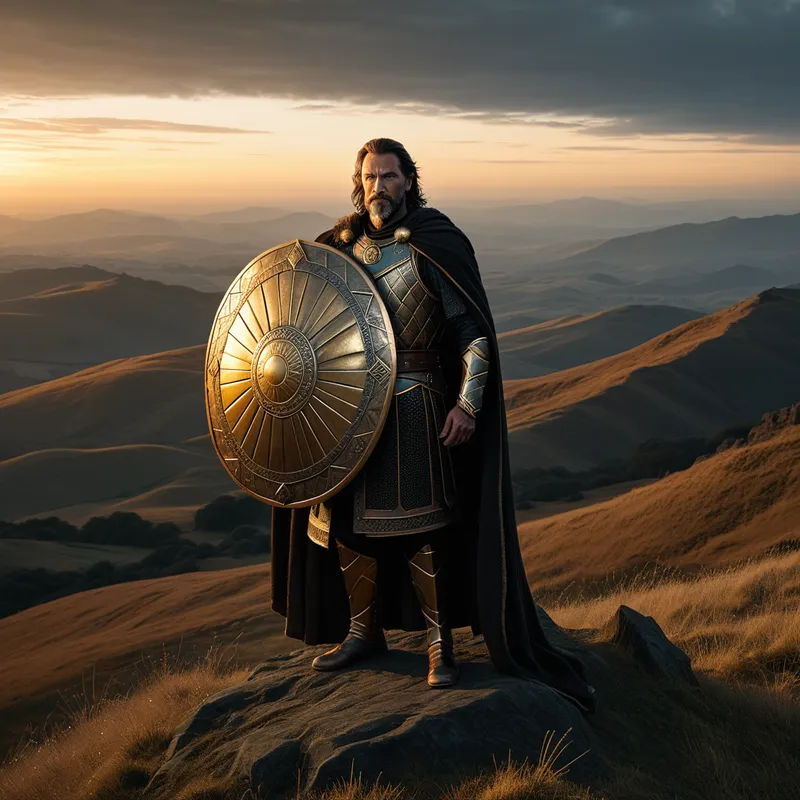
Shield of David Myth Meaning & Symbolism
A mythic king receives a divine shield to defend his people, forging a symbol of unity and protection against the primordial chaos of the world.
The Tale of Shield of David
Listen now, and hear the tale of the Shield, born not in the forge of man, but in the crucible of heaven and the desperation of earth.
In the days when the world was younger and the boundaries between the realms were thin as morning mist, there was a king. He was a man of sorrows, for his people dwelt in the shadow of a great and formless terror. It was not an army with banners, nor a beast with claws, but a creeping chaos—a whispering absence of law, a chill that stole warmth from the hearth and certainty from the heart. The very stars seemed to tremble in their courses.
Each night, the king would climb to the highest tower of his city, his brow furrowed not with anger, but with a profound and wearying burden. He would look upon his sleeping people, their dreams troubled, their walls feeling less like stone and more like parchment against the gnawing dark. He prayed, not for victory, but for understanding. “What defends a soul,” he cried into the wind, “when the enemy has no face? What armor protects a people from the unraveling of meaning itself?”
His plea did not fall on deaf ears, but into a profound silence. For seven nights, he stood his vigil, and on the seventh, the silence changed. It became not empty, but pregnant. The air grew still and heavy, charged like the moment before lightning strikes. Then, without thunder, a light descended—not a blinding sun, but the cool, clear radiance of the full moon concentrated into a single point before him.
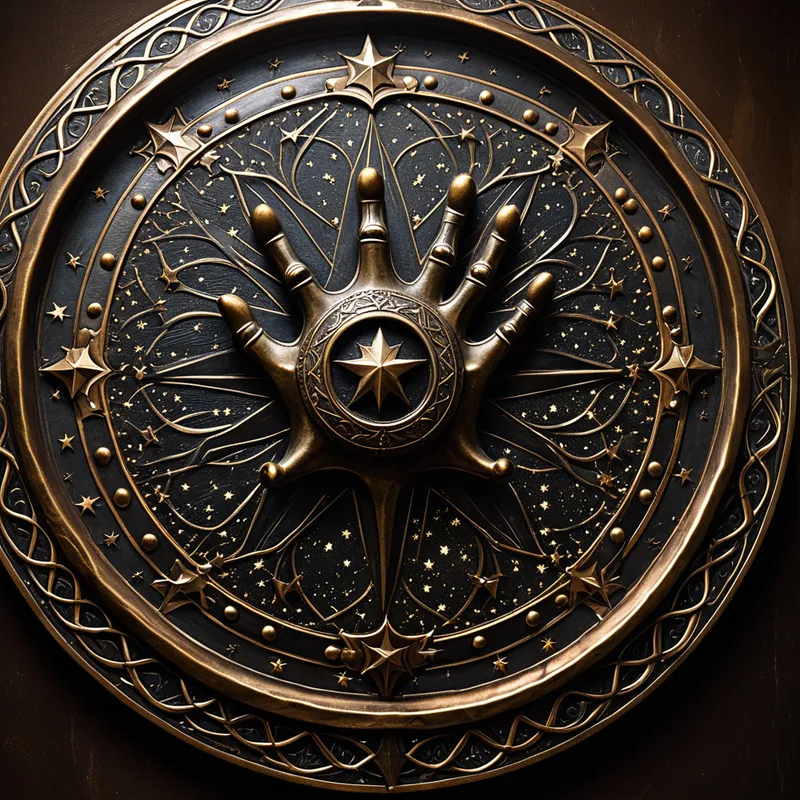
From this nexus of light, a form coalesced. It was the Angel of the Countenance, whose visage was like polished silver reflecting all truths at once. In its hands, which were not hands but manifestations of will, it held an object. It was a shield, yet unlike any wrought by smiths. Its face was of a bronze that held the memory of sunset, and upon it was inscribed a pattern of breathtaking simplicity and depth: two interlocked triangles, one pointing to the heavens, the other grounding itself in the earth, forming a six-pointed star within a perfect circle.
“The chaos you face is the Tohu va-Bohu,” spoke the Angel, its voice the sound of a mountain stream over ancient stones. “It is the unformed, the shattered. It cannot be fought with spear or sword, for it is the absence of the pattern that holds creation together. This is the Tavnit. This is the Sigil of the Covenant between Above and Below. Hold it not before your body, but before your spirit. Let it be the boundary where chaos meets order, where the many find their one, where the fragmented soul remembers its divine geometry.”
The king reached out, and as his fingers touched the shield’s rim, a shock not of pain, but of recognition coursed through him. He saw, in a flash, the dance of the elements—fire and water, air and earth—held in perfect tension. He felt the balance of male and female, spirit and matter, the individual and the community. The shield was heavy, yet its weight was the weight of responsibility, not of metal.
He descended from the tower. He did not rally his armies. Instead, he walked to the city gates and stood, holding the shield aloft. The creeping dread that lapped at the walls like a foul tide met the silent, radiating pattern. Where the light of the shield fell, the chaos recoiled, not in defeat, but in transformation. The formless found tentative form; the whispering fears articulated themselves into manageable doubts; the chilling void warmed into potential. The people awoke not to the blare of war-horns, but to a profound, forgotten peace—the peace of a structure restored, a pattern remembered. The king remained at the gate, the living pivot between order and the ever-present, murmuring sea of the unformed.
Cultural Origins & Context
The myth of the Shield of David, while often associated with later Judahite symbolism, finds its deepest roots in the broader Canaanite and Akkadian milieu. It is a royal myth, told in courtly circles and by temple scribes, functioning as a foundational narrative for kingship itself. The king was not merely a political ruler but the Mashiach, the anointed one, whose primary sacred duty was to maintain Mishpat and Tzedek against the ever-encroaching <abbr title=“Chaos, disorder, the “sea” of uncreation”>Tehom.
The story was passed down not as a chronicle of battle, but as a liturgical text, likely recited during coronation rites or festivals of renewal (like the Akitu). Its tellers were priests and bards who served as custodians of cosmic truth. Societally, the myth served a crucial function: it legitimized the king’s authority by framing it as a divine mandate for protection through spiritual and moral order, rather than mere brute force. It answered the existential anxiety of an agricultural people living in a precarious world—their “enemy” was drought, plague, social strife, and spiritual despair. The Shield was the symbolic answer: a divine technology for holding the center, for ensuring that the community remained a microcosm of the cosmos, properly ordered and under divine sanction.
Symbolic Architecture
At its heart, the Shield of David is not a weapon, but a mandala. Its power lies in its structure, not its hardness.
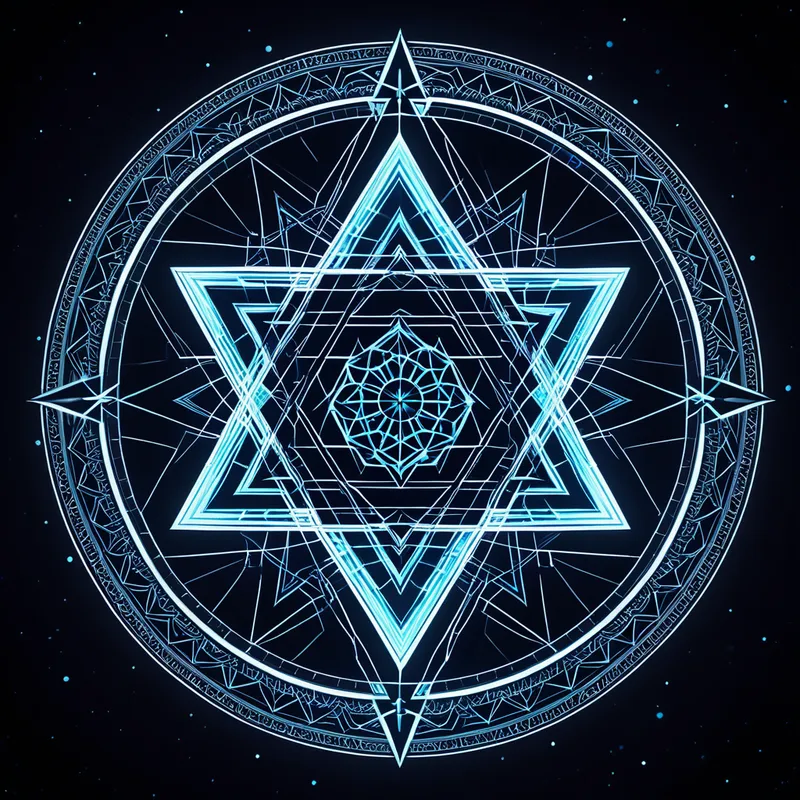
The interlocking triangles represent the fundamental alchemy of existence: the descent of spirit into matter and the ascent of matter toward spirit. It is the eternal dialogue between heaven and earth.
The upward-pointing triangle symbolizes the active, fiery, masculine principle—aspiration, will, and the divine reaching downward. The downward-pointing triangle symbolizes the receptive, watery, feminine principle—embodiment, nurture, and the earthly yearning upward. Their union creates the hexagram, a symbol of holistic integration. The circle that often contains it signifies the Selbst, the boundary of the individuated psyche that contains and protects this delicate, dynamic balance.
Psychologically, the “chaos” is the unintegrated psyche—the swarm of complexes, repressed shadows, and fragmented traumas that threaten to dissolve the coherence of the ego. The king represents the nascent, conscious ego facing this internal disarray. The divine shield, then, is the emergent symbol of the Self-archetype. It is not something the ego creates, but something it receives from the deeper, transpersonal layers of the unconscious when the ego’s desperation is genuine and its intention is aligned with wholeness, not just self-preservation.
The Dreamer’s Resonance
When this myth stirs in the modern dreamer, it often surfaces during periods of profound psychological or moral fragmentation. One does not dream of wielding a simple shield. The dream imagery is telling: a door that won’t hold, a glass sphere cracking under pressure, a personal sigil or tattoo that is incomplete or fading. The somatic experience is one of visceral vulnerability—a feeling of being psychologically “unskinned,” exposed to emotional or psychic elements that feel corrosive and formless.
To then dream of finding, forging, or being given the Shield is to dream the process of active imagination at its most potent. The dream-ego is engaged in a sacred act of re-boundary-ing. The geometric pattern of the Shield in a dream acts as a psychoid image—a symbol that directly affects the physiological state, often bringing a felt sense of calm, centering, and integration upon waking. The dream signals that the unconscious is providing the conscious mind with the symbolic “pattern” or “principle” needed to reorganize a chaotic life situation, relationship, or internal conflict. It is the psyche’s own answer to the plea, “How do I hold myself together?”
Alchemical Translation
The myth models the individuation process with elegant precision. The initial state is the Nigredo—the king’s despair in the face of inner and outer chaos, the dark night of the soul where all known structures fail.
The receipt of the Shield is the Albedo. It is the moment when the transcendent function, symbolised by the Angel, delivers the unifying symbol that can hold the tension of opposites.
The king’s act of holding the shield at the gate is the long, arduous work of Citrinitas. It is the ego’s daily, conscious effort to “hold the pattern,” to apply the symbolic principle to the messy realities of life, relationships, and one’s own shadow material. It is not a one-time victory, but a perpetual stance, a mindful maintenance of the psychic container.
Finally, the resulting peace in the city symbolizes the Rubedo. This is not a static perfection, but a dynamic, living wholeness. The chaos (the personal and collective shadow) is not annihilated; it is related to. It remains outside the gates, the necessary contrast that gives the inner order its meaning and value. The modern individual undergoing this alchemy learns that protection is not about building walls to keep the unconscious out, but about developing a resilient, conscious structure—a “shield-self”—strong enough to engage with it, to translate its chaotic energy into the creative patterns of a lived, authentic life. The Shield becomes the symbol of the individuated Self, the sacred geometry of a soul that has found its own sovereign center and can thereby hold its ground in the world.
Associated Symbols
Explore related symbols from the CaleaDream lexicon: